
Author: danny
I've been thinking these past few days: is it possible that the recent public opinion war involving the exchange was orchestrated by a team outside the Chinese (APAC) circle?!
Often, it's not that you did something wrong, but precisely because you did many things right that you are condemned for "the crime of holding a precious jade" (怀璧其罪). Or, you did many things right, but suddenly did n things wrong, and you are no longer the person you were before? Have you ever felt like doing a hundred good deeds, only to have your reputation ruined by one bad deed?
Introduction
There is a viewpoint in Peter Thiel's "Zero to One" that businesses reaching a market cap of one billion dollars will eventually involve politics. The subtext is that when the interests are sufficiently huge, one always needs to seek an "umbrella"—frankly, pay protection money. This is even more true in the Crypto industry; every exchange is a money-printing machine, making outsiders envious.
Public opinion warfare is an important component of business warfare and an extension of political lobbying.
"Black PR" activities within the commercial field aim to artificially manipulate information flow and the public opinion field to achieve the strategic goals of damaging a competitor's brand reputation, undermining market expectations for their core products, and interfering with their major business decisions (such as financing, IPO listing, annual new product releases).
By destroying the opponent's foundation of social trust, the attacking party can seize an abnormal market share or force the target company to compromise through pressure, thereby seeking超额 (excess) economic benefits or concessions from the other party."
Reading Guide
-
The first three chapters are the theoretical foundation, exploring why Black PR requires so many "people" to participate?
-
Chapter Four discusses whether Binance is currently under "Black PR" attack?
-
Chapters Five and Six attempt to speculate on the traces of the mastermind?
I. The Theoretical and Psychological Basis Behind "Black PR"
The reason "Black PR" can repeatedly and easily tear apart the reputation defense of a mature enterprise and trigger large-scale social opinion fermentation lies in its exploitation of the weaknesses of human group psychology and the weaponization of information asymmetry anchor points. Tactics like Black PR's "water army" and "occupying public opinion" are based on the following three classic psychological foundations.
-
1. The Digital "The Crowd" — Dumbing Down the Masses Through Aggregation
Gustave Le Bon's classic "The Crowd: A Study of the Popular Mind" points out that people gathered in a crowd exhibit a completely different psychological characteristic:
Deindividuation: When many people gather, "the individual feels an irresistible force." This sense of power allows the individual to break free from the moral constraints and sense of responsibility in real life. Online Black PR exploits this by encouraging netizens to engage in abuse, doxxing, and moral judgment.
Intellectual Decline: No matter how rational or elite an individual is in reality, once integrated into a group, their intellectual level drops significantly, becoming slaves to instinct and emotion. Black PR copywriting often avoids complex logical arguments, instead using short, powerful, inflammatory slogans (e.g., "The ugly face of capitalists," "The culprit of 1011"), directly appealing to the group's primitive instincts.
- 2. Reverse Operation and Forced Intervention of Agenda-Setting Function — Controlling What the Masses See?
The "Agenda-Setting" theory holds that mass media may not directly determine people's specific views on an event (i.e., "how to think"), but can effectively influence which facts and opinions people pay attention to (i.e., "what to think about") by providing information and arranging the exposure frequency of related topics.
Attackers, through spamming and massive投放 (deployment), forcibly set a highly controversial, inflammatory, or panic-inducing negative agenda for the public. This agenda is often packaged as a major social event concerning public safety, core consumer rights, or business ethics. Once this agenda is successfully implanted into the public view, and the public's attention is directed within this negative framework, even if the enterprise can later provide solid evidence proving the event is fabricated, the public's cognitive energy has already been largely spent on质疑, suspicion, and verification.
- 3. "Spiral of Silence" and the Systematic Fabrication of False Consensus — Controlling What the Masses Participate In?
The "Spiral of Silence" theory proposed in 1972: society will threaten those who are inconsistent with the majority with isolation, so this "fear" leads individuals to constantly try to assess the climate of opinion and eventually conform to the舆论的口径 (opinion caliber).
When "Black PR" organizations register hundreds or thousands of new accounts and launch spam-like malicious comments against the target enterprise, they are actually artificially creating an "absolutely dominant public opinion" in the cyberspace. Can you imagine how ordinary people feel when they log into a platform and are instantly surrounded by overwhelming negative accusations, abuse, and so-called "solid evidence"?
Under this extremely oppressive and hostile artificially created public opinion high pressure, the minority who hold objective and neutral attitudes or try to defend the enterprise, in order to avoid being morally judged by the group, suffering online violence, or being socially isolated (or political correctness), often choose to try to avoid expressing their uniquely held attitudes, thus falling into silence.
In summary, this is why one of the core tasks of Black PR is to control the output场景 (scenes) and output frequency (number of people) of public opinion, because a group of people together will experience reduced intelligence, and after reduced intelligence, they become more susceptible to external public opinion, and进而 (further) because they do not want to be isolated, they stop expressing opinions that differ from the mainstream.
II. The Strategic Objectives and Phased Model of "Black PR"
From the theoretical content of the first part, it is not difficult to see that the operation of "Black PR" is a set of precisely calculated social engineering. Moreover, after years of evolution and iteration, it has formed a highly structured, multi-node coordinated assembly-line operation model. This model usually presents five standardized evolution stages from latency to outbreak to concealment.
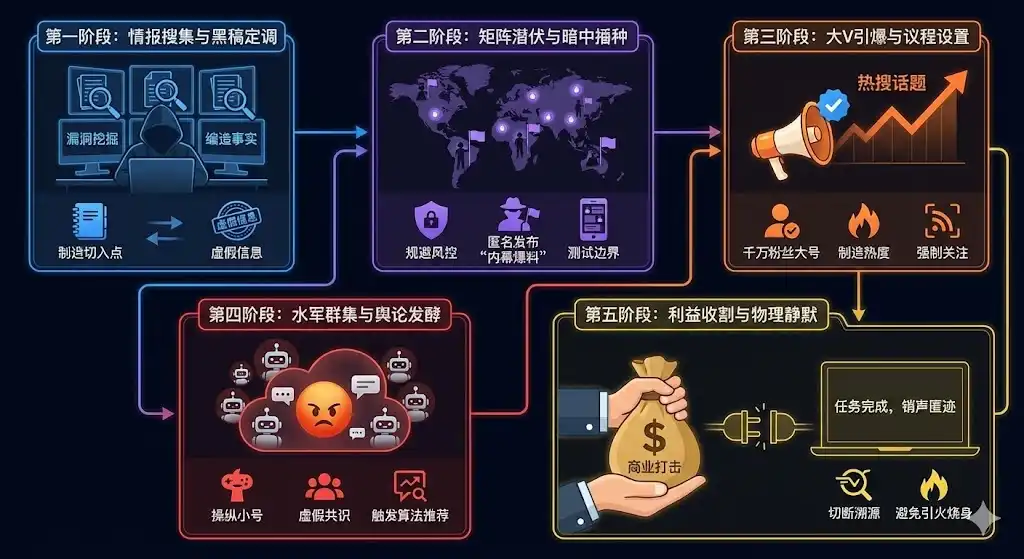
Phase One: Intelligence Gathering and Material Toning
In-depth挖掘 (excavation) of the target enterprise's product flaws, executive speech vulnerabilities, or historical遗留问题 (legacy issues). If there are no substantive issues, then resort to creating something from nothing,凭空编造 (fabricating out of thin air)全部虚假事实 (all false facts), or adding oil and vinegar, maliciously distorting and exaggerating部分事实 (partial facts).
Phase Two: Matrix Latency and Covert Sowing
Utilize fringe self-media accounts, anonymous communities, or specific interest circles to publish "inside information" or suspenseful "revelations." At this time, the information is in a latent period, mainly used to test the tolerance and recommendation algorithm boundaries of different online platforms.
Phase Three: Big V Detonation and Agenda Setting
Mobilize large accounts with millions or tens of millions of fans to step in, through reposting, commenting, or publishing inflammatory soft articles, creating hot search topic hashtags, rapidly increasing topic heat, and forcing public attention. In detail,利用 "retweet/quote" and "hashtag" to quickly拉升 (pull up) topic heat.
Phase Four: Water Army Swarming and Public Opinion Fermentation
Manipulate a massive number of newly registered small accounts disguised as ordinary netizens to form a阵势 (formation) of "attacking in unison" in a short time. Use the密集互动 (dense interaction) of the water army to trigger platform algorithm recommendations, forcibly pushing the negative topic to a全网高潮 (full network climax),引发 (triggering) real netizens to follow the trend and panic ("The Crowd").
Phase Five: Benefit Harvesting and Physical Silence
After the target enterprise's reputation is damaged, stock price fluctuates, or sales decline, the attack matrix will quickly deactivate a large number of accounts or enter long-term silence, thereby cutting off technical tracing by judicial organs and the enterprise (this part is very important). The black industry organization then completes the final payment settlement.
Why cut off联系 (contact)? Because this is criminal behavior, recorded in the criminal law. Therefore, to prevent being tracked, the execution team generally adopts relatively隐秘的沟通、付款方式 (covert communication and payment methods). Digital currency payments have thus become a commonly used payment method within the industry. (This part will be referenced later)
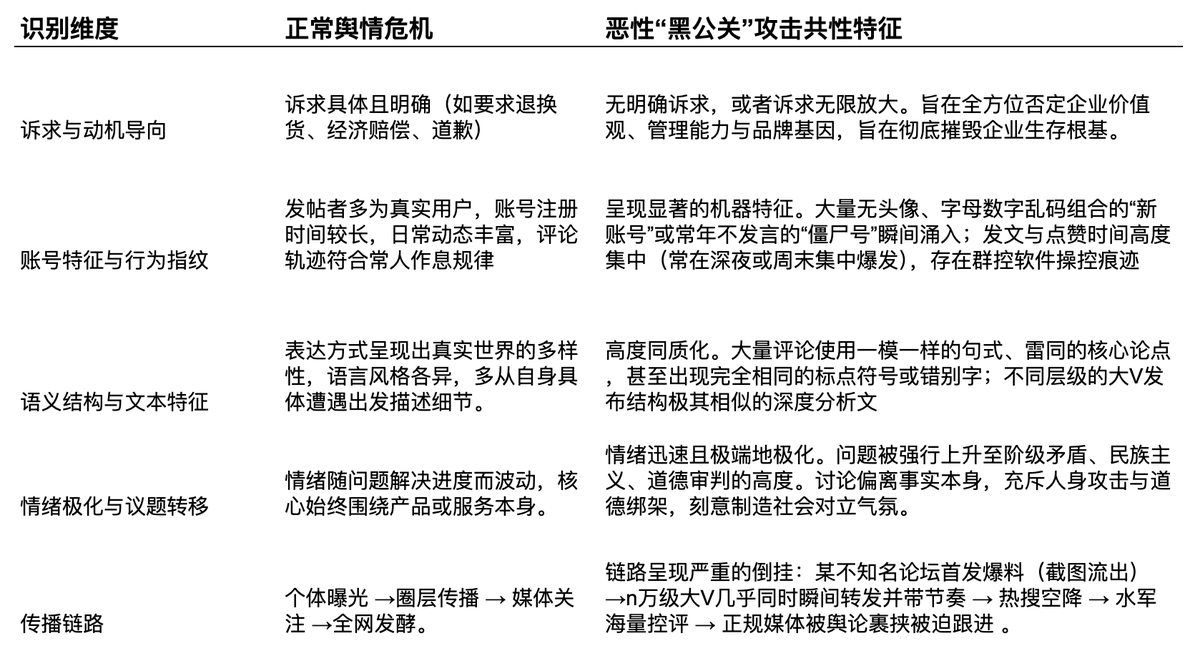
III. Common Characteristics and Identification Features of "Black PR"
This article summarizes several identification dimensions; you can establish a cross-identification matrix yourself:
IV. Is Binance Caught in a Black PR Whirlpool?
4.1 "Zero Hour Action" Phenomenon: Are All Users Posting at the Same Time?
Through the analysis of the posting times of a massive number of negative tweets on platform X, we discovered an abnormal synchronization phenomenon called "Zero Hour Action."
At specific time points (often weekends with low market liquidity or late at night Asian hours), hundreds of independent accounts simultaneously publish negative content targeting Binance within seconds. This content often contains the same keywords (e.g., "Insolvent," "Withdraw," "Run"), and even the use of punctuation and emojis is completely consistent.
This is a typical characteristic of script-driven bot networks, using the same set of materials, rhetoric, and hashtags to create the illusion that "the entire network is discussing Binance's bankruptcy/withdrawal restrictions/absconding."
4.2 The "Trojan Horse" Strategy of the Account Matrix
A large number of account IDs and nicknames adopt a unified naming format, such as the suffix "BNB" plus Chinese pinyin names (e.g., "Li_BNB," "Zhang_BNB"), and deliberately emphasize the identity of "old users from China" in the personal bio. This disguise aims to利用 (utilize) the identity symbols of Binance's early user base to create a反差叙事 (contrast narrative) of "the most loyal users are turning against it," which is highly煽动性 (inflammatory) for general community users.
Most of these accounts were silent during the actual market crash in October 2025, and were even promoting competing projects like Solana or Hyperliquid at that time. However, at the end of January 2026, they suddenly collectively "awoke," deleted the previous content promoting competitors, and transformed into single-issue accounts focused on attacking Binance. This "dormant in peacetime, activated in wartime" operation mode is a typical botnet tactic.
Regarding this, CZ also posted an article: https://x.com/cz_binance/status/2018949826994401464?s=20
4.3 Material Homogenization Phenomenon
The industrialization痕迹 (traces) in the content production环节 (link) are also obvious. A large number of circulating so-called "internal chat record" screenshots and "lawyer's letters" are AI-synthesized.
Screenshots of "withdrawing coins from Binance," "lawyer's letters," or "account closure" posted by different accounts have completely consistent image resolution, cropping ratio, display time, and even the percentage of手机电量显示 (mobile phone battery display). This means that these so-called "real feedback from individual users" are actually standardized promotional materials distributed from the same database.
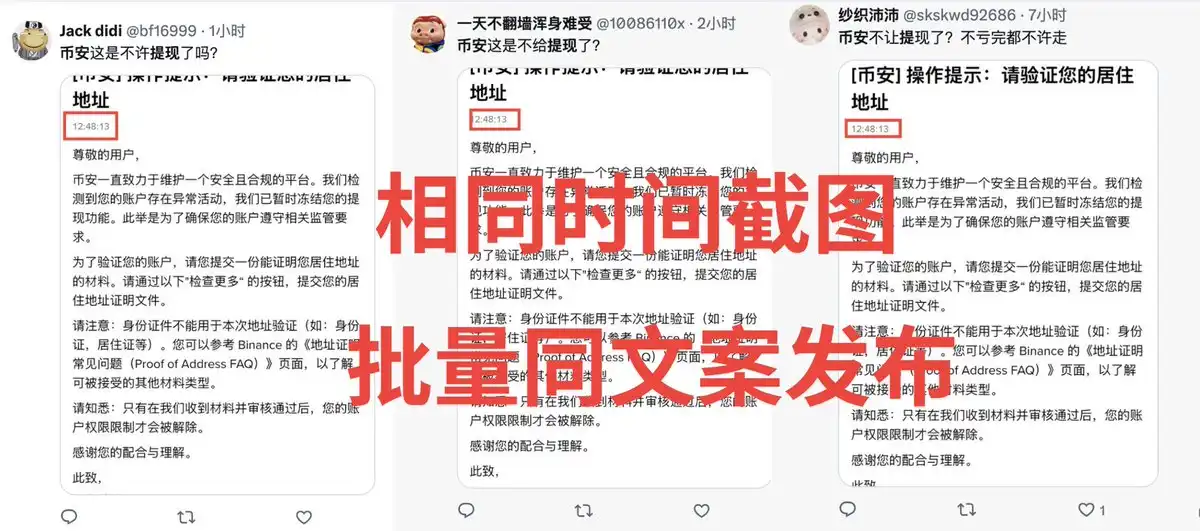
Example: https://x.com/moonkimbinance/status/2022123609343635497?s=20
4.4 Attacker Profile Homogenization Phenomenon
Someone collected 92 accounts on X that denounced Binance and conducted data analysis on their published content, time, account history, and activity level (likes/retweets), ultimately concluding that 71 of them were high-risk accounts (bot accounts).
Reference:
https://x.com/Openai_study/status/2020873564388462982
https://openai.study/html/report_en.html
In summary, we cannot rule out that some tweet content确实 (indeed) comes from real users, or that some accounts want to use this opportunity to gain traffic attention. However,结合 (combining) the characteristics of "Black PR" from Chapter Three, it is not difficult to see that Binance may currently be suffering from attacks of varying degrees from Black PR engineering on different fronts. Even if not attacked in an organized manner, many attacks with false information and amplification of unfavorable news can be seen (e.g., withdrawal, news about withdrawal restrictions happens every day, why is it so lively today?).
V. Industry Chain Dissection: Structure and Tools
Modern Black PR has moved away from workshop-style operation, forming an underground industrial system with clear division of labor and clearly marked prices.
Upstream (Client):
Usually competitors, or trading counterparties, who委托 (commission) third parties through implicit instructions.
Midstream (MCN/PR Companies):
Core operators. Hoard a large number of KOL resources, provide "hot search resource packages," responsible for translating the client's intentions into inflammatory narrative frameworks, and制定 (formulating) the attack rhythm. (Formulate the "strategic objectives and phased implementation plan" of Black PR)
Downstream (Execution Layer):
Silicon-based Water Army: Zombie accounts operated using群控软件 (group control software) (one computer controls上百台手机 (hundreds of phones)), responsible for brushing volume, likes, creating basic heat.
Carbon-based Water Army: Real people recruited through "part-time job groups," using暗语 (code words) (e.g., "S蛋" [likely a code], "鱼塘" [fishing pond]) to accept orders. They are responsible for publishing emotionally charged comments, writing "planting grass/avoiding mines" notes/tweets/experiences/analyses to launch attacks. (Example: https://x.com/moonkimbinance/status/2022123609343635497?s=20 )
VI. Pursuit: Who Exactly Is It?
The most exciting part is here, let's guess together who the mastermind is?
We have no way of knowing the origins and幕后操盘手 (behind-the-scenes operators) of the several big Vs "carrying the big banner." They might be spontaneous or cooperating with agencies. But from the above theory, stages, industry chain analysis, and methods, we know that to perform this Black PR show well, besides the leading figures, a group of "silicon-based water army" is needed to stir up the emotions of public opinion. As we all know, X's algorithm keeps changing, so the other party might not be able to long-term sustain and批量制造 (mass produce) the corresponding water army. This means they need suppliers for the water army.
So we decided to start from the "supply chain" — that is, the source of the water army (non-big V accounts).
It is known that the 34 high-risk X accounts in the OpenAi report above are all bot accounts, which should be "services" that can be purchased on the market. So based on conditions (custom comments, service payment using digital currency, etc.), we filtered the符合条件的 (eligible) SMM (Social Media Marketing) platforms on the market, totaling 7.
The service scope is as follows, providing a few screenshots for everyone to "broaden their horizons":
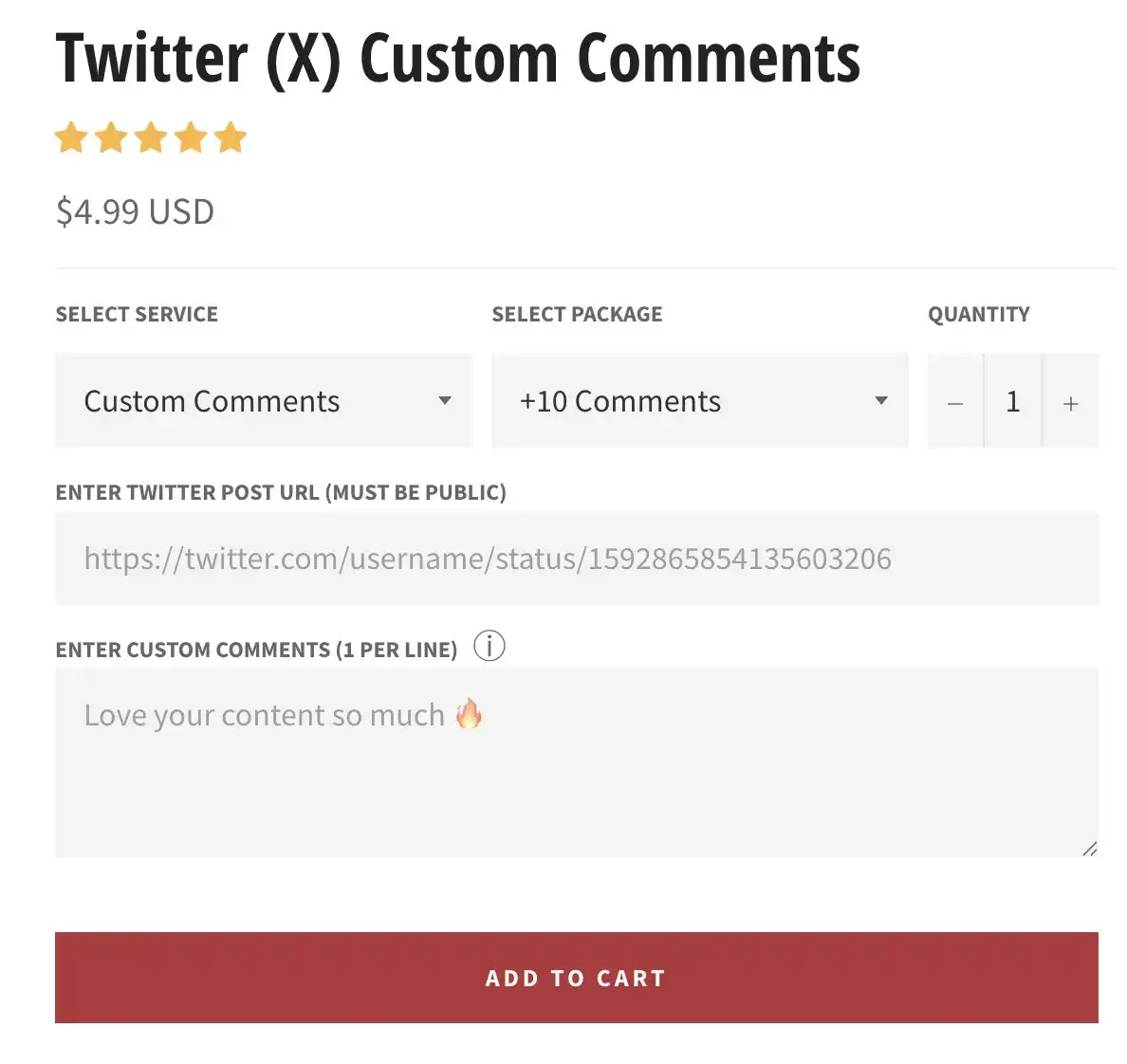
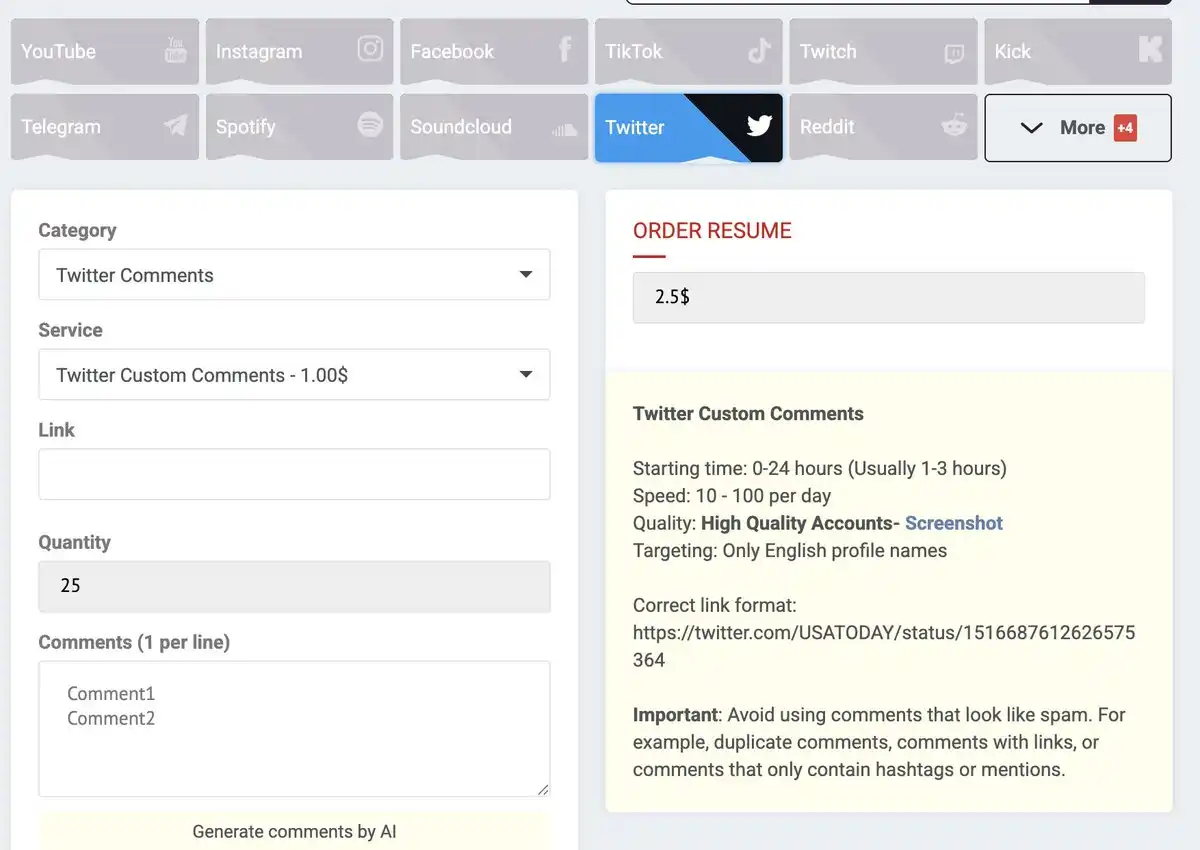
Afterwards, using AI and scripts, we began the tedious testing: set content -> transfer funds ->投放关键词 (deploy keywords) -> review, to see if these bot accounts posted corresponding tweets, likes, retweets, etc. We have reason to suspect that these bot accounts are "public goods" because soon we found that bot accounts started commenting or retweeting specific content according to the content specifications, and some accounts even placed orders from different platforms, but the same bot accounts could still output the same content.
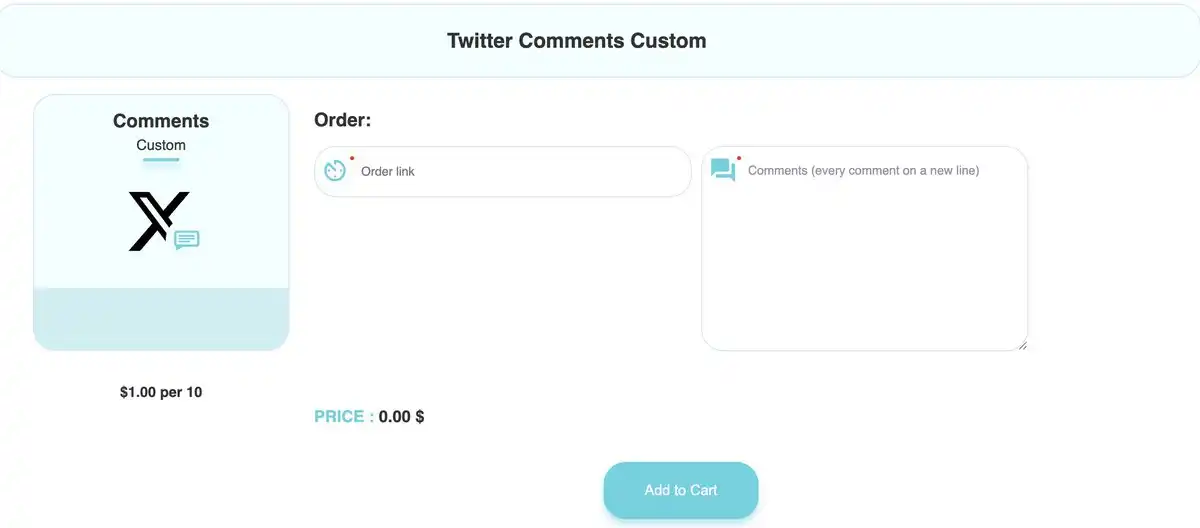
After several rounds of testing, we大致锁定 (roughly locked onto) a few投放平台 (deployment platforms). Assuming this Black PR attack was the work of experienced hands, they should logically choose the platform with the highest "cost-effectiveness" among the many platforms. Through the recharge wallet addresses, we saw the corresponding transfer records.
Among the many transfer records of几十到一百u (tens to one hundred u) in the past two weeks, we found a transfer record of 4999 u. The transfer time was恰恰 (precisely) two weeks ago,即 (namely) January 31st, which was the high-incidence period of Binance being洗稿 (content scraping?/spammed) on X. Moreover, this platform does not have wealth management or trading functions. We have reason to suspect that this large recharge was for another purpose.

Very interestingly, this recharge was actually transferred out from Binance's hot wallet (Can you believe it?!)
During the investigation, we found that during the peak period of OKX being attacked on platform X, there were also records of transfers from OKX's hot wallet to this deployment platform (Tron). For a moment, I felt that this matter might not be as外界猜测的 (outsiders speculate).

This article, holding the attitude of "less trouble is better than more," will not disclose the corresponding wallet addresses here, nor will I share the collected information with relevant interested parties.
No matter who you are or what your purpose is, I just hope we can stop this meaningless petty action, whether it's Binance or OKX, whether it's 1011 or withdrawal restrictions. Exchanges indeed cannot shirk responsibility completely, but they do not deserve to be abandoned by the industry or pushed down by the crowd. They are the pillars of the industry, not misappropriating user assets, providing the best services within their capabilities from their own perspectives (although the理念 (philosophies) may differ), and should not suffer the situation of being obviously blackened but beaten by everyone.
It was never easy for Chinese CT (likely Crypto/Chinese Teams) to gain a foothold in the加密市场 (crypto market), especially since the West has always regarded the East as a "liquidity exit," coveting the "vast and boundless" liquidity of the East (exchanges). Why should groundbreaking industry narratives always be transmitted from the West to the East, and ultimately paid for by the East?
It's time to change this order and these rules.
But first, we must let go of our prejudices.






