The Dilemmas and Future of Web3 Chinese Entrepreneurs

marsbitОпубліковано о 2025-12-15Востаннє оновлено о 2025-12-15

Анотація

In the increasingly mainstream crypto industry, Chinese entrepreneurs appear to be receding from the center stage. While early Chinese-founded projects like Binance, OKX, and Bitmain once dominated sectors such as exchanges and mining, a noticeable decline in the visibility and influence of new-generation Chinese entrepreneurs has emerged since the 2020 DeFi Summer. Three major factors contribute to this trend. First, regulatory crackdowns and shifting geopolitical dynamics in China disrupted local crypto activities, forcing entrepreneurs to relocate overseas and lose their native market advantages in user acquisition and community building. Second, capital preferences have shifted structurally toward欧美-led ventures due to better compliance alignment and exit opportunities, leaving Chinese projects at a funding disadvantage. Third, a mismatch exists between the skill sets of Chinese engineers—who excel in B2C applications—and the industry’s earlier focus on B2B infrastructure development. Notable exceptions, like Hyperliquid’s Jeff Yan, highlight the rising importance of multicultural backgrounds. Many successful new-wave founders have Western education or experience, enabling better integration into global ecosystems. The article concludes that future success in crypto will depend less on cultural origin and more on cross-cultural collaboration, long-term technical commitment, and adaptive resilience amid regulatory complexity.

Author: Hu Tao, ChainCatcher

As the crypto industry becomes increasingly mainstream, Chinese entrepreneurs seem to be moving further away from the center stage.

There was a time when projects founded by Chinese entrepreneurs occupied half of the industry, including well-known cryptocurrency exchanges such as Binance, OKX, Bybit, Bitget, Gate, HTX, and Bitmart. This was even more true in the mining sector, where projects like Bitmain, Canaan, and Spark Pool held significant positions. Their commonality is that they were all established in 2017-2018 or even earlier.

Although figures like Changpeng Zhao, Mingxing Xu, Jihan Wu, and Justin Sun continue to be active on the front lines of the industry, a general consensus has gradually formed since the DeFi Summer boom in 2020: the visibility and influence of the new generation of Chinese entrepreneurs in the global crypto industry have declined, and no leaders comparable to the previous generation have yet emerged. Given this gap, what has happened to the ecosystem of Chinese entrepreneurs, and where do future opportunities lie?

Regulatory and Geopolitical Reshaping: The First Impact on the Ecosystem Disruption

The most significant factor over the past five years has been the drastic changes in regulatory and geopolitical environments.

Starting in 2021, China significantly increased its regulatory efforts on cryptocurrency-related activities, swiftly shutting down previously gray-area scenarios such as trading and mining. In recent market trends, almost any popular concept has been flagged by regulators, from earlier ICOs, NFTs, and digital collectibles to recent payment and real-world asset initiatives. This undoubtedly limits the inflow and support of quality resources into the Chinese crypto ecosystem.

These crackdowns not only accelerated the relocation of mining and exchange businesses but, more critically, deprived Chinese entrepreneurs of a native market with natural network effects, a dense talent pool, and capital aggregation advantages, forcing them to develop in unfamiliar overseas environments.

In the early crypto ecosystem, many explosively growing Chinese projects rapidly accumulated users through the mobilization mechanisms of Chinese internet communities: WeChat group fission, KOL networks, media matrices, offline gatherings... These channels were once among the most efficient systems for spreading crypto narratives. However, regulatory changes have largely rendered this system ineffective.
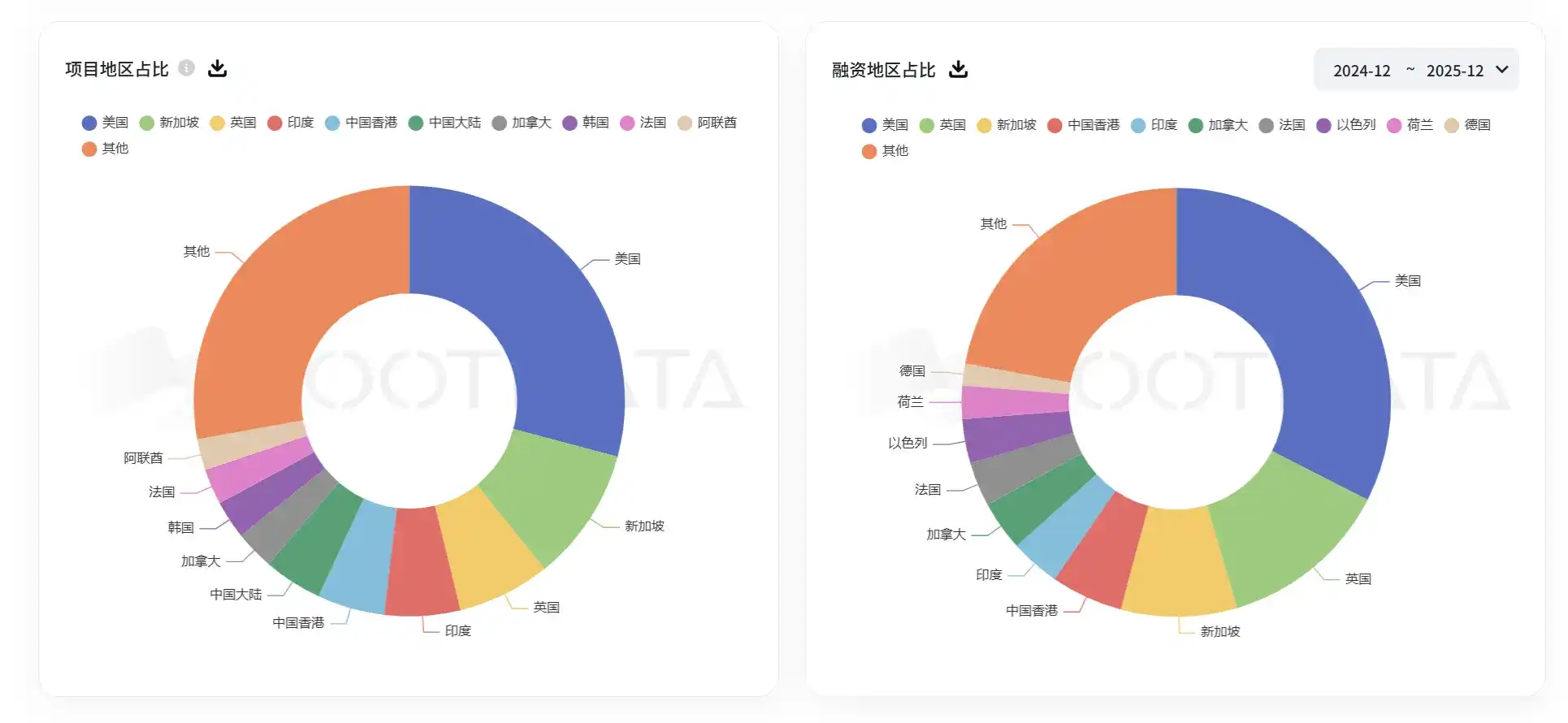
Proportion of projects and funding amounts from Mainland China in the industry. Source: RootData

Following this, the industry's power center quickly shifted to Europe and the United States—driven by U.S. compliance leadership, the influx of institutional capital, and increasingly mature regulatory frameworks, shaping an industry order starkly different from that of 2017–2018. New narratives, regulatory landscapes, and capital structures naturally favor English-speaking markets and compliance-oriented entrepreneurial teams. For instance, prediction markets, which have certain gambling-like properties, are unlikely to emerge in the Chinese-speaking market due to strict regulations on gambling.

In such an industry environment, the new generation of Chinese entrepreneurs also finds it harder to gain "default trust" from global media, regulators, capital, and users, requiring more trial and error costs in marketing, compliance, and other areas compared to similar Western projects.

Shift in Capital Preferences: The Second Impact on the Ecosystem Disruption

If regulatory and geopolitical barriers constitute the first impact, then the "structural shift in preferences" from the capital market side further exacerbates the marginalization trend of Chinese entrepreneurs in the new cycle.

In today's industry environment, without strong VC funding and resource support, projects are at a disadvantage in user acquisition, token listings, and narrative building. Chinese entrepreneurs are already at a disadvantage on the funding front.

Due to the poor performance of altcoins and a significant decline in investment returns, Chinese-background VCs have substantially reduced their investment frequency over the past 2-3 years, with some halting entirely. Chinese entrepreneurs face constrained options in both fundraising and exit paths. When dealing with Western-dominated VCs, Chinese projects struggle to leverage advantages due to language and cultural differences, leading to a continued decline in the amount and number of funding rounds secured by Chinese projects in recent years.

This year, the crypto industry has seen a wave of IPOs and acquisitions, with companies like Circle and Gemini successfully listing on U.S. stock exchanges, and Coinbase and Ripple frequently making acquisitions. This has significantly boosted confidence among entrepreneurs and VCs, but these developments have largely bypassed Chinese projects. It can be said that Western projects are enjoying the institutional红利 (benefits) of the crypto industry's mainstreaming.

From the perspective of mainstream capital, Western projects have inherent advantages in compliance, cultural alignment, and exit strategies. Chinese projects, unless they possess exceptional team composition and technical backgrounds, find it difficult to win the favor of Western capital.

Misalignment of Skill Sets and Industry Maturity: The Third Impact on the Ecosystem Disruption

Over the past decade, the main theme of the crypto industry has consistently been infrastructure and tooling sectors. Although there have been iterations of new concepts like DeFi, NFTs, gaming, and inscriptions, most have failed to become mainstream projects.

In a previous interview with ChainCatcher, Jason Kam, founder of Folius Ventures, stated that the development of Web3 over the past 5 to 10 years has been about laying the foundation, focusing more on product categories and states. This has been a decade偏重于 (leaning towards) ecosystem, infrastructure, tools, and consensus-building. In other words, a decade of B2B products.

The West has three generations of extremely talented engineers who are very adept at building this B2B ecosystem. In contrast, the Asia-Pacific region mainly has young engineers from the 80s and 90s generations, whose career paths developed alongside the wave of China's B2C industry starting around 2005. In other words, their engineering experience is in B2C and applications, which is格格不入 (incompatible) with the development trajectory of blockchain. Therefore, they might not excel in public chains and infrastructure.

"If Asia-Pacific entrepreneurs compete with Western entrepreneurs on the To C front, I believe Asia-Pacific entrepreneurs are at no disadvantage; in fact, they have advantages. Their strengths lie in their rich product experience and their highly aggressive tactics for capturing market share."

Although Chinese entrepreneurs have proven this point in the more Web2-like exchange sector, and in on-chain C-end products, the昙花一现 (short-lived) success of Stepn demonstrated the talent of Chinese entrepreneurs in C-end products, the overall market explosion for consumer-grade products has been slow to arrive. This is closely related to the maturity of industry infrastructure; the market has not yet reached the "comfort zone" for Chinese entrepreneurs.

Entrepreneurs with Multicultural Backgrounds Are Becoming Industry Leaders

Strictly speaking, there have been new representative cases of Chinese entrepreneurs in recent years. Jeff Yan, founder of Hyperliquid, is of Chinese descent. His parents were immigrants from China, and he was born and raised in Palo Alto, California. He later attended Harvard University, majoring in mathematics and computer science. After graduation, Jeff joined high-frequency trading giant Hudson River Trading as a quantitative trader. In 2022, Jeff founded Hyperliquid and, with a philosophy of "small but refined," no VC backing, and user-driven growth, built it into one of the fastest-growing giants in the crypto industry in recent years.

However, although Hyperliquid is one of the most successful projects this cycle with "Chinese heritage" involvement, it is difficult to view it as a continuation of the influence of Chinese entrepreneurs. Jeff is almost never active in the Chinese ecosystem, projects almost entirely Western values externally, and has never expressed himself in Chinese. The rise of Jeff and Hyperliquid highlights a fact: in the new cycle, Chinese heritage can still produce global influence, but the prerequisite is integration into the mainstream cultural system, not reliance on the old path of Chinese entrepreneurship. Relying solely on one cultural system can only make you a regional leader, not achieve outstanding results in the globalization process.

In fact, the founders of many well-known Chinese projects that have become sector leaders this cycle mostly have multicultural backgrounds, having studied in Europe or the US至少 (at least) at the university level. Examples include Sean Ren, founder of Sahara; Yu Hu, founder of Kaito; and Erick Zhang, founder of BuidlPad. Their long-term experience in the West plays a significant role in their development path.

Indeed, entrepreneurs with multicultural backgrounds are more popular in the crypto industry. For example, Ethereum's founder, Solana's founder, and Binance's founder Changpeng Zhao all immigrated from China/Russia to North American countries during their childhood. The collision of different political systems and cultures allowed these entrepreneurs to recognize the value of blockchain in empowering individual sovereignty earlier and take rapid action. They prioritize cultural inclusivity in team building, resource对接 (connection), and daily operations, ultimately making it easier to gain the favor of users from different regional cultural backgrounds.

The inherent borderless nature of crypto, conflicting and磨合 (grinding in/adapting) with the regulatory and interest demands of various countries, will dominate the development trend of the crypto industry for a long time. Chinese entrepreneurs indeed face increasing challenges against the backdrop of multiple Sino-US conflicts and the mainstreaming of the crypto industry. However, as the industry recently faces skepticism towards gambling tendencies, nihilism, and the disproval of more project concepts, the development态势 (situation) of Chinese entrepreneurs may no longer be a critical industry issue. What truly deserves attention is: as speculative growth and narrative泡沫 (bubbles) gradually recede, who can continue to invest in the long-term value of decentralized technology and redefine the industry's direction through real products and verifiable innovation.

The core competitiveness of the future industry landscape will depend more on whether founding teams possess cross-cultural collaboration skills, long-termist technological investment capabilities, and institutional understanding and organizational resilience in the face of regulatory uncertainty. Regardless of cultural or national origin, those who can persistently excel in these dimensions may become the true beneficiaries of the next cycle. In other words, the secret to success in the crypto industry has never been about "where they are from" but about "what they can achieve."


Пов'язані питання

QWhat are the main challenges faced by Chinese Web3 startups in recent years?

AThe main challenges include: 1) Stricter regulatory policies in China since 2021, which cut off domestic crypto activities and forced migration to overseas markets; 2) Shift in VC preferences towards欧美 projects due to compliance advantages and better exit opportunities; 3) A mismatch between the B2C-focused experience of Chinese engineers and the infrastructure-heavy, B2B-oriented nature of Web3 development in the past decade.

QHow has the regulatory environment in China impacted Chinese Web3 entrepreneurs?

AChina's intensified crypto regulations since 2021 have banned trading, mining activities, and restricted resources for concepts like ICOs, NFTs, and RWAs. This dismantled the efficient Chinese marketing ecosystem (WeChat, KOL networks, offline events), forced projects to relocate abroad, and reduced global trust in Chinese startups, increasing their compliance and marketing costs.

QWhy are Chinese Web3 projects receiving less venture capital funding compared to欧美 projects?

AChinese VCs have reduced investments due to poor altcoin performance and lower ROI.欧美 VCs prefer欧美 projects for their compliance readiness, cultural alignment, and better exit prospects (e.g., IPOs, acquisitions). Chinese projects struggle to attract欧美 capital unless they have exceptional technical teams, leading to a decline in funding amounts and counts.

QWhat advantages do Chinese entrepreneurs have in Web3, according to Folius Ventures' Jason Kam?

AJason Kam noted that Chinese engineers have strong B2C product expertise and aggressive market capture tactics from China's internet boom. In consumer-facing (To C) products, Chinese entrepreneurs are competitive or even advantaged compared to欧美 counterparts, as seen in exchange successes and StepN's brief rise, though infrastructure maturity limits broader C-end product breakthroughs.

QHow are multicultural backgrounds becoming important for success in Web3 entrepreneurship?

AMulticultural founders (e.g., Hyperliquid's Jeff Yan, Sahara's Sean Ren) often have exposure to diverse cultures, frequently through education or upbringing in欧美 countries. This fosters cross-cultural collaboration, compliance awareness, and global user appeal. Early exposure to different systems also heightens appreciation for blockchain's value in personal sovereignty, aiding in building inclusive, resilient teams and products.

Пов'язані матеріали

Has Hook Summer Truly Arrived? sato, Lo0p, FLOOD Ignite the New Uniswap v4 Narrative

With the broader market showing signs of recovery, a new wave of interest has emerged around Ethereum-based meme coins. Following ASTEROID, tokens like sato, sat1, Lo0p, and FLOOD, built upon the Uniswap v4 Hook protocol, are capturing market attention. Their market capitalizations range from millions to tens of millions of dollars, injecting much-needed focused liquidity into a market lacking narratives. This article explores whether this trend signifies an incoming "Hook Summer" and its potential impact on UNI's price. Hooks are essentially plug-in smart contracts for Uniswap v4 liquidity pools, allowing developers to inject custom logic at key points in a pool's lifecycle (like initialization, adding/removing liquidity, swaps). This transforms the AMM into programmable building blocks. Key highlighted projects include: * **sato**: Peaked over $38M market cap. It utilizes a v4 curve for minting/burning; buying locks ETH as reserve to mint new tokens, while selling redeems ETH from the reserve and burns tokens. * **sat1**: Market cap briefly exceeded $10M, promoted as an "optimized sato," but later declined significantly. * **Lo0p**: Reached nearly $6.6M. It's a lending AMM protocol where buying LO0P tokens locks them as collateral, allowing users to borrow ETH from the pool reserve at 40% LTV, aiming to improve capital efficiency for idle ETH in LPs. * **FLOOD**: Peaked near $6M. Its mechanism directs asset reserves from buys into Aave v3 to generate yield, with fees and interest retained in the pool to potentially influence the token's price long-term. In the long term, the development of the Hook ecosystem can attract users and liquidity to Uniswap v4, benefiting UNI's fundamentals—especially combined with the recent activation of the protocol fee switch, where a portion of fees is used to burn UNI. However, in the short term, these Hook-based tokens are unlikely to directly drive significant UNI price appreciation. Their impact is moderated by factors like token sustainability, price volatility, and broader market and regulatory conditions. Currently, Uniswap v4's TVL ($595M) still trails behind v2 and v3, indicating adoption and growth will take time. The article concludes that while the Hook ecosystem provides long-term "nourishment" for UNI, its short-term role is more of a "catalyst" than a "booster." Readers are cautioned that these are early-stage experimental tokens and may carry unknown risks.

Odaily星球日报6 хв тому

Has Hook Summer Truly Arrived? sato, Lo0p, FLOOD Ignite the New Uniswap v4 Narrative

Odaily星球日报6 хв тому

Interview with Michael Saylor: I Did Say I Would Sell Bitcoin, But Never a Net Sale

Interview with Michael Saylor: I Said We'd Sell Bitcoin, But Never Be a Net Seller In a recent podcast, MicroStrategy Executive Chairman Michael Saylor clarified the company's stance on potentially selling Bitcoin. Following MicroStrategy's earnings call statement about being prepared to sell BTC to fund dividends for its STRC (Strategic) credit product, Saylor emphasized the distinction between selling and being a "net seller." Saylor explained the core business model: MicroStrategy sells credit instruments like STRC and uses the proceeds to buy Bitcoin, which is viewed as "digital capital" expected to appreciate around 30-40% annually. A portion of these capital gains can then be used to pay the dividends on the credit products. He stressed that even if the company sells some Bitcoin for dividends, it simultaneously buys much more with new credit issuance. For example, after raising $3.2 billion from STRC sales in April, the dividend obligation was only $80-90 million, making the company a net buyer. The clarification aims to counter market narratives questioning the value of Bitcoin on MicroStrategy's balance sheet if it were never sold, and to dismiss claims of a "Ponzi scheme." Saylor reiterated his personal philosophy for investors: "Don't be a net seller of bitcoin" and ensure your Bitcoin holdings increase each year. Saylor also discussed Bitcoin's role as the foundation for "digital credit," noting that STRC has become the largest and most liquid preferred stock issue in the U.S., offering high risk-adjusted returns (Sharpe ratio). He highlighted Bitcoin's deep liquidity, stating that even large purchases by MicroStrategy do not move the market significantly, which is driven by macro factors, geopolitical tensions, and capital flows from ETFs and credit products. Finally, Saylor reflected on his early inspiration from sci-fi books, which motivated his path to MIT, and maintained his fundamental thesis on Bitcoin remains unchanged: it is superior digital capital enabling superior digital credit.

链捕手10 хв тому

Interview with Michael Saylor: I Did Say I Would Sell Bitcoin, But Never a Net Sale

链捕手10 хв тому

Beaten SK Hynix Employees in China: Year-end Bonus Less Than 5% of Korean Staff's

"SK Hynix Chinese Staff Hit Hard: Bonuses Less Than 5% of Korean Counterparts" Driven by the AI boom, South Korea's SK Hynix is experiencing record performance, with media reports predicting massive year-end bonuses for its employees, making them highly desirable in the matchmaking market. However, this prosperity starkly contrasts with the situation for the company's Chinese employees. According to reports, SK Hynix operates under a rule allocating 10% of operating profit for employee bonuses. While projections suggest Korean employees could receive bonuses reaching millions of RMB, a Chinese employee with over a decade of technical experience revealed the disparity: "If they get 3 million, Chinese staff get less than 5% of that." After adjustments based on KPI ratings, this employee's highest bonus was slightly over 100,000 RMB. Bonuses are paid annually in Korea but semi-annually in China. During the industry downturn in 2023-2024, Chinese employees received no bonus at all. The gap extends beyond bonuses. Recruitment posts for SK Hynix's Chinese factories (in Wuxi, Dalian, Chongqing) show engineer monthly salaries ranging from 10,000 to 35,000 RMB, with a 13th-month salary promised. Chinese employees also receive standard benefits like annual leave but lack stock incentives, which are reportedly unavailable to them. Furthermore, management positions in China are predominantly held by Korean personnel, though industry observers note a gradual increase in local middle managers over time. SK Hynix has confirmed the 10% bonus rule but cautioned that specific future bonus amounts remain unpredictable. The company forecasts strong demand for HBM and other high-value enterprise products for the next 2-3 years, driven by AI infrastructure investment. This focus on business-to-business markets may continue to constrain supply for consumer products, potentially prolonging price increases for components like memory.

链捕手24 хв тому

Beaten SK Hynix Employees in China: Year-end Bonus Less Than 5% of Korean Staff's

链捕手24 хв тому

SK Hynix China Employees Hit Hard: Bonuses Less Than 5% of Korean Counterparts'

"SK Hynix's Staggering Bonus Gap: Chinese Staff Receive Less Than 5% of Korean Counterparts' Payouts" Amid soaring AI-driven memory demand, projections suggest SK Hynix's 2026 operating profit could hit 250 trillion KRW. Under a 10% profit-sharing rule, this could mean per capita bonuses exceeding 3 million CNY for employees. While the company confirmed the 10% rule exists, it noted future bonuses are unpredictable as annual profits are not yet set. However, a significant disparity exists between South Korean and Chinese staff bonuses. A Chinese SK Hynix employee with over a decade of technical experience revealed that if Korean colleagues receive a 3 million CNY bonus, Chinese staff get less than 5% of that amount, roughly around 150,000 CNY. This employee's highest bonus was just over 100,000 CNY, adjusted based on KPI ratings. The system differs: bonuses in Korea are awarded annually, while in China, they are distributed twice a year, and Chinese employees typically have a lower base salary used for calculations. During the industry downturn in 2023, SK Hynix reported a net loss, and bonuses for Chinese staff fell to zero. Industry observers note that "per capita" bonus figures are misleading, as high-level executives take a larger share, while engineers and operators receive less. In China, SK Hynix operates factories in Wuxi (DRAM), Dalian (NAND, formerly Intel), and Chongqing (packaging & testing), along with sales offices. Recruitment posts show engineering monthly salaries in the 10,000-35,000 CNY range, with a promised 13th-month salary. Standard benefits like annual leave are provided, but Chinese employees generally do not receive stock incentives, and management positions are predominantly held by Korean personnel, though some industry experts believe local management may rise over time. Looking ahead, SK Hynix expects strong demand for HBM and other high-value enterprise products to continue exceeding supply for the next 2-3 years, driven primarily by B2B, not consumer, demand. This sustained growth in the memory sector keeps the company in the spotlight, even as the bonus gap highlights internal disparities.

marsbit44 хв тому

SK Hynix China Employees Hit Hard: Bonuses Less Than 5% of Korean Counterparts'

marsbit44 хв тому

Торгівля

Спот
Ф'ючерси
活动图片




