The Boundaries and Channels of Finance: The New Pricing Logic of Global Markets

比推Опубліковано о 2026-03-11Востаннє оновлено о 2026-03-11

Анотація

The article "Financial Boundaries and Channels: The New Pricing Logic of Global Markets" explores the evolving relationship between traditional finance and decentralized finance (DeFi), focusing on the growing interest of asset management giants like BlackRock and Apollo in on-chain vaults and RWA (Real World Assets). It argues that while DeFi has adopted USDT/USDC as de facto standards due to their scale, this reliance on U.S. Treasury-backed stablecoins means DeFi is subject to external monetary policies without reciprocal influence. The piece highlights the absence of a native DeFi risk-free rate and examines past attempts, like algorithmic stablecoins, which failed to challenge this dominance. The author suggests that vaults and curators may become central to a new financial architecture, facilitating global capital flow and efficiency. However, these structures currently lack mechanisms for asset price inflation and face risks from code vulnerabilities and governance issues. The future may lie in broker-like channels that enhance capital fluidity beyond centralized exchanges, potentially leading to a more integrated and efficient global market system. Ultimately, the article concludes that while DeFi infrastructure matures, the real innovation opportunity resides in creating channels that enable seamless, scalable capital interaction, moving beyond traditional token economics.

Written by: Zuo Ye

Original Title: The Limits of Finance, The Channel Value of Global Markets


On-Chain Asset Management Vaults and Channels

No matter how many lies are woven, the truth will still illuminate the outline of light.

Asset management giants' interest in on-chain Vaults is growing daily, and the mainstreaming of the DeFi dream seems to be becoming a reality.

This is the best of times: BlackRock buys $UNI tokens, Apollo commits to buying hundreds of millions of dollars worth of $Morpho tokens, and Wall Street is collectively bullish on the future of DeFi.

This is the worst of times: BlackRock, Blackstone, and Blue Owl face concentrated redemption waves, and the founder of Aave warns that Wall Street is using RWA as a liquidity exit channel.

Crises always contain rare bargain prices. Faced with future asset price inflation, emerging forces are excited, completely disregarding the iceberg ahead.

No matter what it's called—DeFi/RWA/Vault—on-chain finance must eat the sugar coating and fire the cannonball back. Only by being good at breaking an old world can a new Eden possibly be built.

This sweet apple can even be made concrete—the risk-free rate.

The Dream of a Risk-Free Rate

Establish a risk-free rate market based on on-chain asset-backed stablecoins to have bargaining power against traditional asset management giants.

Let's start with a question to anchor our discussion: Why has DeFi not yet achieved a risk-free rate?

Or, reframe it as the linear narrative of how "U.S. Treasuries" became the benchmark rate for DeFi.
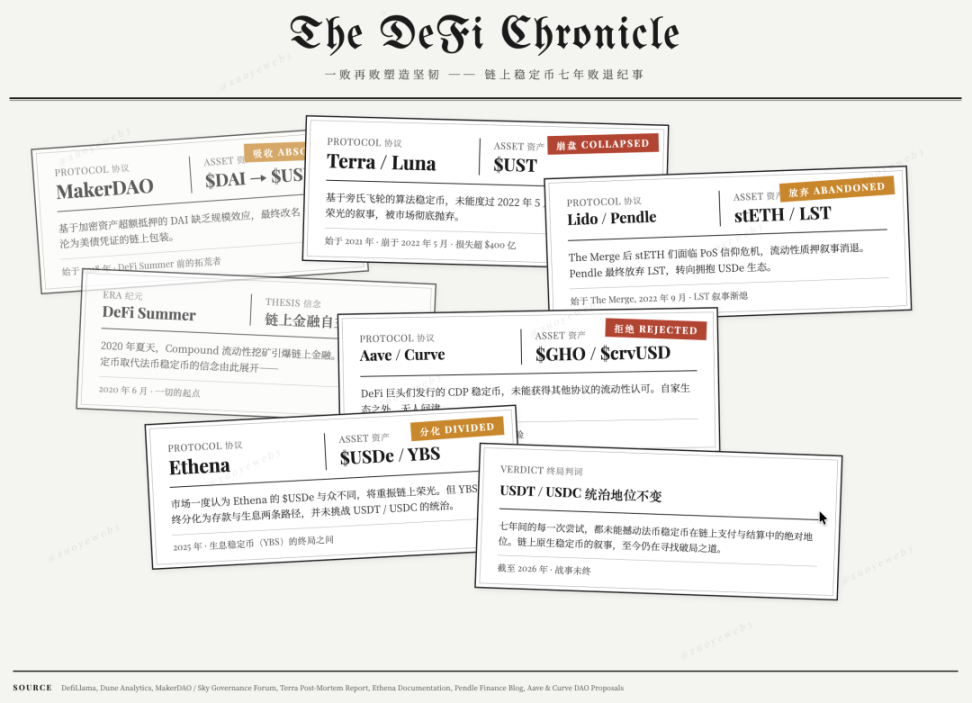
Image Caption: Stablecoin Chronicle

Image Source: @zuoyeweb3

Starting from the DeFi Summer of 2020, repeated defeats have forged resilience:

  • Starting in 2018, DAI based on crypto assets lacked scale, $USDS ultimately became a U.S. Treasury certificate

  • Starting in 2021, the ponzi-based $UST did not survive the 2022 bank run crisis; the story of rebuilding algorithmic stablecoin glory was abandoned

  • In 2022, stETH and others faced a PoS faith crisis post-The Merge; Pendle ultimately abandoned LST for USDe

  • In 2023/24, CDP stablecoins issued by DeFi giants like Aave/Curve were not recognized by other protocols

  • In 2025, the market once believed Ethena's $USDe was different, reviving on-chain glory, but yield-bearing stablecoins ultimately split into deposit and yield-bearing activities, failing to challenge the dominance of USDT/USDC in their respective domains.

The facts are very clear: it's not that USDT swallowed user profits, but that DeFi chose the scale effect of USDT/USDC.

Exchanging the Treasury profits generated by $300 billion for the entire market's trading foundation is not a bad deal for DeFi and the crypto market.

But at what cost?

The cost is not the evil claimed by yield-bearing stablecoin challengers that Tether takes profits, or the selfishness accused by Coinbase and Trump Jr. that banks prohibit interest-bearing accounts.

The bitter pill DeFi swallowed is that the U.S. Treasury rate, as the risk-free rate, is transmitted on-chain via stablecoins, but the U.S. Treasury is an asset of the U.S. government and its actions do not care about on-chain sentiments.

This is also the fundamental reason for the bankruptcy of tokenomics: UNI relies on A16Z, A16Z relies on USD financing, the USD is the embodiment of U.S. Treasuries, so UNI is just the fourth derivative relying on U.S. Treasuries. Why not just buy Treasuries directly, with no middleman taking a cut?

U.S. Treasuries are the de facto DeFi benchmark, but DeFi can only passively endure it, unable to interact with it bidirectionally. This is the root of all happiness or pain.
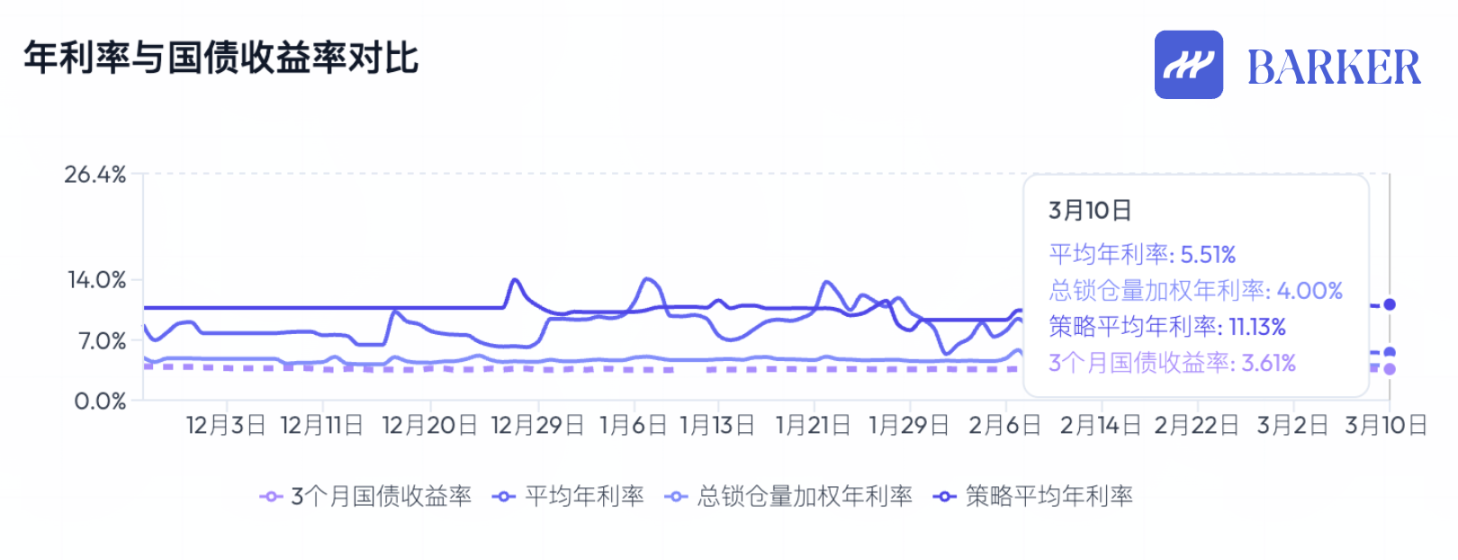
Image Caption: Comparison of On-Chain Stablecoin Yield APY and U.S. Treasuries

Image Source: @BarkerMoneyX

The salvation of DeFi never stops. Although tokenomics are bankrupt and DAO governance structures have collapsed, the overall direction of DeFi remains clear:

  1. Fixed-rate investment and financing,公认 risk grading system, unsecured credit lending –> The main themes of the next stage,蕴含某种形式的 mass-market products;

  2. The expansion period for public chains, exchanges, and DeFi protocols is over; new application forms are evolving into Vaults. It's not yet certain that Vaults are the form of mass-market products, but this is the starting point of the new stage.

Note here that public chains and exchanges are no longer the central links for value capture, but this does not mean their time is zero. Their period of asset price inflation is over, and only linear, steady growth remains.

This can also connect to the progressive relationship between UNI and U.S. Treasuries. Aave/Morpho are closer to asset management itself; their businesses don't have much narrative space, but are indispensable for the industry.

The real star products will definitely be Vaults used by the masses, based on public chains and DeFi protocols, utilizing分散 RWA assets, and triggering asset price inflation mechanisms.

For mass usage, Curators choose to ally with exchanges: Morpho enters Coinbase via Stakehouse, Aave expands to C-end users via Metamask and other U-cards.

Based on RWA assets, Curators partner with custodians like Galaxy to constantly maneuver between crypto and real-world assets, such as Grove buying Galaxy's CLO bonds.

But what's missing is the Vault that triggers the price inflation mechanism. Even before this wave of large-scale asset management moving on-chain, BlackRock's BUILD token was already live, and Circle's USYC also supports yield, but neither could replicate their own success.

It's not important that Vaults lack their own tokens. Asset price inflation is a mechanism. U.S. stocks, real estate, bonds, tulips, graphics cards, and Mac Minis all have their own price cycles. Current Vaults only have yield-bearing black boxes but始终 fail to solve two problems:

  1. Where does the high yield actually come from?

  2. How is high risk actually handled?

Towards a New Financial System

The form of channels is evolving; Vaults are not the endpoint.

The crypto industry evolves extremely fast. Before this year, we never dared to imagine that the global financial system would truly move on-chain, but today this is an undeniable ongoing process.

It's not yet time for a victory banquet. RWA can only serve as a funding source, Vaults are still boring deposit products, various Curators haven't demonstrated brand effects, and white-label Vaults like Veda are highly similar to SaaS, with the operator Curator only earning management fees.

This has no imagination for price inflation. If traditional asset management, with a scale of $2 trillion, endures cyclical煎熬, it's hard to imagine Vaults can withstand it.
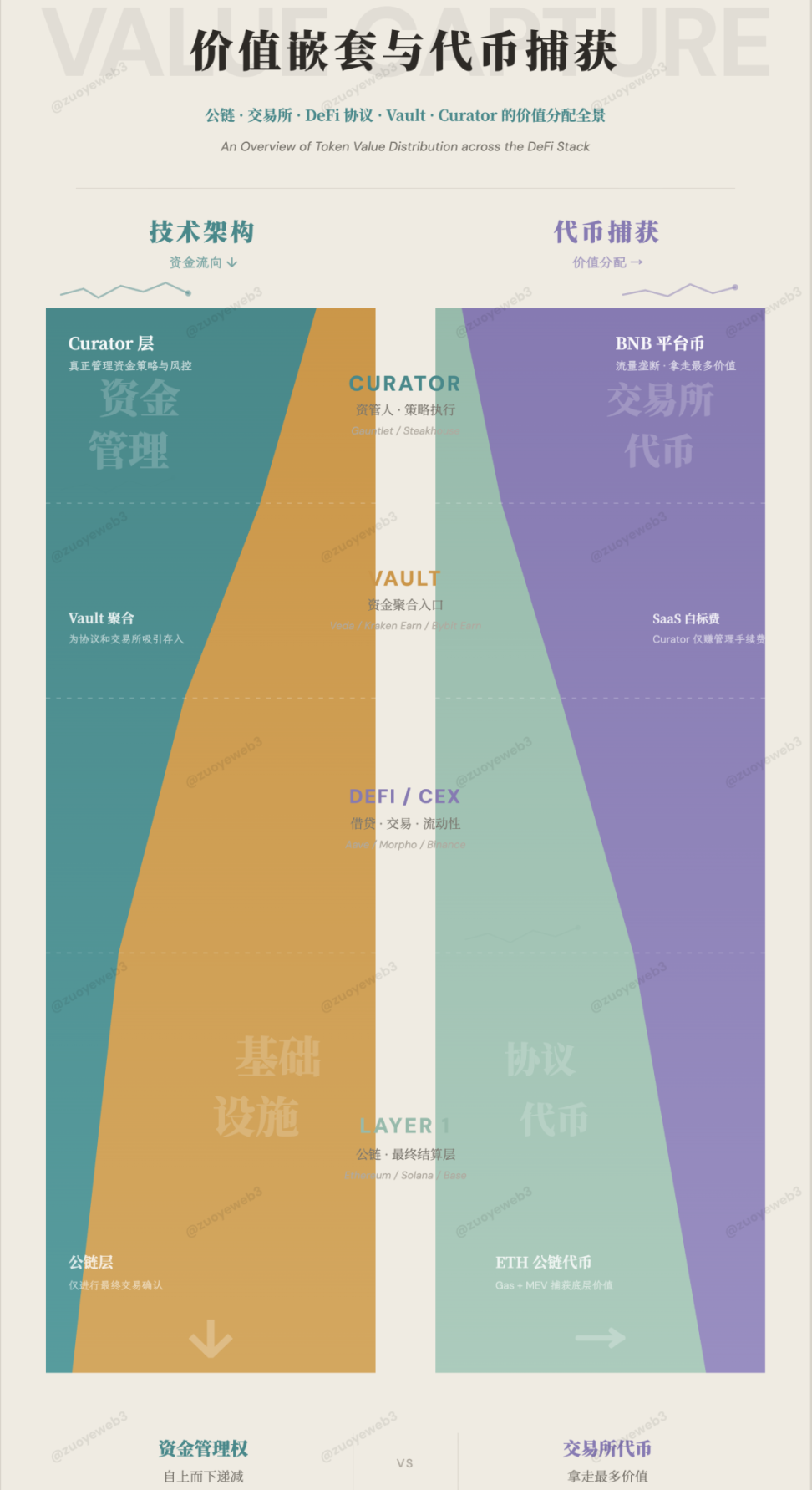
Image Caption: Fund Flows and Value Distribution

Image Source: @zuoyeweb3

Asset management moving on-chain is not driven by短暂 sentiment. In a sense, it's like the banking industry's IOE—you can't go back to the paper era. Even Spark has begun unifying the calculation of CEX/DEX position adjustment margins. DeFi is becoming the next step for TradFi.

Whether Vaults, after absorbing sufficient funds, will trigger the establishment of a risk-free rate is the biggest博弈 point of this cycle.

During the previous DeFi Summer, TVL was the decisive metric. The amount of资金 mapped to the get-rich coefficient of tokens, creating mining that continued into airdrop farming, studios, and Binance Alpha. The core logic was "projects need more funds to support token growth."

But with Vaults, for the first time, there is a huge demand for deposits but an inability to support their own tokens. Even if Morpho captures more market share from Aave, it cannot trigger a token surge.

Extending this, Hyperliquid compared to Binance, Lighter compared to Hyperliquid—their market sizes and token prices show a huge inversion. This is a great change unprecedented in DeFi.

On one hand, old infrastructure continues to吸血. For example, after the listing effect disappeared, $BNB should have declined, but CEXs still have a larger user base than the entire on-chain + DeFi. A very ironic fact: exchanges have retail users; DeFi protocols like Aave and Morpho have completely become the domain of a few professionals.

In this context, the high risk of Vault&Curator comes from code and structure:

  • Curve's immutable contract programming language can have problems; the xUSD team self-issued tokens

  • Aave ended the表面 harmony between the DAO and the development team; Re7 severely damaged on-chain asset management credibility

In this context, where does the high yield of Vault&Curator come from?

I know it's not regulatory arbitrage, HLP fees, or token incentives, but many still cling to these three, believing traditional finance's compliance creates too-big-to-fail credibility.

They completely forget that tokenomics are already bankrupt, while Vault deposits keep growing. Sky is already deeply integrated into the Morpho system, and the future of Aave V4 is also institutionalization and modularization.

Moreover, this article has always emphasized that the scale of Vault funds has not triggered some price inflation mechanism. This is the structural dilemma of Vaults.

The yield of Vaults essentially comes from the trading efficiency of global markets. If CEXs don't provide a certain Vault, then configure it on-chain. The personified Curator happens to be suitable for dealing with all sorts of people.

Even in TradFi's global markets, like U.S. stocks, one faces lengthy account opening, trading times, and process limitations. Can we really say that the gradual move towards全天候 trading for U.S. stocks and DTCC going on-chain is also for arbitrage?

The final question: What mechanism can actually trigger asset price inflation, allowing the funds沉淀 in Vaults to create a legendary price-to-dream ratio?

In other words, what is missing between Vaults and asset price inflation?

Channels are missing. Channels for funds to couple with each other. The personification of Curators hinders the programmability of DeFi Legos.

Currently, CEXs serve as a placeholder, still the fastest place for funds to intertwine.

Referencing the evolution of Perp DEXs, they are capturing market share from CEX futures. RWA funding sources are also抢夺 CEX market share.

CEXs only have存量. They themselves cannot solve user acquisition problems, let alone help Vaults expand to hundreds of millions of users. Vaults start by white-labeling, but in the future, they must build their own超级 factories.

I speculate the channel will be some form of Broker product.

Under高度 social division of labor, Super Apps like exchanges that integrate deposit/withdrawal, trading, custody, and清算 will gradually separate into different businesses. Binance's compliance framework in Abu Dhabi's ADGM is already divided into three parts.

This will fundamentally facilitate the professionalism of fund handling, utilize the unified ledger system of blockchain, and require the居中 coordination of Vault&Curator.

Referencing Neobrokers like Robinhood/Trade Republic, they attract年轻化, retail users to participate in professional trading, then build asset management, wealth management, and other business forms. The model of stablecoins at the front end and Curators managing Vaults is more efficient.

In summary, Binance monopolizes fund flow, BNB gets the strongest empowerment. Next, Brokers handle fund interaction. Some asset form, or even纯粹 business flow, could be highly profitable. After all, Robinhood is just a little disguise for a profitable market maker.

Conclusion

Compared to code and trading, regulation and tokens appear more stable.

Private credit and the RWA cycle have halted.抢先 issuing the 402 document feels prophetic. DeFi can serve as a liquidity exit channel, but it lacks the asset price inflation mechanism.

Asset Management ≈ Aave/Morpho will slowly, like public chains, end their historical mission. They will exist long-term but only with scale growth and stable token prices;

Vault&Curator ≈ Star fund managers are quickly acquiring customers and monopolizing markets. Giantization already shows preliminary signs. Whether they can continuously capture value is highly doubtful;

Channel ≈ CEX (temporary)反而 has the most innovation space. Facilitating the freedom of funds will always receive the highest reward.

A highly efficient global market is operating on a next-generation blockchain that doesn't need traditional tokens. This is the proposition of the next era, and everyone must provide an answer.


Twitter:https://twitter.com/BitpushNewsCN

Bitpush TG Discussion Group:https://t.me/BitPushCommunity

Bitpush TG Subscription: https://t.me/bitpush

Original Link:https://www.bitpush.news/articles/7618714

Пов'язані питання

QWhy does the article claim that DeFi has no risk-free rate, and what is the role of US Treasury bonds in this context?

AThe article states that DeFi lacks a true risk-free rate because it relies on USDT and USDC, which are backed by US Treasury bonds. These stablecoins transmit the US Treasury yield on-chain, but DeFi cannot interact with or influence US monetary policy, making it a passive recipient of this benchmark rate rather than an active participant in setting it.

QWhat is the significance of Vaults in the current evolution of DeFi and traditional finance integration?

AVaults represent a new application layer in DeFi, acting as on-chain asset management products that attract institutional and retail capital. They are seen as the starting point for mass adoption and value capture, but they currently lack a mechanism for asset price inflation and face challenges in generating sustainable yields and managing risks.

QHow does the article describe the relationship between CeFi (like CEXs) and DeFi in the context of global financial markets?

AThe article suggests that centralized exchanges (CEXs) currently serve as temporary channels for capital flow and liquidity, but their role may evolve as DeFi infrastructure matures. It predicts that super-apps like CEXs will eventually unbundle into specialized services (e.g., brokerage, custody), with DeFi Vaults and Curators facilitating more efficient global market operations.

QWhat are the main challenges facing Vaults and Curators in achieving sustainable growth and value capture?

AVaults and Curators struggle with two core issues: the source of high yields (beyond temporary incentives like token rewards or regulatory arbitrage) and the management of high risks (including smart contract vulnerabilities and governance failures). They also lack a price inflation mechanism to drive token value, unlike earlier DeFi protocols that benefited from TVL-driven speculation.

QWhat does the article propose as the potential solution to DeFi's structural limitations in establishing a independent financial system?

AThe article suggests that the future lies in creating efficient 'channels' or brokerage-like products that enhance capital fluidity and interoperability between TradFi and DeFi. This would involve unbundling CEX functions into specialized services, leveraging blockchain's unified ledger, and enabling Vaults to act as intermediaries for global asset allocation, ultimately fostering a new price discovery mechanism.

Пов'язані матеріали

Торгівля

Спот
Ф'ючерси

Популярні статті

Що таке G$

Розуміння GoodDollar ($G$): План для децентралізованого універсального базового доходу Вступ У постійно змінному ландшафті криптовалют та технології блокчейн ініціативи, що прагнуть вирішити нагальні соціальні проблеми, привертають все більше уваги. Одним із таких проектів є GoodDollar ($G$), рішення для універсального базового доходу (UBI) на базі Web3. GoodDollar намагається подолати нерівність і скоротити розрив у багатстві, створюючи та розподіляючи доступні економічні ресурси тим, хто найбільше цього потребує. Завдяки інноваційному використанню децентралізованих фінансів (DeFi) GoodDollar представляє унікальну модель, яка може суттєво змінити сприйняття та надання фінансової допомоги у всьому світі. Що таке GoodDollar ($G$)? GoodDollar - це криптовалютний протокол, який полегшує випуск і розподіл цифрових токенів, що називаються $G$, своїм зареєстрованим користувачам на щоденній основі. Ці токени функціонують як форма універсального базового доходу, сприяючи фінансовій підтримці людей з різних культур, особливо тих, хто традиційно виключений із фінансової системи. Функціонуючи на блокчейні, GoodDollar використовує кілька мереж, включаючи Ethereum, Celo та Fuse, забезпечуючи широкий доступ і зручність. Основною метою GoodDollar є зробити криптовалюту доступною та вигідною для всіх, незалежно від їх економічного старту. Творець GoodDollar ($G$) Деталі щодо творця GoodDollar залишаються дещо неясними. Однак варто зазначити, що проект має сильну підтримку від eToro, широко визнаної інвестиційної платформи, яка надала початкове фінансування та основну підтримку для розвитку GoodDollar. Візія проекту не є виключно прибутковою, а більше схиляється до соціального підприємництва, прагнучи до системних змін у економічній доступності. Інвестори GoodDollar ($G$) GoodDollar користується фінансовою підтримкою та оперативною підтримкою eToro. Це партнерство зіграло значну роль у запуску протоколу та його подальшому розвитку. Хоча eToro відігравала важливу роль у встановленні основ проекту, GoodDollar прагне перейти до моделі, що фінансується її спільнотою в довгостроковій перспективі. Цей перехід до фінансування спільнотою відповідає зобов'язанням GoodDollar щодо децентралізації, що дає можливість її користувачам мати прямий інтерес у майбутньому проекту. Як працює GoodDollar ($G$)? Операційна структура GoodDollar значною мірою базується на принципах DeFi для генерації процентів від застрахованих криптовалют. Цей механізм дозволяє проекту карбувати та розподіляти токени $G$ як цифровий базовий дохід для користувачів у всьому світі. Декілька ключових характеристик роблять GoodDollar унікальним і інноваційним: Універсальний базовий дохід (UBI): Щодня зареєстровані користувачі отримують безкоштовні токени, що встановлює автоматичний потік доходу, призначений для полегшення фінансового тиску. Стійка економічна модель: Токеноміка проекту націлена на балансування попиту та пропозиції токенів $G$, щоб забезпечити стабільність їхньої вартості з часом. Токени з резервами: Кожен токен $G$ забезпечується резервом криптовалют, що надає йому вбудовану цінність і надійність, що є критично важливим для підтримки довіри користувачів. Децентралізоване управління: GoodDollar впроваджує демократичний підхід до прийняття рішень через управління на основі токенів. Це дозволяє членам спільноти активно брати участь у формуванні траєкторії проекту, роблячи його дійсно орієнтованим на спільноту. Глобальна доступність: GoodDollar створив значний слід у спільноті, з понад 640 000 членами в 181 країні. Такий широкий охват є інструментом у полегшенні UBI на глобальному рівні. Хронологія GoodDollar ($G$) Еволюція GoodDollar позначена кількома значними етапами в його історії: 2019: Запуск гаманця GoodDollar став першим кроком до реалізації його бачення надання UBI через криптовалюту. 2020: Після успішного впровадження гаманця, протокол GoodDollar офіційно дебютував. Це ознаменувало критичну фазу в його місії надання щоденних розподільних доходів. 2021: Проект далі прогресував із запровадженням свого Децентралізованого автономного органу (DAO), що сприяло більшій залученості спільноти та управлінню. 2022: GoodDollar представив свою дружню до DeFi версію 2 (V2), прагнучи до підвищення залученості користувачів та ефективності роботи. Того ж року також відбувся перехід до децентралізованої структури управління через GoodDAO. 2022: Була концептуалізована нова дорожня карта, зосереджена на ініціативах, таких як грантова програма, спрямована на просування підприємницьких проектів, пов'язаних з $G$, і оновленого ринку GoodDollar. Ключові особливості GoodDollar ($G$) Проект GoodDollar вводить численні важливі особливості, спрямовані на переосмислення ландшафту базового доходу: Універсальний базовий дохід: Щоденна доставка безкоштовних токенів своїм користувачам основополагає його місію з усунення економічної нестабільності. Багатоканальна операція: Використання кількох блокчейн-мереж підвищує доступність і масштабованість, забезпечуючи ширшу участь. Взаємодія з децентралізованими фінансами: Використання DeFi дозволяє забезпечити сталість фінансування моделі UBI, зміцнюючи її життєздатність як економічного рішення. Залучення спільноти та управління: GoodDollar передбачає модель, в якій спільнота впливає на операції через демократичну участь, що сприяє прозорості та підзвітності. Глобальна спільнота: Наявність різноманітної глобальної спільноти дозволяє проекту реалізовувати рішення UBI, адаптовані до різних культурних та економічних контекстів. Висновок GoodDollar представляє собою трансформаційний крок до впровадження принципів універсального базового доходу через інноваційний погляд на технологію блокчейн. Використовуючи децентралізовані фінанси, проект не лише пропонує рішення для фінансової нерівності, але й активно залучає користувачів до його управління та операцій. Зростаюча спільнота та еволюційна дорожня карта роблять GoodDollar значущим гравцем на перетині криптовалюти та соціального добра, прокладаючи шлях до більш справедливого фінансового майбутнього. Як він продовжує еволюціонувати, шлях GoodDollar може в кінцевому підсумку надихнути інші ініціативи розглянути подібні моделі, просуваючи справу економічного розширення можливостей для всіх.

104 переглядів усьогоОпубліковано 2024.04.05Оновлено 2024.12.03

Що таке G$

Як купити G

Ласкаво просимо до HTX.com! Ми зробили покупку Gravity (G) простою та зручною. Дотримуйтесь нашої покрокової інструкції, щоб розпочати свою криптовалютну подорож.Крок 1: Створіть обліковий запис на HTXВикористовуйте свою електронну пошту або номер телефону, щоб зареєструвати обліковий запис на HTX безплатно. Пройдіть безпроблемну реєстрацію й отримайте доступ до всіх функцій.ЗареєструватисьКрок 2: Перейдіть до розділу Купити крипту і виберіть спосіб оплатиКредитна/дебетова картка: використовуйте вашу картку Visa або Mastercard, щоб миттєво купити Gravity (G).Баланс: використовуйте кошти з балансу вашого рахунку HTX для безперешкодної торгівлі.Треті особи: ми додали популярні способи оплати, такі як Google Pay та Apple Pay, щоб підвищити зручність.P2P: Торгуйте безпосередньо з іншими користувачами на HTX.Позабіржова торгівля (OTC): ми пропонуємо індивідуальні послуги та конкурентні обмінні курси для трейдерів.Крок 3: Зберігайте свої Gravity (G)Після придбання Gravity (G) збережіть його у своєму обліковому записі на HTX. Крім того, ви можете відправити його в інше місце за допомогою блокчейн-переказу або використовувати його для торгівлі іншими криптовалютами.Крок 4: Торгівля Gravity (G)Легко торгуйте Gravity (G) на спотовому ринку HTX. Просто увійдіть до свого облікового запису, виберіть торгову пару, укладайте угоди та спостерігайте за ними в режимі реального часу. Ми пропонуємо зручний досвід як для початківців, так і для досвідчених трейдерів.

459 переглядів усьогоОпубліковано 2024.12.10Оновлено 2025.03.21

Як купити G

Що таке @G

Graphite Network, $@G: Міст між традиційними фінансами та Web3 Вступ до Graphite Network, $@G У яскравому світі криптовалют та проектів web3 Graphite Network виступає як маяк інновацій. З його рідним токеном, $@G, цей блокчейн Layer-1, що працює на основі Proof-of-Authority (PoA), призначений для подолання розриву між традиційними фінансами (TradFi) та швидко розвиваючою екосистемою Web3. Оскільки цифрові валюти набирають популярності, Graphite Network прагне запропонувати блокчейн-платформу, яка пріоритетно ставить безпеку, відповідність та швидкість, представляючи себе як посередника довіри та підзвітності. Що таке Graphite Network, $@G? Graphite Network не просто ще один блокчейн-проект; він має на меті переосмислити, як децентралізація, безпека та підзвітність користувачів сприймаються у сфері цифрових фінансів. Проект має ряд відмінних характеристик: Блокчейн на основі репутації: У своїй основі Graphite Network реалізує політику один користувач, один рахунок, підкріплену інтегрованою перевіркою Know Your Customer (KYC) та механізмами оцінки. Цей дизайн забезпечує баланс між конфіденційністю користувачів та прозорістю — критично важливий аспект фінансових операцій у сучасному цифровому світі. Дохід від вузлів входу: Мережа стимулює користувачів налаштовувати вузли входу, що дозволяє операторам отримувати винагороди від транзакцій у мережі. Ця модель генерації доходу не лише підвищує залученість користувачів, але й зміцнює здоров'я мережі та децентралізацію. Сумісність з EVM: Завдяки віртуальній машині (VM), сумісній з Ethereum, Graphite Network забезпечує безшовну інтеграцію існуючих децентралізованих додатків (dApps) на Solidity та смарт-контрактів, запрошуючи розробників використовувати її можливості без значних модифікацій. Інтеграція KYC: В епоху, коли відповідність є надзвичайно важливою, інтегрована структура KYC з кількома рівнями перевірки підвищує контроль над фінансовими операціями без обов'язкової участі, встановлюючи прецедент для автономії користувачів. Хто є творцем Graphite Network, $@G? Graphite Network виник внаслідок зусиль Graphite Foundation, неприбуткової організації, що займається розвитком, підтримкою та еволюцією Graphite Network. Зобов'язання фонду підкреслює бачення проекту створити безпечне та стійке блокчейн-середовище, зосереджене на справжньому залученні користувачів та відповідності. Хто є інвесторами Graphite Network, $@G? На даний момент є обмежена інформація про конкретних інвесторів, які підтримують ініціативу Graphite Network. Засновницька організація, Graphite Foundation, функціонує незалежно, сприяючи зростанню проекту, одночасно шукаючи партнерства, які резонують з її баченням відповідальної та доступної блокчейн-платформи. Як працює Graphite Network, $@G? Операція Graphite Network ґрунтується на його унікальному механізмі консенсусу Proof-of-Authority, який досягає вражаючого балансу між високою пропускною здатністю та децентралізацією. Давайте розглянемо різні компоненти, які визначають його роботу: Транспортні вузли: Служачи вузлами входу, вони є критично важливими для екосистеми. Оператори можуть отримувати дохід від транзакцій, які проходять через мережу, що не лише надає можливості окремим користувачам, але й зміцнює децентралізацію мережі. Авторизовані вузли: У центрі Graphite Network знаходяться основні валідатори, які проходять суворі тести на відповідність, що включають надійну перевірку KYC разом з технічними оцінками. Цей рівень довіри є важливим для забезпечення високого рівня цілісності транзакцій у мережі. Система тікерів: Graphite Network використовує унікальну систему тікерів для своїх обгорнених токенів, позначених як @G. Ця функція підвищує ясність інтеграції активів, роблячи транзакції користувачів зрозумілими та простими. Інноваційний підхід Graphite Network відображає значний крок у вирішенні критичних питань цифрових фінансів, позиціонуючи себе вигідно для майбутнього, оскільки все більше користувачів переходять від традиційних форм фінансів до світу децентралізованих додатків. Хронологія Graphite Network, $@G Щоб зрозуміти прогрес і етапи Graphite Network, корисно переглянути ключові події в його хронології: 2021: Заснування Graphite Network Graphite Foundation знаменує початок нової ери в розвитку блокчейнів, зосереджуючись на відповідності та розширенні можливостей користувачів. Ключові події: Після запуску впровадження доходу від вузлів входу, встановлення моделі на основі репутації, інтегрована перевірка KYC та забезпечення сумісності з EVM представляють значні досягнення в проекті. Останні події: Постійний розвиток та зусилля Graphite Foundation зосереджені на покращенні функцій мережі, одночасно сприяючи зростанню екосистеми, демонструючи довгострокове зобов'язання до стійкості та інновацій. Додаткові ключові моменти Окрім своїх основних компонентів, Graphite Network охоплює кілька інструментів та функцій, які підвищують його зручність: Гаманець Graphite: Зручне розширення для Chrome, яке полегшує доступ до різних функцій та додатків мережі на сумісних з Ethereum ланцюгах, підвищуючи зручність для користувачів. Міст Graphite: Цей інструмент дозволяє безшовні передачі активів Graphite через різні мережі, сприяючи інтегрованій та взаємодійній екосистемі. Explorer Graphite: Служачи важливим інструментом у межах екосистеми, ця функція дозволяє користувачам переглядати та перевіряти вихідний код смарт-контрактів, відстежувати транзакції та досліджувати іншу важливу інформацію в реальному часі. Тестова мережа Graphite: Проект забезпечує надійне тестове середовище для розробників, дозволяючи їм забезпечити стабільність та масштабованість перед розгортанням у основній мережі. Ця ініціатива не лише надає можливості розробникам, але й підвищує надійність усієї мережі. Висновок Graphite Network з його рідним токеном $@G представляє значний крок до подолання розриву між традиційними фінансами та передовими блокчейн-технологіями. Зосереджуючись на безпеці, відповідності та децентралізації, ця інноваційна платформа готова очолити перехід у еру Web3. Оскільки залучення користувачів зростає, а все більше проектів використовують її можливості, Graphite Network має всі шанси зробити тривалі внески в швидко змінюваний цифровий ландшафт. На завершення, Graphite Network є свідченням того, що можна досягти, коли інноваційне мислення зустрічається з зростаючими вимогами сучасних фінансів та технологій. Оскільки світ досліджує потенціал децентралізованих фінансів, Graphite Network, безумовно, залишиться помітним гравцем у цій сфері.

7 переглядів усьогоОпубліковано 2025.01.06Оновлено 2025.01.06

Що таке @G

Обговорення

Ласкаво просимо до спільноти HTX. Тут ви можете бути в курсі останніх подій розвитку платформи та отримати доступ до професійної ринкової інформації. Нижче представлені думки користувачів щодо ціни G (G).

活动图片














