The Blockchain Industry Enters a Phase of Mass Adoption and Efficiency

cryptonews.ruОпубліковано о 2026-07-31Востаннє оновлено о 2026-07-31

Анотація

In Q2 2026, the blockchain industry demonstrated a divergence between market sentiment and fundamental network growth. While on-chain activity surged, network fee revenues declined due to protocol designs making block space cheaper and more abundant. Ethereum saw institutional staking reach an all-time high of 40.2 million ETH. Despite processing nearly double the transactions per second, its network revenue fell 51% YoY to $64 million, with staker yields driven primarily by consensus rewards. Solana processed nearly 10 billion transactions, but its economic value also dropped to $51 million due to reduced congestion. Notably, its real-world asset (RWA) sector boomed, with tokenized stock trading volume growing 2,479x YoY to $3.32 billion in June 2026. Hyperliquid emerged as an outlier, generating $175 million in revenue with 32% of its $652 billion trading volume from non-crypto markets like commodities. Avalanche saw transaction growth but a sharp drop in fee revenue, while focusing on sovereign L1s for enterprise use. The NEAR Protocol ecosystem shifted from gas-intensive apps to Intents-based trading and introduced a novel feature allowing users to pay for AI services via staked tokens. The Tempo network, backed by Stripe and Paradigm, processed $386 million in stablecoin transfers, including $30 million for contractor payouts by Deel. The report concludes that the industry is transitioning from high-fee speculation to a phase of mass adoption and infrastructure efficienc...

The second quarter of 2026 revealed a surprising divergence between market sentiment and the fundamental metrics of blockchain networks.

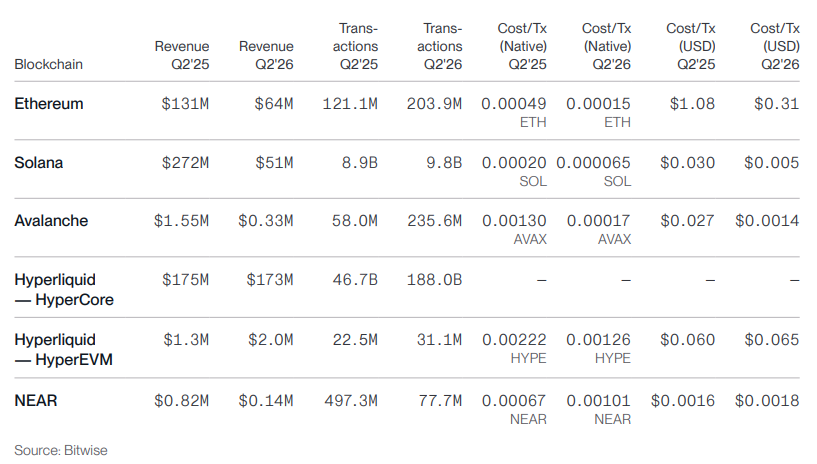
According to a large-scale study by Bitwise, the blockchain space has become cheaper, on-chain activity has increased, and fee revenue has fallen. The decline in revenue was driven mainly by protocol design, as networks made block space more accessible and capacious.

The divergence between revenue and activity is the key theme of the quarter. While fees were falling, usage was growing, noted Bitwise researchers.
Ethereum: Institutional Inflow and Lower Fees

Let's start with the smart contract flagship. Active staking in the Ethereum network reached an all-time high of 40.2 million ETH, representing 33% of the total supply. The growth of this metric is driven by an inflow of institutional funds.

Thanks to an increased gas limit, the network processed 26 transactions per second, almost double the rate from a year earlier. However, despite this growth in activity, network revenue fell to $64 million, down 51% year-over-year.

Staker yield was 2.84%, with the overwhelming majority coming from consensus rewards, not transaction fees. Data aggregated by the Allium analytics platform clearly shows that the Pectra and Fusaka updates created an oversupply of blob space, crashing fees almost to zero.

Solana: Resilience of Activity and Asset Tokenization

A similar picture is observed in the Solana ecosystem. The network processed approximately 10 billion non-vote transactions, exceeding any quarter of the previous year. Nevertheless, the real economic value fell to $51 million due to reduced network congestion. The share of staked coins remains one of the highest in the market — 68% of the supply (427 million SOL), providing a yield of about 6.25%. The real-world tokenized asset sector deserves particular attention.

The trading volume of tokenized stocks on Solana grew 2,479 times compared to the previous year, reaching $3.32 billion in June 2026, facilitated by the listing of SpaceX and the launch of trading in Micron shares on the Backpack Securities platform, with data confirmed by Blockworks Research reports.

If there is a category that could become the driver of the next growth phase on Solana, then real-world assets, especially trading tokenized stocks, seem like the perfect candidate, emphasized Bitwise analysts.

Hyperliquid and Avalanche: New Development Vectors

Moving to specialized networks, it's worth highlighting the success of Hyperliquid. While traditional networks were losing revenue, Hyperliquid generated $175 million in revenue in the second quarter. An impressive factor was diversification: markets not related to cryptocurrencies (such as commodities and indices) accounted for 32% of the total trading volume of $652 billion.

The Avalanche network, despite a fourfold increase in the number of transactions on the C-Chain (to 236 million), conversely faced a sharp drop in fee revenue to 42 thousand $AVAX. Avalanche's staking yield, according to on-chain monitoring of the P-Chain, stabilized at 6.3%, while the network is actively developing the direction of sovereign Layer 1 networks for corporate needs, such as infrastructure for FIFA World Cup tickets.

$NEAR and Tempo: Transformation of Use Models

The $NEAR ecosystem underwent a significant transformation. Gas usage fell by 81% compared to the first quarter of 2025, mainly due to the outflow of activity from the Kai-Ching application. However, it was replaced by Intents, which became a new growth point with a trading volume of $1.9 to $2.7 billion per month.

Yesterday, the $NEAR Protocol team announced the launch of a feature for paying for AI services via staking. The new option allows users to pay fees for confidential computations and continuous agent operation without linking a bank card. It is enough to lock $NEAR tokens in staking.

The frozen funds are automatically converted into computational credits, the volume of which is recalculated monthly and directly depends on the amount of staked tokens. At the same time, the assets themselves are not spent and can be returned to the user at any time after withdrawal from staking.

The service can be used for all 43 models presented on the $NEAR AI platform, including solutions from Anthropic, OpenAI, Google, and other leading developers.

Finally, the emergence of the Tempo network, supported by Stripe and Paradigm, demonstrated real corporate adoption. Launched in March 2026, the network processed $386 billion in stablecoin transfers, with the Deel platform using it to pay $30 million to its contractors. This statistic, analyzed by specialists via Dune Analytics dashboards, proves the demand for inexpensive and fast payment solutions.

The Bitwise report confirms that the blockchain industry is transitioning from an era of high fees and speculative hype to a phase of mass adoption and infrastructure efficiency. Now, cheap block space stimulates transaction growth and opens doors for institutional players.

end-content

Пов'язані питання

QWhat is the main theme of Q2 2026 in the blockchain industry according to the Bitwise report?

AThe main theme is the divergence between network revenue and on-chain activity. While transaction fees fell, network usage and activity increased significantly.

QHow did Ethereum's staking and network throughput change in Q2 2026, and what impact did this have on network revenue?

AActive staking on Ethereum reached an all-time high of 40.2 million ETH. Network throughput nearly doubled to 26 transactions per second. However, network revenue fell by 51% year-over-year to $64 million, largely due to protocol upgrades (Pectra, Fusaka) that made block/block space cheaper and more abundant.

QWhat asset class is highlighted as a potential growth driver for the Solana ecosystem, and what evidence supports this?

ATokenized real-world assets (RWAs), particularly tokenized stocks, are highlighted as a potential growth driver. The trading volume for tokenized stocks on Solana grew 2479x year-over-year, reaching $3.32 billion in June 2026, driven by listings like SpaceX and Micron on Backpack Securities.

QWhat is a key innovation announced by the NEAR Protocol team regarding payments for AI services?

ANEAR Protocol announced a feature allowing users to pay for AI services via staking. Users can lock NEAR tokens in a staking contract, which are automatically converted into computational credits used to pay for services from models on NEAR AI without spending the underlying assets, which remain returnable.

QWhat does the Bitwise report conclude about the current phase of the blockchain industry?

AThe report concludes that the blockchain industry is transitioning from an era of high fees and speculative hype to a phase of mass adoption and infrastructural efficiency, where cheaper block space is driving transaction growth and opening doors for institutional players.

Пов'язані матеріали

In Conversation with Ray Dalio: We Are Currently in an AI Bubble, with 1% of My Portfolio in Bitcoin

Ray Dalio, founder of Bridgewater Associates, warns in an interview that the current AI boom shows classic bubble characteristics, which could lead to significant economic downturns as seen in past cycles like 1929 or 2000. He explains that speculative enthusiasm, fueled by debt and overvaluation, often precedes a crash when rising rates or taxation force asset sales, causing widespread losses and recession. Dalio also outlines his "Big Cycle" theory, describing an approximate 80-year pattern where widening wealth gaps, massive government deficits, and shifting geopolitical power (like China's rise) create internal conflict and global instability. He emphasizes that we are in a late-cycle, transitional phase where traditional powers like the US and UK face decline. For personal wealth protection, Dalio advises diversification beyond cash into assets like stocks, bonds, real estate, and particularly gold, which he prefers over Bitcoin. While he holds about 1% of his portfolio in Bitcoin as a non-printable hard asset, he views gold as more secure from technological or governmental threats. Regarding AI's impact, Dalio believes it will disproportionately benefit capital owners, worsening inequality by replacing both physical and cognitive labor. He suggests that human intuition and emotional intelligence, combined with AI, will be key for future workers. On taxation, Dalio argues that wealth taxes are impractical and risk triggering asset sell-offs, reducing productive investment. He points to the UK as a cautionary example of debt, low productivity, and political strife. Geopolitically, Dalio foresees a more regionalized world, with the US showing weakness in prolonged conflicts like with Iran, akin to past imperial declines. The ideal outcome, he suggests, is coexisting powerful blocs (e.g., Americas, China-Asia Pacific) without major war.

marsbit1 год тому

In Conversation with Ray Dalio: We Are Currently in an AI Bubble, with 1% of My Portfolio in Bitcoin

marsbit1 год тому

Daily 7.2 Trillion KRW: Foreign Capital's Record Net Buying on Friday! Wall Street Says Headwinds for Korean Stock Fund Flows Have Subsided

South Korean stock market sees a dramatic shift in fund flows. On July 31, foreign investors made a record net purchase of approximately KRW 7.2 trillion in KOSPI stocks, marking a fundamental reversal from the persistent large-scale net outflows seen in previous months. This contributed to a significant narrowing of foreign net selling in July to KRW 9.8 trillion, down sharply from KRW 48.4 trillion in June and KRW 44.5 trillion in May. Simultaneously, domestic institutional pressure eased. South Korean pension funds and asset managers turned to a net buying position in July, purchasing KRW 1.0 trillion worth of KOSPI shares, contrasting with net sales in May and June. Market volatility is expected to be dampened by new financial regulations. Effective July 31, the Financial Services Commission tightened access for retail investors to single-stock leveraged ETFs by raising the minimum cash deposit requirement. Trading volumes for these products subsequently dropped to about 50% of their monthly average. Citigroup Research maintains its year-end KOSPI target of 10,000 points. The firm cites several supportive factors: the substantial easing of headwinds from capital outflows, a robust fundamental outlook for the semiconductor sector, historically low market valuations, strong economic fundamentals, and the potential for policy support from financial authorities if needed.

marsbit1 год тому

Daily 7.2 Trillion KRW: Foreign Capital's Record Net Buying on Friday! Wall Street Says Headwinds for Korean Stock Fund Flows Have Subsided

marsbit1 год тому

Thanks to Dice Rolls, Bitcoin Keys Are Stored Offline, But Not Everyone Will Do It

The article discusses using dice rolls to generate secure Bitcoin wallet seeds, providing entropy independent of potentially flawed hardware random number generators. It explains that each fair dice roll offers about 2.585 bits of entropy, with around 50 rolls needed for a standard 12-word seed phrase and 99+ recommended for higher security. This method gained attention after a vulnerability was revealed in some Coldcard hardware wallets, where a faulty firmware RNG (dating back to 2021) compromised generated keys. The analysis notes that while a dice-generated main seed was safe from this specific flaw, other Coldcard functions (like creating paper wallets, backup keys, or passwords) could still be vulnerable if they used the defective RNG. The piece argues that while dice-based entropy is technically robust, the manual process is error-prone, tedious, and unrealistic for most new users, who might make mistakes in recording or inputting rolls. It concludes that while manual entropy generation should remain an option for advanced users, the long-term goal is to develop reliable, user-friendly hardware and software that securely generates randomness without requiring specialized knowledge. Coldcard users are advised to check their firmware version and replace any secondary secrets (like paper wallet keys) created with vulnerable devices, while also considering multi-signature setups with devices from different manufacturers for added security.

cryptonews.ru6 год тому

Thanks to Dice Rolls, Bitcoin Keys Are Stored Offline, But Not Everyone Will Do It

cryptonews.ru6 год тому

Торгівля

Спот
活动图片




