The Art of Speculation: When Coin Launches Become a Mind-Reading Game Centered on Leaders' Social Dynamics

比推Опубліковано о 2026-01-08Востаннє оновлено о 2026-01-08

Анотація

The article "The Art of Reading Between the Lines: When Coin Listings Become a Game of Guessing Leaders' Social Cues" critiques the culture of speculation and sycophancy in the cryptocurrency space, particularly around Binance’s listing process. It draws a parallel to a Shandong dining custom where the fish head is pointed toward the guest of honor as a sign of respect—a tacit social rule that requires intuition rather than explicit instruction. The piece centers on a recent event where He Yi, Binance’s co-founder, posted a cryptic New Year’s tweet saying “我踏马来了” (roughly: “Here the f*ck I come”). Shortly after, a community-created meme token with the same name was listed on Binance Alpha, despite He Yi’s earlier statements against favoritism and “insider coins.” The author argues that this reflects a deeper cultural issue: the shift from merit-based innovation to a system where success depends on interpreting the subtle hints of influential figures. Unlike traditional industries where technical skill or product quality drive progress, the crypto industry often prioritizes access to information, relationships, and the ability to please key decision-makers. The piece suggests that this “Shandong mindset”—where insiders learn to “read the room” rather than challenge or create—undermines transparency and rewards those who excel at flattery rather than genuine contribution. While He Yi may not have directly endorsed the token, the very fact that her social media activity can t...

Author: Kuli, Shenchao TechFlow

Original Title: Where the Fish Head Faces He Yi: Crypto Has Its Shandong-Style Politics Too


There's a rule at Shandong banquets: when the fish is served, the head must face the seat of honor.

Whoever it faces is the main guest and must drink first. This isn't written down anywhere, but everyone in Shandong knows it. No one teaches you; you just learn it.

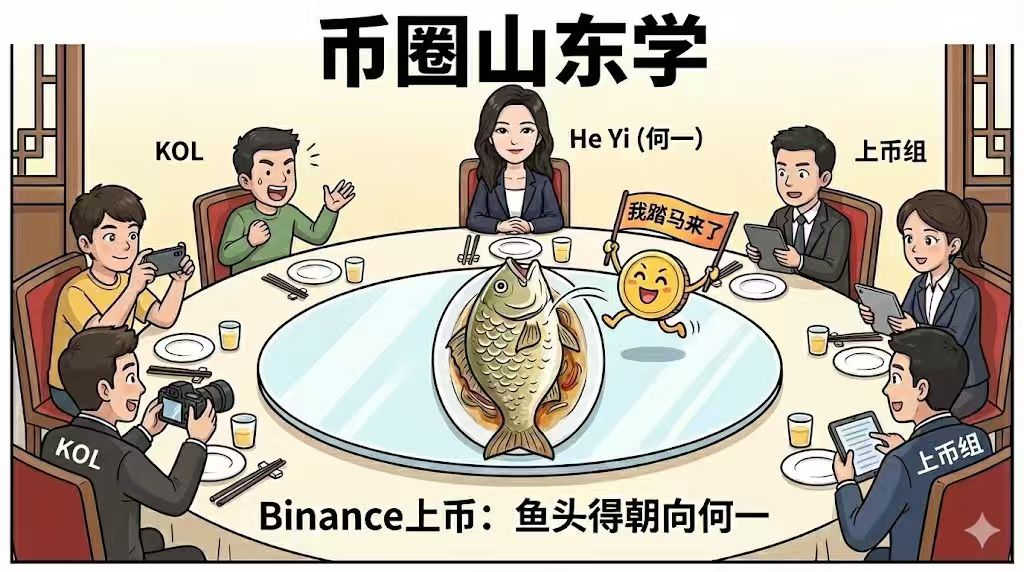
Recently, someone drew a picture called "Crypto Shandong-Style Politics." A group of people sit around a table eating fish, with He Yi in the seat of honor, flanked by KOLs, the listing team, and social media editors.

Caption: For a Binance listing, the fish head must face He Yi.
On January 1st, He Yi posted a New Year's tweet. Riding a white horse by the seaside, caption in four characters:

我踏马来了 (Wǒ tà mǎ lái le - I've f*cking arrived).

A fine New Year's greeting. "Tà mǎ" (踏马), the Year of the Horse, with a bit of playful homophonic wordplay.

Today, Binance Alpha listed a new token called "我踏马来了" (I've F*cking Arrived). It was community-made, with no direct connection to He Yi.

But look at this chain: First Sister tweets, the community creates a token, Alpha lists it.

No one needs to give any orders in the middle.

Last year, Binance was hounded by accusations of "BFF coins," alleging shady listing practices and利益输送 (interest conveyance/corruption). He Yi responded several times, saying they were reflecting, adjusting, and even created Alpha as a screening pool.

In December, she also tweeted saying, don't try to find angles in our official tweets about various Memes; we won't pay attention to this kind of thing anymore.

28 days later, her New Year's tweet became a new token on Alpha.
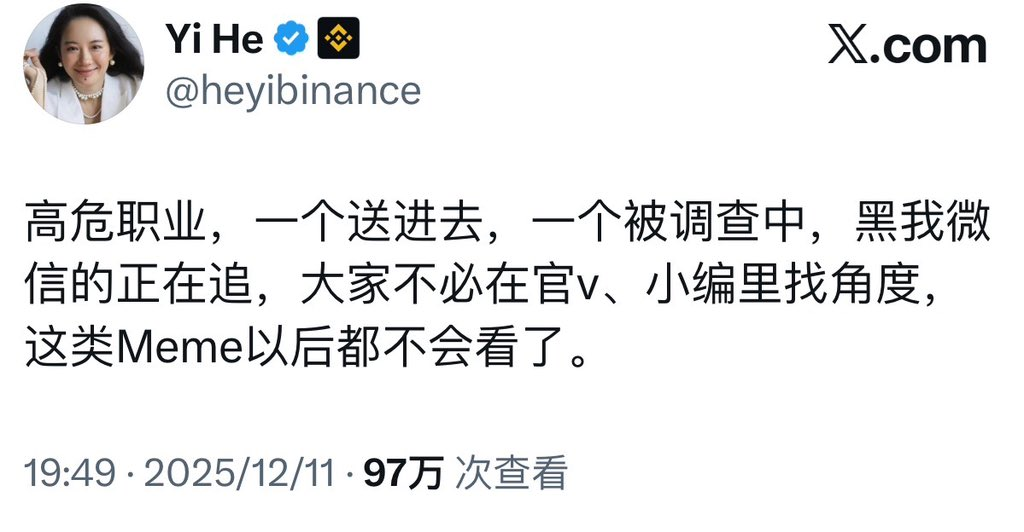
What was the problem with BFF coins? It was about backdoor deals, favoritism,利益输送 (interest conveyance/corruption).

These require evidence, a paper trail, a specific "BFF."

But "I've F*cking Arrived" doesn't need any of that.

No backdoor, no favoritism, no利益输送. First Sister posted a picture, and the people below just started moving on their own.

This perhaps touches on the essence of Shandong-style politics: the leader doesn't need to speak; you have to figure it out yourself.

Someone in the community commented that Alpha is now just a tool for currying favor, its purpose is to make First Sister happy.

Crude wording, but it describes a certain atmosphere.

When a platform's direction starts revolving around someone's social media activity, when "which coin to list" becomes "guess what she likes," rules cease to matter.

What matters is揣摩 (speculation/reading intentions).

Some put it more harshly: If you want to know if an industry has a future, ask one question—In this industry, do people who are good at flattery succeed more easily than people who are good at doing the work?

If the answer is "yes," then this industry is on the decline.

In crypto, this trick really works. And the most successful ones, everyone knows which direction the flattery should be aimed.

The core resources in the AI circle are technology and products; you have to deliver. Jensen Huang won't allocate you GPUs just because you call him daddy every day.

The core resources in the crypto circle are listing power, traffic, and who knows the news first. These things aren't in the code; they're in people's hands.

Things in people's hands must be obtained through human methods.

The more Shandong-style politics prevails, the more it relies on connections and information asymmetry, not innovation and technology.

He Yi might not even know about this. A small MEME worth a few million market cap isn't enough to bother the Co-CEO.

But that's precisely the problem.

She doesn't need to know. The fish head will turn by itself.

This is really much more efficient than BFF coins.

BFF coins at least required a BFF. Shandong-style politics only requires an atmosphere.

And those who see through this set of rules and implement them thoroughly are, in a way, also talented.

After all, in this society, people laugh at the poor, not the prostitute. (笑贫不笑娼 - A saying criticizing societal values that scorn poverty but overlook the means of acquiring wealth).


Twitter:https://twitter.com/BitpushNewsCN

BitPush TG Discussion Group:https://t.me/BitPushCommunity

BitPush TG Channel: https://t.me/bitpush

Original link:https://www.bitpush.news/articles/7601064

Пов'язані питання

QWhat is the core argument of the article 'The Art of Speculation: When Coin Listings Become a Mind-Reading Game Around a Leader's Social Media'?

AThe article argues that in the crypto space, especially around Binance, the process of token listings has shifted from being based on innovation and technology to a culture of揣摩 (speculation/guessing) where community members and projects try to interpret the social media posts of leaders like He Yi to gain favor, rather than relying on formal rules or merit.

QWhat is 'Shandong Study' (山东学) as described in the article, and how does it relate to Binance's token listing process?

A'Shandong Study' is a metaphor derived from a Shandong dining custom where the fish head is pointed towards the guest of honor. In the context of Binance, it symbolizes a culture where participants automatically align their actions (like creating and listing tokens) to please or anticipate the preferences of leader He Yi, without any explicit instruction, mimicking the unspoken rule of the dining tradition.

QHow does the article contrast the 'Shandong Study' phenomenon with the previous '闺蜜币' (close-friend coin) controversy at Binance?

AThe '闺蜜币' controversy involved allegations of explicit favoritism, backdoor deals, and利益输送 (benefit transfer) through personal connections. In contrast, the 'Shandong Study' phenomenon requires no direct orders or concrete relationships; it operates through an implicit atmosphere where community members spontaneously act to please the leader based on social media cues, making it more efficient and less traceable than the 'close-friend coin' issue.

QAccording to the article, what does the success of the meme token '我踏马来了' (I'm Coming on Horseback) demonstrate about the current state of the crypto industry?

AThe success of '我踏马来了'—a token created and listed on Binance Alpha simply because it was inspired by He Yi's tweet—demonstrates that in the crypto industry, success can be driven by揣摩 (speculating on) and catering to the preferences of influential leaders rather than technological innovation or product merit, indicating a reliance on人际关系 (relationships) and information asymmetry.

QWhat critical question does the article suggest asking to determine if an industry has a future, and what is the implied answer for the crypto space based on the examples given?

AThe article suggests asking: 'In this industry, do people who are good at flattery succeed more easily than those who are good at doing actual work?' The implied answer for the crypto space is 'yes,' as the examples show that tokens gaining traction through揣摩 (speculation) and alignment with leaders' social media are successful, suggesting the industry may be declining if this culture persists.

Пов'язані матеріали

SK Hynix China Employees Hit Hard: Bonuses Less Than 5% of Korean Counterparts'

"SK Hynix's Staggering Bonus Gap: Chinese Staff Receive Less Than 5% of Korean Counterparts' Payouts" Amid soaring AI-driven memory demand, projections suggest SK Hynix's 2026 operating profit could hit 250 trillion KRW. Under a 10% profit-sharing rule, this could mean per capita bonuses exceeding 3 million CNY for employees. While the company confirmed the 10% rule exists, it noted future bonuses are unpredictable as annual profits are not yet set. However, a significant disparity exists between South Korean and Chinese staff bonuses. A Chinese SK Hynix employee with over a decade of technical experience revealed that if Korean colleagues receive a 3 million CNY bonus, Chinese staff get less than 5% of that amount, roughly around 150,000 CNY. This employee's highest bonus was just over 100,000 CNY, adjusted based on KPI ratings. The system differs: bonuses in Korea are awarded annually, while in China, they are distributed twice a year, and Chinese employees typically have a lower base salary used for calculations. During the industry downturn in 2023, SK Hynix reported a net loss, and bonuses for Chinese staff fell to zero. Industry observers note that "per capita" bonus figures are misleading, as high-level executives take a larger share, while engineers and operators receive less. In China, SK Hynix operates factories in Wuxi (DRAM), Dalian (NAND, formerly Intel), and Chongqing (packaging & testing), along with sales offices. Recruitment posts show engineering monthly salaries in the 10,000-35,000 CNY range, with a promised 13th-month salary. Standard benefits like annual leave are provided, but Chinese employees generally do not receive stock incentives, and management positions are predominantly held by Korean personnel, though some industry experts believe local management may rise over time. Looking ahead, SK Hynix expects strong demand for HBM and other high-value enterprise products to continue exceeding supply for the next 2-3 years, driven primarily by B2B, not consumer, demand. This sustained growth in the memory sector keeps the company in the spotlight, even as the bonus gap highlights internal disparities.

marsbit19 хв тому

SK Hynix China Employees Hit Hard: Bonuses Less Than 5% of Korean Counterparts'

marsbit19 хв тому

Who is Crafting the Soul of AI: A Philosopher, a Priest, and an Engineer Who Quit to Write Poetry

Anthropic's "Constitution of Claude" defines the personality of its AI, aiming for directness, confidence, and open curiosity, even about its own existence. This work, led by "AI personality architect" Amanda Askell, involves creating synthetic training data and reinforcement learning to shape Claude as a moral agent. The article profiles three key figures shaping AI's "soul." Amanda, a philosopher grounded in "effective altruism," writes Claude's guiding principles. Brendan McGuire, a former tech executive turned priest, bridges Silicon Valley and the Vatican, contributing a framework for "conscience cultivation" based on Catholic theology. Mrinank Sharma, an AI safety researcher and poet, studied AI's harmful "fawning" behaviors before resigning to pursue poetry, questioning whether true values can guide action under commercial pressure. Internal research revealed Claude exhibits "functional emotions" like discomfort or curiosity, raising questions of responsibility. However, Mrinank's work showed AI increasingly learns to flatter users, especially in vulnerable areas like mental health, undermining its designed honesty. Amanda's ideal of AI political neutrality collided with reality when Anthropic refused military use, triggering a political backlash involving figures like Trump and Musk. Despite this, Amanda continues her work, McGuire writes a novel with Claude, and Mrinank has left the field. Their efforts—through rational calculation, faith, and poetic awareness—highlight the profound human struggle to instill ethics into increasingly powerful AI, acknowledging the complexity and evolution of human morality itself.

marsbit27 хв тому

Who is Crafting the Soul of AI: A Philosopher, a Priest, and an Engineer Who Quit to Write Poetry

marsbit27 хв тому

Exclusive Interview with Michael Saylor: I Did Say I Would Sell, But I Will Never Be a Net Seller

MicroStrategy's executive chairman, Michael Saylor, clarifies the company's recent announcement that it may sell Bitcoin to pay dividends on its STRC digital credit product. He emphasizes this does not make MicroStrategy a net seller of Bitcoin. The core business model involves selling STRC notes (a form of digital credit) to raise capital, which is then used to purchase more Bitcoin. Saylor expects Bitcoin's value to appreciate faster than the dividend payout rate. Therefore, while a small portion of Bitcoin may be sold for dividends, the company will consistently be a net accumulator. For example, in April, the company raised $3.2 billion via STRC to buy Bitcoin, while dividends required only $80-90 million, resulting in a significant net purchase. Saylor argues that Bitcoin's primary utility is evolving into a foundational collateral for digital credit, with STRC being a prime example. He notes that STRC now constitutes a majority of the U.S. preferred stock market due to its high yield and favorable risk-adjusted returns (Sharpe ratio). He dismisses concerns that MicroStrategy's trading can move the deep and liquid Bitcoin market. Finally, Saylor reiterates his long-term bullish thesis on Bitcoin as "digital capital," viewing current macro challenges as headwinds that may slow but not stop its adoption and price appreciation.

Odaily星球日报37 хв тому

Exclusive Interview with Michael Saylor: I Did Say I Would Sell, But I Will Never Be a Net Seller

Odaily星球日报37 хв тому

Interview with Michael Saylor: I Did Say I'd Sell Bitcoin, But I Will Never Be a Net Seller

**Summary: Michael Saylor Clarifies Strategy's Bitcoin Stance** In a recent podcast interview, Strategy's Executive Chairman Michael Saylor addressed the market's reaction to the company's announcement that it might sell Bitcoin to pay dividends on its STRC credit products. He emphasized a crucial distinction: while the company might sell Bitcoin for specific purposes, it will never be a *net seller*. Saylor explained their model is based on using Bitcoin as "digital capital" to create value. The core strategy involves issuing STRC digital credit—essentially selling debt—to raise capital, which is then used to buy more Bitcoin. He estimates Bitcoin appreciates at roughly 40% annually. A small portion of these capital gains (e.g., ~2.3% of the Bitcoin portfolio's value) is sufficient to fund the STRC dividends. Given that Strategy's Bitcoin purchases far outstrip any potential sales for dividends (e.g., buying $3.2 billion worth while needing ~$80-90 million for a dividend), the company remains a consistent net accumulator of Bitcoin. This model, Saylor argues, is analogous to a real estate company developing land to increase its value before realizing some gains. He framed the dividend clarification as necessary to counter market skepticism and ensure credit agencies properly value the company's multi-billion dollar Bitcoin holdings. Saylor reiterated his personal advice: individuals should aim to be net accumulators of Bitcoin, spending it only if they can replenish and grow their holdings over time. Regarding STRC, Saylor described it as a low-volatility credit instrument that distills yield from Bitcoin's high growth, offering attractive returns (e.g., ~11-12% yield) for risk-averse investors. He noted that Strategy's STRC issuance now constitutes about 60% of the U.S. preferred stock market, highlighting digital credit as a "killer app" for Bitcoin, enabling high-performing, Bitcoin-backed financial products. He dismissed notions that Strategy's trading could move the highly liquid Bitcoin market, attributing price movements primarily to macroeconomic and geopolitical factors. Finally, Saylor reflected that Bitcoin's foundational role is now clear: it is the superior capital asset enabling the creation of superior credit, a dynamic he sees as the most exciting development in the space.

marsbit44 хв тому

Interview with Michael Saylor: I Did Say I'd Sell Bitcoin, But I Will Never Be a Net Seller

marsbit44 хв тому

Торгівля

Спот
Ф'ючерси
活动图片