The Art of Speculation: When Coin Launches Become a Mind-Reading Game Centered on Leaders' Social Dynamics

比推Опубліковано о 2026-01-08Востаннє оновлено о 2026-01-08

Анотація

The article "The Art of Reading Between the Lines: When Coin Listings Become a Game of Guessing Leaders' Social Cues" critiques the culture of speculation and sycophancy in the cryptocurrency space, particularly around Binance’s listing process. It draws a parallel to a Shandong dining custom where the fish head is pointed toward the guest of honor as a sign of respect—a tacit social rule that requires intuition rather than explicit instruction. The piece centers on a recent event where He Yi, Binance’s co-founder, posted a cryptic New Year’s tweet saying “我踏马来了” (roughly: “Here the f*ck I come”). Shortly after, a community-created meme token with the same name was listed on Binance Alpha, despite He Yi’s earlier statements against favoritism and “insider coins.” The author argues that this reflects a deeper cultural issue: the shift from merit-based innovation to a system where success depends on interpreting the subtle hints of influential figures. Unlike traditional industries where technical skill or product quality drive progress, the crypto industry often prioritizes access to information, relationships, and the ability to please key decision-makers. The piece suggests that this “Shandong mindset”—where insiders learn to “read the room” rather than challenge or create—undermines transparency and rewards those who excel at flattery rather than genuine contribution. While He Yi may not have directly endorsed the token, the very fact that her social media activity can t...

Author: Kuli, Shenchao TechFlow

Original Title: Where the Fish Head Faces He Yi: Crypto Has Its Shandong-Style Politics Too


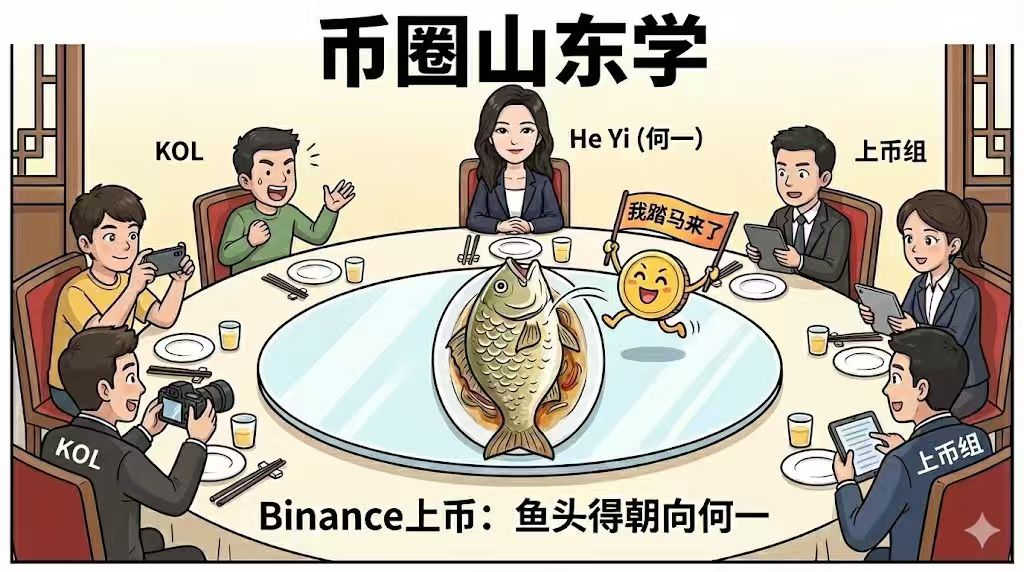
There's a rule at Shandong banquets: when the fish is served, the head must face the seat of honor.

Whoever it faces is the main guest and must drink first. This isn't written down anywhere, but everyone in Shandong knows it. No one teaches you; you just learn it.

Recently, someone drew a picture called "Crypto Shandong-Style Politics." A group of people sit around a table eating fish, with He Yi in the seat of honor, flanked by KOLs, the listing team, and social media editors.

Caption: For a Binance listing, the fish head must face He Yi.
On January 1st, He Yi posted a New Year's tweet. Riding a white horse by the seaside, caption in four characters:

我踏马来了 (Wǒ tà mǎ lái le - I've f*cking arrived).

A fine New Year's greeting. "Tà mǎ" (踏马), the Year of the Horse, with a bit of playful homophonic wordplay.

Today, Binance Alpha listed a new token called "我踏马来了" (I've F*cking Arrived). It was community-made, with no direct connection to He Yi.

But look at this chain: First Sister tweets, the community creates a token, Alpha lists it.

No one needs to give any orders in the middle.

Last year, Binance was hounded by accusations of "BFF coins," alleging shady listing practices and利益输送 (interest conveyance/corruption). He Yi responded several times, saying they were reflecting, adjusting, and even created Alpha as a screening pool.

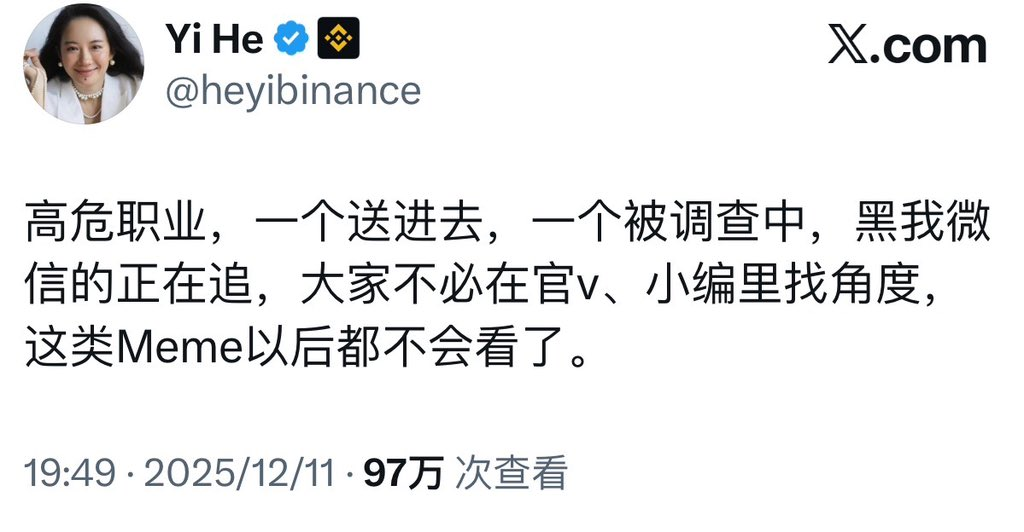
In December, she also tweeted saying, don't try to find angles in our official tweets about various Memes; we won't pay attention to this kind of thing anymore.

28 days later, her New Year's tweet became a new token on Alpha.
What was the problem with BFF coins? It was about backdoor deals, favoritism,利益输送 (interest conveyance/corruption).

These require evidence, a paper trail, a specific "BFF."

But "I've F*cking Arrived" doesn't need any of that.

No backdoor, no favoritism, no利益输送. First Sister posted a picture, and the people below just started moving on their own.

This perhaps touches on the essence of Shandong-style politics: the leader doesn't need to speak; you have to figure it out yourself.

Someone in the community commented that Alpha is now just a tool for currying favor, its purpose is to make First Sister happy.

Crude wording, but it describes a certain atmosphere.

When a platform's direction starts revolving around someone's social media activity, when "which coin to list" becomes "guess what she likes," rules cease to matter.

What matters is揣摩 (speculation/reading intentions).

Some put it more harshly: If you want to know if an industry has a future, ask one question—In this industry, do people who are good at flattery succeed more easily than people who are good at doing the work?

If the answer is "yes," then this industry is on the decline.

In crypto, this trick really works. And the most successful ones, everyone knows which direction the flattery should be aimed.

The core resources in the AI circle are technology and products; you have to deliver. Jensen Huang won't allocate you GPUs just because you call him daddy every day.

The core resources in the crypto circle are listing power, traffic, and who knows the news first. These things aren't in the code; they're in people's hands.

Things in people's hands must be obtained through human methods.

The more Shandong-style politics prevails, the more it relies on connections and information asymmetry, not innovation and technology.

He Yi might not even know about this. A small MEME worth a few million market cap isn't enough to bother the Co-CEO.

But that's precisely the problem.

She doesn't need to know. The fish head will turn by itself.

This is really much more efficient than BFF coins.

BFF coins at least required a BFF. Shandong-style politics only requires an atmosphere.

And those who see through this set of rules and implement them thoroughly are, in a way, also talented.

After all, in this society, people laugh at the poor, not the prostitute. (笑贫不笑娼 - A saying criticizing societal values that scorn poverty but overlook the means of acquiring wealth).


Twitter:https://twitter.com/BitpushNewsCN

BitPush TG Discussion Group:https://t.me/BitPushCommunity

BitPush TG Channel: https://t.me/bitpush

Original link:https://www.bitpush.news/articles/7601064

Пов'язані питання

QWhat is the core argument of the article 'The Art of Speculation: When Coin Listings Become a Mind-Reading Game Around a Leader's Social Media'?

AThe article argues that in the crypto space, especially around Binance, the process of token listings has shifted from being based on innovation and technology to a culture of揣摩 (speculation/guessing) where community members and projects try to interpret the social media posts of leaders like He Yi to gain favor, rather than relying on formal rules or merit.

QWhat is 'Shandong Study' (山东学) as described in the article, and how does it relate to Binance's token listing process?

A'Shandong Study' is a metaphor derived from a Shandong dining custom where the fish head is pointed towards the guest of honor. In the context of Binance, it symbolizes a culture where participants automatically align their actions (like creating and listing tokens) to please or anticipate the preferences of leader He Yi, without any explicit instruction, mimicking the unspoken rule of the dining tradition.

QHow does the article contrast the 'Shandong Study' phenomenon with the previous '闺蜜币' (close-friend coin) controversy at Binance?

AThe '闺蜜币' controversy involved allegations of explicit favoritism, backdoor deals, and利益输送 (benefit transfer) through personal connections. In contrast, the 'Shandong Study' phenomenon requires no direct orders or concrete relationships; it operates through an implicit atmosphere where community members spontaneously act to please the leader based on social media cues, making it more efficient and less traceable than the 'close-friend coin' issue.

QAccording to the article, what does the success of the meme token '我踏马来了' (I'm Coming on Horseback) demonstrate about the current state of the crypto industry?

AThe success of '我踏马来了'—a token created and listed on Binance Alpha simply because it was inspired by He Yi's tweet—demonstrates that in the crypto industry, success can be driven by揣摩 (speculating on) and catering to the preferences of influential leaders rather than technological innovation or product merit, indicating a reliance on人际关系 (relationships) and information asymmetry.

QWhat critical question does the article suggest asking to determine if an industry has a future, and what is the implied answer for the crypto space based on the examples given?

AThe article suggests asking: 'In this industry, do people who are good at flattery succeed more easily than those who are good at doing actual work?' The implied answer for the crypto space is 'yes,' as the examples show that tokens gaining traction through揣摩 (speculation) and alignment with leaders' social media are successful, suggesting the industry may be declining if this culture persists.

Пов'язані матеріали

Vitalik's Algorithmic Stablecoin Vision: Interpreting the Mechanism and Challenges from an Options Perspective

Vitalik Buterin's recent algorithmic stablecoin proposal envisions using an option-like mechanism to create a stablecoin without the liquidation risks inherent in traditional collateralized debt position (CDP) models. The design splits one unit of ETH into two components: a 'stable' leg (P) that maintains value up to a certain strike price, and an 'upside' leg (N) that captures any appreciation above that price. Together, they always sum to one ETH, eliminating the need for debt or liquidation mechanisms. From an options perspective, the stable leg essentially functions as a synthetic, covered call position. However, significant challenges exist. For the stable asset to maintain its peg, it must continuously roll deep in-the-money call options, leading to potential rollover slippage, predictable trading paths vulnerable to front-running, and liquidity issues. Crucially, the system's scalability depends on a constant demand for the upside leg—a form of leveraged ETH long position without funding rates or liquidation risk. It's unclear if such persistent, specific demand will materialize from speculators or market makers who have simpler alternatives like perpetual swaps. The author, drawing from experience with Rysk, argues that DeFi options have struggled as standalone trading products due to complexity and fragmented liquidity. Their potential lies instead as foundational infrastructure underpinning more complex financial primitives like stablecoins, structured yields, or index products—transforming from a direct product into a core pricing and risk distribution engine for the next generation of on-chain finance.

marsbit17 хв тому

Vitalik's Algorithmic Stablecoin Vision: Interpreting the Mechanism and Challenges from an Options Perspective

marsbit17 хв тому

GPT-5.6 Countdown: Abandon the Illusion of a Single API, Computational Iteration Can't Outpace a Single Page of Compliance

In mid-June, three seemingly independent industry events—the compliance-driven throttling of Fable 5, the open-sourcing of GLM-5.2, and the leaked release timeline for GPT-5.6—are pushing the global AI industry toward a watershed moment. These shifts signal a fundamental restructuring of the industry's underlying logic. First, **"usability" has substantially overtaken "advanced capabilities"** as the primary weight, pushing the global large language model (LLM) supply chain into a "dual-track" phase of controlled closed-source and local open-source coexistence. Second, **the competitive moats of closed-source giants are shifting**. Their technical focus is moving from "language intelligence" toward "spatial intelligence (world models)"—a domain heavily reliant on computing power. Third, faced with常态化 transnational compliance risks, **a "model-agnostic" decoupled design has become a survival necessity for application-layer developers to maintain business continuity.** The article details how Anthropic's Fable 5, despite its advanced engineering feats, was restricted for non-U.S. citizens within 72 hours of launch, highlighting how geopolitical compliance can instantly limit even the most advanced models. In response, the open-source camp, exemplified by Zhipu AI's MIT-licensed GLM-5.2, is gaining market share by offering stable performance improvements and significant cost advantages (up to 70% savings for enterprises), while achieving full adaptation with domestic semiconductor platforms. Meanwhile, closed-source leaders like OpenAI are pivoting. The anticipated GPT-5.6 reportedly shifts focus from language to spatial intelligence and world models, aiming to rebuild a generational gap in areas like 3D understanding, simulation, and industrial design that demand immense compute. The core conclusion is that the LLM supply chain's logic has changed. Enterprises must now evaluate infrastructure based on a composite of technical performance and policy compliance. For developers, complete reliance on a single closed-source API poses unacceptable risk. Implementing a truly model-agnostic architecture—enabling swift switches to compliant, locally deployable open-source alternatives—is no longer just good practice but a fundamental baseline for business continuity.

marsbit3 год тому

GPT-5.6 Countdown: Abandon the Illusion of a Single API, Computational Iteration Can't Outpace a Single Page of Compliance

marsbit3 год тому

Is the 'Token Subsidy War' Among AI Giants Almost Over?

The article discusses the ongoing "token subsidy war" among AI giants like OpenAI and Anthropic, questioning whether it's nearing its end. It reveals that current AI subscription prices are heavily subsidized, with some plans offering tokens at up to 70 times the actual cost to attract and retain heavy users, especially developers and enterprises. This strategy mirrors past internet-era subsidy battles, but with a key difference: AI tokens lack "lock-in" effects. Unlike ride-hailing or food delivery apps, users can easily switch between AI providers as APIs become standardized, making it difficult for companies to raise prices post-subsidy. The piece highlights a structural asymmetry in the competition. Giants like Google, with massive advertising revenue, can afford to subsidize tokens indefinitely, akin to using "tokens as a weapon." In contrast, venture-backed companies like OpenAI and Anthropic face pressure to become profitable, especially as they approach IPO. The article cites Google Ventures founder Bill Maris, who suggests Google could slash token prices by 80%, putting immense pressure on competitors. Two potential endgames are presented: the "internet service" model (subsidize, monopolize, then raise prices) and the "utility" model (tokens become a standardized, low-margin commodity like electricity). Given the low switching costs, the latter seems more likely. The competition may not have a single winner but could instead accelerate AI's evolution into a foundational, infrastructure-level technology, akin to a public utility. For now, users continue to benefit from heavily subsidized token costs.

marsbit3 год тому

Is the 'Token Subsidy War' Among AI Giants Almost Over?

marsbit3 год тому

Торгівля

Спот
Ф'ючерси
活动图片