The Ambition of the OEM: Dissecting Leju Robot's External Investments to Understand the 'Ecosystem Positioning' Battle in the Humanoid Robot Track

marsbitОпубліковано о 2026-08-26Востаннє оновлено о 2026-08-26

Анотація

Leju Robotics, a leading humanoid robot manufacturer from China, is aggressively building an industrial ecosystem through strategic investments as it pursues a public listing. Founded in 2016 and known for its "Kuavo" robot, Leju saw its revenue surge to 258 million yuan in 2025, though it remains unprofitable. Its IPO plan, submitted in May 2026, outlines a strategy focused on cost reduction and full-stack capability development. Analysis of Leju's 13 disclosed investments reveals a three-pronged approach to securing its value chain. First, it targets core components like precision actuators (e.g., Lingxinqiaoshou), joint modules, and motors to control costs and supply. Second, it invests in software and AI layers, including companies working on foundational models and embodied intelligence datasets, to develop an independent "brain" while maintaining partnerships with giants like Huawei. Third, it forms alliances with firms in logistics and service robotics to transform from a hardware seller into a solution provider for real-world applications. While this investment network aims to create a competitive moat and support Leju's industrialization story, risks persist. The company faces ongoing losses, declining gross margins, and potential industry price wars. Many investments are early-stage with long payback periods and unproven synergistic benefits. Leju's strategy exemplifies how humanoid robot players are moving beyond pure R&D to ecosystem competition, betting that co...

In the embodied AI track of 2026, the strategy of 'fundraising while investing' has evolved from a special tactic for a few leading companies to a norm for participants in the sector. IT桔子 has previously conducted a special report and analysis on this phenomenon. Data shows that at least 29 domestic embodied AI companies are currently making external investments.

Today, we focus on Leju Robot, which has relatively high activity in this regard.

I. About Leju:

A Humanoid Robot OEM Charging Towards an IPO

In 2016, Leng Xiaokun founded Leju in Shenzhen with partners from the HIT Robot Club. A decade later, they developed the humanoid robot "Kuafu"—China's first full-size, highly dynamic humanoid robot capable of jumping, adapting to multi-terrain walking, and among the first to be equipped with OpenHarmony and integrated with Huawei's Pangu model.

According to data from institutions like Omdia and IDC, Leju's shipment volume ranked among the top four globally in 2025, with its full-size bipedal robot ranking second globally. In the same year, 577 Kuafu units were sold, generating revenue of approximately 178 million RMB (a roughly 12-fold year-on-year increase), accounting for nearly 70% of the company's revenue. Overall revenue grew from 54 million RMB in 2023 to 258 million RMB in 2025.

Behind the impressive shipment growth lies profitability pressure: the company accumulated net losses exceeding 170 million RMB over three years, with gross margin sliding from 50.45% to 40.78%, exhibiting characteristics of 'trading price for volume'.

In May 2026, Leju's ChiNext IPO application was accepted by the Shenzhen Stock Exchange (the first to apply under the 'fourth set of standards'), aiming to raise 2.6 billion RMB with a post-investment valuation of 4.327 billion RMB.

The prospectus reveals its industrial logic: on one hand, advancing core component localization and supply chain collaboration for cost reduction; on the other, listing the embodied AI R&D center and high-quality dataset as key fundraising projects—this set of 'cost reduction, full-stack capability, and capacity expansion' tactics is almost precisely mirrored in the targets of its external investments over the past two years.

II. Panorama of 13 External Investments:

Three-Tier Positioning Along the Value Chain

According to IT桔子 data, as of August 2026, Leju has made 13 investments as an investor, which can be categorized into three types based on the value chain: core component supply (4), software & intelligence layer (6), and scenario joint ventures & industrial synergy (3).
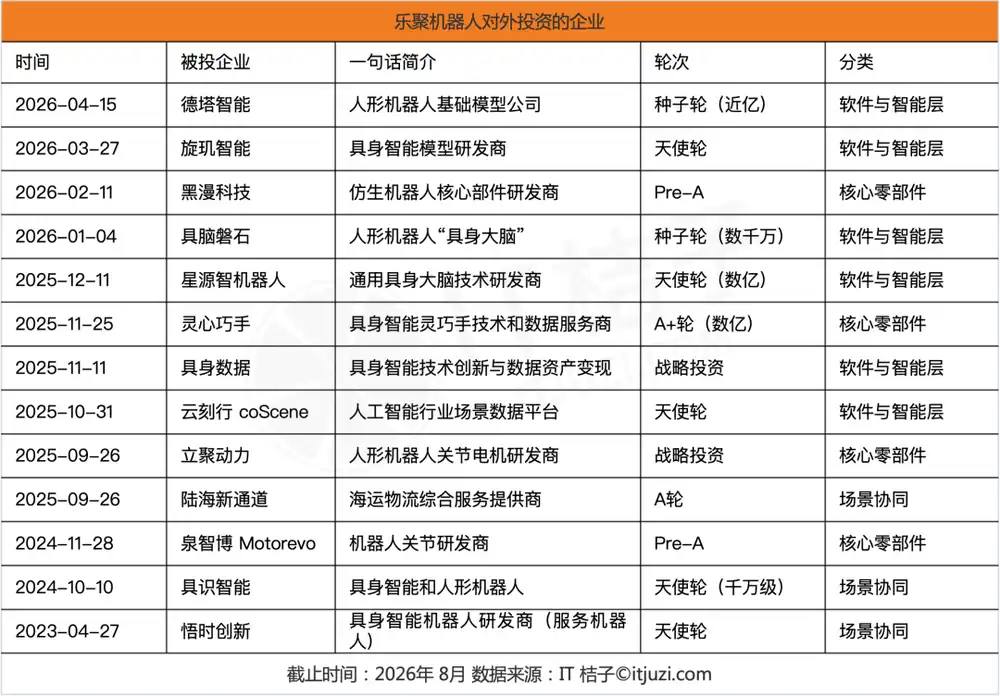
III. Logic Analysis:

How Were the 13 Investments Made?

1. Core Components: Keeping Cost Control in Its Own Hands

The most expensive parts of a humanoid robot are precisely the motion joints and end effectors, and the prospectus precisely lists 'supply chain collaboration for cost reduction' as the fundamental source of Kuafu's price advantage.

Leju's four investments in components equate to grasping the lifeline of cost reduction within its shareholder registry.

The most notable is Lingxinqiaoshou. This Beijing Haidian-based company is already a unicorn in the dexterous hand sector, securing hundreds of millions in its A+ round.

Dexterous hands are widely recognized as the end effector, the 'final piece of the puzzle' for humanoid robots, directly determining whether a robot can perform delicate tasks like grasping, pinching, and twisting—Leju's bet on the leader secures both the supply and pricing power of high-end dexterous hands, while ensuring Kuafu does not rely on external purchases for 'real work', aligning highly with the industrial and commercial service applications emphasized in its prospectus.

Further upstream, Quanzhibo and Lijudongli are positioned in joint modules and joint motors, respectively.

Quanzhibo, based in Wuxi, focuses on robot joints and servo motors, and is already a high-tech enterprise; Lijudongli, located in Ningbo, specializes in joint motors.

Together, these two form a 'module + drive' combination, allowing Leju to control the heaviest part of its cost structure and avoid the earlier predicament of 'relying on imported core components and spending millions to build a prototype generation'.

Heiman Technology adds a future option for bionic core components, leaving room for differentiation in the next-generation platform.

2. Software & Intelligence Layer: Creating Backups for the 'Brain'

Leju's strength lies in the 'cerebellum'—high-dynamic bipedal motion control, while the 'brain' has long relied on external partners like Huawei's Pangu. The six investments in the software layer represent multiple backup forces it has positioned on the 'brain' side.

The youngest and most aggressive of these is Deta Intelligent.

Founded only in 2026, with a team boasting Google and Facebook backgrounds, this company raised nearly 100 million RMB in its seed round. Its bet is on the strategic high ground of 'humanoid foundational models', backed by the imaginative space of world models and spatial intelligence.

Correspondingly, Jubao Panshi focuses on developing the 'embodied brain' for humanoid robots, with a team carrying Huawei backgrounds—while deeply integrating with HarmonyOS and Pangu, Leju clearly intends to maintain a self-controllable backup, leveraging the ecosystem's light while not putting all its eggs in one basket.

data-check-id="558120">Jushen Data and Yunkexing extend the reach into training data.

The former works on monetizing data assets for embodied AI, while the latter is a sector-specific scenario data platform with a team carrying Apple backgrounds.

Both directly target the 'high-quality, large-scale dataset' (approximately 616 million RMB) listed in this IPO's fundraising projects, effectively extending the R&D system externally to supply data for Kuafu's continuous iteration.

Additionally, Xingyuan Zhi Robot, Xuanji Intelligent, etc., also have their stakes in general embodied brains and multimodal vision, making this 'external brain' network denser.

3. Scenario & Industrial Synergy: From Selling Devices to Selling Solutions

The remaining three investments are not purely in supply, pointing towards real-world deployment—what Leju seeks is not just financial returns, but channels to transform Kuafu from 'a single robot' into 'a set of solutions'.

Land-Sea New Corridor is a cross-border logistics service provider with nearly a decade of experience. Leju's investment opens real channels for humanoid robots to enter logistics handling, and even follow Chinese manufacturing overseas, echoing the 'logistics' industrial scenario specified in the prospectus.

Jushi Intelligent and Wushi Innovation complement the whole-machine ecosystem: the former is a Shanghai-based company also developing humanoid robots, serving as an ecosystem synergy and co-opetition partner for complementary whole-machine solutions and joint delivery; the latter, rooted in Shenzhen developing service robots, neatly fits Leju's scenarios like exhibition hall guiding and storefront shopping assistance.

By pulling upstream and downstream scenario partners into its circle through investments, Leju's industrialization narrative becomes complete.

IV. The Ecosystem Empire and Underlying Concerns

As humanoid robotics approaches the eve of industrialization, simply 'self-developing the platform' is no longer sufficient to constitute a barrier.

Leju's choice is to use capital to 'weave' the value chain into a network—self-developing the body, externally connecting the brain, holding stakes in the supply chain. This not only tells a complete industry chain story for the IPO but also lays the groundwork for mass production cost reduction and scenario deployment.

However, the concerns are equally clear: Leju itself remains loss-making, with operating cash flow persistently negative and gross margins declining; most of the 13 investments are early-stage, with undisclosed or small amounts, long return cycles, and most have not yet formed quantifiable synergistic revenue with the parent entity.

If the industry experiences short-term overcapacity and intensified price wars, the 'synergistic dividends' of this ecosystem network may not materialize as expected.

Founder Leng Xiaokun once stated frankly: 'Only doing the dirty and hard work constitutes a barrier; technology may not necessarily become the industry's barrier.' Leju is using 13 external investments to gradually turn those 'dirty and hard jobs'—joints, motors, dexterous hands, embodied data—into its own moat.

Whether this network can ultimately catch the future of a quasi-listed company, time will tell.

This article is from the WeChat public account: IT桔子 , Author: Judy

Пов'язані питання

QAccording to the article, what is the current trend in the Embodied AI/humanoid robotics sector regarding the investment behavior of companies?

AThe trend is that '边融边投' (raising funds while investing) has evolved from a strategy used by a few leading companies to a common practice among participants in the sector. At least 29 domestic Embodied AI companies are currently making external investments.

QWhat are the three main categories of Leju Robot's 13 external investments, as described in the article?

ALeju Robot's investments fall into three categories along the value chain: 1) Core component supply (4 investments), 2) Software and intelligence layer (6 investments), and 3) Scenario joint ventures and industrial collaboration (3 investments).

QWhy did Leju Robot invest in Lingxinqiaoshou (灵心巧手), and what strategic advantage does this provide?

ALeju invested in Lingxinqiaoshou, a unicorn in the dexterous hand segment, because dexterous hands are considered the 'final piece of the puzzle' for humanoid robots, crucial for performing fine tasks like grasping and twisting. This investment secures the supply and pricing power for high-end dexterous hands, ensures its Kuavo robot doesn't rely on external purchases for core functionality, and aligns with its goal of industrial and commercial service applications.

QWhat are the potential risks or hidden concerns for Leju Robot mentioned in the article, despite its active investment strategy?

AThe article highlights several concerns: Leju itself is still operating at a loss, with negative operating cash flow and declining gross margins. Its 13 investments are mostly in early-stage companies with long payback periods, and their synergistic benefits with Leju's main business are not yet quantifiable. If the industry faces short-term overcapacity or intensified price wars, the expected 'synergistic dividends' from this ecosystem network may not materialize on schedule.

QWhat is the significance of Leju Robot's investment in Deta Zhineng (德塔智能), according to the article?

AThe investment in Deta Zhineng, a company founded in 2026 with a team from Google and Facebook background, represents Leju's bet on the commanding height of the 'humanoid foundation model.' It focuses on world models and spatial intelligence. This investment provides a strategic backup option for the 'brain' (AI intelligence) of its robots, complementing its deep partnership with Huawei's HarmonyOS and PanGu model, ensuring it doesn't 'put all its eggs in one basket.'

Пов'язані матеріали

a16z Deep Dive: Stop Chasing the 'AI Smell', Here's a Practical Guide to Writing with AI

"Don't Obsess Over AI Detection: A Practical Guide to Writing Alongside AI" by Steph Zinn (a16z Crypto) This guide moves beyond the flawed premise that AI-generated text can be easily spotted by a set of "tells" and that these features automatically mean poor quality. Instead, it focuses on how writers and founders can use LLMs effectively by understanding, controlling, and editing the common stylistic tendencies of AI-assisted prose. The article breaks down AI writing "tells" into four key dimensions: **1. Rhetorical Features (Insight-Shaped Writing):** AI often produces semantically empty, "corporate-sounding" filler language—vague profundities, hedging phrases, excessive parallelism, and summary statements. The advice is to ruthlessly edit these out, using prompts to make language more specific and direct. **2. Voice Features (The Alexa Voice):** Default AI writing relies on a narrow, fungible vocabulary of low-friction, abstract words and cliché phrases that lack personality. While this generic voice is acceptable for support docs or mass communications, founders should preserve their unique voice for impactful writing. Use LLMs to identify and replace jargon, aiming for concrete, distinctive word choices. **3. Structural Features (Form Without Function):** AI tends towards over-structured text with excessive subheadings, lists, roadmaps, and the rigid "three-point" framework. While clear structure is good for readability and SEO, it shouldn't force ideas into unnatural containers. Choose a structure that serves the format and purpose, borrowing from effective examples. **4. Punctuation Features (Dash Panic):** The overuse of em dashes and colons has become a hallmark, but writers shouldn't avoid useful punctuation just to seem "human." The key is avoiding repetitive, distracting patterns. Use punctuation that is grammatically correct and supports the flow of your argument. The core argument is that many so-called AI flaws are just amplified versions of existing bad writing habits. The goal isn't to eliminate AI's role but to use it as a tool while maintaining editorial control. The final question shouldn't be "Can this be detected as AI?" but "Does this writing effectively do its job?"

marsbit11 хв тому

a16z Deep Dive: Stop Chasing the 'AI Smell', Here's a Practical Guide to Writing with AI

marsbit11 хв тому

Podcast Notes | Conversation with Tom Lee: Bitmine Acquiring Nearly 5% of Total ETH Supply Is Not the End Goal, ETH Price Target Set at $10,000

In a podcast interview, Tom Lee, Chairman of BitMine Immersion Technologies, discusses the company's strategy to accumulate nearly 5% of the total Ethereum supply within 14 months, using equity financing and avoiding debt. BitMine has consistently purchased ETH for over 60 consecutive weeks, with recent weeks combining buybacks with purchases. The company's substantial ETH holdings generate approximately $300 million in annual staking rewards, covering operational costs like the dividends for its 9.5% perpetual preferred stock (BMNP). Lee positions ETH as a store-of-value asset, likening it to stocks or land, rather than a pure cash-flow instrument. Looking ahead, Lee suggests BitMine may continue buying beyond the 5% target if institutional adoption grows. He outlines a bullish price target for ETH: surpassing $5,000 in a new crypto bull cycle and potentially exceeding $10,000 within 1-2 years, driven by Wall Street tokenization and AI-related demand. The discussion also covers BitMine's evolution into an ecosystem player, funding Ethereum Foundation spin-offs and developing its Maven staking platform. Lee acknowledges his significant financial interests are tied to ETH's price and BitMine's performance. The interview provides a framework for evaluating ETH as a long-term asset, emphasizing staking yield sustainability and future institutional demand, while noting the uncertainties surrounding macro cycles and real-world adoption.

marsbit11 хв тому

Podcast Notes | Conversation with Tom Lee: Bitmine Acquiring Nearly 5% of Total ETH Supply Is Not the End Goal, ETH Price Target Set at $10,000

marsbit11 хв тому

Pricing Risk Assets in 8 Hours: Tonight's PCE to Set the Discount Rate, Nvidia to Test Earnings Tomorrow Morning

"Pricing Risk Assets in 8 Hours: PCE to Set the Discount Rate Tonight, NVIDIA to Test Profits Tomorrow Morning" Risk asset prices hinge on two variables: the numerator (earnings expectations) and the denominator (the discount rate). Both will be recalibrated within eight hours. First, at 20:30 Beijing time, the US Bureau of Economic Analysis releases July PCE inflation data and the second estimate of Q2 GDP. Consensus expects mild core PCE growth, but a surge in key PPI components poses an upside risk. A hotter-than-expected print could push Treasury yields and the dollar higher, threatening the recent rally in Bitcoin (BTC) above $80K, which was fueled by falling yields. A benign reading would support risk assets. Market sentiment is already "greedy" (Fear & Greed Index at 74), making it vulnerable to disappointment. Second, around 04:20, NVIDIA reports its Q2 FY27 earnings. While consensus revenue of ~$91.85B slightly exceeds company guidance, the market has priced in a beat. The key will be the magnitude of the beat and, crucially, the Q3 guidance. As a bellwether for tech and AI narratives, NVIDIA's results will significantly impact overall risk appetite and AI-related crypto tokens. The combination creates four scenarios: 1) Benign PCE & strong NVIDIA guidance confirms the bullish trend. 2) Hot PCE & strong NVIDIA leads to conflicted signals and likely volatility for BTC. 3) Benign PCE & weak NVIDIA guidance pressures tech but offers some macro support for BTC. 4) Hot PCE & weak NVIDIA guidance presents a "double whammy," risking a sharp pullback in BTC toward the $75K-$76K support zone. The outcomes will set the tone for markets ahead of the upcoming Jackson Hole symposium.

marsbit44 хв тому

Pricing Risk Assets in 8 Hours: Tonight's PCE to Set the Discount Rate, Nvidia to Test Earnings Tomorrow Morning

marsbit44 хв тому

Торгівля

Спот
活动图片