The Altcoin Vector #59

insights.glassnodeОпубліковано о 2026-06-23Востаннє оновлено о 2026-06-23

Анотація

The article "The Altcoin Vector #59" appears to be a newsletter or market analysis publication focused on the altcoin sector of the cryptocurrency market. The content presented shows only the opening section, which includes an "Executive Summary" heading followed by a prompt for existing subscribers to log in. This indicates the full article is behind a subscription paywall or login requirement. No substantive analysis, market data, or specific altcoin insights are accessible from the provided text. The title suggests this is the 59th issue in a series dedicated to tracking and analyzing trends, opportunities, and narratives within the broader altcoin landscape beyond Bitcoin.

Executive Summary

Пов'язані питання

QWhat is the main topic of the article titled 'The Altcoin Vector #59'?

AThe provided article content only shows the title, a section header for 'Executive Summary', and a subscriber login prompt, so the main topic is not revealed in the given text.

QIs the full content of 'The Altcoin Vector #59' accessible without logging in?

ANo, the provided text indicates that only the executive summary is visible, and a subscriber login prompt is shown, suggesting the full article requires a subscription.

QWhat is the purpose of the HTML `aside` element with class 'post-upgrade-cta' in the article?

AIts purpose is to display a call-to-action for subscribers to log in, indicating that further content is restricted.

QBased on the structure, what would a reader likely find in the 'Executive Summary' section of this article?

AThe 'Executive Summary' section likely contains a brief overview or key takeaways from the main article, which is a common practice for subscriber-gated content.

QWhat can be inferred about 'The Altcoin Vector' from the title '#59'?

AIt can be inferred that 'The Altcoin Vector' is likely a recurring publication, report, or newsletter series, with this being the 59th edition or issue.

Пов'язані матеріали

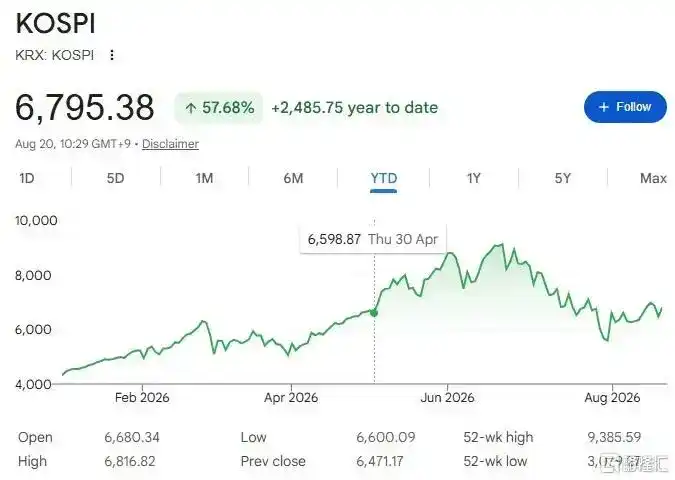
South Korean Stocks Stage Violent Rebound as Multiple Positive Factors Converge

South Korean stocks surged sharply today, with the KOSPI index rising over 5% to 6,848.81 points. Major companies like SK Hynix and Samsung Electronics saw gains exceeding 12% and 8%, respectively. The rally was triggered by multiple positive factors. A key catalyst was the U.S. Treasury's announcement to at least double its buyback size for long-term bonds, signaling intervention to curb high yields. This boosted risk sentiment globally. Concurrently, significant corporate news provided support: SK Hynix unveiled a massive 40 trillion won share buyback plan, while Samsung Electronics is reportedly preparing a record shareholder return policy potentially worth 100 trillion won. The market rebound follows a volatile period for Korean equities, which had soared earlier in the year on AI-driven semiconductor demand before correcting sharply. Analysts note the pullback cleared excess leverage. HSBC upgraded South Korean stocks to "overweight," citing robust domestic demand. Industry leaders like SK Group's Chairman forecast a severe memory chip shortage in 2025, with analysts predicting continued strong demand and price increases for HBM and other memory products. Despite the strong bounce, analysts caution about potential near-term profit-taking and ongoing market volatility, influenced by upcoming earnings, U.S. monetary policy, and external uncertainties.

marsbit18 хв тому

South Korean Stocks Stage Violent Rebound as Multiple Positive Factors Converge

marsbit18 хв тому

UBS Research Report Analysis: Murata's MLCC Factory Opens to the Public for the First Time in 20 Years, 20% Production Increase Potential from Optimization of Existing Assets

On August 18, UBS analysts visited Murata's Fukui Takefu factory, its first public opening in about 20 years. As the global MLCC leader with ~35% market share, this plant serves as the mother factory for advanced MLCCs used in AI servers and premium smartphones. UBS confirmed key findings: deep technical barriers remain, existing equipment holds ~20% latent production capacity, and physical expansion is nearing its limits. Murata's competitive edge lies in a closed-loop system encompassing proprietary ceramic material uniformity control, capacitance-maximizing self-developed technology, and self-built production equipment—a "black box" model difficult to replicate. Its flexible segmented production system efficiently manages over 50,000 product types. With new facility construction constrained and equipment lead times lengthening, optimizing existing lines becomes a crucial, lower-cost path to increase output. Murata's strategy involves shifting generic production to overseas sites like Thailand while focusing Japanese facilities on advanced, high-margin products. UBS projects significant operating margin expansion from 15.4% in FY2026 to 37.6% in FY2029, driven by this product mix upgrade toward high-capacitance, small-size MLCCs for AI and smartphones. Primary risks include U.S. economic slowdown, technology diffusion in Asia, and circuit integration trends. UBS maintains a positive industry outlook, noting potential for guidance upgrades, and sets a 13,200 yen target price based on a 30x FY2029 P/E, implying ~76% upside contingent on successful MLCC product structure advancement.

marsbit29 хв тому

UBS Research Report Analysis: Murata's MLCC Factory Opens to the Public for the First Time in 20 Years, 20% Production Increase Potential from Optimization of Existing Assets

marsbit29 хв тому

Arthur Hayes: Awaiting Fed Signal, Replenishing Ammo to Position for Crypto Bull Market

Arthur Hayes, co-founder of BitMEX, argues that the yen is significantly undervalued and analyzes three potential paths for its appreciation. He dismisses the first two options—the Bank of Japan raising interest rates or Japanese institutions selling foreign assets—as politically or economically unfeasible. Instead, he identifies the preferred method: Japan's Ministry of Finance (MOF) using the Federal Reserve's FIMA (Foreign and International Monetary Authorities) repo facility to borrow dollars against its U.S. Treasury holdings, then selling those dollars to buy yen in the forex market. Hayes explains that U.S. Treasury Secretary "Besant" has already called for removing the FIMA per-counterparty limit to enable this. The execution depends on Fed Chair "Warsh" convening a subcommittee to adjust the FIMA rules. Hayes is confident this will happen, signaling a major shift in USD/JPY dynamics and the end of the "cheap" yen era. He connects this potential massive dollar liquidity injection directly to a surge in asset prices, particularly Bitcoin, physical gold, and gold miners' stocks, drawing parallels to the Fed's balance sheet expansion during COVID-19. Within crypto, besides Bitcoin, he views Ethereum as undervalued and highlights Ethena (ENA) as a high-potential, speculative altcoin that could see 5-10x returns if liquidity increases and boosts Bitcoin basis trade yields. Hayes concludes he is waiting for the Fed's signal to fully deploy capital, anticipating a significant crypto bull market.

marsbit1 год тому

Arthur Hayes: Awaiting Fed Signal, Replenishing Ammo to Position for Crypto Bull Market

marsbit1 год тому

BTC Sees Largest Single-Day Short Liquidation in History: Overnight $1.1 Billion Short Positions Evaporate, But Calling a Bull Return is Premature

Bitcoin experienced its largest single-day short liquidation in history, with approximately $1.191 billion in short positions being forcibly closed within 24 hours as the price surged nearly 7% to approach $70,000. This event, occurring on the evening of August 19, resulted in total liquidations of about $1.345 billion across the network. The massive short squeeze was attributed to a combination of catalysts: a White House meeting between former President Trump and crypto industry executives fueling regulatory optimism, and a more substantial signal from the U.S. Treasury doubling its liquidity support for long-term bond repurchases, hinting at looser macro liquidity for risk assets. Data showed strong institutional buying, with U.S. spot Bitcoin ETFs seeing significant inflows. The liquidation process itself created a feedback loop, accelerating the price rise as forced buy-backs pushed prices higher. This event surpassed the previous record for BTC perpetual short liquidations set during the volatile "5.19" period in 2021. While such extreme short liquidations have historically signaled a potential medium-term bottom formation, analysts caution that the market often undergoes weeks of consolidation and "cooling off" afterward. Current sentiment remains mixed, with the Fear & Greed Index still in "Fear" territory, and the key test for the rally being whether it can sustain momentum to challenge higher resistance levels like $75,000. The article concludes by warning against immediate "bull market is back" assumptions, emphasizing that history provides context but not guaranteed outcomes.

marsbit1 год тому

BTC Sees Largest Single-Day Short Liquidation in History: Overnight $1.1 Billion Short Positions Evaporate, But Calling a Bull Return is Premature

marsbit1 год тому

Торгівля

Спот
活动图片