The $6 Billion Business of Stablecoin Wealth Management: Where Does the Yield Come From, and Where Does the Risk Go?

marsbitОпубліковано о 2026-01-30Востаннє оновлено о 2026-01-30

Анотація

The article examines the resurgence of crypto yield products, specifically "Vaults," which manage over $6 billion in assets and are marketed as transparent, non-custodial alternatives to failed centralized lenders like Celsius and BlockFi. These Vaults use smart contracts to automate lending and trading strategies, offering yields from activities like liquidity provision and stablecoin lending. However, the piece highlights inherent risks: competitive pressure for higher returns can lead to increased leverage and off-platform exposures, as seen in the collapse of Stream Finance, which lost $93 million. While Vaults aim to avoid the opacity of previous models, the article questions whether transparency alone can prevent a shadow banking crisis, especially as stablecoin adoption grows and platforms like Coinbase promote high-yield products. The balance between innovation and risk remains unresolved.

Author:Muyao Shen

Compiled by: Deep Tide TechFlow

Deep Tide Guide: The collapse of BlockFi and Celsius in 2022 plunged the crypto lending industry into a deep freeze, but now, a Vault model touting "transparency and non-custodial" features is making a comeback with $6 billion in assets under management.

This article provides an in-depth analysis of this new format: how it uses smart contracts to avoid the black-box risks of traditional centralized lending, and how, under the pressure to pursue high yields, it might repeat the mistakes of a firm like Stream Finance.

As the "Genius Act" pushes stablecoins into the mainstream, are Vaults the cornerstone of crypto finance's maturation, or the next shadow banking crisis cloaked in transparency?

This article will reveal the old and new logic behind high yields.

Full Text Below:

When the crypto platform Stream Finance collapsed at the end of last year (resulting in the loss of approximately $93 million in user funds), it exposed a familiar breaking point in digital assets: when markets turn, promises of so-called "safe yield" often crumble.

This failure was disturbing not only because of the losses incurred, but also because of the mechanism behind it. Stream had positioned itself as part of a new generation of more transparent crypto yield products, designed to avoid the hidden leverage, opaque counterparty risks, and arbitrary risk decisions that brought down centralized lending institutions like BlockFi and Celsius in the previous cycle.

Instead, it demonstrated how quickly the same dynamics—leverage, off-platform risk exposure, and centralized risk—can return when platforms start chasing yield, even if the underlying infrastructure appears safer or the transparency is more reassuring.

Yet, the broader promise of safer crypto yield remains. According to industry data, Vaults—on-chain pools built around this idea—currently manage over $6 billion in assets. Crypto asset management firm Bitwise predicts that assets in Vaults could double by the end of 2026, driven by growing demand for stablecoin yield.

Cryptocurrency's "Safe" Yield Trade Reaches $6 Billion
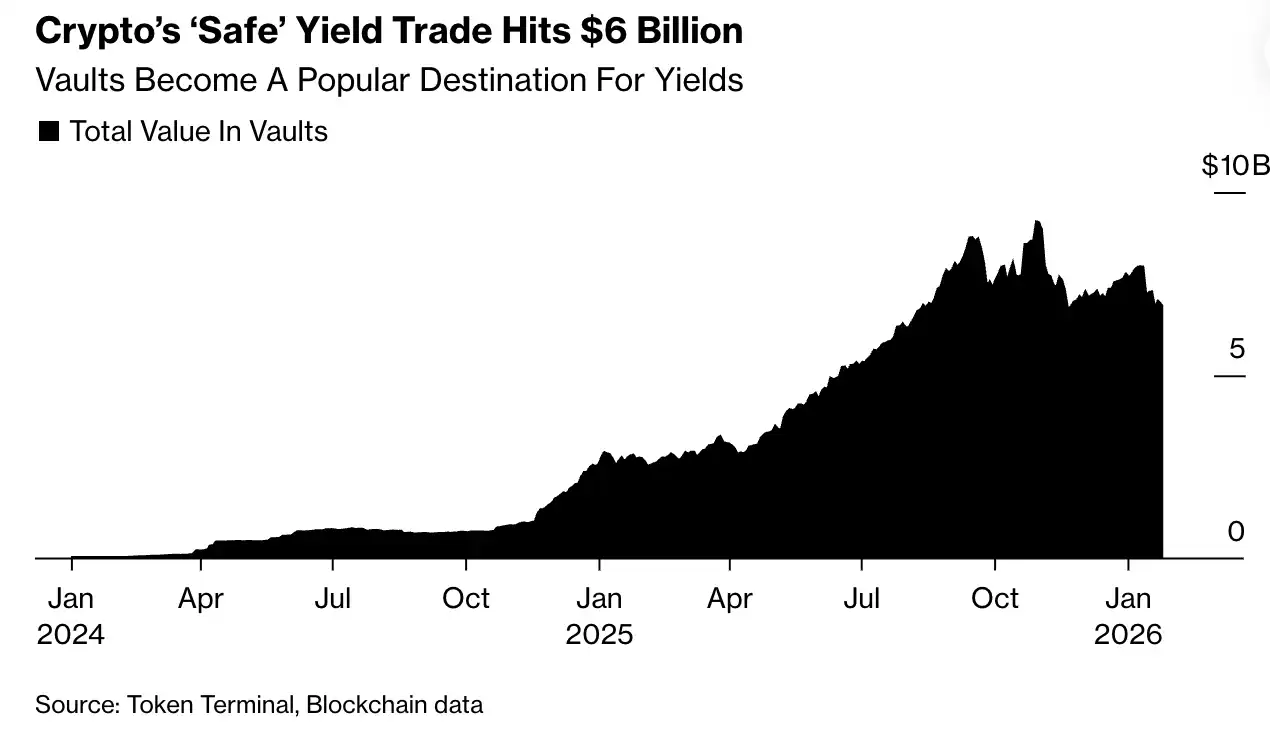
At a basic level, Vaults allow users to deposit cryptocurrency into shared pools, and these funds are deployed into lending or trading strategies designed to generate returns. The difference with Vaults lies in how they are marketed: they are promoted as a clean break from the opaque lending platforms of the past. Deposits are non-custodial, meaning users never hand over their assets to a company. Funds are held in smart contracts that automatically deploy capital according to pre-set rules, with key risk decisions clearly visible on the blockchain. Functionally, Vaults resemble a familiar component of traditional finance: pooled funds converted into yield and providing liquidity.

But their structure is distinctly crypto. This all happens outside the regulated banking system. Risk is not buffered by capital reserves or overseen by regulators—it is embedded in software, where algorithms automatically rebalance positions, liquidate collateral, or unwind trades as markets move, automating losses.

In practice, this structure can produce mixed results, as curators (the companies that design and manage Vault strategies) compete on returns, and users find themselves navigating just how much risk they are willing to bear.

"Some players will do a terrible job," said Paul Frambot, co-founder of Morpho, the infrastructure behind many lending Vaults. "They might not survive."

For developers like Frambot, this churn is less a warning sign and more a feature of an open, permissionless market—where strategies are tested in the open, capital flows quickly, and weaker approaches are replaced over time by stronger ones.

The timing of its growth is no accident. With the passage of the "Genius Act," stablecoins are moving into the financial mainstream. As wallets, fintech apps, and custodians race to distribute digital dollars, platforms face a common problem: how to generate yield without putting their own capital at risk.

Vaults have emerged as a compromise. They offer a way to manufacture yield while technically keeping assets off a company's books. Think of it like a traditional fund—but without handing over custody or waiting for quarterly disclosures. This is how curators pitch the model: users retain control of their assets while gaining access to professionally managed strategies that run automatically on-chain.

"The curator's role is similar to a risk and asset manager, like what BlackRock or Blackstone does for the funds and endowments they manage," said Tarun Chitra, CEO of crypto risk management firm Gauntlet, which also operates Vaults. "But, unlike BlackRock or Blackstone, it's non-custodial, so the asset manager never holds the user's assets; the assets are always in the smart contract."

This structure is designed to correct recurring weaknesses in crypto finance. In previous cycles, products marketed as low-risk often hid borrowed money, reused client funds without disclosure, or relied heavily on a handful of fragile partners. The algorithmic stablecoin TerraUSD offered yields nearing 20% by subsidizing returns. Centralized lenders like Celsius quietly parked deposits in high-risk bets. When markets turned, the damage spread quickly—and without warning.

Most Vault strategies today are more restrained. They typically involve floating-rate lending, market making, or providing liquidity to blockchain protocols, rather than pure speculation. The Steakhouse USDC Vault is one such example, lending stablecoins against what it describes as blue-chip cryptocurrencies and tokenized real-world assets (RWAs), offering a return of about 3.8%. Many Vaults are deliberately designed to be "boring": their appeal lies not in outsized returns, but in the promise of earning yield on digital cash without handing over custody or making users creditors of a single company.
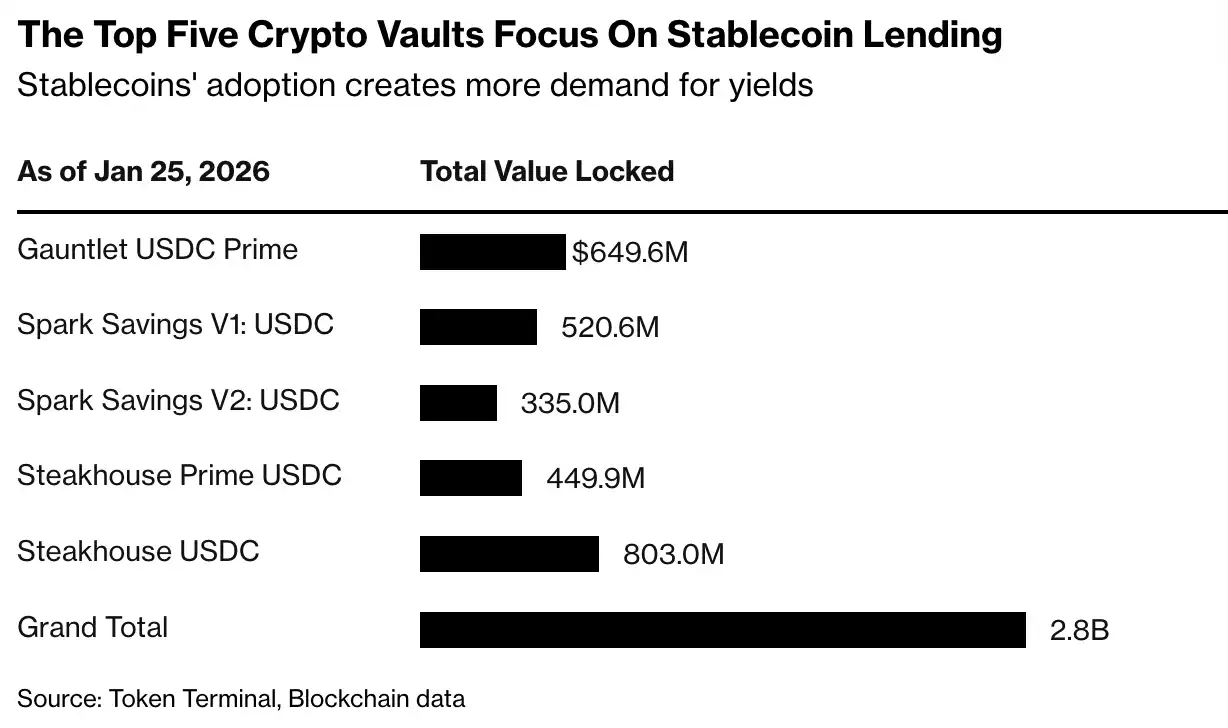
"People want yield," said Jonathan Man, portfolio manager and head of multi-strategy solutions at Bitwise, which just launched its first Vault. "They want their assets to be productive. Vaults are just another way to do that."

Vaults could also gain more momentum if regulators move to ban paying yield directly on stablecoin balances—a suggestion floated in market structure legislation. If that happens, the demand for yield won't disappear; it will just shift.

"Every fintech company, every centralized exchange, every custodian is talking to us," said Sébastien Derivaux, co-founder of Vault curator Steakhouse Financial. "Traditional finance companies too."

But this restraint isn't hard-coded into the system. The pressure shaping the industry comes from competition, not technology. As stablecoins proliferate, yield becomes a primary tool for attracting and retaining deposits. Underperforming curators risk losing capital, while those offering higher returns attract more inflows. Historically, this dynamic has pushed non-bank lenders—both in crypto and elsewhere—to loosen standards, add leverage, or shift risk off-platform. This shift has already touched large consumer-facing platforms. Crypto exchanges Coinbase and Kraken have both launched products giving retail customers access to Vault-like strategies, advertising yields as high as 8%.

Transparency, in sum, can be misleading. Public data tools and visible strategies build confidence—and confidence attracts capital. But once money is in place, curators face pressure to deliver returns, sometimes by reaching into off-chain deals that are difficult for users to assess.

Stream Finance later exposed this breaking point; the platform had advertised returns as high as 18%, then reported significant losses related to an unnamed external fund manager. The event triggered a sharp pullback across the Vault industry, with total assets falling from a peak near $10 billion to around $5.4 billion.

Proponents of the model say Stream was not representative. Stream Finance did not respond to a request for comment sent via X private message.

"Celsius, BlockFi, all of these, even Stream Finance, I kind of lump them all together as failures of disclosure to the end user," said Bitwise's Man. "People in crypto always focus more on what the upside might be and less on what the downside risk is."

That distinction may matter for now. Vaults were built in response to the last wave of failures, with the explicit goal of making risk visible rather than hidden. The open question is whether transparency alone is enough to constrain behavior—or whether, as in previous cases of shadow banking, a clearer structure just makes it easier for investors to tolerate risk until the music stops.

"At the end of the day, it's about embracing transparency, but it's also about having proper disclosures for any type of product—DeFi or non-DeFi," Man said.


Пов'язані питання

QWhat is the Vault model in crypto and how does it claim to be different from previous centralized lending platforms?

AThe Vault model allows users to deposit crypto into shared pools that are invested in lending or trading strategies to generate yield. It is marketed as a break from opaque, centralized lending platforms by being non-custodial (users never hand over assets to a company), using smart contracts with pre-set rules for automatic capital deployment, and making key risk decisions visible on the blockchain.

QAccording to the article, what is the predicted growth for assets under management in Vaults by 2026?

ACrypto asset management firm Bitwise predicts that the assets under management in Vaults could double by the end of 2026, driven by growing demand for stablecoin yield.

QWhat major event caused a significant withdrawal from the Vault industry, and what was the approximate amount involved?

AThe collapse of Stream Finance, which caused approximately $93 million in user losses, triggered a sharp withdrawal from the Vault industry, with total assets falling from a peak of nearly $10 billion to around $5.4 billion.

QHow does the article describe the potential risk or pressure that Vault curators face despite the transparent structure?

AThe pressure comes from competition rather than technology. Curators face the risk of losing capital if they underperform, which can push them to relax standards, increase leverage, or move risk off-platform to deliver higher returns and attract more inflows, similar to dynamics in traditional non-bank lending.

QWhat role does the 'Genius Act' play in the context of the growing Vault model?

AThe passage of the 'Genius Act' is helping to push stablecoins into the financial mainstream. As wallets, fintech apps, and custodians race to distribute digital dollars, Vaults offer a compromise solution for generating yield without taking the platform's own capital onto its balance sheet, thus meeting the demand for yield while technically keeping assets off the company's books.

Пов'язані матеріали

STAR 50 Soars 10.73%, Why Did A-Shares Stage a "V-Shaped Reversal"?

After a prolonged decline, the Chinese A-share market staged a strong rally on July 21. The STAR 50 index surged 10.73%, its largest single-day gain in nearly a year, leading a broad-based "V-shaped" reversal. The Shanghai Composite Index rose 1.79%, the Shenzhen Component Index gained 4.81%, and the ChiNext Index jumped 7.05%. Total market turnover reached 2.97 trillion yuan, an increase of 256.1 billion yuan from the previous session, with over 3,100 stocks advancing. The semiconductor sector spearheaded the rebound, with related ETFs posting significant gains. Analysts attribute the surge to three converging factors. First, coordinated capital inflows from "national team" institutions, insurance funds, listed company buybacks, and fund house self-purchases have bolstered market liquidity and confidence. Second, supportive policy signals, including commitments from regulators to ensure stable market operations, provided a favorable backdrop. Third, a stabilization and recovery in overseas markets, notably South Korea, created a positive external environment. Institutions suggest the most severe panic selling phase for the tech sector has likely passed, following a significant digestion of crowded positions and leveraged funds. While short-term volatility may persist, the medium to long-term outlook remains underpinned by enduring trends like AI computing demand expansion and semiconductor localization. The market's focus now shifts to the sustainability of supportive fund flows, earnings reports, and upcoming catalysts from the global AI industry chain.

marsbit31 хв тому

STAR 50 Soars 10.73%, Why Did A-Shares Stage a "V-Shaped Reversal"?

marsbit31 хв тому

U.S. Tech Momentum Stocks Post Largest Single-Day Gain Ever, But Is the Plunge Over?

US tech momentum stocks staged a sharp rebound on Tuesday (July 21st). Morgan Stanley's TMT Momentum Factor surged over 12%, marking its largest single-day gain on record, exceeding even peaks from the 2000 dot-com bubble. Key momentum indices from Goldman Sachs also posted their strongest daily performances in years. The rally was led by semiconductors, with the Philadelphia Semiconductor Index jumping 4.6%. This rebound followed three consecutive down days and a cumulative 33% plunge in momentum stocks, one of the steepest drawdowns since the dot-com era. Analysts attribute the surge largely to a short squeeze. Heavy selling had pushed high-beta momentum stocks into deeply oversold territory, forcing many short sellers, particularly in Asia, to cover their positions, creating a self-reinforcing buying spiral. However, the rebound's internals appear weak. Trading volume was notably low, and advancing stocks still lagged decliners on the S&P 500, indicating a narrow, concentrated rally rather than broad market participation. Diverging views emerge on the outlook. BTIG warns the bounce has hit key resistance and recommends selling into strength, citing extreme volatility and historical parallels to past market tops. Conversely, Goldman Sachs and UBS believe the momentum unwind is nearing its end, suggesting it may be time to gradually add exposure, as positioning has been significantly reduced. They caution, however, that high volatility warrants a measured approach, potentially using defined-risk strategies. The upcoming earnings season, particularly reports from major tech firms like Alphabet, is seen as a critical test for the rally's sustainability. Simultaneously, bond markets flashed a warning, with yields rising partly due to spiking oil prices. Analysts note that if long-term Treasury yields break decisively higher, it could pose a significant headwind for equities, especially growth stocks.

marsbit38 хв тому

U.S. Tech Momentum Stocks Post Largest Single-Day Gain Ever, But Is the Plunge Over?

marsbit38 хв тому

U.S. Tech Momentum Stocks Record Largest Single-Day Gain Ever, but Has the Rout Ended?

U.S. tech momentum stocks staged a dramatic rebound on Tuesday, July 21st. Key momentum indices like the Morgan Stanley TMT Momentum Factor and Goldman Sachs' High Beta Momentum Long Index posted historic or near-historic single-day gains, fueled largely by semiconductor stocks. This sharp rally followed a severe three-day sell-off that saw momentum stocks plunge 33%, marking one of the steepest pullbacks since the dot-com bubble. Analysts attribute the bounce primarily to a short squeeze, as forced covering from over-leveraged traders, particularly in Asia, created a buying spiral. However, the rally's health is questioned due to weak market breadth—overall trading volume was low, and decliners outnumbered advancers in the S&P 500 despite the index's gain—suggesting a narrow, concentrated surge rather than broad recovery. Opinions on the sustainability diverge. BTIG strategists warn the rebound has hit key resistance levels, citing extreme volatility and historic stock dispersion as signs of an ongoing broader correction, and recommend selling into strength. Conversely, Goldman Sachs and UBS view the aggressive momentum unwinding as nearing its end, noting reduced positioning and a lack of new fundamental catalysts. They suggest the sell-off presents a selective opportunity to add exposure, albeit cautiously and gradually using defined-risk strategies. The immediate trajectory hinges on the ongoing earnings season, with market focus on Alphabet's capital expenditure guidance for AI investment clarity. Meanwhile, bond markets present a risk, with rising Treasury yields—potentially heading toward 5.5%—and widening credit spreads for mega-cap tech companies posing a threat to equity valuations. The combination of technical factors, earnings results, and macro conditions leaves the durability of the rebound in doubt.

链捕手41 хв тому

U.S. Tech Momentum Stocks Record Largest Single-Day Gain Ever, but Has the Rout Ended?

链捕手41 хв тому

Long-Divided Must Unite, Long-United Must Divide: When L1 Becomes Its Own Rollup, What Is Ethereum's Endgame?

"The Inevitable Cycle: When L1 Becomes Its Own Rollup – What is Ethereum's Endgame?" For years, the Ethereum community grappled with concerns that L2s were fragmenting the ecosystem and eroding L1's value. While L2s provided cheaper execution, they also splintered liquidity and the unified user experience of a single chain. This has prompted a fundamental reassessment of the relationship between L1 and L2. Ethereum's roadmap is evolving. The "Scale" initiative merges L1 and L2 expansion into a holistic framework. L1 itself is advancing with higher gas limits, statelessness, and zkEVM verification, no longer content to be just a low-throughput settlement layer. Consequently, the primary value proposition of L2s is shifting from merely providing cheap blockspace to offering L1 cannot easily provide: application-specific optimizations, privacy features, and flexible governance models. L2s are becoming a spectrum of execution environments with varying degrees of security inheritance from Ethereum. A critical challenge in this multi-chain future is interoperability. The vision is to make Ethereum "feel like one chain again." This relies on advancements in native account abstraction (like EIP-7702) and intent-based architectures (Open Intents Framework), where users declare desired outcomes, and solvers handle the complex cross-chain execution. Furthermore, shortening Ethereum's finality time from minutes to seconds is crucial, as it underpins trust between chains for bridges, stablecoins, and cross-chain applications. Perhaps the most provocative idea is that Ethereum L1 itself could become a form of "its own Rollup." As zkEVM and proof systems mature, high-performance nodes could execute transactions and generate validity proofs. Regular validators would then verify these proofs instead of re-executing all transactions. This blurs the traditional L1/L2 hierarchy, making "Rollup" more of a general execution-verification architecture. Native Rollup aims to integrate L2 validation more directly into the Ethereum protocol, allowing L2s to inherit L1's security more fully and move away from reliance on security councils. In the end, L2s are not destined to replace L1 or be made obsolete by it. The likely future is a unified system where diverse execution environments—each optimized for specific use cases like DeFi, gaming, or privacy—coexist. They will share a common foundation of security, liquidity, and verifiable state, seamlessly connected to restore a cohesive user experience. The next phase for Ethereum is not just about scaling through separation, but about intelligently reintegrating what was separated back into a coherent whole.

链捕手57 хв тому

Long-Divided Must Unite, Long-United Must Divide: When L1 Becomes Its Own Rollup, What Is Ethereum's Endgame?

链捕手57 хв тому

Торгівля

Спот
活动图片




