The 4 Truths and Fee Traps Behind Polymarket's LP Market Making Incentives

marsbitОпубліковано о 2026-03-22Востаннє оновлено о 2026-03-22

Анотація

Polymarket, a prediction market platform, has recently shifted its focus to incentivizing liquidity providers (LPs) to address its core issue of low liquidity. While most markets remain free, it now charges a taker fee on specific markets like crypto price movements and select sports events. This fee, highest near 50% probability, funds new LP reward programs. There are two primary reward systems: one pays LPs when their limit orders are executed (maker rewards), and another rewards simply for placing orders within a set spread to provide liquidity, even if they don't get filled. A third mechanism allows anyone to sponsor additional incentives for specific markets. A positive view argues this structure values genuine liquidity over mere trading volume, making fees earned and rewards received a potential key, anti-sybil metric for a future POLY token airdrop. It rewards users who improve market depth and stability. A contrasting, negative view claims the LP program is a "trap." Critics argue that professional market makers avoid it due to insider trading risks and that most LPs are actually losing money due to hidden "LP wear and tear" (impermanent loss), only participating based on speculation of a valuable airdrop. They warn that if Polymarket expands fees to fund these unsustainable rewards, it could lose its competitive edge of zero fees and better odds compared to traditional sportsbooks. Proposed solutions include a fixed fee only on profits, using a native POLY pool ...

Original Author:shtanga0x&securezer0

Compiled by | Odaily Planet Daily (@OdailyChina)

Translator | Wenser (@wenser2010)

Editor's Note: Recently, posts about Polymarket's LP incentives for the NCAA "March Madness" have almost flooded the timeline on platform X. At the same time, official Polymarket members hinted at a major announcement next Monday, with community speculation pointing towards funding or a token launch.

After the U.S. SEC and CFTC cleared the obstacle for airdrops on crypto platforms using the Howey test, POLY has become the "last hope for airdrop farming" in the eyes of many, and LP market making might become one of the key metrics for the airdrop.

In light of this, Odaily Planet Daily will use the opposing views of two analysts on LP market making incentives to provide Polymarket users with a more comprehensive perspective. The following is the compiled content, with some information edited.

Positive View: The 4 Major Categories Behind Polymarket's LP Incentive Program

Recently, Polymarket's incentive mechanism underwent a low-key upgrade, shifting its focus to Liquidity Providers (LPs). For the past few years, the platform has maintained a "zero trading fee" strategy, but since the beginning of this year, it has quietly introduced fees for specific prediction markets and launched two major market maker reward programs.

On the surface, charging trading fees seems unfavorable for trading users, but in reality, it addresses the core structural pain point of prediction markets—the liquidity problem.

The new fee structure aims to fund incentive programs, rewarding users who provide limit orders and maintain order book depth. Therefore, both Polymarket and its users benefit from: narrower spreads, richer order books, and a better trading experience—especially in high-frequency crypto markets.

Its rollout path is also very clear, showing a trend from single to multiple:

  • January 2026: 15-minute Crypto markets
  • February 2026: Expanded to 5-minute Crypto markets + NCAAB college basketball + Serie A football
  • March 6, 2026: Expanded to all Crypto markets (covering 1H, 4H, daily, weekly events, etc.)

Based on the above information, this article will detail how the new fee and reward system works—and why fees paid + rewards earned could become a potential anti-sybil indicator in the POLY airdrop. This is not a simple monetization operation; it's Polymarket showing through action that what it truly wants is liquidity, not volume-bot farming.

Part I. Complete Analysis of the New Taker Fee Mechanism

The vast majority of Polymarket markets remain completely free. Deposits, withdrawals, and trading (for most event markets) still have zero platform fees.

Trading fees currently only apply to the taker side (taker orders) and cover three types of markets:

  • All Crypto up/down markets (15min, 5min, 1H, 4H, daily, weekly, etc.)
  • NCAAB (US College Basketball League)
  • Serie A (Italian Football League)

The key point is that taker fees only take effect for markets created after the fee activation date; existing prediction events created previously are not affected.

The fee formula is uniform (where C = number of shares traded, p = share price/market probability, fees rounded to 4 decimal places, minimum fee is 0.0001 USDC):
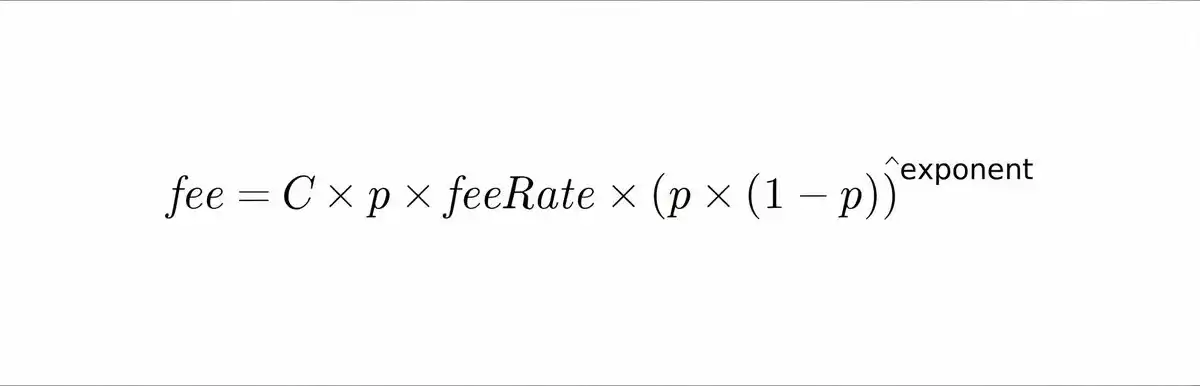
The effective fee rate follows a symmetric probability curve:

  • Fees are highest when the probability is near 50% (highest outcome uncertainty);
  • Fees approach 0 when the probability is near 0 or 1 (higher outcome certainty).

For example, for a $100 trade in a Crypto market:

  • p=0.50 → trading fee ≈ $0.44;
  • p=0.10 or 0.90 → trading fee ≈ $0.02.

The probability curve for sports events is similar, but the midpoint fee (around 50% probability) is slightly higher. The fee direction is specifically:

  • Buy: Fee deducted from the share quantity;
  • Sell: Fee deducted from the USDC funds;
  • Market making incentives are paid in USDC.

It is worth mentioning that the Polymarket platform does not keep the entire fee pool; a fixed percentage of the fees (20% for Crypto markets, 25% for sports prediction events) is directly returned to LPs. (Note: Polymarket's US compliant platform uses a simple fixed fee of 0.01%. This analysis only discusses the global CLOB platform, which introduced the new fee system in 2026.)

Part II. Market Maker Incentive Program (Limit Order Execution Rewards)

Incentives in this section only cover markets where taker fees are collected. This means only limit orders that are executed (taken) by traders are eligible for corresponding rewards; simply placing an order without execution does not count.

The reward amount uses the same calculation method as the taker fee. Each participant's reward is proportional to their trading volume, and the total prize pool consists of a portion of the collected fees (20% for Crypto markets, 25% for sports prediction events).

Competition occurs only within specific prediction events; LP orders only compete with other LPs in the same liquidity pool for that event.

Daily incentives are sent directly in USDC to the corresponding wallet address.

Part III. Liquidity Incentives (Resting Order Incentives)

The second incentive system is provided by the Polymarket platform and applies to all prediction events (including those without fees).

The core difference is: Order execution is NOT required; you can earn money just by placing orders on the order book to provide liquidity.

Each prediction event defines several parameters that determine eligibility:

  • Maximum incentive spread (e.g., ±4 cents)
  • Minimum order size
  • Daily total reward pool

The platform samples the order book every minute, recording 10,080 snapshots per week.

The reward calculation formula is highly detailed:

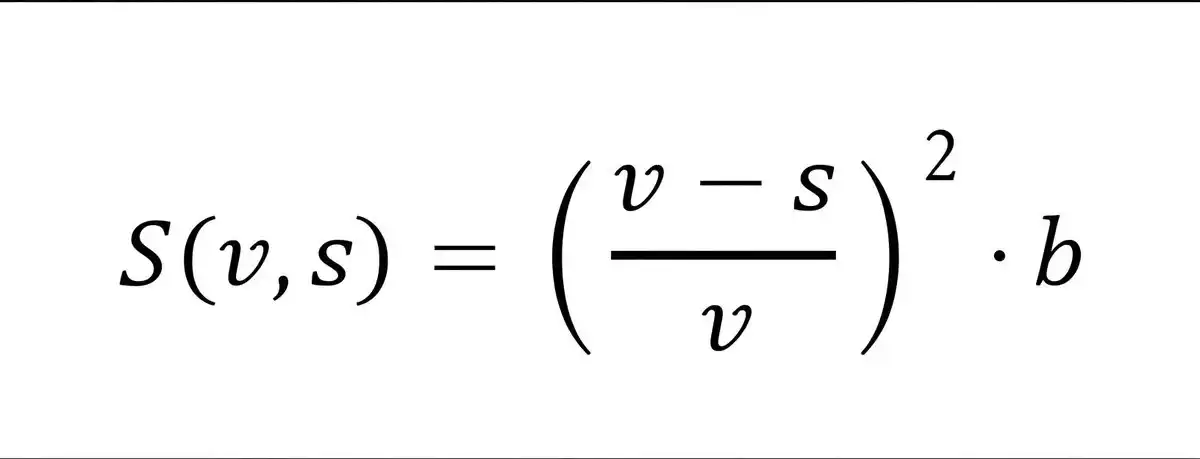
1. Distance Score (Quadratic Equation)

Where,

V - Maximum incentive spread

s - Distance from the midpoint

Orders closer to the midpoint score exponentially higher.
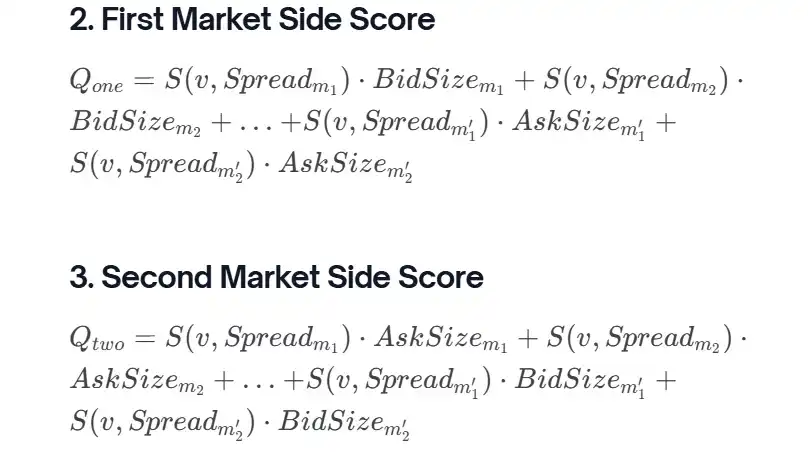
2. Two-Sided Score (YES/NO Complementary Structure)

Bid and ask orders are scored separately, considering the complementary structure of Yes/No markets.
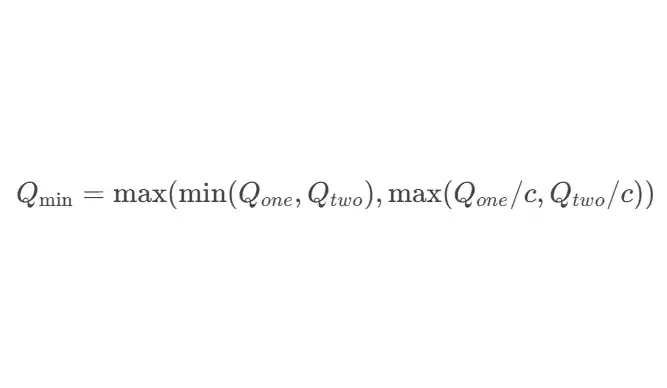
3. Q-value Minimization Adjustment

Providing liquidity on both sides of the order book scores higher points for the prediction event.

One-sided quoting is penalized unless the market probability is near 0 or 1.
4. Final Score

All LP scores are normalized and aggregated over time to determine each participant's proportional share of the market's reward pool.

Rewards are distributed in USDC at UTC midnight, with a minimum payout of $1.
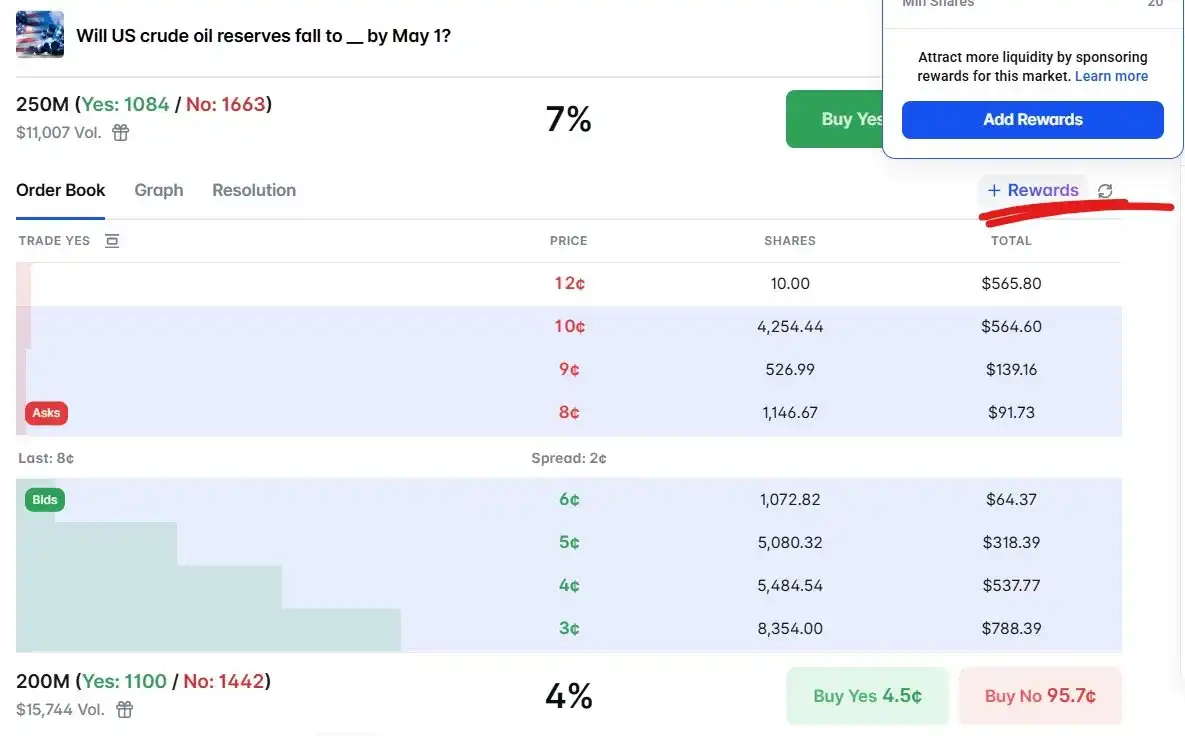
Active reward prediction events and personal earnings can be viewed in real-time at polymarket.com/rewards. The incentive spread range is highlighted in blue on the order book interface. Users can also check the Polymarket official documentation.

Currently, one-sided orders can still earn points (but at a significant discount), while two-sided quoting is prioritized for incentive points. Rewards are calculated separately for each individual prediction event. There is no cross-event calculation. Effectively, the system rewards traders who maintain tight spreads and balanced liquidity near the market midpoint, enhancing the trading experience for all users.

Part IV. Sponsored LP Incentives

The third mechanism allows anyone to directly add LP incentives to specific markets using USDC, attracting LPs to provide market making. Sponsors can add or withdraw funds at any time; unused funds are automatically returned.

The rules of this mechanism are completely consistent with the Liquidity Incentive Program—just place orders, no execution required.
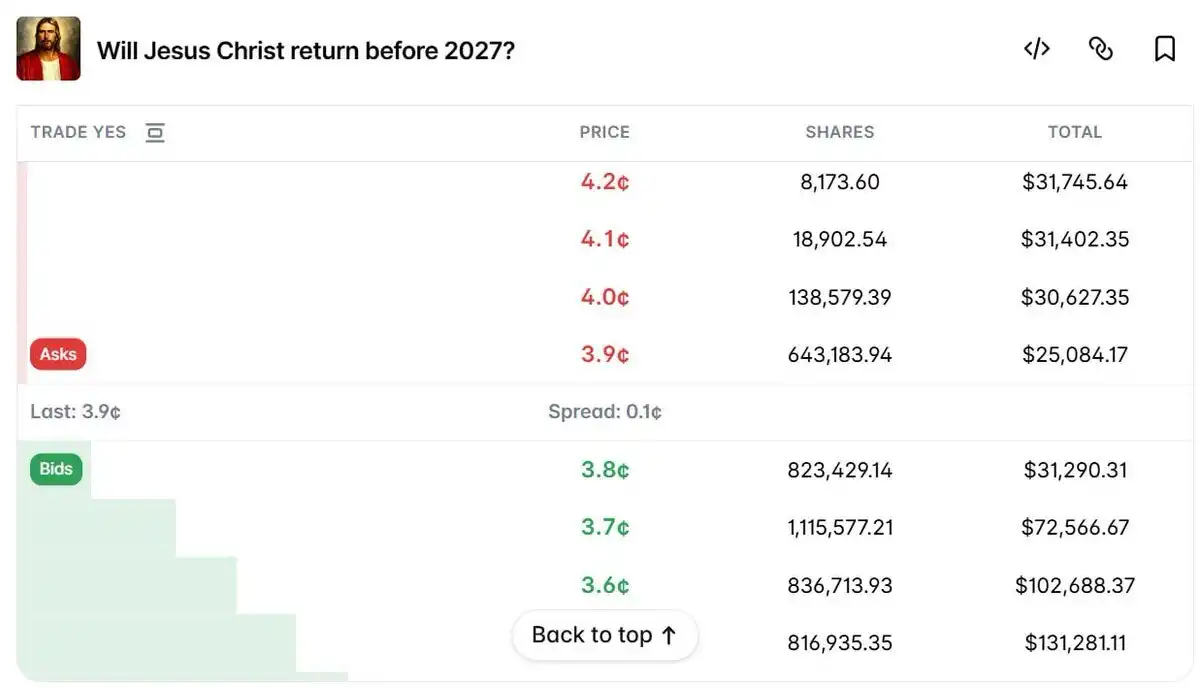
A typical case is the prediction event "Will Jesus Christ return by 2027?". A platform user invested $70,000 as an LP incentive in February and now receives about $57 per day in liquidity incentives, making this event one of the deepest markets on the platform. This mechanism allows the community itself to deeply activate market liquidity for any prediction event without waiting for official Polymarket action.

Part V. The Strongest Anti-Sybil Indicator for the POLY Airdrop

At first glance, Polymarket seems to just need more traders.

However, if most users rely solely on market orders, the platform will quickly face liquidity problems.

Polymarket does not rely on centralized market makers, so if limit orders are insufficient, the order book becomes sparse.

In this situation, it is difficult to avoid high slippage and sudden fee increases when buying, selling, or executing large orders.

Polymarket doesn't need volume-bots; it needs LPs who provide real value.

Previously, everyone only focused on trading volume, thinking high volume was the key to getting the airdrop. However, the new fee structure and reward program suggest a different incentive model—what matters is not just volume, but participation in fee-generating prediction events that need liquidity. In other words, the platform rewards targeted LP activity, not just passive limit orders.
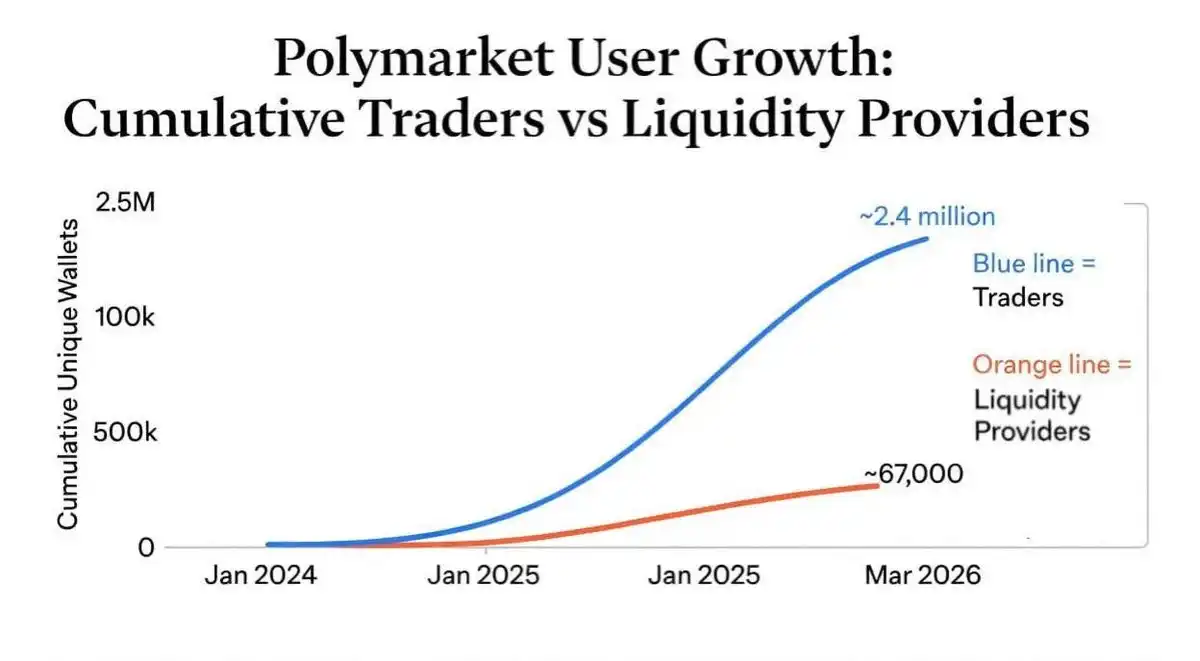
The reward distribution formula effectively reveals the type of liquidity Polymarket values most. The scoring system evaluates:

  • Proximity of the order to the midpoint
  • Order size
  • Balance between bid and ask prices

Therefore, rewards become a direct measure of a trader's value to the platform's liquidity. If a trader consistently earns rewards, it means their orders are actively improving market liquidity and execution quality. Here are examples of potential incentives for market participants:

  • Will Arctic sea ice reach its maximum extent this winter?—Existed for 3 months, volume less than $20k, liquidity reward only $9;
  • Will Bitcoin reach $75,000 in March?—Existed for two weeks, volume reached $3 million, liquidity reward $142;
  • Bitcoin Up/Down - 15 minutes Covers hundreds of prediction events, daily trading volume millions of dollars, average daily fees ~$10k, liquidity reward $2000.

More important than specific prediction events is the truth revealed by the data—taker fees and earned liquidity rewards are harder to manipulate artificially compared to simple volume metrics. Systematically earning market making incentives requires capital, risk management, and constant presence, which significantly削弱 (weakens) the advantage of airdrop farmers and instead benefits genuine market participants.

Conclusion: Taker Fees and LP Incentives May Become Key Metrics for POLY Airdrop

Future POLY token distribution may depend not only on trading volume but also on taker fees paid and LP rewards earned. These metrics are transparent, measurable, and highly aligned with platform needs. In this model, rewards are not tied to farming volume but to contributions that truly optimize the platform's trading experience: liquidity, stability, and efficient price discovery.

In other words, the best performing LPs are the most valuable users. The most hardcore Polymarket players were never the ones with the highest trading volume, but the LPs who provide the deepest order book liquidity.

Also attached is a Polymarket LP market making guide: 《Now is the Best Time to Interact with Polymarket (Exclusive Tutorial)》

Of course, there are always different views in the market. Some believe that Polymarket's LP incentive program appears to be "spending money to buy liquidity" but is actually profiting from it, setting a trap for LP users. Let's hear the opposing view.

Opposing View: Is Polymarket's LP Incentive a Platform Scam? Are LPs Actually a "Pay-to-Lose" Trap?

Regarding Polymarket's recently launched LP incentive program, arbitrage trader and Polymarket/Kalshi bot player securezer0 directly called the much-hyped "Polymarket Rewards Farming" within the circle a massive psychological warfare operation, pointing out that it is a collective hype campaign paid for directly by the platform or heavily incentivized KOLs.

The Truth for LPs: Another Form of "Paying to Lose Money"?

Multiple LPs stated bluntly: The current LP mechanism on Polymarket is essentially "spending money to incur losses".

Where is the problem? The leaderboard directly incorporates LP rewards into the P&L data display but remains silent on a key concept—LP wear and tear (impermanent loss).

When your position gets filled on one side, it often cannot be sold at a reasonable price, or cannot be sold at all before the event resolves. This part of the capital loss is systematically hidden by the platform. The real ROI data is much lower than the book value. For most LP participants, the profit is actually negative. They just believe the POLY airdrop will cover the losses—this is not an arbitrage incentive program; it's a trade based on platform faith.

Why Are Professional Market Makers Reluctant to Enter?

Professional market makers generally avoid Polymarket LP market making for one core reason: Insider trading risk is real.

Both Polymarket and Kalshi had to offer equity in exchange for liquidity to get professional market makers to the table—this in itself speaks volumes.

Effective LP operation is an extremely complex automated risk control system. The myth of "low barrier to entry, high returns" for LPs only holds true if Polymarket continues to heavily subsidize liquidity rewards—a path that is fundamentally unsustainable in the long run.

The Platform's Real Dilemma: Needing to "Create" Millions of Dollars Out of Thin Air Daily

Insufficient liquidity is the primary driver behind Polymarket gradually turning on the fee switch.

To maintain liquidity rewards for various prediction events and keep more USDC liquidity on the platform, Polymarket needs to consume millions of dollars daily to maintain trading depth. If a better solution cannot be found, the platform has no choice but to charge fees on every buy and sell, using this revenue to support investors and market makers.

Once fees are fully implemented, ordinary users will be in an extremely awkward position—because traditional sports betting platforms might actually be more cost-effective, for the following reasons:

  • Odds are comparable after factoring in fees;
  • Traditional platforms offer cashback and monetary incentives;
  • Rules are clear and regulated;
  • Insider traders face account bans and even prison risks.

3 Viable Solutions: Fixed Fees on Profit, POLY Liquidity Pools, Extended Product Fees

Instead of seeking a quick fix that worsens the situation, it's better to address the root cause: Target the vampires, not the users. Charge fees on the arbitrage bots that extract USDC from real users. After all, these bots are the source of polluted liquidity. Specifically, the methods are:

Charge a fixed 1% fee only on profits, i.e., only on the net gain (sell price minus cost basis), not touching the principal, thus not harming the user trading experience.

Build a native liquidity pool with POLY tokens. Provide liquidity programmatically at the protocol level for various prediction events, deeply binding token economics with liquidity provision.

Charge on extended products, not the core product. Parlays, derivatives, leverage—these are natural fee scenarios; touching these won't damage the fundamental user experience.

Currently, the moat of Polymarket's platform business still needs strengthening. Zero fees and better odds are its most important value anchors区别于 (differentiating it from) traditional betting platforms. Abandoning these two points for short-term revenue is tantamount to self-sabotage.


Пов'язані питання

QWhat are the four main categories of Polymarket's LP incentive programs as described in the article?

AThe four main categories are: 1. The new taker fee mechanism, 2. The market maker incentive program (limit order execution rewards), 3. The liquidity incentive (idle order rewards), and 4. The sponsored LP incentive.

QAccording to the opposing view, why might professional market makers be hesitant to participate in Polymarket's LP program?

AProfessional market makers are hesitant due to the real risk of insider trading. The article states that Polymarket and Kalshi had to offer equity in exchange for liquidity to attract professional market makers, indicating the inherent challenges and risks in the market structure.

QWhat is the core structural problem that Polymarket's new fee structure aims to solve?

AThe new fee structure aims to solve the core structural problem of liquidity in prediction markets. The fees are designed to fund incentive programs that reward users who provide limit orders and maintain order book depth.

QWhat does the opposing view claim is the true nature of being an LP on Polymarket, despite the visible rewards?

AThe opposing view claims that being an LP is essentially 'paying to lose money.' The visible rewards on leaderboards mask the critical concept of 'LP wear and tear' or losses incurred when positions are filled on one side and cannot be sold at a reasonable price before market resolution, often leading to a negative real ROI.

QWhat alternative solutions does the opposing view propose for Polymarket instead of charging taker fees?

AThe opposing view proposes three alternative solutions: 1. Charge a fixed 1% fee only on profits (net gains from selling price minus cost basis), 2. Build a native liquidity pool with the POLY token to programmatically provide liquidity, and 3. Charge fees on extended products like parlays, derivatives, and leverage instead of the core betting markets.

Пов'язані матеріали

If the AI Bubble Is Already Bursting, Who Will Truly Survive?

If the AI Bubble is Bursting, Who Will Remain? The debate over an AI bubble is intensifying, with figures like Ray Dalio warning of high levels and Jensen Huang seeing immense, early-stage opportunity. Both views hold truth: a speculative bubble in capital markets likely exists, mirroring the dot-com era, but the underlying technological shift is real and transformative. History shows that while bubbles burst—wiping out overvalued companies and speculative capital—they often leave behind critical physical and digital infrastructure. The dot-com bust, for instance, eliminated many firms but left the global fiber optic networks and data centers that enabled the rise of Amazon, Netflix, and cloud computing. Today's massive AI infrastructure investments (projected at trillions by 2030) in data centers, power, cooling, and GPUs may follow a similar path, creating the foundation for future applications. A key divergence from past bubbles is the "Jevons Paradox" effect in AI. As the cost of AI inference has plummeted by over 99.7% since 2023, enterprise spending on AI has skyrocketed. Cheap "tokens" have unlocked vast, previously uneconomical use cases, moving AI from simple chatbots into core business workflows—code generation, legal document review, scientific simulation, and financial analysis. The market is now in a phase of self-correction, weeding out superficial "API-wrapper" startups, but this cleansing process strengthens the ecosystem. The long-term trajectory is clear. The value is gradually shifting from capital expenditure (CapEx) on hardware to operational expenditure (OpEx) on transformative applications. As AI becomes a utility, the winners will be firms that deeply integrate it to solve vertical industry problems in law, healthcare, finance, and manufacturing. The泡沫 will recede, but the foundational shift towards an AI-powered era across all sectors is irreversible. The underlying productive force of AI contains no bubble.

marsbit29 хв тому

If the AI Bubble Is Already Bursting, Who Will Truly Survive?

marsbit29 хв тому

If the AI Bubble Is Already Bursting, Who Will Truly Remain?

**Summary: If the AI Bubble is Bursting, What Will Remain?** The debate around an AI bubble is intensifying, with figures like Ray Dalio warning of high valuations while Jensen Huang sees immense opportunity. This echoes the dot-com bubble, which saw massive wealth destruction but ultimately left behind critical infrastructure like undersea cables and broadband, enabling future giants like Amazon and Netflix. Similarly, today's AI boom involves trillions invested in data centers, power, cooling, and GPUs, while application-layer revenue remains comparatively modest. This investment-disparity signals a bubble. However, the core technological progress is real and accelerating. AI inference costs have plummeted by over 99.7% since 2023, making intelligence increasingly cheap and accessible. This cost collapse is unlocking vast new demand. Instead of reducing spending, enterprises are tripling their AI cloud expenditure. Cheap "tokens" enable AI to move beyond simple chatbots into complex workflows—automating code writing, legal document review, financial analysis, and scientific research. This follows "Jevons's paradox": improved efficiency leads to greater total consumption. The market is now undergoing a necessary purification, weeding out "API-wrapper" startups with no real moat. The deeper evolution involves a shift from capital expenditure (CapEx) on infrastructure to operational expenditure (OpEx) on value-creation in applications. While hardware vendors currently profit most, long-term value will migrate to AI-native firms solving vertical industry problems. Ultimately, a market correction will cleanse speculative excess but will not reverse the AI+ trend. The massive physical and algorithmic infrastructure being built will endure, becoming a cheap, utility-like foundation. Just as the internet became indispensable to all industries post-2000, AI is poised to empower and redefine every sector, moving society irreversibly toward an intelligence-augmented era. The bubble may burst, but the underlying productive momentum is solid.

链捕手36 хв тому

If the AI Bubble Is Already Bursting, Who Will Truly Remain?

链捕手36 хв тому

Microsoft CEO: In the AI Era, How Do You Define a Company's Moat?

Microsoft CEO Satya Nadella argues that in the AI era, a company's true competitive edge, or "moat," is not determined by choosing the single most powerful model, but by its ability to build a continuous "learning loop." This system integrates and evolves by connecting human workflows, domain expertise, organizational judgment, and employee experience. He posits that future companies will accumulate two types of capital: Human Capital (employee knowledge, judgment, creativity) and "Token Capital" (a firm's own built and owned AI capabilities). Importantly, AI amplifies rather than devalues human capital. Human direction is essential to guide progress, as computational power alone is aimless. The core opportunity lies in creating a closed-loop system where human and token capital reinforce each other in a compound, self-improving cycle. A company must be able to preserve its unique institutional knowledge—its "company veteran" expertise—even if it switches underlying general-purpose AI models. This requires private evaluation benchmarks, reinforcement learning environments based on internal data, and queryable knowledge bases. Nadella warns against a future where economic value is concentrated by a few dominant models that commoditize entire industries' knowledge. Instead, the priority should be building a broad "frontier ecosystem" where every company, industry, and nation can own its learning loop. This allows organizations to retain control of their intellectual property, amplify employee capabilities, and ensure the economic value created by AI is captured within their own businesses and communities. True corporate sovereignty in the AI age comes from turning organizational knowledge into a compounding system that creates enduring, defensible value.

marsbit1 год тому

Microsoft CEO: In the AI Era, How Do You Define a Company's Moat?

marsbit1 год тому

ETFs Are Just the Ticket: The True Institutionalization of Bitcoin Is Happening Where You Can't See It

Beyond the Bitcoin ETF spotlight, a deeper institutionalization is underway, leveraging Bitcoin as a foundational financial primitive. Institutions are using Bitcoin for purposes long reserved for assets like U.S. Treasuries and gold: as collateral for loans, insurance reserves, and the backbone of rated bonds. Examples include a Barbados-based insurer capitalizing with $40M in Bitcoin reserves and Ledn's $188M securitization of Bitcoin-backed loans, which received the first-ever investment-grade rating (BBB-) from S&P for a digital asset-backed security. This structure was stress-tested during a 27% price drop in early 2026, triggering automatic liquidations that functioned as designed but revealed the systemic risk of synchronized selling across leveraged positions. Infrastructure is evolving to support this, with platforms like Anchorage Digital's Atlas network enabling secure, institutional-grade settlement and collateral management. Strategies like basis trades and corporate treasuries (exemplified by companies like MicroStrategy issuing billions in equity and debt to fund Bitcoin acquisitions) further integrate Bitcoin into financial mechanics. While ETFs solved "how to own" Bitcoin, these developments answer "what to do with it," embedding the asset into the working machinery of finance—as collateral upon which loans, derivatives, and structured products are built. The real, enduring institutional shift is happening in these largely invisible plumbing and financing systems.

marsbit1 год тому

ETFs Are Just the Ticket: The True Institutionalization of Bitcoin Is Happening Where You Can't See It

marsbit1 год тому

ZEC Co-Founder Responds to Orchard Vulnerability: No Signs of Theft, Orchard Pool to Be Sealed

ZEC Co-Founder Addresses Orchard Vulnerability: No Signs of Theft, Plans to Sunset Orchard Pool A security vulnerability was recently discovered in Zcash's Orchard shielded pool, raising key concerns. The primary questions are whether the flaw was exploited, if user funds are safe, whether users can verify the total ZEC supply, and if other similar vulnerabilities exist. Analysis suggests the vulnerability was likely not exploited prior to its discovery. It was found proactively by a researcher using specialized tools, not due to an active breach. The development team and mining pools acted quickly to contain the issue. Typical financially-motivated attacks would likely have left visible on-chain evidence, which has not been observed. User funds in Orchard are considered safe and should be recoverable, assuming no prior exploitation. If the flaw was never used, all legitimate funds can be withdrawn. The article outlines risks associated with moving funds to transparent addresses or other pools, but concludes that leaving assets in place is a reasonable option. Currently, users cannot independently verify that the total ZEC supply hasn't been inflated due to this bug. However, the planned Ironwood network upgrade is designed to resolve this. It will permanently close the Orchard pool to new deposits and internal transfers, allowing only withdrawals. This mechanism will cap total withdrawals at the amount of legitimately deposited funds, enabling anyone to cryptographically verify the supply post-upgrade. Multiple teams, including Shielded Labs, have conducted extensive audits focused on counterfeiting vulnerabilities, assisted by advanced AI tools. No additional flaws of this type have been found so far, increasing confidence that no other similar undisclosed vulnerabilities exist. In summary, evidence indicates the Orchard bug was probably not used, user funds are secure, and no other counterfeiting flaws are currently known. The upcoming Ironwood upgrade will restore users' ability to independently verify the total ZEC supply, closing this chapter.

Foresight News1 год тому

ZEC Co-Founder Responds to Orchard Vulnerability: No Signs of Theft, Orchard Pool to Be Sealed

Foresight News1 год тому

Торгівля

Спот
Ф'ючерси

Популярні статті

Як купити 4

Ласкаво просимо до HTX.com! Ми зробили покупку 4 (4) простою та зручною. Дотримуйтесь нашої покрокової інструкції, щоб розпочати свою криптовалютну подорож.Крок 1: Створіть обліковий запис на HTXВикористовуйте свою електронну пошту або номер телефону, щоб зареєструвати обліковий запис на HTX безплатно. Пройдіть безпроблемну реєстрацію й отримайте доступ до всіх функцій.ЗареєструватисьКрок 2: Перейдіть до розділу Купити крипту і виберіть спосіб оплатиКредитна/дебетова картка: використовуйте вашу картку Visa або Mastercard, щоб миттєво купити 4 (4).Баланс: використовуйте кошти з балансу вашого рахунку HTX для безперешкодної торгівлі.Треті особи: ми додали популярні способи оплати, такі як Google Pay та Apple Pay, щоб підвищити зручність.P2P: Торгуйте безпосередньо з іншими користувачами на HTX.Позабіржова торгівля (OTC): ми пропонуємо індивідуальні послуги та конкурентні обмінні курси для трейдерів.Крок 3: Зберігайте свої 4 (4)Після придбання 4 (4) збережіть його у своєму обліковому записі на HTX. Крім того, ви можете відправити його в інше місце за допомогою блокчейн-переказу або використовувати його для торгівлі іншими криптовалютами.Крок 4: Торгівля 4 (4)Легко торгуйте 4 (4) на спотовому ринку HTX. Просто увійдіть до свого облікового запису, виберіть торгову пару, укладайте угоди та спостерігайте за ними в режимі реального часу. Ми пропонуємо зручний досвід як для початківців, так і для досвідчених трейдерів.

425 переглядів усьогоОпубліковано 2025.10.20Оновлено 2026.06.02

Як купити 4

Обговорення

Ласкаво просимо до спільноти HTX. Тут ви можете бути в курсі останніх подій розвитку платформи та отримати доступ до професійної ринкової інформації. Нижче представлені думки користувачів щодо ціни 4 (4).

活动图片