The 24/7 Takeover: How Crypto’s $130B TradFi Surge Is Absorbing The Global Commodities Trade

bitcoinistОпубліковано о 2026-03-07Востаннє оновлено о 2026-03-07

Анотація

Cryptocurrency exchanges are expanding beyond digital assets to become major hubs for traditional financial derivatives, particularly perpetual futures tied to commodities and equities. A CryptoQuant report highlights that this shift is accelerating as TradFi participants leverage crypto infrastructure for 24/7 trading access. Binance’s TradFi perpetual futures have seen cumulative volumes exceed $130 billion, with over 90 million trades. Gold and silver contracts dominate, reaching daily volumes of nearly $4 billion each during strong market rallies. This reflects a broader convergence between traditional finance and crypto trading platforms, enabling continuous global market exposure outside conventional hours.

Cryptocurrency exchanges are increasingly evolving beyond digital asset trading platforms, gradually becoming global venues for traditional financial derivatives. A recent CryptoQuant report highlights how this shift is accelerating as market participants from traditional finance begin to utilize crypto-native infrastructure to trade assets outside the typical cryptocurrency universe.

One of the clearest signals of this transformation is the rapid rise of perpetual futures tied to traditional assets. These instruments allow traders to gain exposure to commodities, equities, and other macro assets through crypto exchanges while benefiting from continuous, 24/7 market access. Unlike conventional financial markets that operate within fixed trading hours, crypto platforms provide uninterrupted liquidity, making them particularly attractive during periods of strong price momentum.

The trend has become especially visible during recent rallies in commodities such as gold and silver. As prices moved sharply, traders increasingly turned to crypto exchanges offering TradFi perpetual contracts to maintain exposure around the clock. This structure enables market participants to respond immediately to global developments rather than waiting for traditional markets to reopen.

According to CryptoQuant, the growth of these instruments reflects a broader structural shift in financial markets. The boundary between traditional finance and crypto-native trading infrastructure is gradually fading, with digital asset exchanges emerging as hybrid platforms capable of supporting both crypto assets and traditional financial products within a unified trading environment.

TradFi Perpetual Futures See Rapid Growth On Crypto Exchanges

The report also highlights the rapid expansion of trading activity in Binance’s TradFi perpetual futures market. Since launch, cumulative trading volume across these contracts has surpassed $130 billion, with more than 90 million trades recorded. Notably, total volume exceeded $100 billion by February 24, just two months after the product’s introduction, underscoring strong demand from traders seeking continuous exposure to traditional assets through crypto-native platforms.
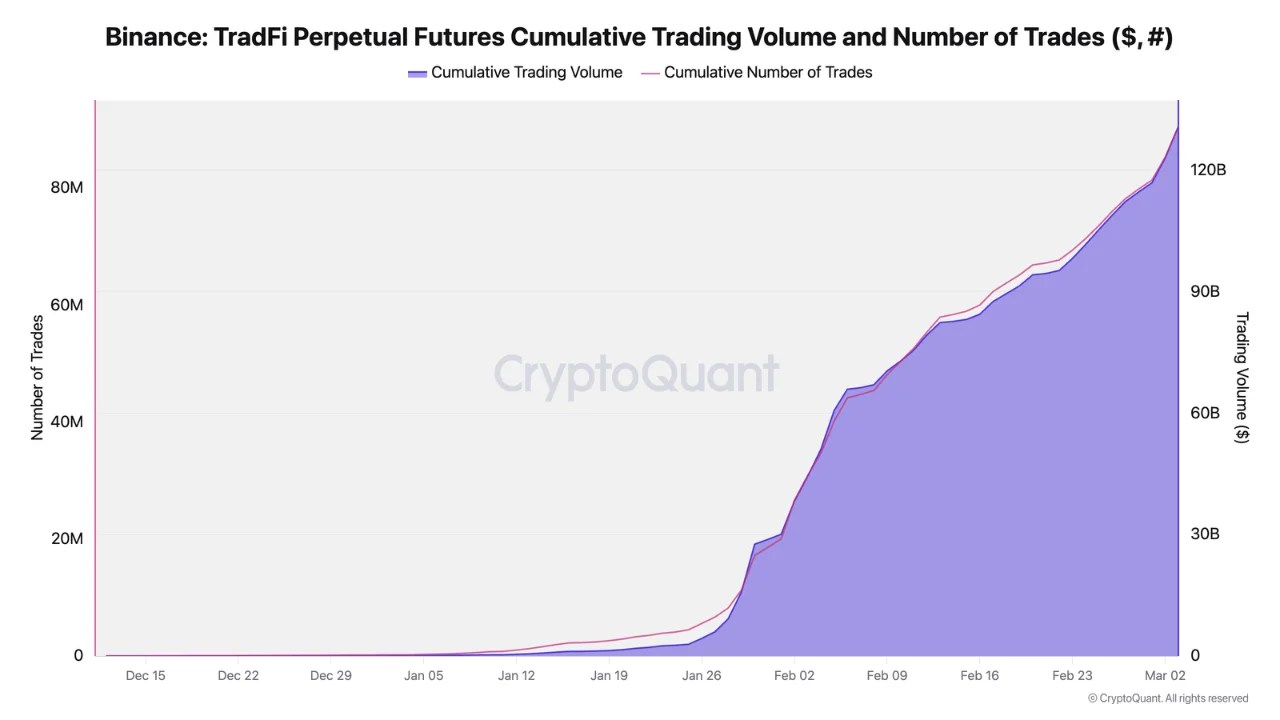
Binance TradFi Perpetual Futures Cumulative Trading Volume and Number of Trades | Source: CryptoQuant

Binance’s TradFi perpetual futures allow users to trade a wide range of instruments, including precious metals and major equities. Available contracts include gold, silver, palladium, and platinum, alongside stocks such as AMZN, COIN, CIRCL, HOOD, INTC, MSTR, PLTR, and TSLA. These products replicate the economic exposure of traditional derivatives while benefiting from the global accessibility and near-continuous trading environment of crypto exchanges.

Precious metals dominate activity within this segment. Daily trading volume is heavily concentrated in gold and silver contracts, which reached approximately $3.77 billion and $3.75 billion, respectively, on March 3. Trading tends to accelerate during strong price trends in metals markets. For example, record daily volumes of roughly $4 billion in gold and $7 billion in silver were observed on January 30, 2025.

High participation levels further illustrate this momentum. TradFi perpetual futures recently recorded around 4.4 million daily trades, with gold accounting for roughly 2.0 million and silver for 1.9 million transactions.


Пов'язані питання

QWhat is the main trend highlighted in the CryptoQuant report regarding cryptocurrency exchanges?

ACryptocurrency exchanges are evolving beyond digital asset trading platforms and becoming global venues for traditional financial derivatives, as market participants from traditional finance begin to use crypto-native infrastructure to trade assets outside the typical cryptocurrency universe.

QWhat key advantage do perpetual futures on crypto exchanges offer compared to traditional financial markets?

AThey provide continuous, 24/7 market access and uninterrupted liquidity, allowing traders to respond immediately to global developments rather than waiting for traditional markets to reopen.

QHow much cumulative trading volume have Binance's TradFi perpetual futures reached since their launch?

ACumulative trading volume has surpassed $130 billion, with more than 90 million trades recorded.

QWhich traditional assets are most actively traded through Binance's TradFi perpetual futures?

APrecious metals, particularly gold and silver, dominate trading activity, with daily volumes reaching approximately $3.77 billion for gold and $3.75 billion for silver on March 3.

QWhat does the growth of TradFi perpetual futures on crypto exchanges signify according to the report?

AIt reflects a broader structural shift in financial markets where the boundary between traditional finance and crypto-native trading infrastructure is fading, with digital asset exchanges emerging as hybrid platforms supporting both crypto and traditional financial products.

Пов'язані матеріали

a16z: AI's 'Amnesia', Can Continuous Learning Cure It?

The article "a16z: AI's 'Amnesia' – Can Continual Learning Cure It?" explores the limitations of current large language models (LLMs), which, like the protagonist in the film *Memento*, are trapped in a perpetual present—unable to form new memories after training. While methods like in-context learning (ICL), retrieval-augmented generation (RAG), and external scaffolding (e.g., chat history, prompts) provide temporary solutions, they fail to enable true internalization of new knowledge. The authors argue that compression—the core of learning during training—is halted at deployment, preventing models from generalizing, discovering novel solutions (e.g., mathematical proofs), or handling adversarial scenarios. The piece introduces *continual learning* as a critical research direction to address this, categorizing approaches into three paths: 1. **Context**: Scaling external memory via longer context windows, multi-agent systems, and smarter retrieval. 2. **Modules**: Using pluggable adapters or external memory layers for specialization without full retraining. 3. **Weights**: Enabling parameter updates through sparse training, test-time training, meta-learning, distillation, and reinforcement learning from feedback. Challenges include catastrophic forgetting, safety risks, and auditability, but overcoming these could unlock models that learn iteratively from experience. The conclusion emphasizes that while context-based methods are effective, true breakthroughs require models to compress new information into weights post-deployment, moving from mere retrieval to genuine learning.

marsbit3 год тому

a16z: AI's 'Amnesia', Can Continuous Learning Cure It?

marsbit3 год тому

Торгівля

Спот
Ф'ючерси
活动图片