Texas targets crypto, gambling loopholes amid prediction market concerns

ambcryptoОпубліковано о 2026-04-01Востаннє оновлено о 2026-04-01

Анотація

Prediction markets have gained significant attention, particularly during the U.S. election cycle, but the rise of gambling within these markets has eroded public trust. In response, Texas Lieutenant Governor Dan Patrick is pushing for legislative changes to close gambling loopholes. He aims to prevent the exploitation of federal regulations, such as those of the CFTC, to bypass state gambling prohibitions. The goal is to ensure the integrity of elections and sports in Texas. Additionally, Patrick advocates for assessing the state’s approach to emerging financial technologies, including crypto, while prioritizing consumer protection and addressing issues like crypto ATM scams. The move coincides with a decline in public interest in prediction market gambling, as shown by Google Trends data.

Prediction markets have gained a lot of attention in the past two years. Zooming in, the rise in these markets escalated in Q4 2024 as the U.S. election started to heat up. However, on the flip side, gambling also became an integral part of the prediction markets’ growth cycle.

These began to undermine people’s trust in the prediction market. Hence, to combat this problem and to regain trust, Dan Patrick, Lieutenant Governor of Texas, came up with some legislative changes.

Under the State Affairs Committee category, Patrick underlined plans to close the gambling loopholes. In this push, the governor urged the lawmakers to,

Study the sudden inundation of prediction market gambling and the exploitation of federal law to circumvent Texas gambling prohibitions by allowing users to place bets on the outcome of elections and other events.

The reason behind this crackdown?

Needless to say, this move is intended to protect and reinforce the regulatory oversight of the Commodity Futures Trading Commission (CFTC). Patrick believes that the prediction markets are now exploiting the CFTC regulations just to bypass Texas state gambling prohibitions.

With clear intentions to have fair elections and corruption-free sports in Texas, Patrick added,

Make recommendations to ensure the integrity of Texas elections and Texas sports.

Echoing similar sentiments at the broader level, David Miller, enforcement director of CFTC, in his first public remark after joining, added,

We are aware of the speculation about insider trading. We are watching.

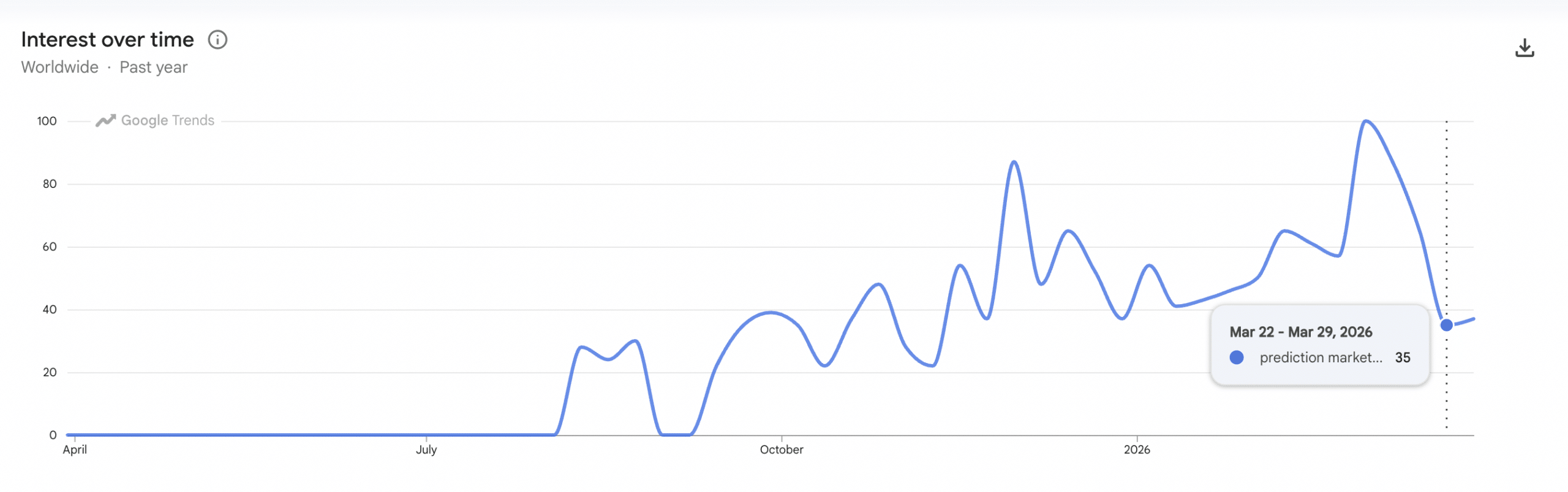
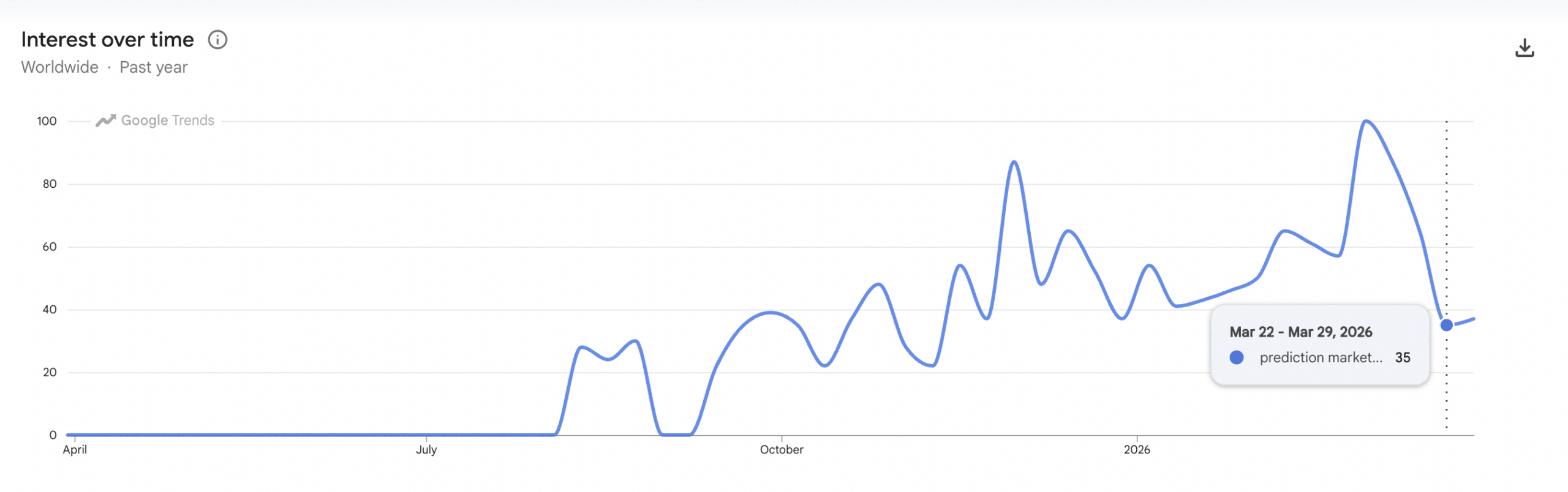
This comes as the Google Trends data saw a drop in the “prediction market gambling” keyword as of writing.
Source: Google Trends

As per the chart, the keyword had peaked to a Google Search score of 100 in early March. However, by the end of Q1 2026, the score stood at 35.

Besides prediction market reforms, Patrick has also come up with a plan to expand the future of crypto in Texas. He urged the lawmakers to:

Assess how the state’s financial regulatory agencies respond to emerging financial technologies and business models, while prioritizing the protection of consumers.

In fact, he also stressed the loopholes of scams surrounding the growing scale of crypto ATMs (virtual currency kiosks).

Lastly, the governor made a point to the lawmakers to look into Senate Bill 21 and how effectively it’s being implemented and whether it’s achieving its goal. For those unaware, Senate Bill 21 of Texas refers to the Texas Strategic Bitcoin Reserve bill implemented on the 20th of June, 2025.

This coincided with Polymarket recently coming up with its updated rulebook across its DeFi platform and CFTC-regulated U.S. exchange.


Final Summary

  • Prediction markets are growing, but with this growth, gambling has taken center stage, raising credibility issues.
  • David Patrick’s push for blockchain technology underlines how individual states are stepping up their crypto game as the U.S.-Iran war continues.


Пов'язані питання

QWhat is the main concern that prompted Texas Lieutenant Governor Dan Patrick to propose legislative changes regarding prediction markets?

AThe main concern is that gambling has become an integral part of prediction markets, which began to undermine people's trust in them. This includes the use of crypto to circumvent Texas gambling prohibitions by allowing bets on elections and other events.

QWhich regulatory body's oversight does Dan Patrick aim to reinforce with his proposed crackdown on prediction markets?

ADan Patrick aims to reinforce the regulatory oversight of the Commodity Futures Trading Commission (CFTC).

QBesides prediction market reforms, what other emerging technology did Dan Patrick urge lawmakers to assess in relation to consumer protection?

ADan Patrick urged lawmakers to assess how the state's financial regulatory agencies respond to emerging financial technologies and business models, specifically mentioning the need to prioritize consumer protection in the context of crypto and the growing scale of crypto ATMs.

QWhat specific Texas bill, related to Bitcoin, did Dan Patrick ask lawmakers to review for effective implementation?

ADan Patrick asked lawmakers to look into Senate Bill 21, which is the Texas Strategic Bitcoin Reserve bill implemented on June 20, 2025.

QAccording to the Google Trends data mentioned in the article, what was the search score for 'prediction market gambling' by the end of Q1 2026?

AThe Google Search score for 'prediction market gambling' stood at 35 by the end of Q1 2026, down from a peak of 100 in early March.

Пов'язані матеріали

Will the Next Crypto Bull Run Start with On-Chain Trading of SpaceX?

This article presents a scenario-based forecast for the crypto industry from 2026 to 2029, arguing that the next major cycle will be driven not by technological narratives but by legal access to real-world assets. The author predicts that by mid-2026, pre-IPO perpetual contracts for top private companies like SpaceX, OpenAI, and Anthropic on platforms like Hyperliquid will become the primary gateway for accessing quality assets, as most crypto-native tokens fail to capture real value. The much-hyped AI x Crypto intersection largely fails except for prediction markets, which thrive on betting on AI model supremacy. By 2027, public blockchain foundations are forced to choose between catering to retail speculation or building compliant infrastructure for institutions, with many opting for the latter. Growth in stablecoins and tokenized private credit/equity hits a "triple ceiling" due to regulatory and political uncertainty rather than market demand. The pivotal shift is forecast for 2028. A major liquidation event in pre-IPO perpetuals exposes the structural flaw of synthetic markets lacking a real underlying asset anchor. In response, regulatory changes finally allow the public solicitation of private securities resales to verified accredited investors. This creates a legitimate secondary market for real company equity, which then becomes the core asset class of the new bull market, relegating synthetic perps to a niche role. By 2029, the industry becomes "boring" but foundational. Tokens without claims on real cash flows or assets cease trading. Stablecoin growth is steady but politically capped. Crypto infrastructure fades from view as it gets absorbed into traditional finance backends. The article's central thesis is that the key bottleneck for crypto's next phase is legal and regulatory channels for real asset ownership, not technology.

marsbit1 год тому

Will the Next Crypto Bull Run Start with On-Chain Trading of SpaceX?

marsbit1 год тому

The Value Distribution of Stablecoins

**Summary: The Value Distribution of Stablecoins** The article argues that stablecoins are evolving from mere trading tools into broader channels for dollar access. It divides the stablecoin ecosystem into four layers to analyze how value is distributed: 1. **Issuance Layer:** Mints stablecoins, holds reserve assets, and captures the spread between reserve yield and user costs (e.g., Tether, Circle). This layer currently earns the largest profit margin. 2. **Infrastructure Layer:** Connects stablecoins to the traditional financial system, handling fiat on/off-ramps, banking integration, compliance (KYC/AML), and asset management (e.g., Bridge, BVNK). This is the "unglamorous" but critical work, building the essential bridges between crypto and real-world finance. 3. **Acquiring/Distribution Layer:** Integrates stablecoins into merchant systems, manages payment flows, and provides enterprise financial software (e.g., Stripe, Coinbase). They act as the access point for businesses. 4. **Application Layer:** The end-users and businesses that ultimately use stablecoins for payments, settlements, or as a store of value. They benefit from convenience but have little pricing power. The core thesis is that while the issuance layer currently dominates profits, the often-overlooked **infrastructure layer holds significant long-term potential**. The real challenge and barrier to mass adoption is not the on-chain transfer of stablecoins (which is simple), but the complex "last mile" integration into existing business workflows, banking systems, and regulatory frameworks across different countries. Companies in this layer are currently in a "land grab" phase, investing heavily to build networks, secure bank partnerships, and establish compliance pathways. While their position is currently pressured by the profitable issuers above and distribution platforms below, the article suggests that if stablecoins become a default financial rail for businesses, the infrastructure providers who have done the hard work of integration will ultimately gain strong pricing power and become entrenched, essential players.

marsbit8 год тому

The Value Distribution of Stablecoins

marsbit8 год тому

The Value Distribution of Stablecoins

The Value Distribution of Stablecoins The article argues that stablecoins are evolving from a mere trading tool into a broad "dollar channel." It analyzes the industry's value chain through four layers: 1. **Issuance Layer (e.g., Tether, Circle):** The top layer that mints stablecoins, holds reserve assets, and captures the thickest interest rate spread. 2. **Infrastructure Layer (e.g., Bridge, BVNK):** Connects stablecoins to the traditional financial system, handling critical but complex "dirty work" like fiat on/off-ramps, banking integration, compliance (KYC/AML), and cross-border settlement. 3. **Acquiring/Distribution Layer (e.g., Stripe, Coinbase):** Embeds stablecoins into merchant systems, manages payment flows, and integrates with enterprise software. 4. **Application Layer:** End-users and businesses that ultimately use stablecoins for payments, settlement, or storing value. The author posits that while the issuance layer currently captures the most profit, the most overlooked and potentially critical layer is infrastructure. The core challenge for stablecoin adoption isn't the on-chain transfer (which is simple), but bridging the gap between blockchain and the real-world financial system. This involves solving practical problems for businesses: fiat conversion, reconciliation, tax handling, and user onboarding. Infrastructure companies are currently in a difficult "land-grab" phase—building networks, securing banking relationships, and achieving compliance country-by-country. They face pressure from both the profitable issuance layer above and distribution platforms below. However, the author suggests this layer is building a crucial moat. Once stablecoins become a default business rail, the infrastructure players who have done the hard work of integration may gain significant, durable value and pricing power.

链捕手8 год тому

The Value Distribution of Stablecoins

链捕手8 год тому

Торгівля

Спот
Ф'ючерси
活动图片




