Texas Poker Bluffing Battle | The Key to Victory in WPT Global High-Stakes Cash Game: AK vs 99

bitcoinistОпубліковано о 2025-12-24Востаннє оновлено о 2025-12-24

Анотація

An analysis of a high-stakes cash game hand on WPT Global between Alan Keating (A♠K♥) and Nik Airball (9♠9♦). The hand demonstrates how player image and credibility are often more critical than raw hand strength in deep-stack play. Keating, known for a loose and aggressive style with a wide range, 3-bet pre-flop. Airball, a skilled player adept at reading opponents, responded with a 4-bet. Keating then made a large 5-bet, a polarized move representing either a very strong hand or a pure bluff. Airball called, taking position to the flop (J♠4♦6♠). With his A-K missing the flop, Keating moved all-in with a massive overbet, attempting to maximize fold equity by representing a very strong range. However, Airball instantly called. His decision was a strategic read based on Keating's image; he calculated that Keating’s line was more likely a bluff with overcards. The board ran out twice with no A or K, and Airball's pocket nines held. The hand underscores a key high-stakes concept: betting power is determined not just by the cards, but by how opponents perceive your image and credibility. Keating’s aggressive play lost its effectiveness against an opponent who correctly adjusted his calling frequency to exploit it.

Learning from real battles, stealing skills from the masters. This hand between Keating and Airball with AK versus 99 at the WPT Global high-stakes cash table is a classic example. On the surface, it's a common high card versus medium pocket pair scenario, but in reality, it's an extreme confrontation under deep stack conditions, pushing image, credibility, and range reading to the limit.

To understand the direction of this hand, we must first understand the table personas of the two players, because at this level, hand strength is just the entry point; the core of decision-making is how much your opponent believes you.

Table Personas: One Relies on Chaotic Pressure, the Other on Reading Hands to Counter

Alan Keating is one of the most popular and difficult types to face at high-stakes tables. His VPIP is extremely high, his entering range is so wide it's almost distorted—he plays strong hands, marginal hands, and even garbage hands, daring to use massive sizing to apply pressure and bluff. His bankroll depth and risk preference give him a natural advantage in many confrontations, making it hard for opponents to pin down his hole cards using traditional signals, as his raises could be AA or 72 offsuit.

This near-crazy image can yield significant fold equity in the long run, but it also erodes his credibility. Once opponents categorize him as "polarized with a high bluff frequency," his big moves are easily counter-interpreted, ultimately becoming the starting point of a tragedy.

Nik Airball is the other extreme. A regular on shows like Hustler Casino Live, he is known for his incessant speech play and strong aggression. Public opinion on him is divided, but his technical foundation should not be underestimated. He is quite solid in range reading and tempo adjustment, especially skilled at making exploitative calls against specific opponents.

Facing an overly aggressive opponent like Keating, he knows when to increase his calling frequency and when to use calls to let the opponent bluff all the way. In other words, he isn't competing with Keating to see who is more aggressive, but rather who is better at turning the opponent's image into harvestable EV.

Pre-flop Raising War: Not AK vs 99, but the Pricing of Credibility

The hand starts with Airball opening with 9♠9♦. Keating's 3bet with A♠K♥ is a standard strong hand line, aiming to isolate the opponent and establish initiative. Airball then chooses to 4bet. This move is crucial in a deep stack scenario. 99 is an awkward medium pocket pair in most frameworks—it doesn't just seek set value like small pocket pairs, nor is it as comfortable under pressure as QQ or better. Airball's 4bet is both a test and a counter, betting that Keating's 3bet range is wide enough for him to still extract value and maintain initiative in the confrontation.

The real turning point occurs when Keating makes a 5bet, raising to 165,000. For most players, a 5bet is often seen as a signal for AA or KK, but in Keating's image framework, his 5bet is closer to a polarized move—either the nuts or using deep stacks and table credibility to force a fold. The question at this moment becomes: does Airball believe Keating's "represented range"? Airball doesn't shove all-in, nor does he fold. Instead, he chooses to call, taking the decision to the flop, using position and information advantage to delay the decision—a common high-level approach in high-stakes games, preserving room to observe Keating's post-flop line.

Flop: J♠4♦6♠, The Purpose and Cost of Keating's Overbet Shove

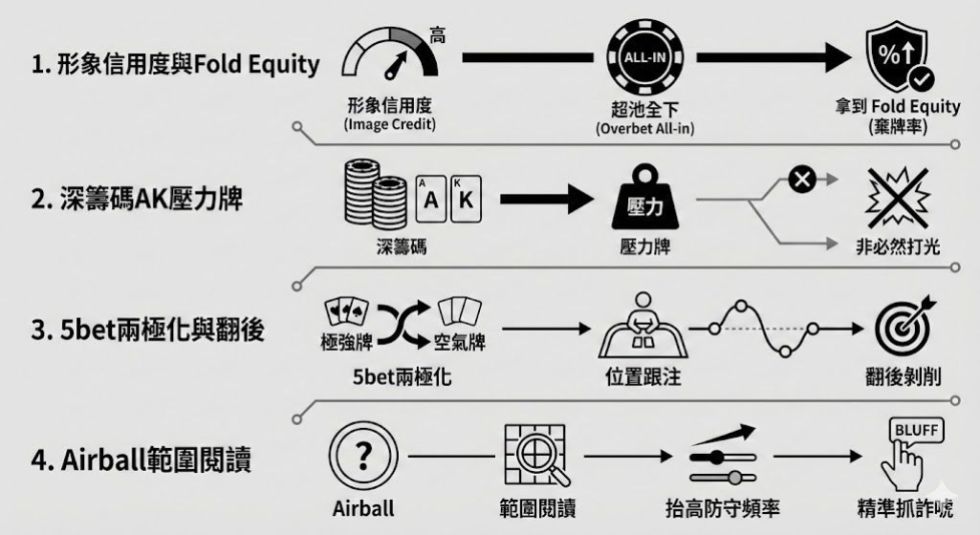
The flop doesn't bring an A or K; AK misses. Keating still chooses an overbet All-in shove. The core of this line is not hand strength, but maximizing Fold Equity. He hopes to use an extreme size to represent high-weight combinations like AA, KK, JJ, or strong flush draws, forcing a medium pocket pair like 99 to fold under immense pressure. Because if he checks or makes a small bet, AK can easily be passively led to a showdown disadvantage.

From a pure strategy perspective, this is a decision that settles the outcome in one go—success means taking the pot directly, failure means risking almost the entire buy-in.

The problem is, an overbet shove极度依赖信用度 (relies extremely on credibility). If the opponent believes you, it's a highly efficient pressure tool. If the opponent doesn't believe you, it becomes a move that locks the opponent's calling range into the "specifically designed to catch your bluff" zone, providing the opponent with the best incentive to call with your maximum size.
Airball's Instant Call: Calling with 99, Catching the Crack in Keating's Image

Airball's instant call looks like a hand strength decision, but it's actually a model decision. He calculates Keating's entire line within the framework of his opponent's persona: Keating has a wide pre-flop range, his 5bet has polarized characteristics, and when he misses the flop, he is more likely to push all the way with his two high-card air using a large size, trying to win the pot in one go.

Under this assumption, the relative strength of 99 on J♠4♦6♠ increases significantly. The call isn't about toughing it out; it's about exploiting the structural flaw of an opponent who applies excessive pressure and lacks credibility. They run it twice; neither runout produces an A or K. 99 holds its lead and busts Keating. The ending is sealed by the deal, but the logic of victory was actually determined the moment the instant call was made.

CoinPoker Gambling – The Overall Best Bitcoin Poker Gambling Site

CoinPoker has long been regarded as the most comprehensive Bitcoin gambling platform in the crypto space, establishing high competitiveness with its smooth interface, diverse gameplay, and strong bonus structure. The platform offers a 150% welcome bonus, with the first deposit going up to $2,000, making it an extremely attractive starting condition for both beginners and advanced players, and successfully solidifying its position as a mainstream BTC gambling site.

In terms of gameplay, CoinPoker offers over 15 betting markets, covering live sports, esports, virtual events, and more. It also supports deposits in multiple mainstream cryptocurrencies. Withdrawals are known for instant processing, zero fees, and anonymous settlement, ensuring players can withdraw their winnings quickly and safely. Beyond sports betting, the platform also features a mature casino system, including high-quality live dealer games, presented in HD stream from Blackjack to Roulette, allowing players to enjoy an immersion close to a physical casino on their mobile or desktop.

For poker players, CoinPoker's appeal is even more evident. The platform offers stable, active poker tables and diverse tournament formats. A 33% online poker rakeback is offered every Monday, providing substantial value for long-term players. Coupled with the platform's transparent operation and continuously promoted events, it creates a highly rated professional poker environment for global players.

CoinPoker combines Bitcoin gambling, live dealer casino, and a professional poker ecosystem, offering fast settlement,完善的奖金制度 (完善的 bonus system), and high anonymity, making it an ideal choice for crypto players seeking security, speed, and entertainment.

Enter CoinPoker to Play

Conclusion: The True Hand Strength in High-Stakes Games is How Your Opponent Sees You

The value of this hand lies in how clearly it illustrates the most essential reality of high-stakes games: the power of your bet is not only determined by the board but also by how your opponent prices your image. Keating's chaotic style can force excessive folds against many opponents, earning him a lot of non-showdown EV in the long run. But once he encounters an opponent who can calculate his bluff frequency into the equation, his 5bet and flop shove lose their intimidation power, even反过来 becoming the most comfortable calling point for the opponent. Airball wins by daring to increase his calling frequency and accurately choosing the most suitable structure to withstand the pressure.

A more realistic statement is: in a deep stack environment, AK is no longer a no-brainer all-in weapon. It's more like a pressure hand that requires credibility加成 (credibility bonus). When you are perceived as loose-aggressive, you must accept that opponents will call more boldly; your value lines need to be more direct, and your bluff lines need to be more selective. The reason this hand becomes a classic is not because 99 beat AK, but because it demonstrates the ultimate rule of high-stakes games: when your opponent sees through who you are, the cards in your hand get repriced.

Пов'язані питання

QWhat was the key factor that determined the outcome of the AK vs. 99 hand between Keating and Airball on the WPT Global high-stakes cash game?

AThe key factor was the players' table image and perceived credibility, not just the raw hand strength. Keating's hyper-aggressive and wide-ranging style had eroded his credibility, allowing Airball to accurately read his large bet on the flop as a likely bluff and make a profitable call with his pocket nines.

QHow did Nik Airball's playing style differ from Alan Keating's in this hand?

ANik Airball's style was based on solid range reading and making exploitative adjustments against specific opponents. He was adept at knowing when to increase his defense frequency and when to call down aggression. In contrast, Alan Keating employed a chaotic, high-VPIP style with a very wide range, using large bet sizes to apply pressure and bluff frequently.

QWhy did Alan Keating choose to make a 5-bet pre-flop and then an overbet all-in on the flop with A♠K♥?

AKeating's 5-bet pre-flop was a polarized move, representing either a very strong hand or a bluff designed to exploit his deep stack and force a fold. His overbet all-in on the J♠4♦6♠ flop was an attempt to maximize fold equity by representing a very strong hand (like an overpair or a strong draw) since his A-K had missed the board, hoping to win the pot without a showdown.

QWhat does the article suggest is the 'ultimate rule' of high-stakes poker, as demonstrated by this hand?

AThe 'ultimate rule' is that the power of a bet is not just determined by the cards, but by how an opponent prices your table image. When an opponent sees through your playing style and understands your tendencies, the value of the cards you hold is re-priced accordingly.

QAccording to the article, what makes A-K a different type of hand in a deep-stack environment against a skilled opponent?

AIn a deep-stack environment against a skilled opponent, A-K is no longer a hand to automatically commit all chips with. It becomes a pressure hand that requires credibility to be effective. If a player is perceived as loose and aggressive, opponents will be more willing to call, meaning value bets need to be more straightforward and bluffs need to be more carefully selected.

Пов'язані матеріали

Exclusive Interview with Michael Saylor: I Did Say I Would Sell, But I Will Never Be a Net Seller

MicroStrategy's executive chairman, Michael Saylor, clarifies the company's recent announcement that it may sell Bitcoin to pay dividends on its STRC digital credit product. He emphasizes this does not make MicroStrategy a net seller of Bitcoin. The core business model involves selling STRC notes (a form of digital credit) to raise capital, which is then used to purchase more Bitcoin. Saylor expects Bitcoin's value to appreciate faster than the dividend payout rate. Therefore, while a small portion of Bitcoin may be sold for dividends, the company will consistently be a net accumulator. For example, in April, the company raised $3.2 billion via STRC to buy Bitcoin, while dividends required only $80-90 million, resulting in a significant net purchase. Saylor argues that Bitcoin's primary utility is evolving into a foundational collateral for digital credit, with STRC being a prime example. He notes that STRC now constitutes a majority of the U.S. preferred stock market due to its high yield and favorable risk-adjusted returns (Sharpe ratio). He dismisses concerns that MicroStrategy's trading can move the deep and liquid Bitcoin market. Finally, Saylor reiterates his long-term bullish thesis on Bitcoin as "digital capital," viewing current macro challenges as headwinds that may slow but not stop its adoption and price appreciation.

Odaily星球日报1 хв тому

Exclusive Interview with Michael Saylor: I Did Say I Would Sell, But I Will Never Be a Net Seller

Odaily星球日报1 хв тому

Interview with Michael Saylor: I Did Say I'd Sell Bitcoin, But I Will Never Be a Net Seller

**Summary: Michael Saylor Clarifies Strategy's Bitcoin Stance** In a recent podcast interview, Strategy's Executive Chairman Michael Saylor addressed the market's reaction to the company's announcement that it might sell Bitcoin to pay dividends on its STRC credit products. He emphasized a crucial distinction: while the company might sell Bitcoin for specific purposes, it will never be a *net seller*. Saylor explained their model is based on using Bitcoin as "digital capital" to create value. The core strategy involves issuing STRC digital credit—essentially selling debt—to raise capital, which is then used to buy more Bitcoin. He estimates Bitcoin appreciates at roughly 40% annually. A small portion of these capital gains (e.g., ~2.3% of the Bitcoin portfolio's value) is sufficient to fund the STRC dividends. Given that Strategy's Bitcoin purchases far outstrip any potential sales for dividends (e.g., buying $3.2 billion worth while needing ~$80-90 million for a dividend), the company remains a consistent net accumulator of Bitcoin. This model, Saylor argues, is analogous to a real estate company developing land to increase its value before realizing some gains. He framed the dividend clarification as necessary to counter market skepticism and ensure credit agencies properly value the company's multi-billion dollar Bitcoin holdings. Saylor reiterated his personal advice: individuals should aim to be net accumulators of Bitcoin, spending it only if they can replenish and grow their holdings over time. Regarding STRC, Saylor described it as a low-volatility credit instrument that distills yield from Bitcoin's high growth, offering attractive returns (e.g., ~11-12% yield) for risk-averse investors. He noted that Strategy's STRC issuance now constitutes about 60% of the U.S. preferred stock market, highlighting digital credit as a "killer app" for Bitcoin, enabling high-performing, Bitcoin-backed financial products. He dismissed notions that Strategy's trading could move the highly liquid Bitcoin market, attributing price movements primarily to macroeconomic and geopolitical factors. Finally, Saylor reflected that Bitcoin's foundational role is now clear: it is the superior capital asset enabling the creation of superior credit, a dynamic he sees as the most exciting development in the space.

marsbit8 хв тому

Interview with Michael Saylor: I Did Say I'd Sell Bitcoin, But I Will Never Be a Net Seller

marsbit8 хв тому

380,000 Apps Exposed, 2,000+ Apps Leaked Secrets: AI Programming Turns 'Intranet' into Public Internet

Israeli cybersecurity firm RedAccess uncovered a severe data exposure trend linked to "vibe coding" or AI-powered software development tools. Their research found approximately 38,000 publicly accessible web applications built with platforms like Lovable, Base44, Netlify, and Replit. Of these, an estimated 2,000 apps exposed sensitive corporate and personal data, including medical records, financial information, internal strategic documents, and customer chat logs. In some cases, access even granted administrative privileges. The core issue stems from default privacy settings that make applications public by default, combined with a lack of built-in security controls (like authentication) in the AI-generated code. This allows employees without security expertise—"citizen developers"—to easily create and deploy applications that bypass standard corporate security reviews. The exposed apps, often indexed by search engines, are trivially discoverable. While some platform providers (Replit, Lovable, Wix/Base44) argue that security configuration is the user's responsibility and question the validity of some findings, security researchers confirm the widespread reality of such exposures. This pattern, also noted in prior studies, highlights a critical security gap as AI democratizes app creation, potentially leading to massive, unintentional data leaks.

marsbit1 год тому

380,000 Apps Exposed, 2,000+ Apps Leaked Secrets: AI Programming Turns 'Intranet' into Public Internet

marsbit1 год тому

Attracting Global Capital, Asia's New 'Super Cycle' Is Unfolding

Investors are turning to Asia as the next frontier for global equity growth, with a new "super cycle" unfolding across the region. Driven by the AI revolution, Asian markets, particularly South Korea, have seen significant rallies. According to Morgan Stanley analysis, the underlying drivers of Asia's industrial cycle are shifting from traditional sectors like real estate and manufacturing to massive investments in AI infrastructure, energy security and transition, and supply chain resilience. Fixed asset investment in Asia is projected to grow from around $11 trillion in 2025 to $16 trillion by 2030, with a 7% annual growth rate from 2026-2030. The AI wave is a primary catalyst, driving immense capital expenditure for chips, servers, data centers, and power systems. Asia is central to this hardware supply chain. In China, AI investment is focused on building a full-system domestic capability, with the local AI chip market potentially reaching $86 billion by 2030. Beyond AI, China's export story is expanding from EVs and batteries to robotics. The country already captures about half of new global industrial robot demand and over 90% of humanoid robot shipments. This growth phase mirrors the early stages of China's EV export boom. Simultaneously, energy security investments, spurred by AI's massive power needs, are rising, with China benefiting from its leadership in solar, batteries, and EVs. Regional defense spending is also increasing structurally, supporting demand for advanced manufacturing. The main beneficiaries are China, South Korea, and Japan, positioned in core supply chain areas. However, risks remain, including potential overcapacity, profit margin pressures from competition, persistent technological restrictions, geopolitical friction, and workforce displacement due to AI-driven automation. Market volatility is also expected to increase as investor expectations diverge on the realization of these capital investment and export themes.

marsbit1 год тому

Attracting Global Capital, Asia's New 'Super Cycle' Is Unfolding

marsbit1 год тому

Торгівля

Спот
Ф'ючерси
活动图片