Tether Launches Bitcoin Mining OS, Fueling $HYPER’s $31.2M Presale

bitcoinistОпубліковано о 2026-02-03Востаннє оновлено о 2026-02-03

Анотація

Tether, the major stablecoin issuer, is expanding its influence in Bitcoin infrastructure by launching MOS, a proprietary mining operating system that integrates IoT technology to optimize energy efficiency. This move signals a strong institutional commitment to Bitcoin's foundational growth. However, Bitcoin's inherent limitations in transaction speed and scalability for DeFi applications remain a challenge. Addressing this, Bitcoin Hyper ($HYPER) is gaining attention as a Bitcoin Layer 2 solution that combines Bitcoin's security with the high-speed performance of the Solana Virtual Machine (SVM). It enables fast, low-cost transactions and smart contracts in Rust, making Bitcoin more usable for DeFi. The project's presale has raised over $31.2 million, indicating significant investor interest, particularly from larger entities, ahead of its Token Generation Event (TGE). The tokenomics include immediate staking post-TGE with a 7-day vesting period to reduce sell pressure. This development represents a growing trend to enhance Bitcoin's utility alongside infrastructure improvements.

Tether isn’t just a stablecoin issuer anymore. It’s rapidly becoming a dominant force in Bitcoin infrastructure.

The company’s recent launch of MOS, its proprietary mining operating system, marks a massive shift in how institutional capital interacts with the network.
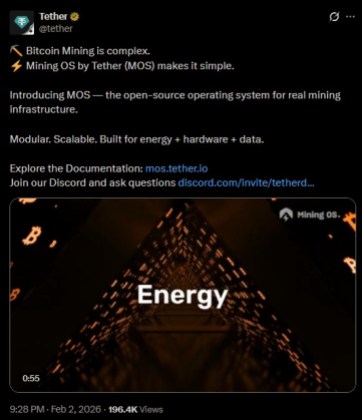
By fusing Internet of Things (IoT) technology with mining hardware, Tether is optimizing energy efficiency in a way that screams long-term commitment. It’s not just about holding $BTC; it’s about building the rails.

That validates the ‘Bitcoin as infrastructure’ thesis. When the world’s largest stablecoin issuer, sitting on over $100B in liquidity, pivots to mining logistics, it de-risks the network for everyone else. But while Tether tackles hardware inefficiencies, a glaring gap remains on the software side: Bitcoin simply can’t handle complex, high-speed transactions natively.

Consequently, focus is shifting toward solutions that can unlock Bitcoin’s $1T+ capital for decentralized finance (DeFi). The liquidity is there. The rails? Too slow. This search for scalability has pushed massive capital toward Layer 2 protocols.

Right now, smart money is circling Bitcoin Hyper ($HYPER), a project merging Bitcoin’s security with the Solana Virtual Machine’s (SVM) speed to bridge institutional security with retail velocity.

You can buy $HYPER here.

Bitcoin Hyper Bridges the Gap Between Security and SVM Speed

Bitcoin’s core limitation has always been the ‘trilemma’ trade-off: it sacrifices speed for absolute decentralization. While reliable for settlement, frankly, it’s functionally useless for modern DeFi applications that require sub-second finality.

Bitcoin Hyper ($HYPER) tackles this by integrating the Solana Virtual Machine (SVM) directly as a Layer 2 execution environment.

This isn’t just narrative fluff, it’s a technical leap. By using the SVM, Bitcoin Hyper lets developers write smart contracts in Rust (the language powering Solana’s ecosystem) while anchoring the final state to Bitcoin’s Layer 1. This modular approach separates execution from settlement.
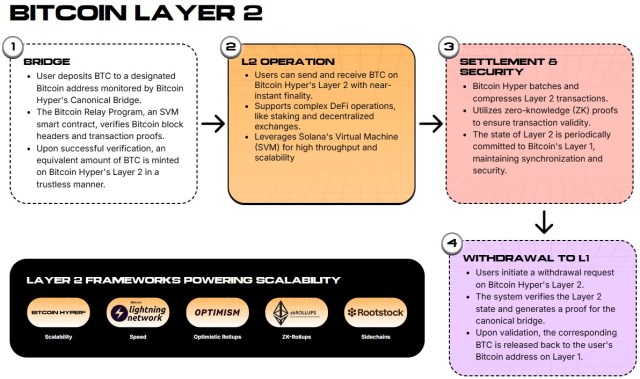
Transactions happen in real-time on the SVM layer, delivering the snappy, low-cost experience users expect, while security remains tied to Bitcoin.

For developers, this removes the friction of learning archaic scripting languages like Bitcoin Script. For users, it means interacting with Bitcoin DeFi without exorbitant fees or 10-minute waits. The protocol includes a Decentralized Canonical Bridge to keep value transfers trust-minimized.

That infrastructure is crucial for high-frequency trading and gaming dApps, stuff that was previously impossible on the Bitcoin network.

Explore the Bitcoin Hyper ecosystem.

Whale Accumulation Signals Confidence as Presale Clears $31M

The appetite for high-performance Bitcoin Layer 2s is real. Just look at the capital flows surrounding the Bitcoin Hyper presale. Official data shows the project has raised over $31.2M, a figure that underscores demand despite market chop. With tokens priced at $0.013675, the valuation offers an early-stage entry point compared to established competitors like Stacks.
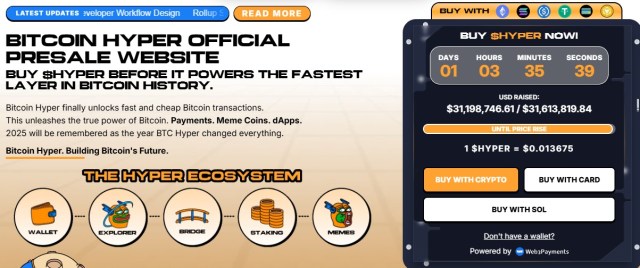
Sophisticated actors appear to be positioning themselves ahead of the Token Generation Event (TGE). The implication? Larger entities are betting the “SVM on Bitcoin” narrative will outperform standard EVM-based Layer 2s.

The tokenomics look designed for the long haul. Bitcoin Hyper offers immediate staking after TGE (though APY rates are still under wraps). There’s a catch: a 7-day vesting period for presale stakers. But that’s likely a feature, not a bug, intended to mitigate immediate sell pressure.

As Tether industrializes Bitcoin mining, projects like Bitcoin Hyper are industrializing Bitcoin utility, creating a dual engine for the network’s next growth phase.

Check out the Bitcoin Hyper presale.

Disclaimer: This article is for informational purposes only and does not constitute financial advice. Cryptocurrency investments, including presales and Layer 2 tokens, carry high risks. Always perform your own due diligence before investing.


Пов'язані питання

QWhat is the main focus of Tether's new initiative mentioned in the article?

ATether is expanding beyond stablecoin issuance by launching its proprietary Bitcoin mining operating system (MOS), focusing on optimizing energy efficiency and becoming a dominant force in Bitcoin infrastructure.

QHow does Bitcoin Hyper ($HYPER) aim to solve Bitcoin's scalability issue?

ABitcoin Hyper integrates the Solana Virtual Machine (SVM) as a Layer 2 execution environment, enabling high-speed, low-cost transactions while anchoring security to Bitcoin's Layer 1, thus addressing Bitcoin's limitations for DeFi applications.

QWhat technical advantage does Bitcoin Hyper offer to developers?

AIt allows developers to write smart contracts in Rust (the language used in Solana's ecosystem) instead of Bitcoin Script, reducing friction and enabling the creation of high-frequency trading and gaming dApps on Bitcoin.

QHow much capital has the Bitcoin Hyper presale raised, and what does it indicate?

AThe Bitcoin Hyper presale has raised over $31.2 million, indicating strong demand and confidence in the 'SVM on Bitcoin' narrative, with whale accumulation signaling institutional interest.

QWhat is one key feature of Bitcoin Hyper's tokenomics designed for long-term stability?

AThe tokenomics include immediate staking after the Token Generation Event (TGE) with a 7-day vesting period for presale stakers to mitigate immediate sell pressure and encourage long-term holding.

Пов'язані матеріали

Has the 'Digital Gold' Narrative for BTC Failed?

**Title: Has the "Digital Gold" Narrative for Bitcoin Failed?** The article argues that Bitcoin's "digital gold" narrative remains valid despite a recent sharp price decline (from a peak near $126k in Oct 2025 to briefly under $61k in Feb 2026). It presents a long-term investment framework based on three core points: **1. Viewing Bitcoin as an Asset:** Bitcoin is presented as a superior potential store of value compared to gold. Key arguments are its absolute scarcity (21 million cap), superior portability, and transparent auditability via its public ledger. While acknowledging its current use in early, volatile stages (~3-4% global adoption), the author draws parallels to the early, disruptive phases of the internet and e-commerce. **2. Understanding the Recent Downturn:** The current ~50% correction is framed as a predictable, consensus-driven cycle following its post-halving peak (the 2024 halving preceded the Oct 2025 high). A crucial factor is a historic "changing of hands": the influx of new institutional buyers via ETFs allowed early, low-cost holders (miners, OG believers) to take profits. The author notes that while severe, Bitcoin's historical drawdowns (e.g., 93% in 2011, 77% in 2021-22) have been progressively smaller, suggesting maturing holder structure and decreasing volatility over time. **3. The Long-Term Perspective:** The long-term thesis hinges on Bitcoin capturing a portion of gold's market value. With Bitcoin's market cap at ~$1.4 trillion (at $70k) versus gold's ~$20 trillion, significant upside potential exists if the "digital gold" narrative is partially realized. However, the author strongly cautions that short-term risks remain, the bottom is unpredictable, and high volatility is inherent. The real risk is not Bitcoin failing but poor personal position management (over-leverage, wrong capital) and a lack of deep understanding, which can force investors out during severe downturns. The conclusion uses Amazon's 95% crash post-2000 dot-com bubble and subsequent 42x recovery as an analogy. The ultimate question is not if Bitcoin's price will rise, but if an investor's strategy and conviction can withstand the volatility to see the long-term play out. The recent divergence (gold up, Bitcoin down) is posed not as a narrative failure, but as potential evidence of this ongoing, painful transition from a speculative asset to a mainstream allocation.

marsbit8 год тому

Has the 'Digital Gold' Narrative for BTC Failed?

marsbit8 год тому

Has BTC's 'Digital Gold' Narrative Failed?

The article discusses Bitcoin's "digital gold" narrative, its recent price drop, and long-term outlook through the perspective of "Jason". It argues the narrative is not a failure but that Bitcoin represents a superior, new asset class due to its fixed supply (21 million), portability, and auditability. The piece compares its current ~3-4% global adoption rate to early internet/e-commerce, suggesting significant growth potential. Regarding the 2025-2026 price decline (from ~$126k to briefly under $61k), the author views it as a predictable, consensus-driven sell-off within Bitcoin's ~4-year cycle post-halving, exacerbated by a major "handover" from early, low-cost holders to new institutional buyers via ETFs. A key observation is that historical peak-to-trough drawdowns have lessened over time (e.g., 93% in 2011 to ~50% in 2026), indicating maturing volatility as holder structure changes. For the long term, the author uses a simple framework: Bitcoin's total market cap (~$1.4T at $70k) is only about 7% of gold's (~$20T). Even capturing 30-50% of gold's value would imply substantial upside. However, the article strongly cautions against viewing this as investment advice, emphasizing extreme volatility and the critical importance of risk management, position sizing, and deep fundamental understanding to survive severe drawdowns. It concludes by drawing a parallel to Amazon's 95% crash in 2000 and subsequent 42x recovery, stressing that the key is surviving market cycles to realize long-term potential.

链捕手8 год тому

Has BTC's 'Digital Gold' Narrative Failed?

链捕手8 год тому

From Code to Cognition: A Ten-Thousand-Word Guide to the Evolution of the Robot Brain

"From Code to Cognition: The Evolution of Robot Brains" The journey of robotic intelligence has shifted dramatically from manually coded systems to AI-driven brains. For decades, robots relied on layered software stacks—perception, state estimation, planning, control—each handcrafted. While predictable, they lacked adaptability. The 2010s saw deep learning revolutionize perception (e.g., object detection) and control (via reinforcement learning), but learned skills remained narrow. The arrival of Large Language Models (LLMs) marked a turning point. LLMs acted as high-level planners, interpreting natural language instructions and generating sequences of actions for traditional robotic systems to execute. However, true integration came with Visual-Language-Action (VLA) models, which fused vision, language, and motion prediction into a single network. Pioneered by models like RT-2 and open-source projects like OpenVLA, VLAs enable robots to reason and act directly from visual input and commands. The most advanced humanoid robots now employ a "dual-brain" architecture: a slow-thinking, large VLA (System 2) for reasoning and planning, and a fast-reacting, small network (System 1) for high-frequency motion control, sometimes with an even lower-level System 0 for balance. This split balances cognition with the physics of real-time movement. Computation is split between onboard hardware (e.g., NVIDIA Jetson) for safety-critical control loops and cloud/edge servers for non-critical tasks like learning and interfaces. A crucial driver is the open-source ecosystem—models like GR00T and OpenVLA allow startups to build upon pre-trained brains and fine-tune them with their own data, accelerating development. Despite progress, current systems struggle with recovery from errors, sample inefficiency, and long-horizon tasks. This has spurred the rise of **World Models**—neural networks that predict the consequences of actions. By simulating possible futures before acting (like NVIDIA Cosmos or Meta V-JEPA), robots can plan, recover, and generalize better. This represents the next frontier: shifting intelligence from learned reactions to an internal model of physics and cause-and-effect. The field is rapidly evolving. While not yet at its "ChatGPT moment," the convergence of cheaper hardware, scalable simulation, and world models points toward robots that are increasingly capable, adaptive, and useful. The question is shifting from "what can robots do?" to "what *should* they do?"

marsbit9 год тому

From Code to Cognition: A Ten-Thousand-Word Guide to the Evolution of the Robot Brain

marsbit9 год тому

Торгівля

Спот
Ф'ючерси
活动图片




