Tether Invests in Humanoid Robots. When Will They Be Launched

RBK-cryptoОпубліковано о 2025-12-09Востаннє оновлено о 2025-12-09

Анотація

Tether, the company behind the USDT stablecoin, has invested in humanoid robotics through a €70 million funding round in Generative Bionics, a spin-off from the Italian Institute of Technology (IIT). The startup is developing "physical AI" robots for industrial use and human interaction, leveraging two decades of IIT research. Tether stated these investments support technologies that "expand human potential and reduce reliance on centralized systems." The first industrial deployment programs for these robots are planned for early 2026, targeting manufacturing, logistics, healthcare, and retail sectors. A full concept of the humanoid robot will be unveiled at the CES exhibition in Las Vegas. Tether investment portfolio also includes AI, financial services, energy, and biotech.

Tether, the company behind the largest stablecoin USDT, has announced investments in the development of humanoid robots through the Italian Institute of Technology's (IIT) spin-off startup Generative Bionics. The funding round raised €70 million.

Generative Bionics specializes in creating robots with "physical AI" designed for industrial use and human interaction. The startup utilizes two decades of IIT's robotics research, holds exclusive licenses to key technologies, and employs about 70 engineers and AI specialists from the Italian Institute of Technology, according to the statement.

Tether describes these investments as supporting new technologies that "expand human potential and reduce dependence on centralized systems controlled by large tech companies." The company noted it has previously invested in similar developments: Tether funds the creation of neural interfaces through Blackrock Neurotech, and together with Northern Data and Rumble, is deploying a global network for AI utilization.

Generative Bionics states that the first industrial deployment programs for robots are planned for early 2026. They will cover industries such as manufacturing, logistics, healthcare, and retail. The first full-concept humanoid robot developed by the company will be presented at the CES international exhibition in Las Vegas (held annually in January).

Tether CEO Paolo Ardoino stated that the company "is proud to support a team that turns Italy's scientific leadership into global industrial influence." Both Ardoino and another Tether founder, Giancarlo Devasini, are originally from Italy.

Beyond AI investments, Tether's portfolio includes investments in financial services, energy, biotechnology, education, and media across various countries. The company holds stakes in projects spanning commodities, money transfers, sports, and entertainment.

Only 7 native tokens have remained in profit since the beginning of the year. And it's not Bitcoin

Binance suspended an employee for insider trading. What happened

Strategy purchased the largest batch of Bitcoin since July

Пов'язані питання

QWhat is the name of the startup that Tether invested in for humanoid robot development?

ATether invested in the startup called Generative Bionics, a spinoff of the Italian Institute of Technology (IIT).

QHow much funding was raised in the investment round for Generative Bionics?

AThe funding round raised €70 million.

QWhat is the primary purpose of the 'physical AI' robots being developed by Generative Bionics?

AThe 'physical AI' robots are designed for industrial use and human interaction.

QWhen are the first industrial deployment programs for these robots planned, and which sectors will they cover?

AThe first industrial deployment programs are planned for early 2026 and will cover manufacturing, logistics, healthcare, and commerce.

QWhere and when will the first full concept of the humanoid robot developed by Generative Bionics be presented?

AThe first full concept of the humanoid robot will be presented at the international CES exhibition in Las Vegas, which is held annually in January.

Пов'язані матеріали

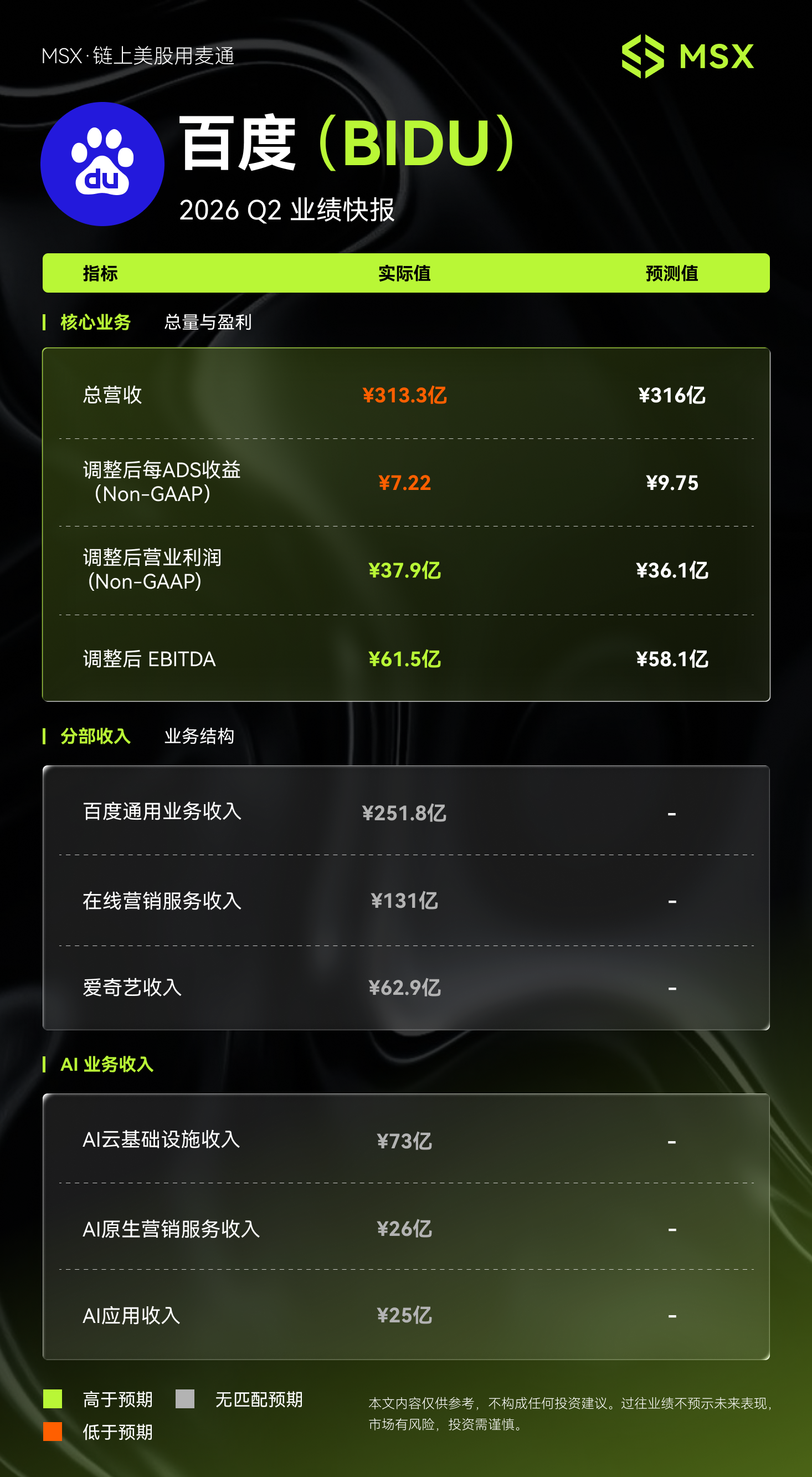
MSX US Stock Daily Observation: Baidu 2026 Q2 Earnings: AI Revenue Accounts for Half of Core Business for Two Consecutive Quarters, 283% GPU Cloud Growth Boosts Business Transformation

**MSX Daily US Stock Observation: Baidu 2026 Q2 Earnings Report** Baidu's Q2 2026 earnings present a clear picture of a company in transition. Total revenue declined slightly to RMB 313.25 billion, missing market expectations. This was driven by a continued double-digit contraction (-19%) in its core online marketing (advertising) business. The key highlight is the structural shift within the company's operations. AI-related revenue reached RMB 125 billion, accounting for approximately half of Baidu's core business income for the second consecutive quarter. Within AI, growth is heavily skewed towards infrastructure: AI cloud infrastructure revenue grew 50% year-over-year to RMB 73 billion, with GPU cloud revenue surging 283%. In contrast, AI application and AI-native marketing services revenue grew only 3% and remained flat, respectively, indicating slower commercialization on the application side. Profitability metrics were mixed. While adjusted operating profit and EBITDA exceeded expectations, demonstrating cost control, adjusted earnings per ADS of RMB 7.22 fell short by about 26%. This gap is largely attributed to depreciation and amortization costs linked to significant AI infrastructure investments, which continue to pressure bottom-line profit realization. The company holds a substantial cash position of RMB 2831 billion, providing runway for continued investment. The critical challenge ahead is translating the explosive growth in AI infrastructure (like GPU cloud) into stronger monetization from AI applications to bridge the gap between operational profit and per-share earnings.

Odaily星球日报3 хв тому

MSX US Stock Daily Observation: Baidu 2026 Q2 Earnings: AI Revenue Accounts for Half of Core Business for Two Consecutive Quarters, 283% GPU Cloud Growth Boosts Business Transformation

Odaily星球日报3 хв тому

Bitwise CIO: Three Major Cognitive Errors Common Among Crypto Investors Today

Bitwise CIO Matt Hougan highlights three key misconceptions he believes many crypto investors currently hold, presenting them as opportunities for those who see beyond them. First, investors significantly underestimate the total addressable market for crypto applications. While many view platforms like Uniswap only as tools for trading crypto assets (a ~$2 trillion market), their true potential lies in tokenizing and trading *all* asset classes—such as stocks and bonds—which represent markets hundreds of trillions of dollars in size. Second, there's a persistent overestimation of traditional financial institutions' ability to dominate crypto-native sectors. Examples like PayPal's stable币 (with ~1% market share vs. Tether/Circle's 88%) and Fidelity's custody business (trailing Coinbase) show that crypto-native firms often win due to faster iteration, focused expertise, and established user trust within the crypto ecosystem. Third, investors linearly extrapolate future on-chain transaction volumes from today's data, severely underestimating potential growth. The shift to 24/7 trading for tokenized assets could multiply trading hours by 5x. When combined with AI agents that may execute trades far more frequently than humans, transaction volumes could grow by 10x to 100x, massively boosting revenue for underlying blockchains and applications. Hougan concludes that the gap between the rapid pace of industry change and slower mainstream perception updates creates significant investment opportunities.

marsbit6 хв тому

Bitwise CIO: Three Major Cognitive Errors Common Among Crypto Investors Today

marsbit6 хв тому

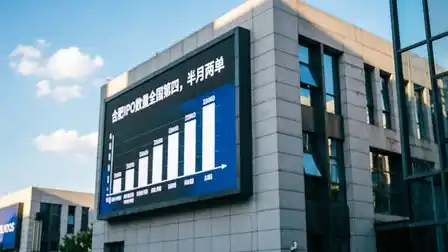
Two IPOs in Half a Month: Hefei Becomes China's Fourth City

Hefei, China's "Capital of Venture Capital," Ascends to Fourth Place in A-P-Share Market Value with Two Recent IPOs Within two weeks, two major IPOs propelled Hefei's A-share market capitalization from 1.27 trillion yuan to over 4.55 trillion yuan, ranking the city fourth nationwide, behind only Beijing, Shenzhen, and Shanghai. This surge is led by Changxin's massive listing, creating over 1 trillion yuan in paper gains for state-owned investors. Simultaneously, Hefei's GDP growth leads among Chinese cities exceeding 1 trillion yuan GDP. This success stems not from gambling on single companies, but from a decades-long, systematic "industrial investment" strategy. Hefei targets critical gaps in its industrial chain, providing patient capital. It invested in BOE in 2008 to secure display panels for its appliance hub, in Changxin in 2016 for semiconductors, and in NIO in 2020 to anchor a new energy vehicle cluster. Each investment was calculated based on long-term industrial necessity. Another IPO, Guoyi Quantum, originates from Hefei's ecosystem. Founded by a prodigy inspired by his professor's experience with overpriced foreign instruments, it symbolizes high-end scientific instrument localization. Behind the trillion-yuan paper gains is remarkable political continuity and a self-reinforcing cycle. Proceeds from earlier successful exits (e.g., BOE, NIO) were reinvested into newer projects like Changxin. The strategy withstands individual project failures and transcends typical government terms, focusing on decade-long industrial cultivation. Hefei's system integrates the University of Science and Technology of China for tech talent, state capital for long-term funding, and an unwavering focus on building complete industrial chains. While risks remain—market volatility, intense EV competition, quantum's commercialization timeline—Hefei demonstrates that when a government calculates returns over decades, the outcome differs fundamentally from short-term bets.

marsbit10 хв тому

Two IPOs in Half a Month: Hefei Becomes China's Fourth City

marsbit10 хв тому

Торгівля

Спот
活动图片