Tether Invests $100M In Anchorage Digital While HYPER Gains Momentum

bitcoinistОпубліковано о 2026-02-05Востаннє оновлено о 2026-02-05

Анотація

Stablecoin issuer Tether has invested $100 million in the federally chartered crypto custodian Anchorage Digital. This strategic move aims to support the launch of a new U.S.-focused stablecoin, $USAT, leveraging Anchorage’s regulatory compliance to attract institutional interest. Simultaneously, Bitcoin Hyper ($HYPER) is gaining traction as a Bitcoin Layer 2 solution integrating the Solana Virtual Machine (SVM) to solve Bitcoin’s scalability issues. It enables high-speed transactions and complex DeFi applications while settling on Bitcoin’s secure base layer. The project has raised over $31 million in its presale, with significant whale activity indicating strong investor confidence. $HYPER aims to unlock Bitcoin’s dormant capital by offering high-yield DeFi opportunities with Solana-like speed.

Stablecoin titan Tether has officially deployed $100M into Anchorage Digital, the San Francisco-based crypto custodian. It’s a strategic pivot.

Instead of just providing liquidity, the $USDT issuer is buying its way into the bedrock of regulated digital asset infrastructure. The capital is largely aimed at backing $USAT, a new stablecoin tailored for the US market, using Anchorage’s status as a federally chartered crypto bank as leverage.

Tether is effectively buying regulatory air cover and institutional rails. By partnering with Anchorage (which holds a charter from the Office of the Comptroller of the Currency), Tether is signaling a hard shift toward compliance-first expansion. It comes right as traditional finance firms are scrambling for ‘safe’ entry points into the digital asset economy.

But while institutions fortify the custody layers, the real infrastructure revolution is happening on the Bitcoin network itself. As Tether locks down banking rails, smart money is rotating into execution layers designed to unlock Bitcoin’s dormant capital.

This search for yield has directed massive volume toward Bitcoin Hyper ($HYPER), a project fixing the ecosystem’s single biggest flaw: Bitcoin’s inability to scale for DeFi.

SVM Integration Answers The Bitcoin Scalability Trilemma

For years, the bottleneck preventing Bitcoin from moving beyond ‘digital gold’ was technical. The network is secure, sure, but it’s notoriously slow and can’t handle complex contracts.

Bitcoin Hyper ($HYPER) is dismantling that barrier by integrating the Solana Virtual Machine (SVM) directly as a Layer 2 solution. It’s a massive architectural shift. By using the SVM, Bitcoin Hyper delivers sub-second finality and Solana-grade throughput, all while settling on the Bitcoin network.
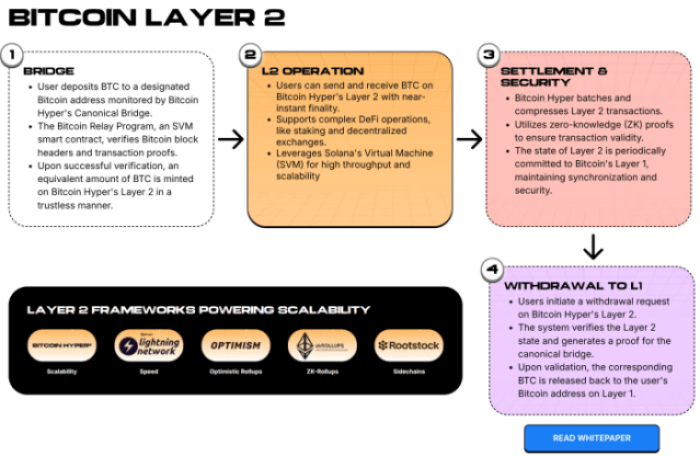
It’s the best of both worlds scenario that developers have chased for a decade. Previous Bitcoin L2 attempts usually suffered from high latency or centralization risks. By employing a decentralized canonical bridge and a modular structure, Bitcoin Hyper allows high-speed payments and complex apps, swaps, lending, and gaming to run on Bitcoin without clogging the main chain.

The implications are massive. If holders can deploy assets into high-yield DeFi protocols with Solana’s speed, trillions in dormant $BTC capital could be unlocked. The architecture mirrors the modular scaling thesis that dominated Ethereum’s roadmap, finally applying it effectively to the Bitcoin ecosystem.

EXPLORE THE $HYPER ECOSYSTEM

High Project Conviction Signal – Whales

The market’s appetite for this solution is visible in the on-chain data surrounding the $HYPER presale. According to live metrics, it has already raised over $31M, a figure that suggests validation from both retail and sophisticated investors.

With the token currently priced at $0.0136751, early positioning is aggressive before the protocol hits its Token Generation Event (TGE).

It’s also worth noting that a big signal of conviction in the project is bellowing – whales. Etherscan data reveals high-net-worth wallets have spent over $1M. The largest transaction was for $500K. That type of accumulation during a presale shows whales hedging against listing volatility by securing an entry price well below projected market value.

The $HYPER incentive structure is designed to lock in long-term liquidity. The protocol offers high APY staking immediately after TGE, with a modest 7-day vesting period for presale stakers. This reduces immediate sell pressure and aligns investor interests with the network’s stability.

As Tether creates a regulated environment for stablecoins, Bitcoin Hyper is building the high-velocity rails where those assets can actually be used.

BUY YOUR $HYPER ON THE OFFICIAL PRESALE PAGE

The information provided in this article is not financial advice. Cryptocurrency investments carry inherent risks, including high volatility and potential loss of capital. Always conduct your own research (DYOR) before making any investment decisions.


Пов'язані питання

QWhat is the strategic significance of Tether's $100 million investment in Anchorage Digital?

ATether's investment represents a strategic pivot toward compliance-first expansion, leveraging Anchorage Digital's status as a federally chartered crypto bank to gain regulatory approval and institutional infrastructure for its new US-focused stablecoin, $USAT.

QHow does Bitcoin Hyper ($HYPER) aim to solve Bitcoin's scalability issues?

ABitcoin Hyper integrates the Solana Virtual Machine (SVM) as a Layer 2 solution, providing sub-second finality and high throughput while settling on the Bitcoin network, enabling complex DeFi applications without congesting the main chain.

QWhat evidence suggests strong market confidence in the $HYPER project during its presale?

AThe presale has raised over $31 million, with on-chain data showing significant whale activity, including a $500,000 transaction, indicating high conviction from both retail and sophisticated investors.

QHow does the article contrast Tether's approach with Bitcoin Hyper's role in the crypto ecosystem?

ATether is focusing on building regulated infrastructure for stablecoins, while Bitcoin Hyper is creating high-speed execution layers to unlock Bitcoin's dormant capital for DeFi and other applications.

QWhat mechanism does $HYPER use to reduce immediate sell pressure after its Token Generation Event (TGE)?

AThe protocol offers high APY staking immediately after TGE with a 7-day vesting period for presale stakers, aligning investor interests with network stability and reducing sell pressure.

Пов'язані матеріали

Within Strategy's Framework, STRC's Dividend Yield Remains at 12% as Share Price Stays Below Par Value

Michael Saylor, Executive Chairman of Strategy (MSTR), confirmed that the dividend rate for its STRC perpetual preferred shares will remain at 12.00% through August 2026. The rate has increased from 9% at its July 2025 launch to the current high via a "ratchet" mechanism, which permanently raises the rate by 0.5% whenever the share price falls below $95. This mechanism is intended to push the price back toward its $100 par value and support Strategy's "at-the-market" (ATM) program for issuing new shares to fund Bitcoin purchases. However, the mechanism has not worked as intended. STRC shares closed at $89.46 on July 31, remaining about 10-11% below par value despite the record-high dividend. Competition from rival Strive's higher-yielding SATA securities has pressured demand. The persistent discount has forced Strategy to suspend new STRC issuances via its ATM program, limiting this funding channel for Bitcoin acquisitions. STRC's struggles reflect Bitcoin's own volatility, as the preferred shares historically move in tandem. Analysts have warned the ratchet structure carries long-term, one-way risk. A law firm is investigating Strategy's ability to maintain dividend payments if Bitcoin's price stays low. Retail investors own roughly 83% of outstanding STRC shares, a group seen as prone to panic selling during downturns. In response, Strategy has established financial reserves, including a liquidity cushion covering about 26 months of dividend/interest obligations, and a $2 billion share buyback program alongside a Bitcoin monetization framework, though the company emphasized it is not obligated to sell any Bitcoin.

cryptonews.ru34 хв тому

Within Strategy's Framework, STRC's Dividend Yield Remains at 12% as Share Price Stays Below Par Value

cryptonews.ru34 хв тому

Analyst: Bitcoin's Price Will Drop to $60k in August, Then Rebound to $70k

Financial analyst Andrey Poroshin has provided a new forecast for Bitcoin's price dynamics in August. Poroshin, an analyst at the Bitbanker exchange, expects the cryptocurrency market to experience a downturn this month, with prices retesting the $60,000 level due to a lack of supportive macroeconomic catalysts. He noted that the recent US Federal Reserve decision to hold interest rates did not significantly impact the market, while inflation remains above the 2% target. Poroshin stated that Bitcoin is ending July under pressure from moderate volatility and a lack of new macroeconomic stimuli, leading to continued market caution. According to his base scenario, Bitcoin will drop to a range of $60,000 to $62,000 before recovering to $70,000. He pointed out that even $70,000 remains below the cost of mining in the US, which has prompted some miners to shift towards AI data center operations. Poroshin cited the winding down of BitMEX's operations as a potential catalyst for a price rebound, suggesting the exit of weaker players often coincides with market reversals and reduced short-term selling pressure. He believes Bitcoin is currently less susceptible to geopolitical shocks, such as the Iran-US conflict, and does not expect significant market changes in August related to the pending CLARITY Act. Looking ahead, Poroshin forecasts that September will bring more active price fluctuations driven by potential Fed rate decisions and possible discussions or approval of the CLARITY Act.

cryptonews.ru34 хв тому

Analyst: Bitcoin's Price Will Drop to $60k in August, Then Rebound to $70k

cryptonews.ru34 хв тому

Торгівля

Спот
活动图片




