Tether Invests $100M In Anchorage Digital While HYPER Gains Momentum

bitcoinistОпубліковано о 2026-02-05Востаннє оновлено о 2026-02-05

Анотація

Stablecoin issuer Tether has invested $100 million in the federally chartered crypto custodian Anchorage Digital. This strategic move aims to support the launch of a new U.S.-focused stablecoin, $USAT, leveraging Anchorage’s regulatory compliance to attract institutional interest. Simultaneously, Bitcoin Hyper ($HYPER) is gaining traction as a Bitcoin Layer 2 solution integrating the Solana Virtual Machine (SVM) to solve Bitcoin’s scalability issues. It enables high-speed transactions and complex DeFi applications while settling on Bitcoin’s secure base layer. The project has raised over $31 million in its presale, with significant whale activity indicating strong investor confidence. $HYPER aims to unlock Bitcoin’s dormant capital by offering high-yield DeFi opportunities with Solana-like speed.

Stablecoin titan Tether has officially deployed $100M into Anchorage Digital, the San Francisco-based crypto custodian. It’s a strategic pivot.

Instead of just providing liquidity, the $USDT issuer is buying its way into the bedrock of regulated digital asset infrastructure. The capital is largely aimed at backing $USAT, a new stablecoin tailored for the US market, using Anchorage’s status as a federally chartered crypto bank as leverage.

Tether is effectively buying regulatory air cover and institutional rails. By partnering with Anchorage (which holds a charter from the Office of the Comptroller of the Currency), Tether is signaling a hard shift toward compliance-first expansion. It comes right as traditional finance firms are scrambling for ‘safe’ entry points into the digital asset economy.

But while institutions fortify the custody layers, the real infrastructure revolution is happening on the Bitcoin network itself. As Tether locks down banking rails, smart money is rotating into execution layers designed to unlock Bitcoin’s dormant capital.

This search for yield has directed massive volume toward Bitcoin Hyper ($HYPER), a project fixing the ecosystem’s single biggest flaw: Bitcoin’s inability to scale for DeFi.

SVM Integration Answers The Bitcoin Scalability Trilemma

For years, the bottleneck preventing Bitcoin from moving beyond ‘digital gold’ was technical. The network is secure, sure, but it’s notoriously slow and can’t handle complex contracts.

Bitcoin Hyper ($HYPER) is dismantling that barrier by integrating the Solana Virtual Machine (SVM) directly as a Layer 2 solution. It’s a massive architectural shift. By using the SVM, Bitcoin Hyper delivers sub-second finality and Solana-grade throughput, all while settling on the Bitcoin network.
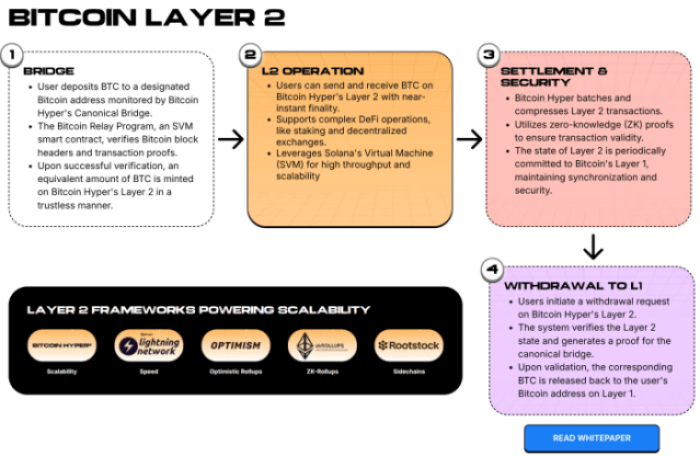
It’s the best of both worlds scenario that developers have chased for a decade. Previous Bitcoin L2 attempts usually suffered from high latency or centralization risks. By employing a decentralized canonical bridge and a modular structure, Bitcoin Hyper allows high-speed payments and complex apps, swaps, lending, and gaming to run on Bitcoin without clogging the main chain.

The implications are massive. If holders can deploy assets into high-yield DeFi protocols with Solana’s speed, trillions in dormant $BTC capital could be unlocked. The architecture mirrors the modular scaling thesis that dominated Ethereum’s roadmap, finally applying it effectively to the Bitcoin ecosystem.

EXPLORE THE $HYPER ECOSYSTEM

High Project Conviction Signal – Whales

The market’s appetite for this solution is visible in the on-chain data surrounding the $HYPER presale. According to live metrics, it has already raised over $31M, a figure that suggests validation from both retail and sophisticated investors.

With the token currently priced at $0.0136751, early positioning is aggressive before the protocol hits its Token Generation Event (TGE).

It’s also worth noting that a big signal of conviction in the project is bellowing – whales. Etherscan data reveals high-net-worth wallets have spent over $1M. The largest transaction was for $500K. That type of accumulation during a presale shows whales hedging against listing volatility by securing an entry price well below projected market value.

The $HYPER incentive structure is designed to lock in long-term liquidity. The protocol offers high APY staking immediately after TGE, with a modest 7-day vesting period for presale stakers. This reduces immediate sell pressure and aligns investor interests with the network’s stability.

As Tether creates a regulated environment for stablecoins, Bitcoin Hyper is building the high-velocity rails where those assets can actually be used.

BUY YOUR $HYPER ON THE OFFICIAL PRESALE PAGE

The information provided in this article is not financial advice. Cryptocurrency investments carry inherent risks, including high volatility and potential loss of capital. Always conduct your own research (DYOR) before making any investment decisions.


Пов'язані питання

QWhat is the strategic significance of Tether's $100 million investment in Anchorage Digital?

ATether's investment represents a strategic pivot toward compliance-first expansion, leveraging Anchorage Digital's status as a federally chartered crypto bank to gain regulatory approval and institutional infrastructure for its new US-focused stablecoin, $USAT.

QHow does Bitcoin Hyper ($HYPER) aim to solve Bitcoin's scalability issues?

ABitcoin Hyper integrates the Solana Virtual Machine (SVM) as a Layer 2 solution, providing sub-second finality and high throughput while settling on the Bitcoin network, enabling complex DeFi applications without congesting the main chain.

QWhat evidence suggests strong market confidence in the $HYPER project during its presale?

AThe presale has raised over $31 million, with on-chain data showing significant whale activity, including a $500,000 transaction, indicating high conviction from both retail and sophisticated investors.

QHow does the article contrast Tether's approach with Bitcoin Hyper's role in the crypto ecosystem?

ATether is focusing on building regulated infrastructure for stablecoins, while Bitcoin Hyper is creating high-speed execution layers to unlock Bitcoin's dormant capital for DeFi and other applications.

QWhat mechanism does $HYPER use to reduce immediate sell pressure after its Token Generation Event (TGE)?

AThe protocol offers high APY staking immediately after TGE with a 7-day vesting period for presale stakers, aligning investor interests with network stability and reducing sell pressure.

Пов'язані матеріали

The End of the Crypto Premium? Market Logic Shift Seen Through Gemini's Post-IPO Struggles

The article "The End of the Crypto Premium? Market Logic Shifts as Gemini Struggles Post-IPO" examines the dramatic downturn of cryptocurrency exchange Gemini following its public listing in September 2025. Initially part of a wave of crypto IPOs, including Bullish, which saw soaring valuations and massive investor interest, Gemini's stock price has since collapsed by over 80%, falling from $28 to around $5. The company has cut 30% of its workforce, exited international markets, and faces significant financial strain, including $330 million in Bitcoin-denominated debt. The core argument is that Gemini's struggles reflect a broader market shift where the "excess premium" once associated with crypto assets is disappearing. Two key factors are identified: the erosion of regulatory arbitrage, as compliance costs rise for all players (up 22.5% for small firms in 2026), and the decline of liquidity scarcity premiums, as institutional investors now access crypto via low-friction ETFs and stocks rather than volatile altcoins. The approval of Bitcoin and other crypto ETPs, which now manage $1.8 trillion globally, has diverted institutional capital away from altcoins, causing their liquidity to dry up and volatility to increase. For Gemini, its strategy of being "the most compliant exchange" became a liability in a bear market, as fixed compliance costs remained high while trading revenue fell. The article concludes that the era of narrative-driven crypto valuations is ending, giving way to a market logic focused on fundamentals like actual usage, liquidity depth, and sustainable institutional adoption.

marsbit42 хв тому

The End of the Crypto Premium? Market Logic Shift Seen Through Gemini's Post-IPO Struggles

marsbit42 хв тому

Utexo Partners with x402 to Provide Near-Instant USDT Settlement for the Agent Economy

Utexo, a Bitcoin-native stablecoin payment execution and settlement layer, has partnered with x402 to integrate USDT compatibility into the x402 payment protocol. This collaboration enables near-instant settlement for agent-to-agent transactions, with speeds as fast as 50 milliseconds. x402 is an open protocol that uses the HTTP 402 "Payment Required" status code to embed payment functionality directly into HTTP requests. This allows applications, APIs, and autonomous systems to pay for services in real-time without requiring pre-funded accounts. The integration expands x402’s initial USDC support to include USDT, one of the most widely used stablecoins globally. Utexo’s infrastructure is designed for high-frequency, low-latency transactions, making it well-suited for machine-driven payments. According to Utexo CEO Viktor Ihnatiuk, supporting USDT within the x402 framework significantly broadens access and provides developers the performance needed for real-time agent-based systems. Kevin Leffew of x402 at Coinbase added that expanding stablecoin access improves performance and accelerates developer adoption. This partnership supports growing use cases where software systems autonomously conduct transactions—such as paying for API calls, accessing data on-demand, and coordinating services across platforms without human intervention. By combining x402’s protocol with Utexo’s settlement infrastructure, the collaboration enables a payment model where transactions are as fast and efficient as the requests that trigger them.

marsbit3 год тому

Utexo Partners with x402 to Provide Near-Instant USDT Settlement for the Agent Economy

marsbit3 год тому

Торгівля

Спот
Ф'ючерси
活动图片




