Tether Expands South Korea Trademark Filings As Stablecoin Rules Take Shape

bitcoinistОпубліковано о 2026-05-21Востаннє оновлено о 2026-05-21

Анотація

Tether has significantly expanded its trademark filings in South Korea, applying for seven trademarks covering its company name, logo, and Tether Gold (XAUT) token, a strategic departure from its previous focus on just product names. This move, coinciding with South Korea's development of new stablecoin regulations, suggests Tether is preparing to establish a formal business presence in the country, potentially in response to upcoming rules that may require foreign issuers to set up local branches. South Korea's large and active crypto market makes it a crucial battleground. Rival stablecoin issuer Circle has already made inroads, filing trademarks last year and increasing USDC's market share. While Circle has advanced its local relationships through high-level meetings, Tether's strategy also targets the broader payments landscape. It sees an opportunity to serve South Korea's export economy by offering faster, cheaper cross-border transactions using stablecoins as payment tools, indicating a future competition that extends beyond trading into mainstream finance.

Tether’s latest move in South Korea goes beyond protecting a product name. The company behind the world’s largest stablecoin filed seven trademark applications with the Korea Intellectual Property Rights Information Service on May 19, covering not just its tokens but its company name, official logo, and gold-backed asset Tether Gold, known as XAUT.

A Shift In Strategy

That’s a departure from how Tether has approached South Korea before. Earlier filings were limited to stablecoin product names. Covering the broader brand signals something bigger — a possible push toward establishing an actual business presence in the country, not just protecting a label.

Timing is everything here. South Korea is in the middle of drafting new rules under the second phase of its Digital Asset Basic Act.

One proposal under discussion would require foreign stablecoin companies to set up a local branch before they can legally offer their tokens to South Korean users.
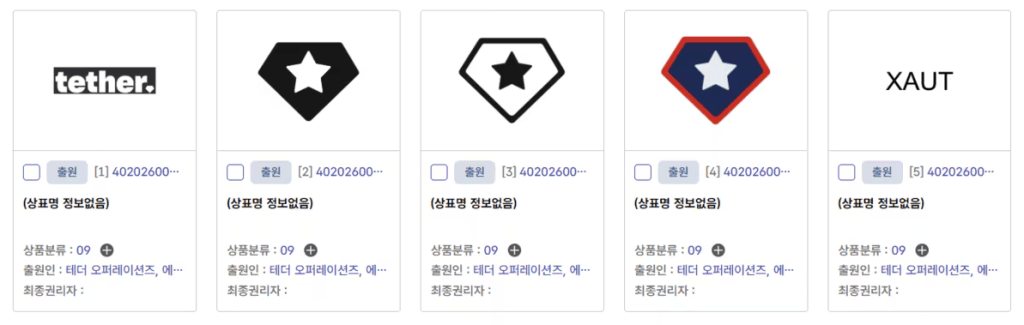
Trademarks for Tether's company name and logo filed with KIPRIS.

Tether’s trademark filings, some observers say, look like early preparation for that kind of requirement.

South Korea is not a small market. The country has one of the most active retail crypto trading populations in the world, which makes it a place no major stablecoin issuer can afford to ignore.

Circle Already Has A Head Start

Tether is not alone in moving on South Korea. Circle, the company behind USDC, filed 11 local trademarks last year and has already seen results — USDC’s market share in the country grew by 10%.

USDT market cap currently at $189 billion. Chart: TradingView

Tether now has seven active trademarks in South Korea, a number that has been growing as competition between the two stablecoin giants heats up.

Earlier this year, Circle CEO Jeremy Allaire traveled to South Korea and held meetings with major banks and crypto exchanges, exploring possible partnerships.

That kind of ground-level relationship building puts Circle ahead in terms of local ties, at least for now.

Seoul, South Korea. Image: Silversea

Payments, Not Just Trading

The trademark filings also fit into a wider ambition Tether has for South Korea. The country runs a significant export economy, and businesses there regularly move money across borders.

Tether sees that as an opening. Using blockchain-based payments instead of traditional bank transfers through systems like SWIFT could offer faster, cheaper transactions for South Korean exporters.

That vision — stablecoins as a real payment tool, not just a trading instrument — reflects where the bigger competition between Tether and Circle may eventually play out, well beyond crypto exchanges and into mainstream finance.

Featured image from Unsplash, chart from TradingView

Пов'язані питання

QWhat is the main strategic shift indicated by Tether's recent trademark filings in South Korea?

AThe main strategic shift indicated is that Tether is now filing to protect its broader brand, including its company name, logo, and Tether Gold, rather than just product names. This signals a possible push toward establishing a formal business presence in the country, potentially in response to upcoming regulations.

QWhat specific regulatory requirement might Tether be preparing for with these trademark filings?

ATether might be preparing for a proposed requirement under South Korea's new Digital Asset Basic Act rules that would mandate foreign stablecoin companies to set up a local branch before legally offering their tokens to South Korean users.

QHow is Circle's position in the South Korean market different from Tether's according to the article?

ACircle already has a head start in the South Korean market. It filed trademarks last year, saw USDC's market share grow by 10%, and its CEO has personally traveled to South Korea to build ground-level relationships with major banks and crypto exchanges, giving it stronger local ties for now.

QBeyond crypto trading, what other major use case does Tether see for stablecoins in South Korea?

ABeyond crypto trading, Tether sees stablecoins as a payment tool for international commerce. It aims to serve South Korea's significant export economy by offering faster and cheaper blockchain-based cross-border payments for businesses, as an alternative to traditional systems like SWIFT.

QWhat broader competition does the article suggest is developing between Tether and Circle?

AThe article suggests the broader competition is shifting beyond dominance on crypto exchanges and into mainstream finance, specifically in establishing stablecoins as practical tools for global payments and financial services.

Пов'язані матеріали

When Hyperliquid Takes Away Solana's "Internet Capital Markets" Script

The article discusses how Solana's vision of becoming the "Internet Capital Markets" is being challenged, primarily by the rise of Hyperliquid. While Solana positioned itself as a high-performance blockchain for tokenizing all global assets, its native token SOL has significantly underperformed, and its core narrative faces pressure. Hyperliquid, initially a perpetual contracts platform, has evolved into a specialized Layer 1 financial network. Its focused, trading-optimized design is attracting users and capital, suggesting a vertical L1 may be better suited for a core capital market than a general-purpose chain like Solana. This external competition was compounded by an internal $200M+ exploit on Solana's key derivatives protocol, Drift, creating a strategic vacuum. In response, Solana founder Anatoly Yakovenko heavily promoted the Phoenix protocol as a decentralized, composable alternative. However, Phoenix's trading volume remains far behind leading platforms. Solana supporters also launched critiques against Hyperliquid's decentralization, citing its limited validators and closed-source code. Critics countered that Solana's own decentralization metrics have weakened, and the foundation's overt backing of Phoenix caused friction with other ecosystem builders. The piece concludes that Solana risks losing the "Internet Capital Markets" race if it cannot regain dominance in derivatives, potentially remaining a meme coin hub rather than achieving its grand ambition of hosting all global assets.

marsbit1 год тому

When Hyperliquid Takes Away Solana's "Internet Capital Markets" Script

marsbit1 год тому

Trump Signs Executive Order, Kraken, Coinbase and Others May Gain Access to Fed Payment Channels

President Trump has signed an executive order, "Incorporating Financial Technology Innovation into the Regulatory Framework," pressuring the Federal Reserve to reassess its rules on granting non-bank financial companies—including crypto and fintech firms—access to its payment systems, specifically master accounts that connect to the Fedwire settlement system. Currently, such accounts are primarily reserved for depository institutions. The order mandates a review to determine if broader access is permissible and to establish an application process. This move, supported by figures like Senator Cynthia Lummis, aims to reduce barriers to innovation and lower public payment costs by fostering fairer competition. It does not grant immediate access but could pave the way for companies like Kraken, Coinbase, Ripple, and Circle to reduce reliance on intermediary banks, lowering costs and speeding up settlements. A key precedent is the Kansas City Fed granting Kraken's parent company a restricted master account in March, offering limited payment services without interest or credit privileges. This model is seen as a potential template for allowing controlled access while mitigating systemic risk. Other firms like Anchorage, Paxos, and BitGo, which hold specialized banking charters, are also well-positioned to apply. The banking industry, represented by the American Bankers Association, opposes easing access, arguing any institution handling bank-like payments must meet the same stringent regulatory, consumer protection, and risk-management standards as traditional banks. Their core concerns include potential systemic risks, compliance gaps in areas like anti-money laundering, and the diversion of liquidity from the traditional banking system. The outcome of the Fed's review will be crucial in determining whether and how crypto and fintech firms can integrate more directly into the core U.S. financial infrastructure, balancing innovation with financial stability.

marsbit1 год тому

Trump Signs Executive Order, Kraken, Coinbase and Others May Gain Access to Fed Payment Channels

marsbit1 год тому

The First Large-Scale Strike in the AI Era Comes from the Factories That Build AI

The article describes a potential large-scale strike at Samsung Electronics, narrowly averted in May 2026 after a temporary agreement. The strike, planned by the company's union, would have been the first major labor action in the AI era targeting a core AI supply chain player. Samsung, alongside SK Hynix, produces roughly two-thirds of the world's memory chips, critical components for AI training and data centers like HBM. An 18-day strike could have disrupted global supply, affecting prices and production for tech companies and cloud providers. For South Korea, where semiconductors constitute about 35% of exports and Samsung represents a quarter of the stock market's value, such an action threatens national economic stability. The union's demands include a 7% base wage increase and, crucially, a clear, substantial profit-sharing model. They want 15% of annual operating profit as an employee bonus pool and the removal of the existing cap (about 50% of annual salary). This frustration is amplified by seeing rival SK Hynix successfully negotiate a deal granting employees 10% of operating profit as bonuses, with reports suggesting some workers could receive bonuses equivalent to hundreds of thousands of dollars. The conflict stems from deeper issues in South Korea's chaebol (conglomerate) system, where rapid national industrialization often prioritized corporate growth over labor rights. Samsung long maintained a "no union" policy until a 2020 apology from its leader. The article argues this strike highlights a fundamental tension in the AI age: as technology advances and corporate profits soar—often driven by AI—the workers who build the infrastructure are demanding a fair share and dignity, rejecting the notion that they are mere expendable components in a machine that "must not stop." The piece concludes that the true test of the AI era isn't just computational power, but whether the people who build the future can secure a stable and valued place within it.

marsbit2 год тому

The First Large-Scale Strike in the AI Era Comes from the Factories That Build AI

marsbit2 год тому

Ripple’s Fed Master Account Bid Gains Momentum After Trump Order

President Donald Trump has signed an executive order directing financial regulators and the Federal Reserve to review expanding fintech and crypto firms' access to core payment infrastructure. This order significantly advances the industry's push for direct Fed connectivity, a central issue for Ripple. The company has been seeking a Federal Reserve master account as part of its strategy for its RLUSD stablecoin, which would allow it to hold reserves directly with the central bank and access its payment rails. The order, titled "Integrating Financial Technology Innovation into Regulatory Frameworks," mandates a Fed review within 120 days on allowing access for entities like uninsured depository institutions and non-bank financial companies, including those in digital assets. This creates a formal policy timeline for resolving whether crypto payment firms must rely on traditional bank intermediaries. Ripple's application for a national bank charter and a master account is part of this broader landscape. The issue gained precedent when Kraken Financial received a limited-purpose master account, while Custodia Bank's application was denied after a legal battle. The Fed has also proposed a more restricted "payment account" option. Trump's order does not guarantee approval for Ripple but forces a high-level examination of the regulatory barriers, bringing the company's long-running effort to the forefront of Washington's financial policy agenda.

bitcoinist2 год тому

Ripple’s Fed Master Account Bid Gains Momentum After Trump Order

bitcoinist2 год тому

Торгівля

Спот
Ф'ючерси
活动图片