Tennessee Regulator Sends Cease-And-Desist Letters To Polymarket, Kalshi, Crypto.com — Details

bitcoinistОпубліковано о 2026-01-11Востаннє оновлено о 2026-01-11

Анотація

The Tennessee Sports Wagering Council (SWC) has issued cease-and-desist letters to prediction market platforms Polymarket, Kalshi, and Crypto.com, accusing them of offering illegal sports betting contracts to state residents without the required licenses. The regulator ordered the firms to void all pending contracts from Tennessee customers and refund their deposits by January 31, 2026. It cited significant consumer protection risks and threatened fines of up to $25,000 per violation, as well as injunctive relief for non-compliance. This action highlights increasing state-level regulatory scrutiny of prediction markets, even though these platforms are registered with the CFTC and permitted to operate nationally. Similar orders were previously issued in Connecticut.

Tennessee’s sports betting regulator has ordered Polymarket, Kalshi, and Crypto.com to cease offering sports betting contracts, bringing focus to the regulatory landscape of event contract exchanges. The agency accused the three major prediction market platforms of violating state gambling laws by operating in Tennessee without the required licenses.

Polymarket, Others Threatened With Fines For Offering Sports Event Contracts

On Friday, January 9, the Tennessee Sports Wagering Council (SWC) issued cease-and-desist letters to Polymarket, Kalshi, and Crypto.com’s Derivatives Exchange. In the letters, the state regulator asked all three prediction market firms to stop offering sports event contracts to the residents of Tennessee.

The state’s SWC also demanded that the three firms void all pending contracts entered into by Tennessee residents, and refund all customer deposits by January 31, 2026.

SWC Executive Director, Mary Beth Thomas, wrote in the letter to Polymarket:

The sports events contracts offered on Polymarket’s exchange are not compliant with these [Tennessee state consumer] protections (and many others) and are an immediate and significant threat to the public interest of Tennessee.

The language in the Tennessee Sports Wagering Council letters to Kalshi and Crypto.com was quite similar to Polymarket’s cease-and-desist letter. This comes despite all three platforms being registered as designated contract markets with the Commodity Futures Trading Commission (CFTC), allowing them to offer event-based derivatives contracts nationwide.
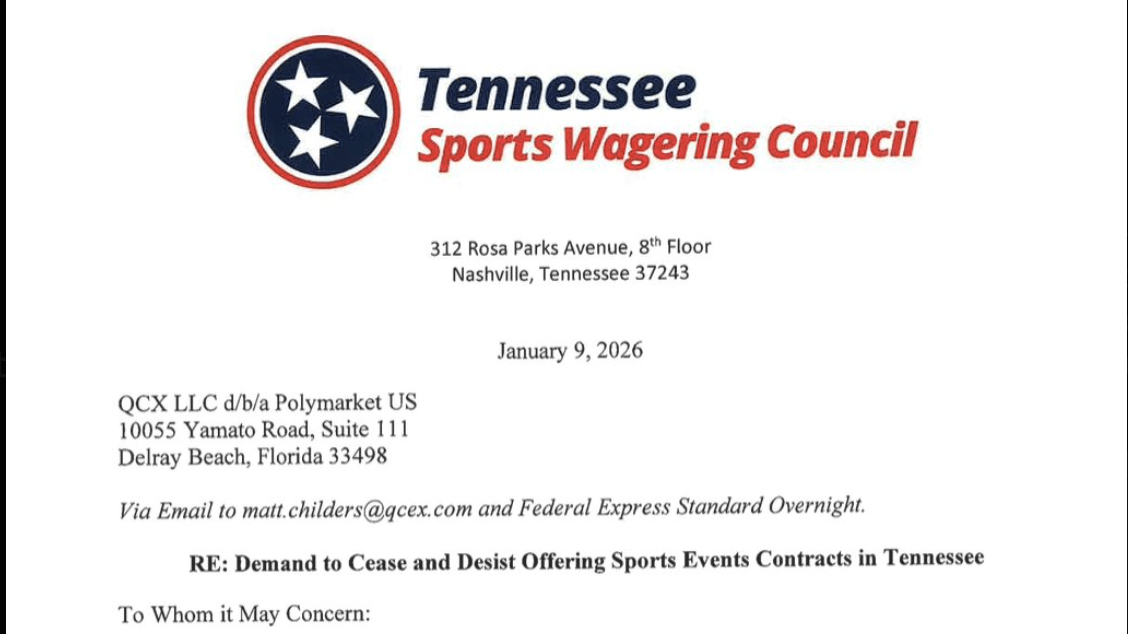
Source: @WALLACHLEGAL on X

Despite this CFTC designation, these prediction market firms have had regulatory run-ins with different states in the US. In December 2025, the state of Connecticut sent a trio of cease-and-desist orders to Robinhood, Kalshi, and Crypto.com. The firms based their defense at the time on receiving the CFTC’s approval to operate in the United States.

This Tennessee cease-and-desist order seems to be the first state-level regulatory issue faced by Polymarket, which currently only offers sports event contracts in the United States. In the letters, the Tennessee Sports Wagering Council threatened a range of penalties for any of the firms’ failure to comply.

One of the letters further read:

Failure to comply with the SWC’s demand will result in the imposition of fines pursuant to the Act, which states that the SWC shall impose a fine against any person offering wagers in Tennessee without a license in the amount of $10,000 for the first offense; $15,000 for a second offense; and $25,000 for a third or subsequent offense. ‘ Moreover, failure to comply with the SWC’s demand will result in the SWC seeking injunctive relief.

Prediction Markets Facing Increased Regulatory Scrutiny

The prediction markets, which gained prominence during the 2024 US elections, have continued to enjoy interest from users and institutional investors. However, the regulatory scrutiny faced by the industry has seen a similar surge lately.

For instance, a Polymarket trader reportedly netted record gains of over $400,000 from predicting the recent US military action in Venezuela, prompting talks of introducing a bill to prevent insider trading. As Bitcoinist reported, Rep. Ritchie Torres (D-N.Y.) plans to introduce a bill that would ban all government-affiliated individuals from participating in state-related events in the prediction market.

The price of BTC on the daily timeframe | Source: BTCUSDT chart on TradingView


Пов'язані питання

QWhich three companies did the Tennessee Sports Wagering Council (SWC) send cease-and-desist letters to?

AThe Tennessee Sports Wagering Council sent cease-and-desist letters to Polymarket, Kalshi, and Crypto.com's Derivatives Exchange.

QWhat is the main reason the Tennessee regulator ordered these platforms to stop operations?

AThe regulator accused them of violating state gambling laws by offering sports betting contracts to Tennessee residents without the required licenses.

QWhat federal regulatory body are these prediction market platforms registered with, and what does that registration allow them to do?

AThey are registered as designated contract markets with the Commodity Futures Trading Commission (CFTC), which allows them to offer event-based derivatives contracts nationwide.

QWhat are the potential financial penalties for these companies if they fail to comply with the SWC's demand?

AFines are $10,000 for the first offense, $15,000 for a second offense, and $25,000 for a third or subsequent offense. The SWC also threatened to seek injunctive relief.

QWhat recent high-profile event was cited as a reason for increased regulatory scrutiny of prediction markets?

AA Polymarket trader netted over $400,000 from predicting recent US military action in Venezuela, which prompted talks of introducing a bill to prevent insider trading.

Пов'язані матеріали

Will the Fed Definitely Raise Interest Rates in September? How Will Crypto and U.S. Stocks Withstand the Pressure?

The market's expectation for a September Fed rate hike surged dramatically in early August, jumping from under 50% to over 80% within a week. This shift followed a contentious July FOMC meeting, where a 9-3 vote to hold rates revealed growing dissent from hawkish members advocating for an immediate hike to combat persistent inflation. The primary catalyst for this repricing is rising oil prices, driven by renewed geopolitical tensions around the Strait of Hormuz, which threaten global supply. Energy costs directly influence inflation metrics, making the upcoming July CPI report (due August 12th) a critical data point. If it shows inflation reaccelerating, the probability of a September hike will solidify. For Bitcoin and crypto assets, this is typically bearish news. Bitcoin continues to behave as a high-beta, liquidity-sensitive risk asset. A rate hike raises the opportunity cost of holding non-yielding assets and could drive capital toward money markets, pressuring crypto prices in the short term. However, historical patterns suggest that if a hike is perceived as the end of a tightening cycle rather than the start, any negative price impact may be brief. U.S. stocks, particularly crypto-linked equities like Coinbase and growth-oriented tech stocks, are also vulnerable. Higher rates increase discount rates in valuation models, putting pressure on high-multiple companies. This coincides with a pivotal tech earnings season where investor focus has shifted from massive AI capital expenditure to tangible revenue and cash flow generation. Companies with negative cash flow and weak growth narratives could face heightened volatility if borrowing costs rise in September. In summary, a September Fed hike has evolved into a mainstream market scenario. Key factors to watch are oil prices, the July CPI report, and Fed communications, which will determine the final decision and its impact on volatile crypto and equity markets.

marsbit6 хв тому

Will the Fed Definitely Raise Interest Rates in September? How Will Crypto and U.S. Stocks Withstand the Pressure?

marsbit6 хв тому

A 'Overlooked' Market Event: Joint US-Japan-South Korea Intervention, Rare US Treasury Involvement, and Bessent's Quiet 'Market Rescue'?

Summary: The United States, Japan, and South Korea executed their largest coordinated foreign exchange intervention in nearly 30 years. The action targeted depreciation pressure on the Japanese yen and South Korean won. This move is seen as a significant effort by the US to stabilize the financial markets of its key allies and prevent the spillover of risks. Key details: * Japan reportedly intervened on July 30 using approximately 8.45 trillion yen (about $52.8 billion). South Korean authorities also intervened that day, selling dollars to support the won. * Notably, the US Treasury Department intervened directly in yen markets for the first time in roughly 30 years. The New York Fed, reportedly acting on behalf of the Treasury, sold euros to buy yen via Goldman Sachs and Morgan Stanley on July 31. Analysts view the use of the euro-yen pair as a way to alleviate yen pressure without adding selling pressure to the US dollar. * Prior to the action, the New York Fed conducted "rate checks" on both USD/JPY and EUR/JPY, a newer signaling tool that falls between verbal and physical intervention. The intervention is interpreted as going beyond traditional currency stabilization. Analysts, such as Michael Hartnett of Bank of America, suggest it resembles a "Price Keeping Operation" for the AI era. The core US objectives are perceived to be: 1. Preventing rapid yen depreciation from triggering a sharp rise in Japanese government bond yields. 2. Containing financial stress from spreading across Asian markets like South Korea and Japan. 3. Reducing the risk of disorderly capital flows impacting the US bond market. This coordinated action underscores the importance of Japan and South Korea as critical partners in the US semiconductor and AI supply chain. Stabilizing their financial markets is seen as vital to mitigating risks to the broader tech industry and the US market itself. The intervention coincides with market pressures, including the KOSDAQ index hitting a low since October 2022. While seen as a move to control volatility, some analysts caution it may not fundamentally reverse existing market trends.

marsbit9 хв тому

A 'Overlooked' Market Event: Joint US-Japan-South Korea Intervention, Rare US Treasury Involvement, and Bessent's Quiet 'Market Rescue'?

marsbit9 хв тому

Will the Federal Reserve Definitely Raise Interest Rates in September? How Will Cryptocurrencies and US Stocks Bear the Pressure?

In early August 2024, market expectations for a September Federal Reserve rate hike surged dramatically, from below 50% to over 80%, driven by renewed inflation concerns. This shift followed a contentious July FOMC meeting where a 9-3 vote to hold rates revealed a growing hawkish faction advocating for an immediate hike, citing prolonged above-target inflation. The key catalyst is escalating conflict near the Strait of Hormuz, which has pushed oil prices up approximately 20% in July, threatening to reignite inflation. The next critical data point is the July CPI report on August 12th; a hot reading could solidify hike expectations. For crypto assets, particularly Bitcoin, this represents near-term pressure. Bitcoin continues to exhibit high-beta, risk-on characteristics, making it sensitive to tightening liquidity and higher opportunity costs. However, historical precedent suggests that if a hike is perceived as the cycle's end rather than its start, the negative impact may be brief, with markets quickly pivoting to anticipate future rate cuts. U.S. stocks, especially crypto-linked equities like Coinbase and high-valuation tech stocks, face amplified volatility. Higher rates increase discount rates in valuation models, pressuring growth stocks. This coincides with a pivotal tech earnings season where investor focus has shifted from massive AI capital expenditures to demonstrable revenue and cash flow generation. Companies with negative cash flows and weak growth narratives could see severe pressure if a September hike materializes, as financing costs would rise. Key indicators to watch include oil prices, upcoming inflation data, and Fed commentary at events like the Jackson Hole symposium.

Odaily星球日报9 хв тому

Will the Federal Reserve Definitely Raise Interest Rates in September? How Will Cryptocurrencies and US Stocks Bear the Pressure?

Odaily星球日报9 хв тому

Торгівля

Спот
活动图片




