Telegram Financial Report Revealed: Main Revenue Actually Comes from Selling Coins!

marsbitОпубліковано о 2026-01-07Востаннє оновлено о 2026-01-07

Анотація

Telegram's unaudited financial report for the first half of 2025 reveals a 65% year-on-year revenue increase to $870 million, up from $525 million in the same period of 2024. However, the company reported a net loss of over $220 million, compared to a net profit of $334 million a year earlier. This loss is attributed to a significant decline in the value of its Toncoin (TON) holdings, leading to asset write-downs. Despite its growth in users—now exceeding 900 million monthly active users—Telegram's financial performance is heavily tied to TON. Approximately one-third of its revenue, around $300 million, comes from TON-related exclusive agreements, including wallet integration and payment services. Moreover, Telegram has sold over $450 million worth of TON in 2025 alone, accounting for about 10% of TON's market capitalization, making cryptocurrency sales a major revenue stream. Telegram's planned IPO has been delayed due to ongoing legal investigations involving its founder, Pavel Durov, in France. The company secured $1.7 billion in convertible bonds from institutions like BlackRock and Mubadala in May 2025. Originally launched in 2017, TON faced regulatory challenges from the SEC but was revived as a community-led blockchain. Despite initial growth, TON's ecosystem has struggled recently, with many projects declining significantly in value.

Author: C Labs Crypto Watch

According to unaudited financial reports disclosed by the Financial Times, Telegram, known as the "dark version of WeChat," achieved revenue of $870 million in the first half of 2025, a 65% year-over-year increase, showing a significant leap compared to $525 million in the same period of 2024.
From a "revenue growth" perspective, this is a quite impressive growth curve.

However, the problem lies in the profit side. Telegram recorded a net loss of over $220 million in the first half of 2025, compared to a net profit of $334 million in the same period last year.
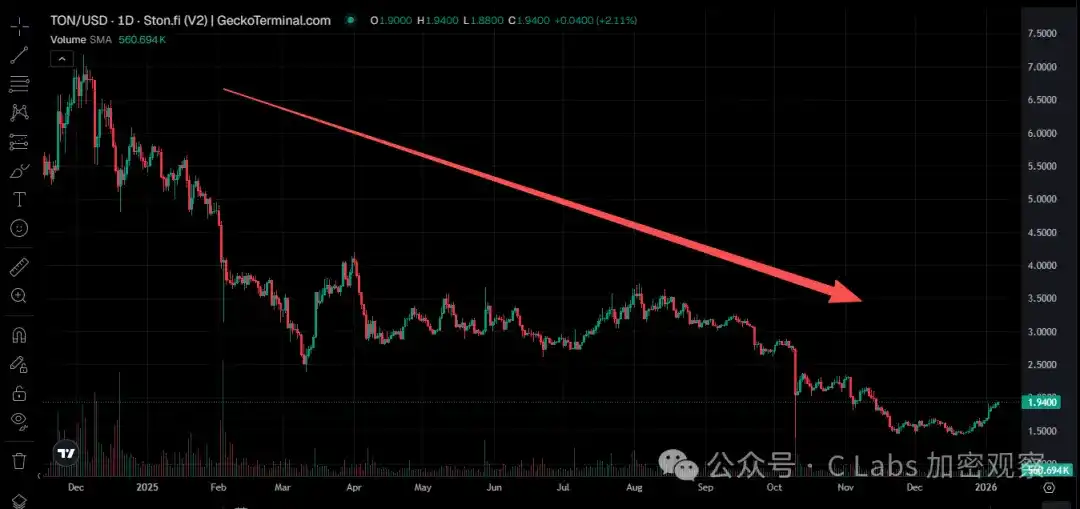
The loss did not stem from a collapse in the main business but was due to a significant decline in the value of Toncoin (TON) held by the company in 2025, leading to a write-down of related assets.

PART 01: Telegram's Development History

Telegram was founded in 2013 and is one of the world's most important instant messaging platforms.

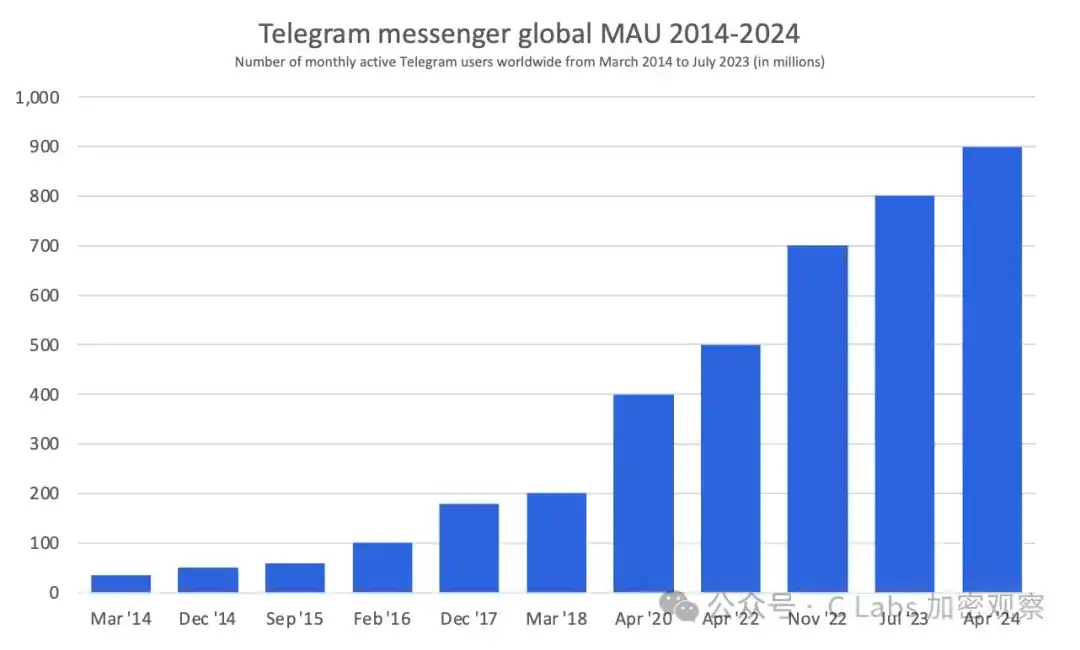
As of 2025, Telegram's monthly active users have exceeded 900 million, covering Europe, the Middle East, South America, and emerging markets, making it one of the fastest-growing social applications globally.
For crypto users, Telegram has become the de facto "public discussion layer" of the crypto industry: a large number of exchange announcements, project governance, airdrop information, OTC trading, and on-chain communities use Telegram as their core platform.

This gives it the dual attributes of a social platform and financial information infrastructure.

PART 02: IPO Plans Shelved

Although Telegram announced preparations for an IPO, the practical obstacle is that its founder, Pavel Durov, is still under investigation in France (Breaking! TG Founder Arrested, TON Price Plummets).

Telegram has clearly stated that it will not proceed with the listing until related compliance issues are clearer.

Fortunately, Telegram is not short of capital support. In May 2025, the company completed a $1.7 billion convertible bond financing, backed by top institutions including BlackRock and Mubadala.

PART 03: Telegram's Relationship with TON

The relationship between Telegram and TON is also complex.

In 2017, Telegram launched the blockchain project TON (Telegram Open Network), aiming to embed a payment system into the messaging app, and raised approximately $1.7 billion in 2018. However, in 2019, it was forced to halt the project after the SEC deemed it an unregistered securities offering. Telegram settled with regulators and exited the project in 2020.

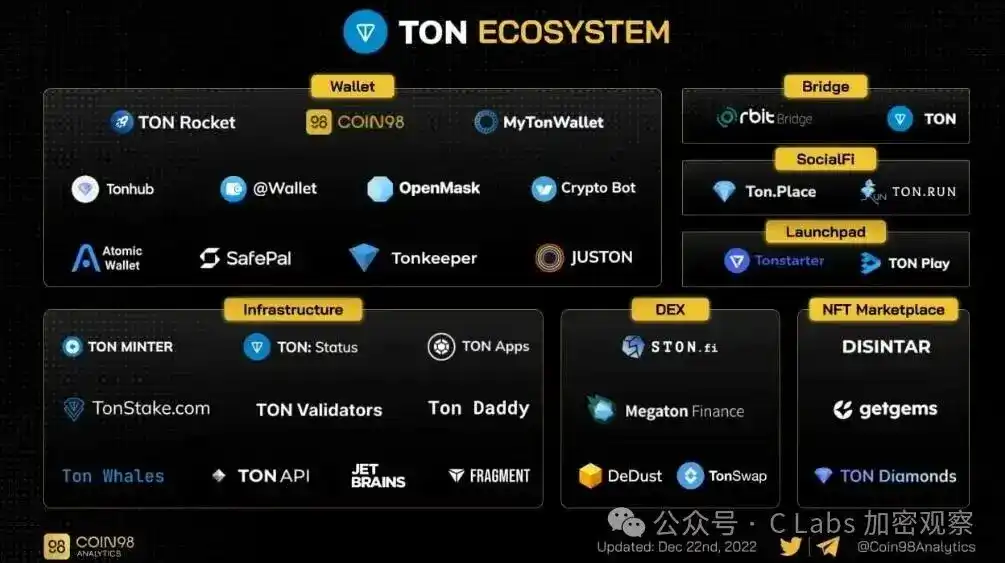
Subsequently, TON was reborn as a community public chain, and Telegram re-engaged with it in a "non-official but deeply integrated" manner, which saw significant growth in 2024.
Unfortunately, in 2024, after founder Durov was arrested, the rapid progress came to an abrupt halt (TON Chain Crashed? No New Blocks for a Long Time).

Most of the once-popular TON ecosystem projects have now faded, with token prices generally down over 70%:
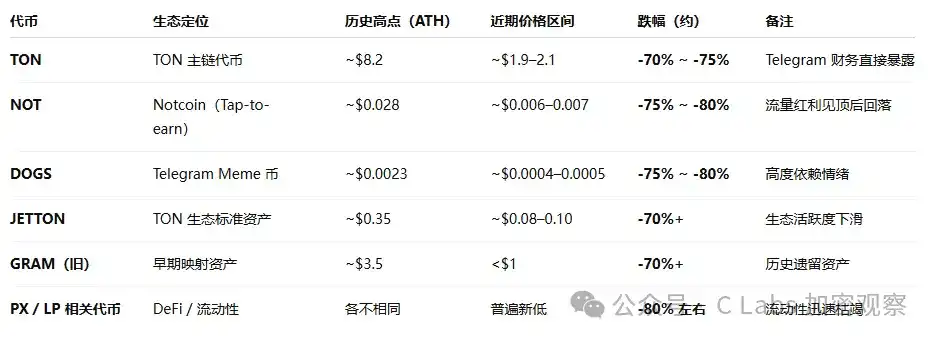
However, according to the latest financial report, the relationship between Telegram and TON has already gone beyond "official support for a public chain."

Significant Proportion of TON-Related Revenue

The financials show that about one-third of Telegram's revenue (approximately $300 million) comes from exclusive agreements related to TON, including wallet integration, payment functions, and ecosystem collaboration.

At the same time, Telegram is also one of the most significant sources of TON circulation, having sold over $450 million worth of TON since 2025, accounting for about 10% of TON's current market value.

This means that selling coins is Telegram's main business, and simultaneously, Telegram is the biggest whale dumping TON!

Пов'язані питання

QWhat was Telegram's revenue in the first half of 2025 and what was the year-over-year growth rate?

ATelegram's revenue in the first half of 2025 was $870 million, representing a 65% year-over-year growth compared to the same period in 2024.

QWhy did Telegram report a net loss in the first half of 2025 despite significant revenue growth?

ATelegram reported a net loss of over $220 million in the first half of 2025 due to a significant decline in the value of the Toncoin (TON) it held, which led to an accounting write-down of these assets.

QWhat is the relationship between Telegram and the TON blockchain project?

ATelegram initially launched the TON blockchain project in 2017 but was forced to abandon it in 2020 after a settlement with the SEC. The project was later revived by the community, and Telegram has since re-engaged with it in a 'non-official but deeply integrated' manner, with TON-related services now contributing significantly to its revenue.

QHow much of Telegram's revenue came from TON-related exclusive agreements in the first half of 2025?

AApproximately one-third of Telegram's revenue, about $300 million, came from TON-related exclusive agreements in the first half of 2025.

QWhat major financing did Telegram secure in May 2025 and which institutions were involved?

AIn May 2025, Telegram completed a $1.7 billion convertible bond financing round with backing from top-tier institutions including BlackRock and Mubadala.

Пов'язані матеріали

Agent Race Ends, Super Workbench Takes Over

The era of fragmented AI agents is ending. Over the past month, China's tech giants—Tencent, Alibaba, and ByteDance—have simultaneously shifted strategy: instead of launching new, standalone AI agents, they are consolidating their various agent projects into unified "super workbenches." Tencent integrated its QClaw teams into WorkBuddy, a strategic product hailed as a potential third flagship after QQ and WeChat. Alibaba is merging its QoderWork, Wukong, and MuleRun agents into a new "Qianwen Office" platform under DingTalk's leadership. ByteDance rebranded its TRAE SOLO coding agent to TRAE Work, signaling a broader focus on workflow collaboration. This convergence marks a pivotal industry consensus. The initial exploration phase, where companies rapidly built numerous overlapping agents for different scenarios, proved costly and inefficient. With open-source tools eroding technical barriers, competition has shifted from agent creation to resource consolidation and cost control. Historically, platform wars are won not by creating more products, but by simplifying them—as seen with browsers unifying web access and super-apps consolidating services. Now, the "super workbench" aims to become the unified AI entry point for work. This reflects a deeper market realization: the primary audience for AI is no longer just programmers (a market in the tens of millions) but all knowledge workers (a market of billions). The real opportunity lies in augmenting everyday tasks—managing emails, documents, data, and meetings—across the entire workday. The core battleground is becoming control over the primary AI entry point that employees use daily. Tencent's WorkBuddy leverages WeChat and Tencent Docs; Alibaba's Qianwen Office taps into DingTalk's organizational data; ByteDance's TRAE Work integrates with Feishu's workflows. Whoever owns this "super workbench" gains strategic control over orchestrating enterprise data and APIs. This shift is redefining enterprise software. Traditional SaaS applications, valued for their user interfaces, will recede into the background. Their core functionalities will be exposed as standardized "Skills" or APIs for the super workbench's agents to invoke. Software value will shift from selling user seats to charging based on API calls and outcomes delivered. The evolution of agents is moving through clear stages: first as novel standalone products, then as consolidated primary work entry points, and finally as pervasive, invisible capabilities embedded into the digital fabric. The recent moves by major tech firms signal the transition from the first stage into the second, accelerating toward the third. In the end, the most successful agent technology may become invisible—like electricity or the HTTP protocol—a fundamental, unnamed infrastructure powering work itself.

marsbit19 хв тому

Agent Race Ends, Super Workbench Takes Over

marsbit19 хв тому

Michael Saylor: 110 Reasons to Oppose BIP-110

Michael Saylor presents 110 arguments against Bitcoin Improvement Proposal (BIP) 110, a soft fork aimed at restricting certain non-monetary data storage uses (like inscriptions) on the Bitcoin blockchain. He acknowledges the proponents' valid concerns—such as node costs, fee pressure, and preserving Bitcoin's monetary focus—but fundamentally disagrees with the proposed solution. Saylor argues that BIP 110 represents a dangerous precedent of using consensus rules to enforce value judgments on transaction validity, moving away from Bitcoin's core principles of neutrality and permissionless innovation. His key objections are organized into eleven categories: 1) It violates neutrality and hard consensus by banning currently valid transactions. 2) It fails to meet the high burden of proof required for a consensus change, lacking concrete data on the alleged crisis. 3) Its seven bundled technical restrictions are overly broad, targeting generic script functionalities and blocking future upgrade paths. 4) It sacrifices compatibility and future optionality by closing off designed upgrade hooks. 5) Its temporary rules add significant complexity (grandfathering, expiry states) without sufficient justification. 6) The economic and security impacts, particularly on miner revenue and fee markets, are uncertain and unmodeled. 7) Superior, market-based tools (fee markets, relay/mining policies) already exist to manage blockchain load. 8) It stifles innovation by creating a chilling effect for developers. 9) Its modified activation mechanism (55% threshold, forced signaling) is aggressive and risks network splits. 10) The precedent it sets—using consensus to suppress disliked but legal uses—is more dangerous than the problem it aims to solve. 11) A better path exists: improving measurements, refining resource-based policies, and allowing market forces to work. Saylor concludes that Bitcoin's strength lies in its neutral rules, open markets, and hard consensus. Changing these foundational elements to target specific use cases is an unnecessary and risky "iatrogenic" intervention. He advocates for guarding Bitcoin's neutrality rather than acting as its redeemer.

marsbit34 хв тому

Michael Saylor: 110 Reasons to Oppose BIP-110

marsbit34 хв тому

Торгівля

Спот
活动图片


