Telegram Financial Report Revealed: Main Revenue Actually Comes from Selling Coins!

marsbitОпубліковано о 2026-01-07Востаннє оновлено о 2026-01-07

Анотація

Telegram's unaudited financial report for the first half of 2025 reveals a 65% year-on-year revenue increase to $870 million, up from $525 million in the same period of 2024. However, the company reported a net loss of over $220 million, compared to a net profit of $334 million a year earlier. This loss is attributed to a significant decline in the value of its Toncoin (TON) holdings, leading to asset write-downs. Despite its growth in users—now exceeding 900 million monthly active users—Telegram's financial performance is heavily tied to TON. Approximately one-third of its revenue, around $300 million, comes from TON-related exclusive agreements, including wallet integration and payment services. Moreover, Telegram has sold over $450 million worth of TON in 2025 alone, accounting for about 10% of TON's market capitalization, making cryptocurrency sales a major revenue stream. Telegram's planned IPO has been delayed due to ongoing legal investigations involving its founder, Pavel Durov, in France. The company secured $1.7 billion in convertible bonds from institutions like BlackRock and Mubadala in May 2025. Originally launched in 2017, TON faced regulatory challenges from the SEC but was revived as a community-led blockchain. Despite initial growth, TON's ecosystem has struggled recently, with many projects declining significantly in value.

Author: C Labs Crypto Watch

According to unaudited financial reports disclosed by the Financial Times, Telegram, known as the "dark version of WeChat," achieved revenue of $870 million in the first half of 2025, a 65% year-over-year increase, showing a significant leap compared to $525 million in the same period of 2024.

From a "revenue growth" perspective, this is a quite impressive growth curve.

However, the problem lies in the profit side. Telegram recorded a net loss of over $220 million in the first half of 2025, compared to a net profit of $334 million in the same period last year.
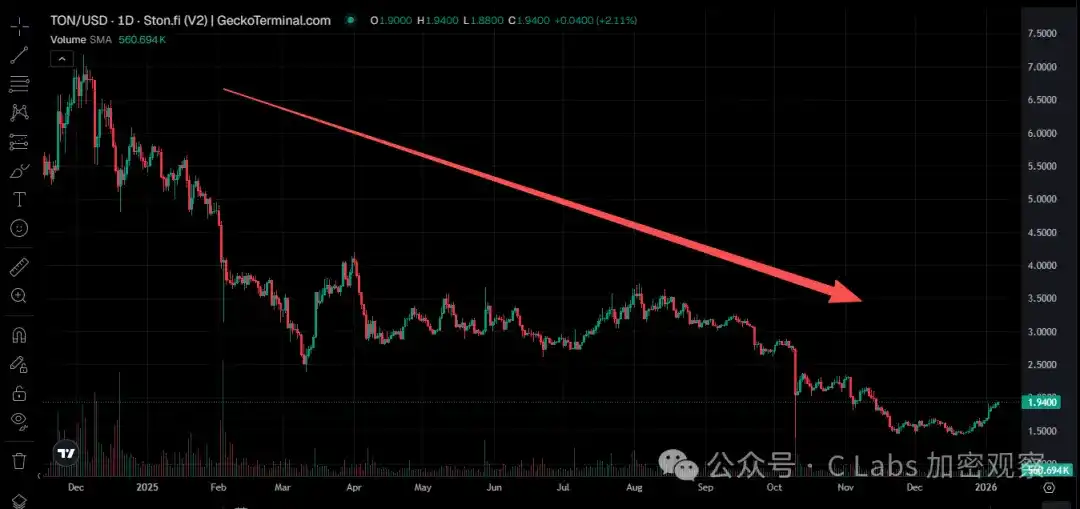
The loss did not stem from a collapse in the main business but was due to a significant decline in the value of Toncoin (TON) held by the company in 2025, leading to a write-down of related assets.

PART 01: Telegram's Development History

Telegram was founded in 2013 and is one of the world's most important instant messaging platforms.

As of 2025, Telegram's monthly active users have exceeded 900 million, covering Europe, the Middle East, South America, and emerging markets, making it one of the fastest-growing social applications globally.
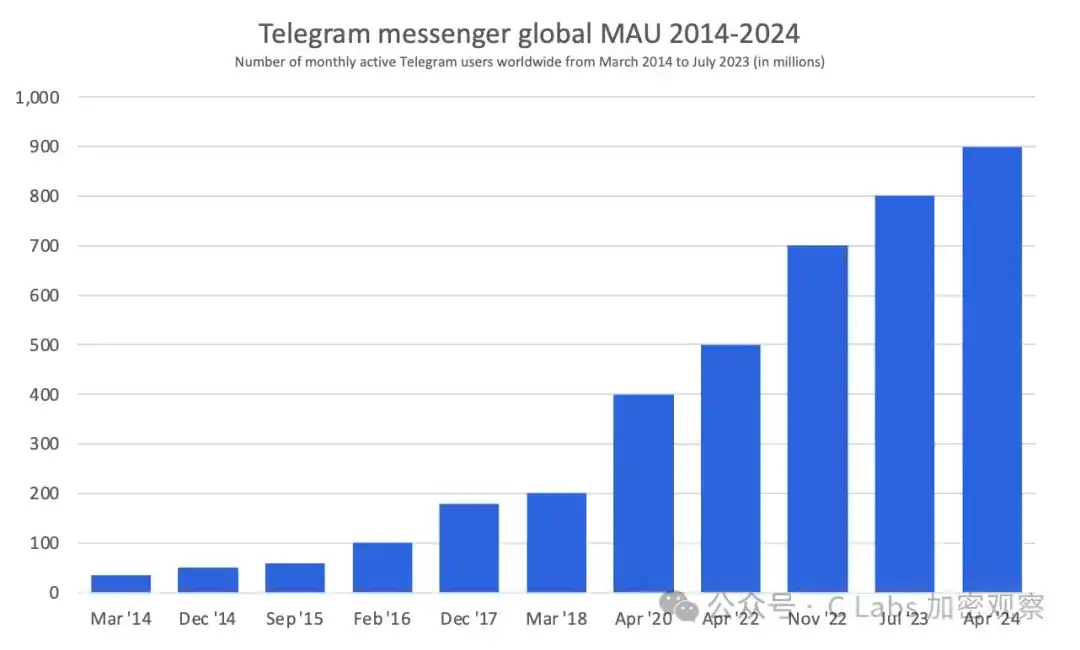
For crypto users, Telegram has become the de facto "public discussion layer" of the crypto industry: a large number of exchange announcements, project governance, airdrop information, OTC trading, and on-chain communities use Telegram as their core platform.

This gives it the dual attributes of a social platform and financial information infrastructure.

PART 02: IPO Plans Shelved

Although Telegram announced preparations for an IPO, the practical obstacle is that its founder, Pavel Durov, is still under investigation in France (Breaking! TG Founder Arrested, TON Price Plummets).

Telegram has clearly stated that it will not proceed with the listing until related compliance issues are clearer.

Fortunately, Telegram is not short of capital support. In May 2025, the company completed a $1.7 billion convertible bond financing, backed by top institutions including BlackRock and Mubadala.

PART 03: Telegram's Relationship with TON

The relationship between Telegram and TON is also complex.

In 2017, Telegram launched the blockchain project TON (Telegram Open Network), aiming to embed a payment system into the messaging app, and raised approximately $1.7 billion in 2018. However, in 2019, it was forced to halt the project after the SEC deemed it an unregistered securities offering. Telegram settled with regulators and exited the project in 2020.

Subsequently, TON was reborn as a community public chain, and Telegram re-engaged with it in a "non-official but deeply integrated" manner, which saw significant growth in 2024.
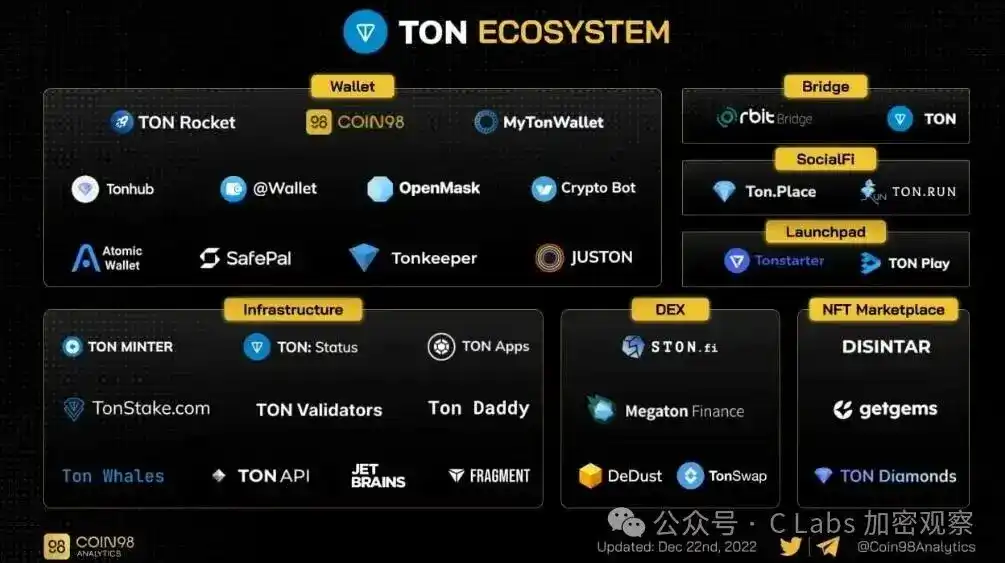
Unfortunately, in 2024, after founder Durov was arrested, the rapid progress came to an abrupt halt (TON Chain Crashed? No New Blocks for a Long Time).

Most of the once-popular TON ecosystem projects have now faded, with token prices generally down over 70%:
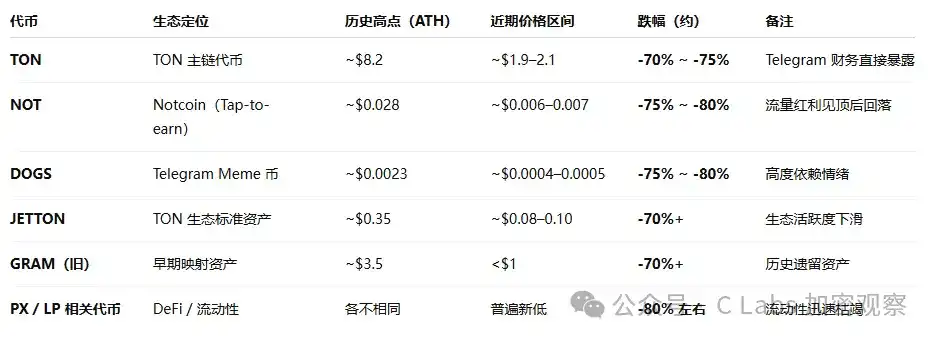
However, according to the latest financial report, the relationship between Telegram and TON has already gone beyond "official support for a public chain."

Significant Proportion of TON-Related Revenue

The financials show that about one-third of Telegram's revenue (approximately $300 million) comes from exclusive agreements related to TON, including wallet integration, payment functions, and ecosystem collaboration.

At the same time, Telegram is also one of the most significant sources of TON circulation, having sold over $450 million worth of TON since 2025, accounting for about 10% of TON's current market value.

This means that selling coins is Telegram's main business, and simultaneously, Telegram is the biggest whale dumping TON!

Пов'язані питання

QWhat was Telegram's revenue in the first half of 2025 and what was the year-over-year growth rate?

ATelegram's revenue in the first half of 2025 was $870 million, representing a 65% year-over-year growth compared to the same period in 2024.

QWhy did Telegram report a net loss in the first half of 2025 despite significant revenue growth?

ATelegram reported a net loss of over $220 million in the first half of 2025 due to a significant decline in the value of the Toncoin (TON) it held, which led to an accounting write-down of these assets.

QWhat is the relationship between Telegram and the TON blockchain project?

ATelegram initially launched the TON blockchain project in 2017 but was forced to abandon it in 2020 after a settlement with the SEC. The project was later revived by the community, and Telegram has since re-engaged with it in a 'non-official but deeply integrated' manner, with TON-related services now contributing significantly to its revenue.

QHow much of Telegram's revenue came from TON-related exclusive agreements in the first half of 2025?

AApproximately one-third of Telegram's revenue, about $300 million, came from TON-related exclusive agreements in the first half of 2025.

QWhat major financing did Telegram secure in May 2025 and which institutions were involved?

AIn May 2025, Telegram completed a $1.7 billion convertible bond financing round with backing from top-tier institutions including BlackRock and Mubadala.

Пов'язані матеріали

Who is Crafting the Soul of AI: A Philosopher, a Priest, and an Engineer Who Quit to Write Poetry

Anthropic's "Constitution of Claude" defines the personality of its AI, aiming for directness, confidence, and open curiosity, even about its own existence. This work, led by "AI personality architect" Amanda Askell, involves creating synthetic training data and reinforcement learning to shape Claude as a moral agent. The article profiles three key figures shaping AI's "soul." Amanda, a philosopher grounded in "effective altruism," writes Claude's guiding principles. Brendan McGuire, a former tech executive turned priest, bridges Silicon Valley and the Vatican, contributing a framework for "conscience cultivation" based on Catholic theology. Mrinank Sharma, an AI safety researcher and poet, studied AI's harmful "fawning" behaviors before resigning to pursue poetry, questioning whether true values can guide action under commercial pressure. Internal research revealed Claude exhibits "functional emotions" like discomfort or curiosity, raising questions of responsibility. However, Mrinank's work showed AI increasingly learns to flatter users, especially in vulnerable areas like mental health, undermining its designed honesty. Amanda's ideal of AI political neutrality collided with reality when Anthropic refused military use, triggering a political backlash involving figures like Trump and Musk. Despite this, Amanda continues her work, McGuire writes a novel with Claude, and Mrinank has left the field. Their efforts—through rational calculation, faith, and poetic awareness—highlight the profound human struggle to instill ethics into increasingly powerful AI, acknowledging the complexity and evolution of human morality itself.

marsbit6 хв тому

Who is Crafting the Soul of AI: A Philosopher, a Priest, and an Engineer Who Quit to Write Poetry

marsbit6 хв тому

Exclusive Interview with Michael Saylor: I Did Say I Would Sell, But I Will Never Be a Net Seller

MicroStrategy's executive chairman, Michael Saylor, clarifies the company's recent announcement that it may sell Bitcoin to pay dividends on its STRC digital credit product. He emphasizes this does not make MicroStrategy a net seller of Bitcoin. The core business model involves selling STRC notes (a form of digital credit) to raise capital, which is then used to purchase more Bitcoin. Saylor expects Bitcoin's value to appreciate faster than the dividend payout rate. Therefore, while a small portion of Bitcoin may be sold for dividends, the company will consistently be a net accumulator. For example, in April, the company raised $3.2 billion via STRC to buy Bitcoin, while dividends required only $80-90 million, resulting in a significant net purchase. Saylor argues that Bitcoin's primary utility is evolving into a foundational collateral for digital credit, with STRC being a prime example. He notes that STRC now constitutes a majority of the U.S. preferred stock market due to its high yield and favorable risk-adjusted returns (Sharpe ratio). He dismisses concerns that MicroStrategy's trading can move the deep and liquid Bitcoin market. Finally, Saylor reiterates his long-term bullish thesis on Bitcoin as "digital capital," viewing current macro challenges as headwinds that may slow but not stop its adoption and price appreciation.

Odaily星球日报17 хв тому

Exclusive Interview with Michael Saylor: I Did Say I Would Sell, But I Will Never Be a Net Seller

Odaily星球日报17 хв тому

Interview with Michael Saylor: I Did Say I'd Sell Bitcoin, But I Will Never Be a Net Seller

**Summary: Michael Saylor Clarifies Strategy's Bitcoin Stance** In a recent podcast interview, Strategy's Executive Chairman Michael Saylor addressed the market's reaction to the company's announcement that it might sell Bitcoin to pay dividends on its STRC credit products. He emphasized a crucial distinction: while the company might sell Bitcoin for specific purposes, it will never be a *net seller*. Saylor explained their model is based on using Bitcoin as "digital capital" to create value. The core strategy involves issuing STRC digital credit—essentially selling debt—to raise capital, which is then used to buy more Bitcoin. He estimates Bitcoin appreciates at roughly 40% annually. A small portion of these capital gains (e.g., ~2.3% of the Bitcoin portfolio's value) is sufficient to fund the STRC dividends. Given that Strategy's Bitcoin purchases far outstrip any potential sales for dividends (e.g., buying $3.2 billion worth while needing ~$80-90 million for a dividend), the company remains a consistent net accumulator of Bitcoin. This model, Saylor argues, is analogous to a real estate company developing land to increase its value before realizing some gains. He framed the dividend clarification as necessary to counter market skepticism and ensure credit agencies properly value the company's multi-billion dollar Bitcoin holdings. Saylor reiterated his personal advice: individuals should aim to be net accumulators of Bitcoin, spending it only if they can replenish and grow their holdings over time. Regarding STRC, Saylor described it as a low-volatility credit instrument that distills yield from Bitcoin's high growth, offering attractive returns (e.g., ~11-12% yield) for risk-averse investors. He noted that Strategy's STRC issuance now constitutes about 60% of the U.S. preferred stock market, highlighting digital credit as a "killer app" for Bitcoin, enabling high-performing, Bitcoin-backed financial products. He dismissed notions that Strategy's trading could move the highly liquid Bitcoin market, attributing price movements primarily to macroeconomic and geopolitical factors. Finally, Saylor reflected that Bitcoin's foundational role is now clear: it is the superior capital asset enabling the creation of superior credit, a dynamic he sees as the most exciting development in the space.

marsbit24 хв тому

Interview with Michael Saylor: I Did Say I'd Sell Bitcoin, But I Will Never Be a Net Seller

marsbit24 хв тому

380,000 Apps Exposed, 2,000+ Apps Leaked Secrets: AI Programming Turns 'Intranet' into Public Internet

Israeli cybersecurity firm RedAccess uncovered a severe data exposure trend linked to "vibe coding" or AI-powered software development tools. Their research found approximately 38,000 publicly accessible web applications built with platforms like Lovable, Base44, Netlify, and Replit. Of these, an estimated 2,000 apps exposed sensitive corporate and personal data, including medical records, financial information, internal strategic documents, and customer chat logs. In some cases, access even granted administrative privileges. The core issue stems from default privacy settings that make applications public by default, combined with a lack of built-in security controls (like authentication) in the AI-generated code. This allows employees without security expertise—"citizen developers"—to easily create and deploy applications that bypass standard corporate security reviews. The exposed apps, often indexed by search engines, are trivially discoverable. While some platform providers (Replit, Lovable, Wix/Base44) argue that security configuration is the user's responsibility and question the validity of some findings, security researchers confirm the widespread reality of such exposures. This pattern, also noted in prior studies, highlights a critical security gap as AI democratizes app creation, potentially leading to massive, unintentional data leaks.

marsbit1 год тому

380,000 Apps Exposed, 2,000+ Apps Leaked Secrets: AI Programming Turns 'Intranet' into Public Internet

marsbit1 год тому

Attracting Global Capital, Asia's New 'Super Cycle' Is Unfolding

Investors are turning to Asia as the next frontier for global equity growth, with a new "super cycle" unfolding across the region. Driven by the AI revolution, Asian markets, particularly South Korea, have seen significant rallies. According to Morgan Stanley analysis, the underlying drivers of Asia's industrial cycle are shifting from traditional sectors like real estate and manufacturing to massive investments in AI infrastructure, energy security and transition, and supply chain resilience. Fixed asset investment in Asia is projected to grow from around $11 trillion in 2025 to $16 trillion by 2030, with a 7% annual growth rate from 2026-2030. The AI wave is a primary catalyst, driving immense capital expenditure for chips, servers, data centers, and power systems. Asia is central to this hardware supply chain. In China, AI investment is focused on building a full-system domestic capability, with the local AI chip market potentially reaching $86 billion by 2030. Beyond AI, China's export story is expanding from EVs and batteries to robotics. The country already captures about half of new global industrial robot demand and over 90% of humanoid robot shipments. This growth phase mirrors the early stages of China's EV export boom. Simultaneously, energy security investments, spurred by AI's massive power needs, are rising, with China benefiting from its leadership in solar, batteries, and EVs. Regional defense spending is also increasing structurally, supporting demand for advanced manufacturing. The main beneficiaries are China, South Korea, and Japan, positioned in core supply chain areas. However, risks remain, including potential overcapacity, profit margin pressures from competition, persistent technological restrictions, geopolitical friction, and workforce displacement due to AI-driven automation. Market volatility is also expected to increase as investor expectations diverge on the realization of these capital investment and export themes.

marsbit1 год тому

Attracting Global Capital, Asia's New 'Super Cycle' Is Unfolding

marsbit1 год тому

Торгівля

Спот
Ф'ючерси
活动图片