Tariff Threat Shocks Market: Trump's Post Triggers Bitcoin Safe-Haven Sell-off

比推Опубліковано о 2026-01-19Востаннє оновлено о 2026-01-19

Анотація

Cryptocurrency markets experienced a sharp sell-off on the morning of January 19, with Bitcoin dropping from $95,531 to a low of $91,910. Ethereum and Solana also saw significant declines, along with several altcoins falling over 10%. The sell-off resulted in $830 million in liquidations over 12 hours, predominantly long positions. The downturn was triggered by former U.S. President Donald Trump’s announcement on Truth Social that the U.S. would impose tariffs—starting at 10% on February 1 and rising to 25% by June—on imports from eight European countries, including Denmark, Germany, and the UK. The move is tied to Trump’s demand for a “complete and total purchase of Greenland,” citing unspecified security concerns. European leaders strongly opposed the tariffs, warning of strained transatlantic relations and potential benefits to geopolitical rivals like China and Russia. Meanwhile, traditional safe-haven assets like gold and silver surged to record highs amid the geopolitical tension and market uncertainty. With a 96% probability that the Federal Reserve will hold interest rates steady, risk assets faced additional pressure. Market analysts suggested that investors take profits and await clearer signals, though some remain optimistic about Bitcoin’s long-term potential, citing macroeconomic trends and increasing demand.

Author: Ma He, Foresight News

Original Title: Trump Stirs Trouble Again: An Island Causes Bitcoin to Plunge by $3,000


At around 7:00 AM on January 19, the cryptocurrency market experienced a sudden flash crash. The price of BTC plummeted sharply in a short period, dropping from $95,531 to a low of $91,910. ETH fell from $3,350 to a low of $3,177, and SOL dropped from $143 to a low of $130. Some altcoins like SUI, XPL, and ASTER saw declines of over 10% in 24-hour period.

According to Coinglass data, over the past 12 hours, $830 million was liquidated across the network, with long positions accounting for $764 million of that. In the past 24 hours, the largest single liquidation order occurred on Hyperliquid for a BTC-USDT perpetual contract worth $25.8337 million.
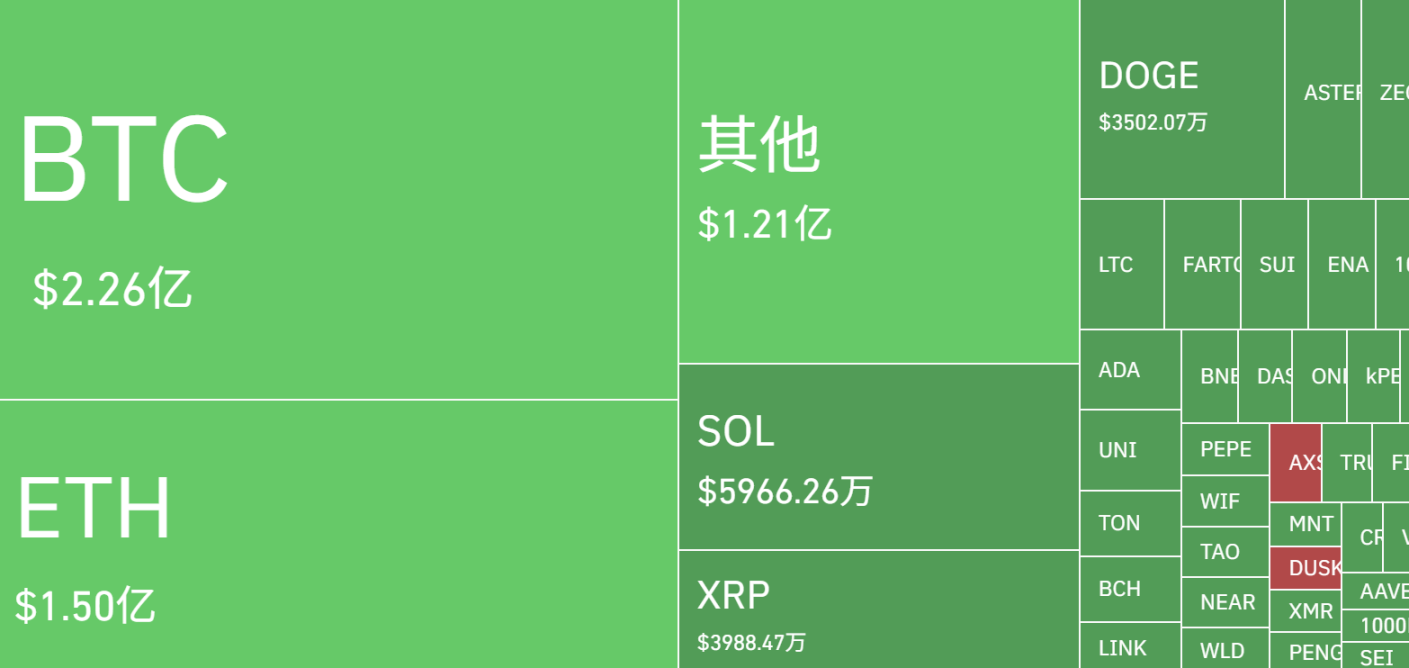
Meanwhile, traditional safe-haven assets like gold and silver bucked the trend and surged to record highs. Spot gold broke through the $4,690 per ounce mark,刷新历史高点, with a daily increase of over 2%. Spot silver broke through the $94 per ounce mark, hitting a record high, with a daily gain of over 4%.

U.S. stock markets are closed today. The U.S. Dollar Index fell 0.26% to 99.14. U.S. stock futures opened lower, with S&P 500 futures down 0.71% and Nasdaq futures down as much as 1.1% at one point. U.S. 10-year Treasury futures rose 5 ticks, and 30-year Treasury futures also rose 5 ticks.

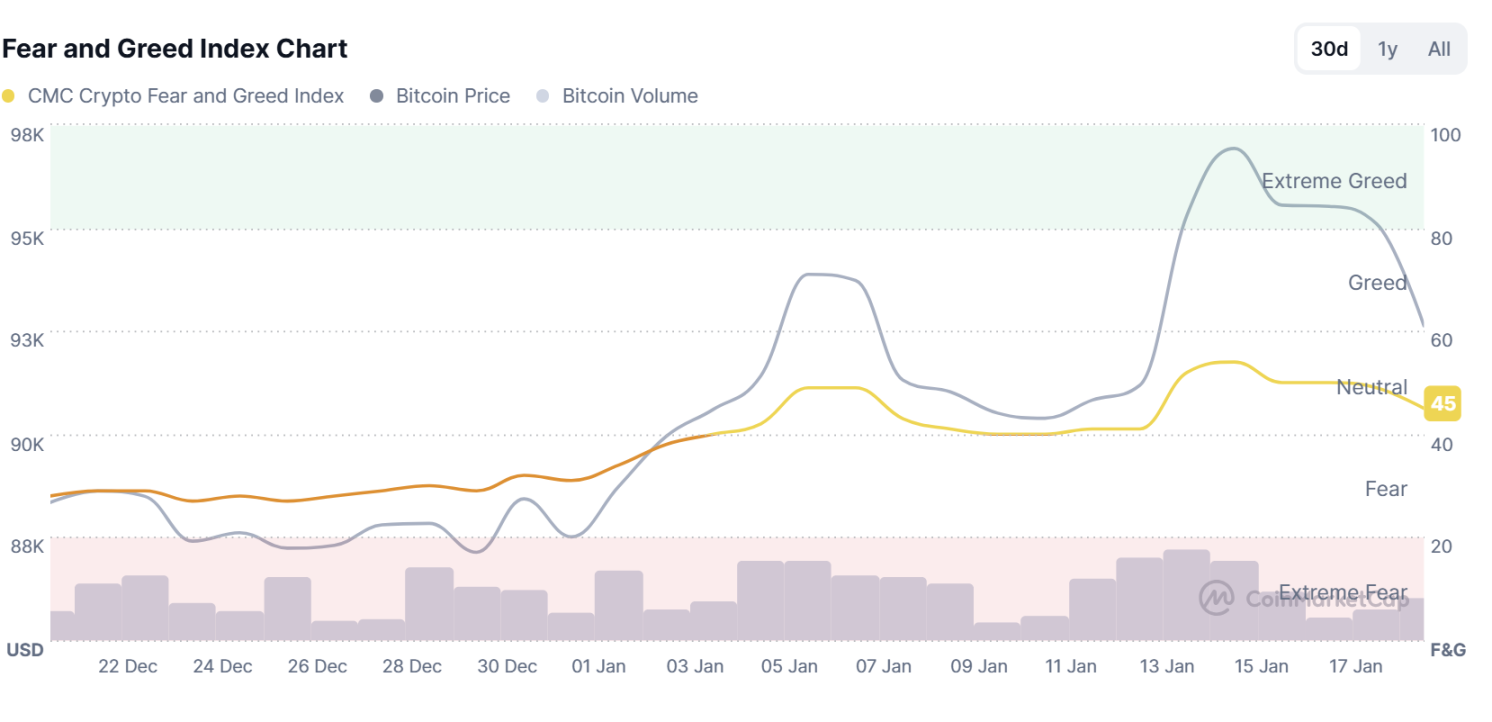
The Crypto Fear & Greed Index has currently retreated to 45.
This event is not isolated but the result of intertwined macroeconomic factors and geopolitical tensions.

Trump Wields Tariff Stick Again, Imposing Tariffs on 8 European Countries Starting February 1st

Last year, the trigger for the crypto market's "1011暴跌" (October 11th crash) was Trump wielding tariff threats against China. Now, this scene is repeating itself.

On January 18, Trump posted on Truth Social, stating that due to the Greenland issue, starting February 1st of this year, all goods exported to the U.S. from Denmark, Norway, Sweden, France, Germany, the UK, the Netherlands, and Finland will be subject to an additional 10% tariff. By June 1st of this year, the tariff will increase to 25%. These tariffs are to be paid continuously until an agreement on the "comprehensive and thorough purchase of Greenland" is reached.

In his post, Trump stated, "These countries—Denmark, Norway, Sweden, France, Germany, the UK, the Netherlands, and Finland—have all gone to Greenland for unknown purposes. This poses a very dangerous situation for the safety, security, and survival of our planet. These countries are playing an extremely dangerous game, and the level of risk they bring is intolerable and unsustainable. Therefore, to protect global peace and security, strong measures must be taken to bring this potential dangerous situation to a swift and indisputable end."
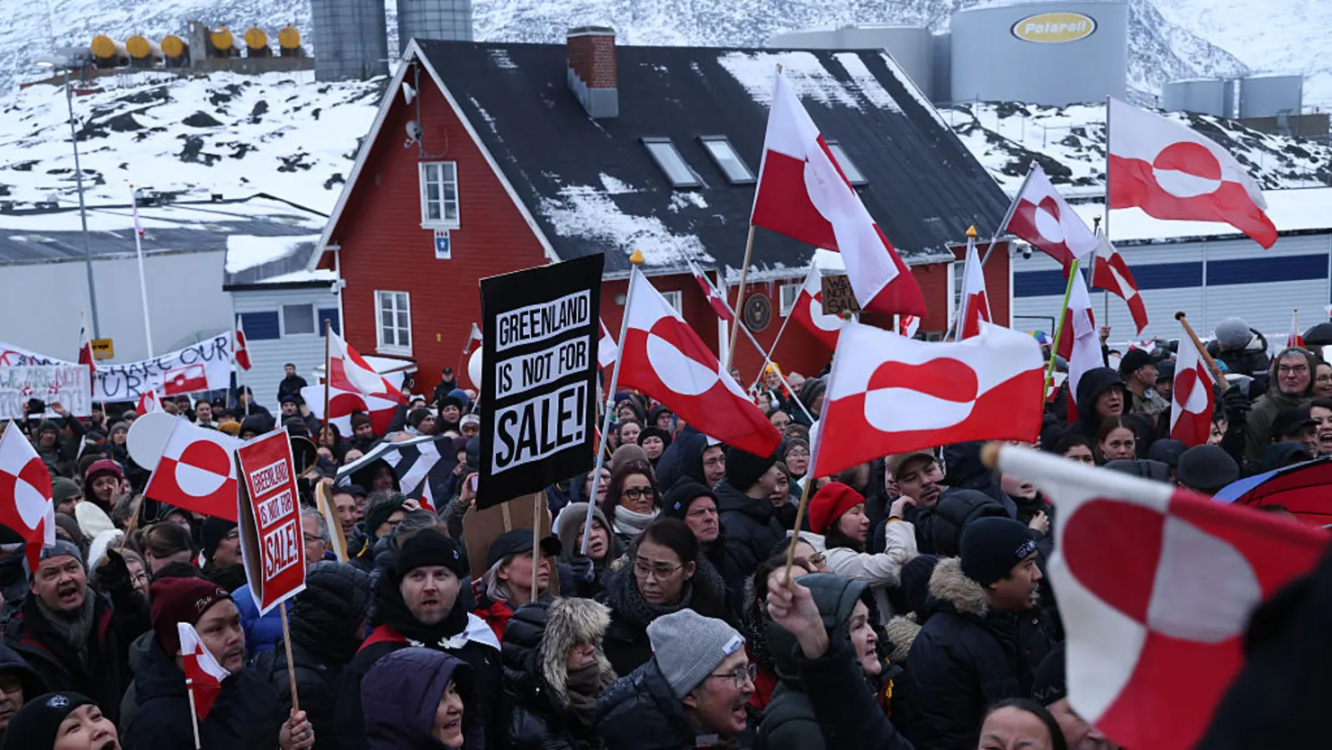
Furthermore, according to CNBC, after Trump issued tariff threats against European allies over the "Greenland issue," several European leaders responded强硬ly, emphasizing that Greenland's sovereignty is non-negotiable and warning that this move would further撕裂 transatlantic relations.

European Commission President Ursula von der Leyen and European Council President António Costa stated that pressuring allies with tariffs would damage EU-US relations and could trigger a "dangerous vicious cycle"; EU High Representative for Foreign Affairs and Security Policy Kaja Kallas said that tariffs would only harm shared prosperity, divert Europe's priorities on Ukraine, and allow rivals like Russia and China to "reap the benefits." Additionally, Spanish Prime Minister Pedro Sánchez warned that more激进 U.S. actions on Greenland would have a major impact on NATO. EU ambassadors from 27 countries plan to hold an emergency meeting to coordinate their response.

That day, according to Bloomberg, Senate Democrats plan to introduce legislation to阻止 Trump from imposing tariffs on European countries that oppose the U.S. annexation of Greenland. Previously, Senate Minority Leader Chuck Schumer criticized the move for harming the U.S. economy and relations with allies.

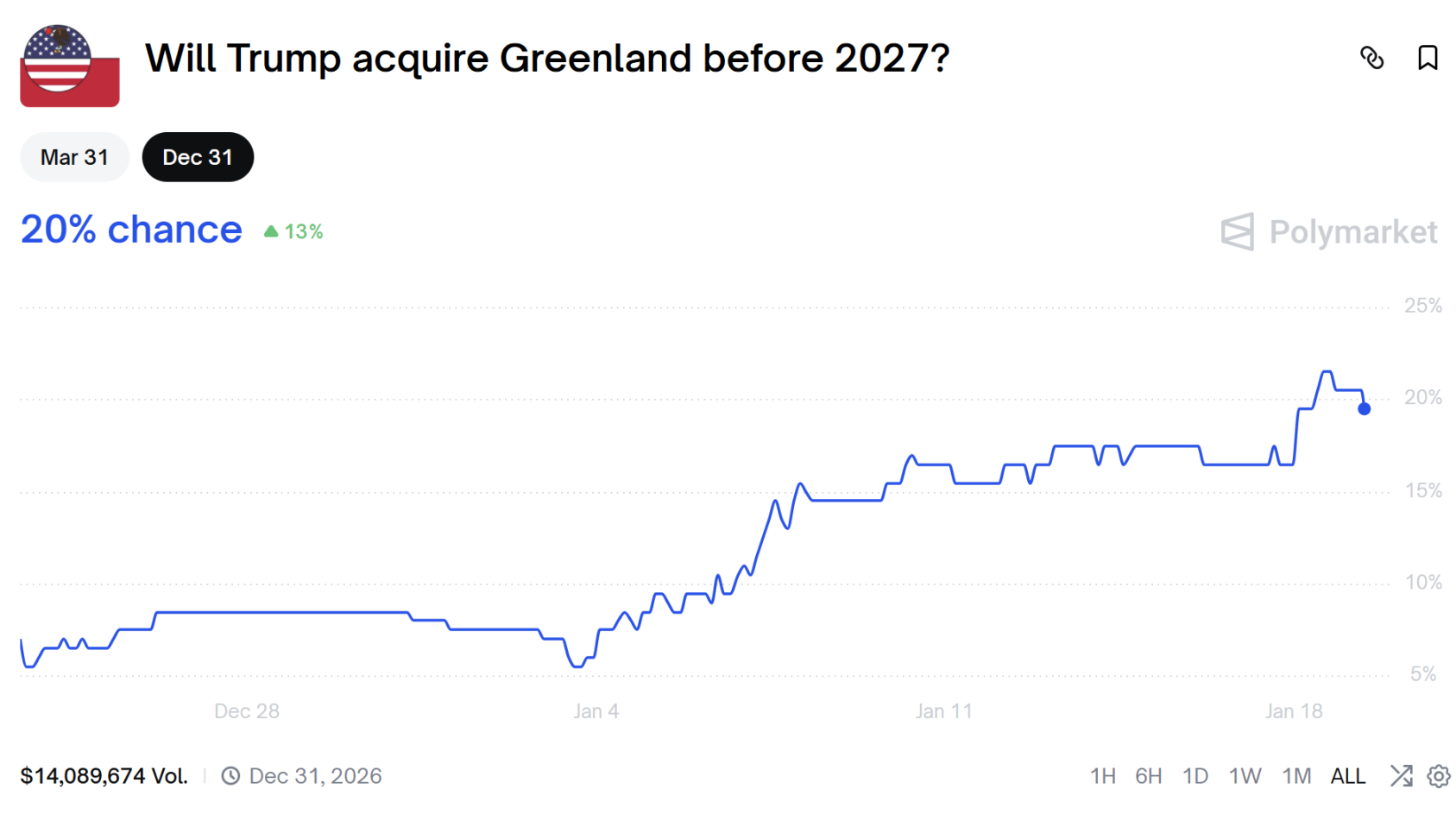
Latest data from Polymarket shows the market is betting a 20% probability that Trump will acquire Greenland by 2027.

Tariffs and geopolitical concerns have caused investors to turn to gold and silver for safety, leading to an outflow of funds from crypto.

Additionally, the probability of the Federal Reserve holding rates steady this January is extremely high. According to Polymarket data, the market's bet on no rate cut has now risen to 96%, putting pressure on risk assets.

On the evening of January 18, crypto trading indicator analysis platform CoinKarma posted, stating, "BTC rose to nearly $98,000 this week, but when it reached that price level, the market saw the most significant selling pressure in recent weeks, causing a slight pullback. However, the overall liquidity between buyers and sellers has not shown a significant imbalance and remains relatively balanced. Other key market indicators have not yet given clear signals. Based on the current situation, long position holders who entered at the relatively low points at the beginning of the year may consider taking profits, either fully or partially closing their positions, and waiting for clearer signals before re-entering the market."

Seasoned crypto investor Dan Tapiero stated: "If investing $10,000 in crypto assets in 2026, I think you can directly allocate funds to Bitcoin, Ethereum, and Solana. As for the specific allocation, it depends on your preference."

Dan Tapiero believes that the biggest opportunities in the cryptocurrency space in 2026 lie in infrastructure and the adoption of stablecoins. Tapiero stated that he expects Bitcoin to rise to $180,000 in this cycle, citing the combined effect of growing demand and a shift in global monetary policy. Falling interest rates and massive government investment in AI infrastructure will bring strong positive factors. This global push is leading to the devaluation of all fiat currencies, including the U.S. dollar. This is very favorable for Bitcoin.


Twitter:https://twitter.com/BitpushNewsCN

Bitpush TG Discussion Group:https://t.me/BitPushCommunity

Bitpush TG Subscription: https://t.me/bitpush

Original article link:https://www.bitpush.news/articles/7604166

Пов'язані питання

QWhat was the immediate impact of Trump's tariff threat on cryptocurrency markets?

ACryptocurrency markets experienced a sharp flash crash, with Bitcoin dropping from $95,531 to a low of $91,910, Ethereum falling from $3,350 to $3,177, and Solana declining from $143 to $130 within a short period.

QWhich traditional safe-haven assets saw price increases following the geopolitical tension?

ATraditional safe-haven assets like gold and silver surged to record highs, with spot gold rising over 2% to above $4,690 per ounce and spot silver increasing over 4% to above $94 per ounce.

QWhich European countries did Trump threaten with tariffs starting February 1st, and why?

ATrump threatened to impose tariffs on Denmark, Norway, Sweden, France, Germany, the UK, the Netherlands, and Finland, citing their activities in Greenland as a 'very dangerous situation' for global security and demanding a agreement for the 'complete and total purchase of Greenland'.

QHow did European leaders respond to Trump's tariff threat over Greenland?

AEuropean leaders strongly opposed the move, emphasizing Greenland's sovereignty is non-negotiable. EU officials warned it would damage transatlantic relations and could create a 'vicious cycle,' while some leaders cautioned it would benefit rivals like Russia and China and impact NATO.

QWhat was the market's probability assessment of Trump acquiring Greenland by 2027 according to Polymarket?

APolymarket data showed a 20% probability that Trump would acquire Greenland by 2027.

Пов'язані матеріали

7 Months After the Collapse of Huiwang, Southeast Asia's Escrow Platforms Undergo a Major Reshuffle

Following the collapse of Huione Pay—dubbed the "Alipay of Southeast Asia"—seven months ago, the region's underground financial guarantee platform sector is undergoing a significant reshuffle. This power vacuum has been swiftly filled by emerging platforms such as XinBi, Tiger/Navigator, JinBei (renamed JinBo), Dali/Tiancheng, and FullyLight. These platforms, operating largely via Telegram and offering services like escrow for illicit transactions, have absorbed the vast user base and markets left behind by Huione. While positioning themselves as "trust intermediaries," their primary clientele consists of networks involved in online scams, money laundering, illegal gambling, and even human trafficking. For instance, the Tiger/Navigator platform explicitly provides "escrow" services for kidnapping-for-ransom operations ("强押车交易"). Data underscores the immense scale: Huione alone processed over $103 billion in cryptocurrency payments and facilitated over $31 billion through its escrow market before its downfall, linking it to Cambodia's notorious Prince Group. Since its collapse, competitors have seen explosive growth. For example, the XinBi platform has accumulated over $1.6 billion in total USDT revenue, while platforms like NewPay, OkPay (under Dali), and FullyLight Wallet collectively processed over $4.8 billion in USDT in a single year. This ecosystem thrives in regions like Cambodia and Myanmar, where regulatory gaps allow these platforms to act as critical financial infrastructure for sprawling cybercrime industries, from scam compounds to online casinos. The article concludes that the moniker "Southeast Asian Alipay" is a misnomer, obscuring the platforms' fundamental role in enabling serious criminal enterprises rather than representing legitimate financial innovation.

Odaily星球日报43 хв тому

7 Months After the Collapse of Huiwang, Southeast Asia's Escrow Platforms Undergo a Major Reshuffle

Odaily星球日报43 хв тому

The Changing Landscape: What Are Crypto VCs Experiencing?

Title: The Shifting Landscape of Crypto Venture Capital The era of dedicated crypto venture capital funds is undergoing a significant transformation. Once essential for navigating the sector's complexity and high risk, these specialized funds are now facing an identity crisis as the market matures. This shift mirrors historical patterns in other specialized investment classes like cleantech and SPACs, where initial information advantages dissipate as technologies become mainstream and integrated into existing industry frameworks. The article argues that crypto is reaching a critical inflection point, transitioning from a "building phase" to an "integration phase." Major players like Stripe, BlackRock, and Visa now engage with crypto not for its novel mechanics but as a foundational financial infrastructure. Their needs—regulatory compliance, banking partnerships, distribution channels—align with traditional fintech, a domain easily understood by large, generalist funds like Sequoia and Founders Fund. This evolution creates a "barbell effect" within the VC landscape. On one end are massive, diversified platforms that can incorporate crypto as one vertical among many. On the other are small, nimble funds focused on niche, experimental projects. The middle ground—medium-sized dedicated crypto funds—is being squeezed out. Their typical fund size makes it impossible to generate sufficient returns solely from early-stage crypto bets, yet they cannot compete with giants for later-stage deals. Consequently, leading crypto-native firms like Paradigm and Framework Ventures are expanding into AI, robotics, and other sectors, driven partly by LP pressure for better returns amid a broader VC DPI crisis. Others, like Dragonfly and a16z, have narrowed their crypto focus predominantly to financial infrastructure like stablecoins, reframing the sector's core narrative. For crypto entrepreneurs, this consolidation presents challenges. While generalist funds offer larger checks and broader resources, crypto projects now compete fiercely with AI for attention and capital within these firms. Furthermore, the long-term, non-commercial foundational work that built the ecosystem—funded by dedicated crypto VCs—is less likely to attract generalist capital focused on direct returns. The conclusion is that "crypto investor" as a standalone category is becoming obsolete, akin to "internet investor." Crypto is becoming a baseline infrastructure layer. The future will see a barbell structure: large-scale growth financing handled by generalist funds, while pioneering, speculative projects are funded by small, specialized vehicles. The dedicated crypto funds of the 2017-2021 boom, which incubated core infrastructure, are giving way to this new, bifurcated reality.

Foresight News1 год тому

The Changing Landscape: What Are Crypto VCs Experiencing?

Foresight News1 год тому

As Consensus Accelerates, What Are Young Investors Betting On?

Title: As Consensus Forms Faster, What Are Young Investors Betting On? In the rapid evolution of tech investment, a new generation of young investors is navigating a landscape where AI, robotics, commercial aerospace, and quantum computing are advancing simultaneously. Traditional investment logic based on financial models is giving way to a need for deep technical understanding and the ability to act before industry consensus forms. An analysis of trends from the "WAIC FUTURE TECH" list of young investment leaders reveals key shifts in focus. The first major trend is the movement of AI from the digital screen into the physical world. Investment is shifting from large language models and chatbots towards embodied AI, robotics, AI hardware, and edge computing. While demonstrations generate excitement, the real challenge lies in achieving scalable, reliable, and cost-effective delivery in complex real-world environments like factories and logistics. Success depends not just on algorithms but on the integration of sensors, actuators, and control systems. Second, the competitive focus for large models is moving beyond raw capability toward building an "intelligence flywheel." The goal is to create self-reinforcing systems where user interaction generates data, improving the model, which in turn enhances the user experience and attracts more engagement. Companies that successfully embed AI into workflows to create these closed-loop systems can build lasting value that isn't easily erased by the next model upgrade. Third, facing a potential bottleneck in high-quality human-generated data, investors are looking at new underlying technologies. Reinforcement learning and self-play, as demonstrated by AlphaGo Zero, offer paths for AI to generate its own experience. Scientific foundation models, which aim to build general AI capabilities for fields like life sciences and materials discovery, represent a non-consensus direction that could unlock new frontiers of knowledge and data. Finally, in deep-tech areas like quantum computing, commercial aerospace, and space-based infrastructure, patient capital is essential. These fields have long, uncertain development and validation cycles involving complex engineering, supply chains, and regulations. Investment here requires a long-term view, focusing on foundational team capabilities and the eventual emergence of market demand, even if commercial returns are distant. Collectively, these trends illustrate how young investors are adapting to a new era. They are learning to make earlier, technically-informed judgments, balance hype with real-world viability, and provide the patient capital needed to build the deep-tech foundations of the future.

marsbit1 год тому

As Consensus Accelerates, What Are Young Investors Betting On?

marsbit1 год тому

Торгівля

Спот
活动图片





