Tariff Threat Shocks Market: Trump's Post Triggers Bitcoin Safe-Haven Sell-off

比推Опубліковано о 2026-01-19Востаннє оновлено о 2026-01-19

Анотація

Cryptocurrency markets experienced a sharp sell-off on the morning of January 19, with Bitcoin dropping from $95,531 to a low of $91,910. Ethereum and Solana also saw significant declines, along with several altcoins falling over 10%. The sell-off resulted in $830 million in liquidations over 12 hours, predominantly long positions. The downturn was triggered by former U.S. President Donald Trump’s announcement on Truth Social that the U.S. would impose tariffs—starting at 10% on February 1 and rising to 25% by June—on imports from eight European countries, including Denmark, Germany, and the UK. The move is tied to Trump’s demand for a “complete and total purchase of Greenland,” citing unspecified security concerns. European leaders strongly opposed the tariffs, warning of strained transatlantic relations and potential benefits to geopolitical rivals like China and Russia. Meanwhile, traditional safe-haven assets like gold and silver surged to record highs amid the geopolitical tension and market uncertainty. With a 96% probability that the Federal Reserve will hold interest rates steady, risk assets faced additional pressure. Market analysts suggested that investors take profits and await clearer signals, though some remain optimistic about Bitcoin’s long-term potential, citing macroeconomic trends and increasing demand.

Author: Ma He, Foresight News

Original Title: Trump Stirs Trouble Again: An Island Causes Bitcoin to Plunge by $3,000


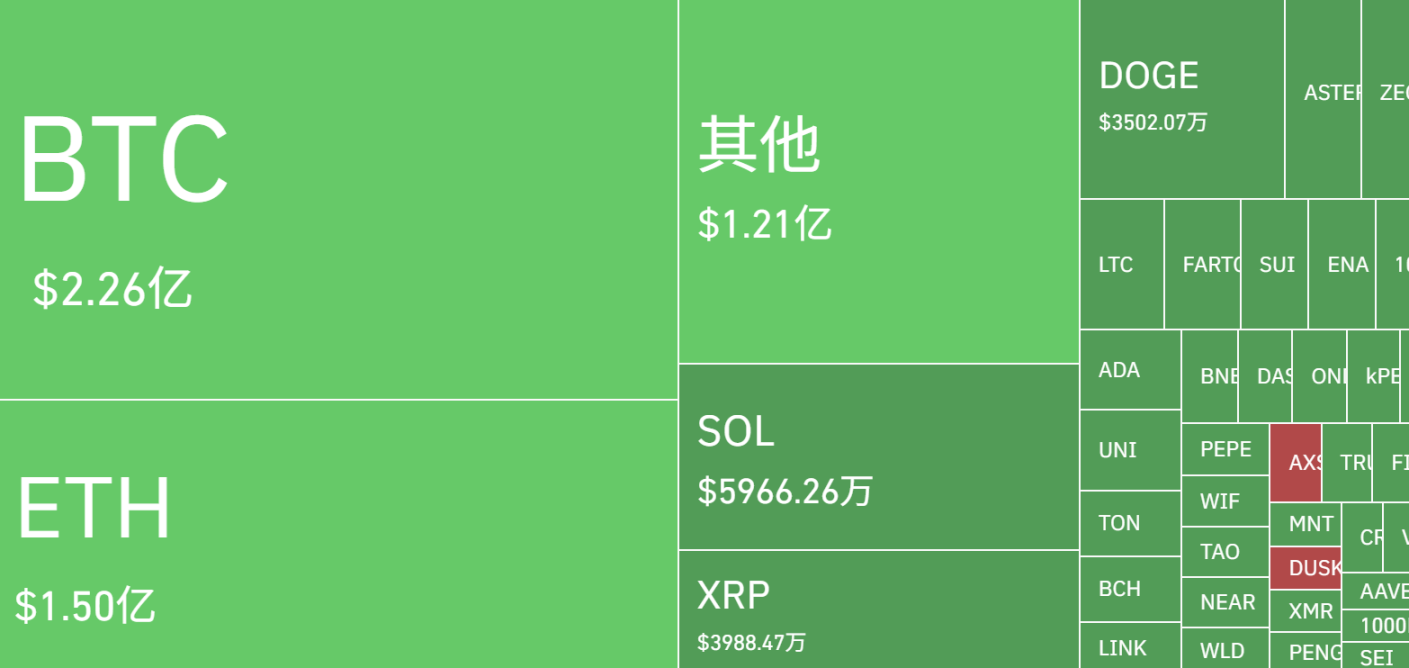
At around 7:00 AM on January 19, the cryptocurrency market experienced a sudden flash crash. The price of BTC plummeted sharply in a short period, dropping from $95,531 to a low of $91,910. ETH fell from $3,350 to a low of $3,177, and SOL dropped from $143 to a low of $130. Some altcoins like SUI, XPL, and ASTER saw declines of over 10% in 24-hour period.

According to Coinglass data, over the past 12 hours, $830 million was liquidated across the network, with long positions accounting for $764 million of that. In the past 24 hours, the largest single liquidation order occurred on Hyperliquid for a BTC-USDT perpetual contract worth $25.8337 million.
Meanwhile, traditional safe-haven assets like gold and silver bucked the trend and surged to record highs. Spot gold broke through the $4,690 per ounce mark,刷新历史高点, with a daily increase of over 2%. Spot silver broke through the $94 per ounce mark, hitting a record high, with a daily gain of over 4%.

U.S. stock markets are closed today. The U.S. Dollar Index fell 0.26% to 99.14. U.S. stock futures opened lower, with S&P 500 futures down 0.71% and Nasdaq futures down as much as 1.1% at one point. U.S. 10-year Treasury futures rose 5 ticks, and 30-year Treasury futures also rose 5 ticks.

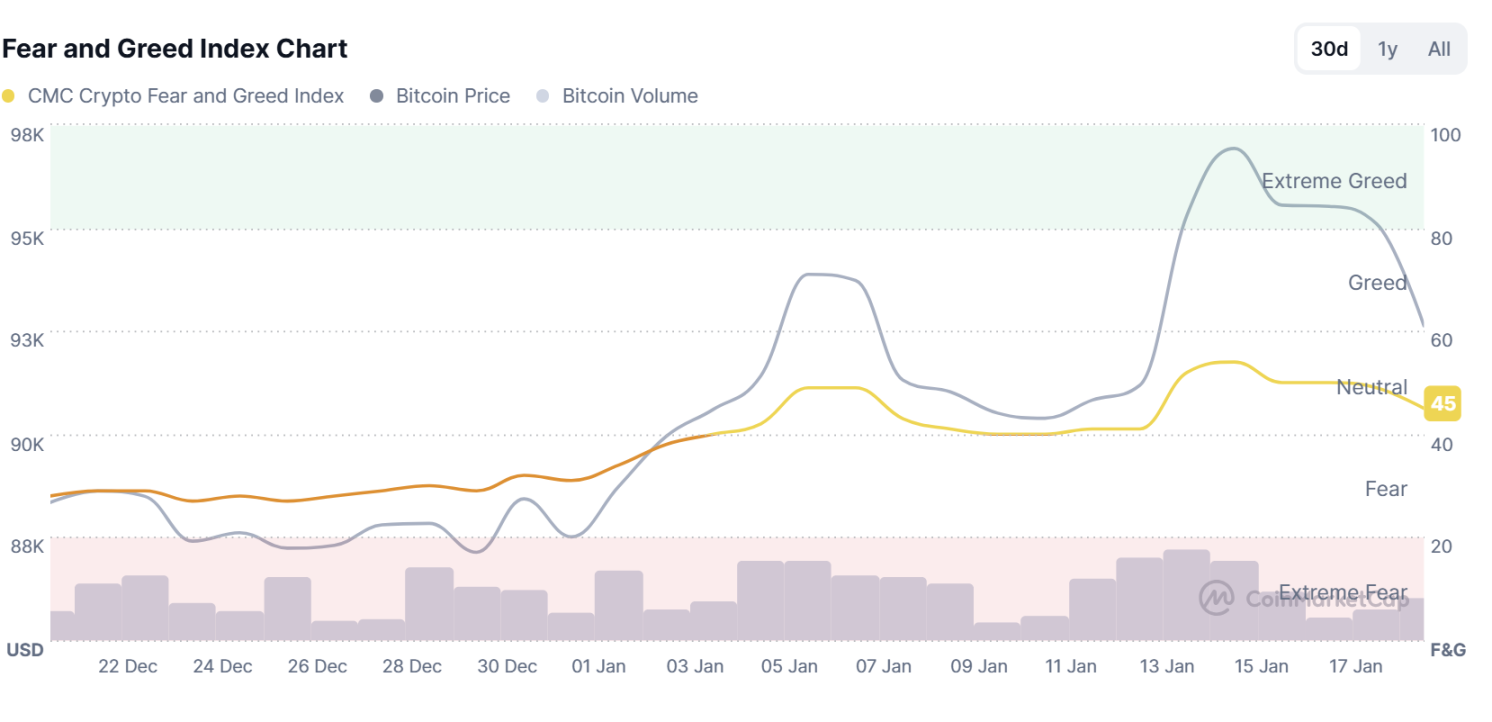
The Crypto Fear & Greed Index has currently retreated to 45.
This event is not isolated but the result of intertwined macroeconomic factors and geopolitical tensions.

Trump Wields Tariff Stick Again, Imposing Tariffs on 8 European Countries Starting February 1st

Last year, the trigger for the crypto market's "1011暴跌" (October 11th crash) was Trump wielding tariff threats against China. Now, this scene is repeating itself.

On January 18, Trump posted on Truth Social, stating that due to the Greenland issue, starting February 1st of this year, all goods exported to the U.S. from Denmark, Norway, Sweden, France, Germany, the UK, the Netherlands, and Finland will be subject to an additional 10% tariff. By June 1st of this year, the tariff will increase to 25%. These tariffs are to be paid continuously until an agreement on the "comprehensive and thorough purchase of Greenland" is reached.

In his post, Trump stated, "These countries—Denmark, Norway, Sweden, France, Germany, the UK, the Netherlands, and Finland—have all gone to Greenland for unknown purposes. This poses a very dangerous situation for the safety, security, and survival of our planet. These countries are playing an extremely dangerous game, and the level of risk they bring is intolerable and unsustainable. Therefore, to protect global peace and security, strong measures must be taken to bring this potential dangerous situation to a swift and indisputable end."

Furthermore, according to CNBC, after Trump issued tariff threats against European allies over the "Greenland issue," several European leaders responded强硬ly, emphasizing that Greenland's sovereignty is non-negotiable and warning that this move would further撕裂 transatlantic relations.

European Commission President Ursula von der Leyen and European Council President António Costa stated that pressuring allies with tariffs would damage EU-US relations and could trigger a "dangerous vicious cycle"; EU High Representative for Foreign Affairs and Security Policy Kaja Kallas said that tariffs would only harm shared prosperity, divert Europe's priorities on Ukraine, and allow rivals like Russia and China to "reap the benefits." Additionally, Spanish Prime Minister Pedro Sánchez warned that more激进 U.S. actions on Greenland would have a major impact on NATO. EU ambassadors from 27 countries plan to hold an emergency meeting to coordinate their response.

That day, according to Bloomberg, Senate Democrats plan to introduce legislation to阻止 Trump from imposing tariffs on European countries that oppose the U.S. annexation of Greenland. Previously, Senate Minority Leader Chuck Schumer criticized the move for harming the U.S. economy and relations with allies.

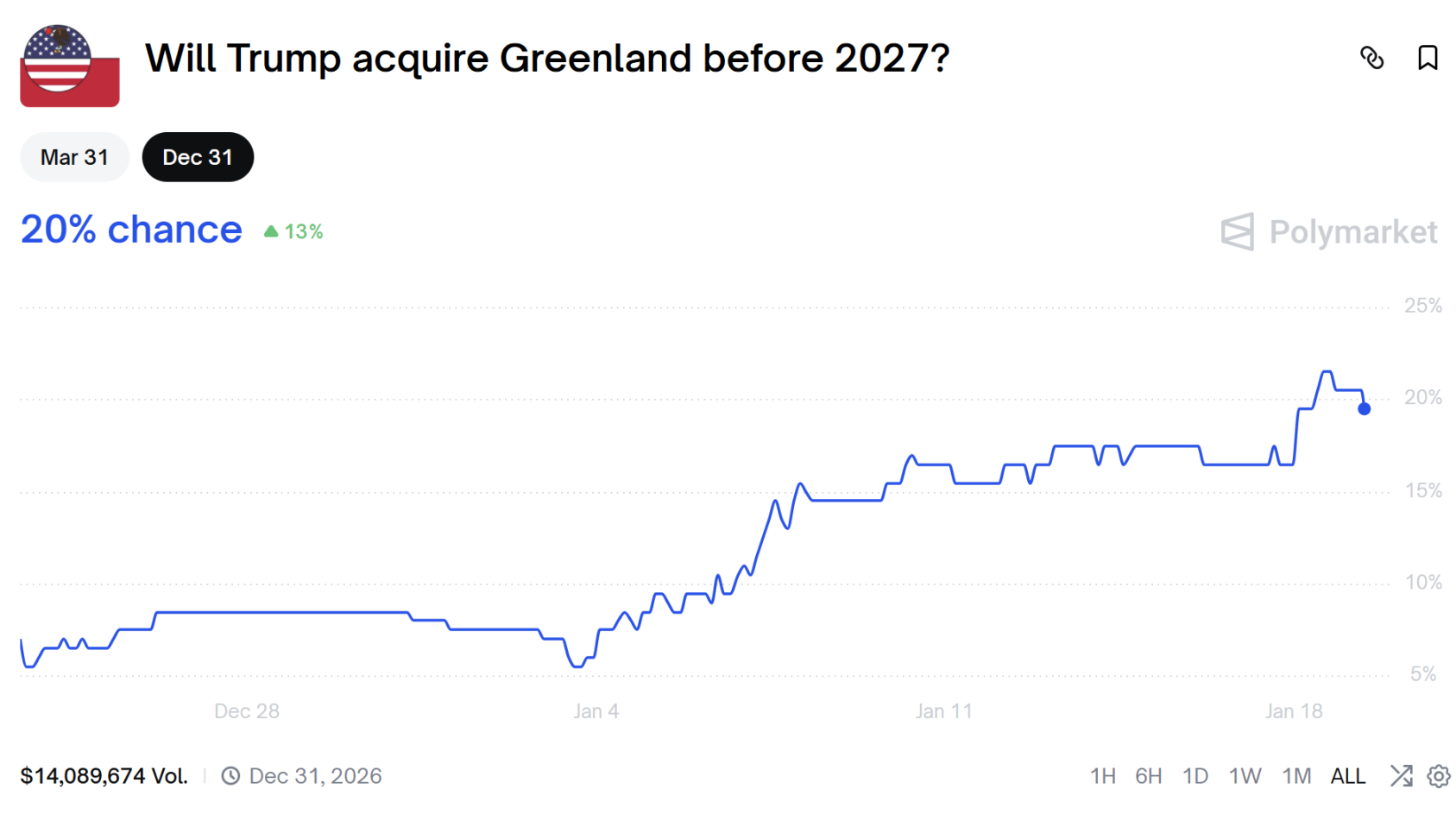
Latest data from Polymarket shows the market is betting a 20% probability that Trump will acquire Greenland by 2027.

Tariffs and geopolitical concerns have caused investors to turn to gold and silver for safety, leading to an outflow of funds from crypto.

Additionally, the probability of the Federal Reserve holding rates steady this January is extremely high. According to Polymarket data, the market's bet on no rate cut has now risen to 96%, putting pressure on risk assets.

On the evening of January 18, crypto trading indicator analysis platform CoinKarma posted, stating, "BTC rose to nearly $98,000 this week, but when it reached that price level, the market saw the most significant selling pressure in recent weeks, causing a slight pullback. However, the overall liquidity between buyers and sellers has not shown a significant imbalance and remains relatively balanced. Other key market indicators have not yet given clear signals. Based on the current situation, long position holders who entered at the relatively low points at the beginning of the year may consider taking profits, either fully or partially closing their positions, and waiting for clearer signals before re-entering the market."

Seasoned crypto investor Dan Tapiero stated: "If investing $10,000 in crypto assets in 2026, I think you can directly allocate funds to Bitcoin, Ethereum, and Solana. As for the specific allocation, it depends on your preference."

Dan Tapiero believes that the biggest opportunities in the cryptocurrency space in 2026 lie in infrastructure and the adoption of stablecoins. Tapiero stated that he expects Bitcoin to rise to $180,000 in this cycle, citing the combined effect of growing demand and a shift in global monetary policy. Falling interest rates and massive government investment in AI infrastructure will bring strong positive factors. This global push is leading to the devaluation of all fiat currencies, including the U.S. dollar. This is very favorable for Bitcoin.


Twitter:https://twitter.com/BitpushNewsCN

Bitpush TG Discussion Group:https://t.me/BitPushCommunity

Bitpush TG Subscription: https://t.me/bitpush

Original article link:https://www.bitpush.news/articles/7604166

Пов'язані питання

QWhat was the immediate impact of Trump's tariff threat on cryptocurrency markets?

ACryptocurrency markets experienced a sharp flash crash, with Bitcoin dropping from $95,531 to a low of $91,910, Ethereum falling from $3,350 to $3,177, and Solana declining from $143 to $130 within a short period.

QWhich traditional safe-haven assets saw price increases following the geopolitical tension?

ATraditional safe-haven assets like gold and silver surged to record highs, with spot gold rising over 2% to above $4,690 per ounce and spot silver increasing over 4% to above $94 per ounce.

QWhich European countries did Trump threaten with tariffs starting February 1st, and why?

ATrump threatened to impose tariffs on Denmark, Norway, Sweden, France, Germany, the UK, the Netherlands, and Finland, citing their activities in Greenland as a 'very dangerous situation' for global security and demanding a agreement for the 'complete and total purchase of Greenland'.

QHow did European leaders respond to Trump's tariff threat over Greenland?

AEuropean leaders strongly opposed the move, emphasizing Greenland's sovereignty is non-negotiable. EU officials warned it would damage transatlantic relations and could create a 'vicious cycle,' while some leaders cautioned it would benefit rivals like Russia and China and impact NATO.

QWhat was the market's probability assessment of Trump acquiring Greenland by 2027 according to Polymarket?

APolymarket data showed a 20% probability that Trump would acquire Greenland by 2027.

Пов'язані матеріали

Agent Race Ends, Super Workbench Takes Over

The era of fragmented AI agents is ending. Over the past month, China's tech giants—Tencent, Alibaba, and ByteDance—have simultaneously shifted strategy: instead of launching new, standalone AI agents, they are consolidating their various agent projects into unified "super workbenches." Tencent integrated its QClaw teams into WorkBuddy, a strategic product hailed as a potential third flagship after QQ and WeChat. Alibaba is merging its QoderWork, Wukong, and MuleRun agents into a new "Qianwen Office" platform under DingTalk's leadership. ByteDance rebranded its TRAE SOLO coding agent to TRAE Work, signaling a broader focus on workflow collaboration. This convergence marks a pivotal industry consensus. The initial exploration phase, where companies rapidly built numerous overlapping agents for different scenarios, proved costly and inefficient. With open-source tools eroding technical barriers, competition has shifted from agent creation to resource consolidation and cost control. Historically, platform wars are won not by creating more products, but by simplifying them—as seen with browsers unifying web access and super-apps consolidating services. Now, the "super workbench" aims to become the unified AI entry point for work. This reflects a deeper market realization: the primary audience for AI is no longer just programmers (a market in the tens of millions) but all knowledge workers (a market of billions). The real opportunity lies in augmenting everyday tasks—managing emails, documents, data, and meetings—across the entire workday. The core battleground is becoming control over the primary AI entry point that employees use daily. Tencent's WorkBuddy leverages WeChat and Tencent Docs; Alibaba's Qianwen Office taps into DingTalk's organizational data; ByteDance's TRAE Work integrates with Feishu's workflows. Whoever owns this "super workbench" gains strategic control over orchestrating enterprise data and APIs. This shift is redefining enterprise software. Traditional SaaS applications, valued for their user interfaces, will recede into the background. Their core functionalities will be exposed as standardized "Skills" or APIs for the super workbench's agents to invoke. Software value will shift from selling user seats to charging based on API calls and outcomes delivered. The evolution of agents is moving through clear stages: first as novel standalone products, then as consolidated primary work entry points, and finally as pervasive, invisible capabilities embedded into the digital fabric. The recent moves by major tech firms signal the transition from the first stage into the second, accelerating toward the third. In the end, the most successful agent technology may become invisible—like electricity or the HTTP protocol—a fundamental, unnamed infrastructure powering work itself.

marsbit9 хв тому

Agent Race Ends, Super Workbench Takes Over

marsbit9 хв тому

Michael Saylor: 110 Reasons to Oppose BIP-110

Michael Saylor presents 110 arguments against Bitcoin Improvement Proposal (BIP) 110, a soft fork aimed at restricting certain non-monetary data storage uses (like inscriptions) on the Bitcoin blockchain. He acknowledges the proponents' valid concerns—such as node costs, fee pressure, and preserving Bitcoin's monetary focus—but fundamentally disagrees with the proposed solution. Saylor argues that BIP 110 represents a dangerous precedent of using consensus rules to enforce value judgments on transaction validity, moving away from Bitcoin's core principles of neutrality and permissionless innovation. His key objections are organized into eleven categories: 1) It violates neutrality and hard consensus by banning currently valid transactions. 2) It fails to meet the high burden of proof required for a consensus change, lacking concrete data on the alleged crisis. 3) Its seven bundled technical restrictions are overly broad, targeting generic script functionalities and blocking future upgrade paths. 4) It sacrifices compatibility and future optionality by closing off designed upgrade hooks. 5) Its temporary rules add significant complexity (grandfathering, expiry states) without sufficient justification. 6) The economic and security impacts, particularly on miner revenue and fee markets, are uncertain and unmodeled. 7) Superior, market-based tools (fee markets, relay/mining policies) already exist to manage blockchain load. 8) It stifles innovation by creating a chilling effect for developers. 9) Its modified activation mechanism (55% threshold, forced signaling) is aggressive and risks network splits. 10) The precedent it sets—using consensus to suppress disliked but legal uses—is more dangerous than the problem it aims to solve. 11) A better path exists: improving measurements, refining resource-based policies, and allowing market forces to work. Saylor concludes that Bitcoin's strength lies in its neutral rules, open markets, and hard consensus. Changing these foundational elements to target specific use cases is an unnecessary and risky "iatrogenic" intervention. He advocates for guarding Bitcoin's neutrality rather than acting as its redeemer.

marsbit24 хв тому

Michael Saylor: 110 Reasons to Oppose BIP-110

marsbit24 хв тому

Торгівля

Спот
活动图片


