Taiwanese Nodes on the AI Industry Chain: 9 Taiwanese Stock Picks Favored by 'New Stock God' Serenity

marsbitОпубліковано о 2026-06-09Востаннє оновлено о 2026-06-09

Анотація

Investment analyst Serenity has spotlighted 9 Taiwanese stocks positioned within three key themes of the AI hardware supply chain: CPO (Co-packaged Optics), ASIC (Application-Specific Integrated Circuits), and Compound Semiconductors. For the CPO theme, anchored by TSMC's COUPE platform expected to mass produce in 2026, Serenity highlighted five stocks: FOCI (fiber array unit supplier), Shunsin Technology (optical packaging & testing), Xintec (wafer-level packaging & testing), MSSCorps (inspection/measurement tools), and Nextronics (connectors & thermal modules). Regarding the ASIC theme, driven by hyperscalers' custom chips, three companies were named: Alchip (design services for AWS), Unimicron (ABF substrates for Google TPU/AWS), and MediaTek (potential collaboration on Google TPU). A singular, strong conviction pick is Win Semiconductor, a compound semiconductor foundry and leader in InP/GaAs, seen as a beneficiary in areas like laser sources for silicon photonics and LEO satellite communications. Serenity argues that current valuations are not in a bubble, geopolitical risks are overstated, and the real systemic risk lies not in cross-strait tensions but in potential future cuts to hyperscaler (Microsoft, Amazon, Google, Meta, Oracle) capital expenditure—the primary driver of the current AI infrastructure boom.

Author: Ada, Deep Tide TechFlow

The "New Stock God" Serenity, popular on X, recently shared his systematic views on Taiwan's AI industry chain. He named 9 Taiwanese stocks covering three main themes: CPO (Co-Packaged Optics), ASIC (Application-Specific Integrated Circuit), and compound semiconductors. He identified CPO as "the biggest industrial theme for the next phase." Goldman Sachs predicts the global Optical TAM will explode from $15 billion in 2026 to $154 billion in 2028, with CPO's share growing from $164 million to $91 billion. He also explicitly stated: Taiwan's AI industry chain does not have a bubble; the real risk is not cross-strait relations, but the capital expenditures of hyperscale cloud service providers.

TSMC COUPE Countdown to 2026 Mass Production, 5 Taiwanese Stocks Cover Each Segment

The hard timeline anchoring Serenity's CPO thesis is TSMC's COUPE (Compact Universal Photonic Engine) platform entering mass production in 2026.

According to TrendForce's April 1st report citing TSMC's Advanced Packaging Integration Director Hou Shangyu at SEMICON Taiwan, COUPE, based on SoIC technology for heterogeneous integration of electronic and photonic integrated circuits, is on schedule for mass production in 2026. Hou also identified three bottlenecks for CPO scaling: wafer-level testing, Fiber Array Unit (FAU) integration, and high-speed optical packaging assembly. The 5 CPO Taiwanese stocks named by Serenity correspond precisely to these three bottleneck segments and their surrounding support infrastructure.

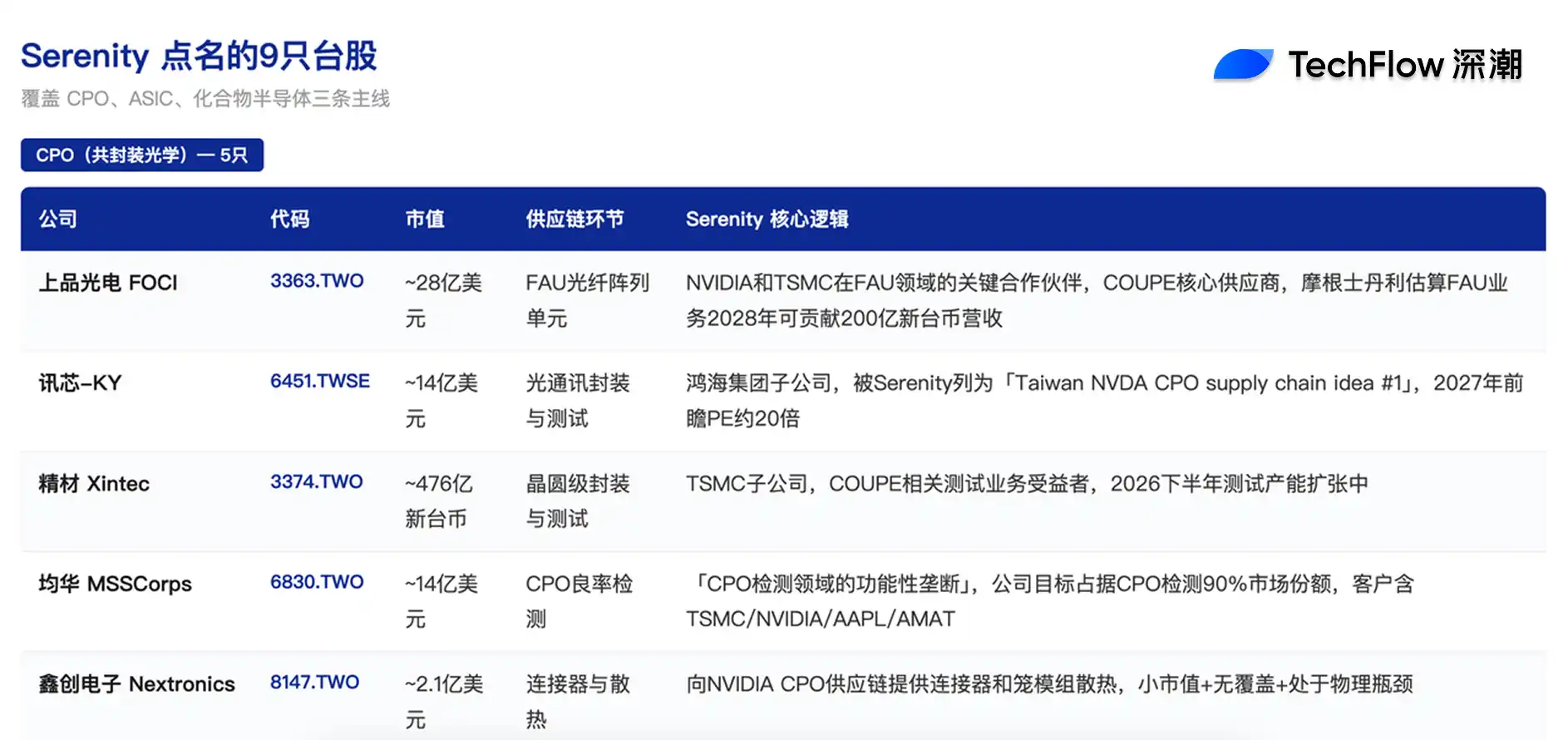
The first is FOCI (First-O-Link Optronics, 3363.TWO), with a market cap of approximately $2.8 billion. FOCI is a key partner for NVIDIA and TSMC in the FAU field and a core supplier within the COUPE architecture. Serenity stated on X that FOCI's current market cap of around $2.8 billion "has not fully reflected its strategic position in the industry chain." Morgan Stanley estimates FOCI's FAU business could contribute approximately NT$20 billion in revenue from a single product line by 2028, whereas it is currently nearly zero. As early as March, Hunterbrook Media and Citrini Research, through cross-referencing four patents from FOCI, Himax, and TSMC, confirmed a "fingerprint-level" correspondence between the three companies on 22-channel FAUs, providing the strongest external evidence of FOCI's entry into COUPE's core supply chain.

The second is Shunsin Technology (6451.TWSE), with a market cap of approximately $1.4 billion. Shunsin is the optical communication packaging and testing subsidiary of Foxconn Group. Serenity once listed Shunsin as "Taiwan NVDA CPO supply chain idea #1" on X, reasoning that "Foxconn is NVIDIA's ODM, akin to Celestial getting a free ride with MRVL's listing." He provided a personal estimate that Shunsin's forward P/E for 2027 is around 20x.

The third is Xintec (3374.TWO), with a market cap of approximately NT$47.6 billion. Xintec is TSMC's wafer-level packaging and testing subsidiary, with Chairman CH Chen. Its main businesses are wafer-level chip-scale packaging and wafer testing. According to a DIGITIMES report on May 29, 2026, Xintec is preparing capacity for testing business expansion in the second half of 2026. In a recent interview, Serenity categorized Xintec as a "beneficiary of COUPE-related testing business."

The fourth is MSSCorps (6830.TWO), with a market cap of approximately $1.4 billion. Serenity explicitly stated on X that he had established a position in MSSCorps, offering a strong judgment: "This looks like a functional monopoly in CPO inspection. The market might confuse it with material/failure analysis oligopolies like MA-tek and iST." He then cited MSSCorps' own statement, "The company aims to capture 90% of the CPO inspection market share," to support this. MSSCorps' customer mapping includes TSMC, NVIDIA, AAPL, AMAT, etc. Among the three CPO bottlenecks pointed out by TSMC, "wafer-level testing" is the segment where MSSCorps directly holds a key position.

The fifth is Nextronics (8147.TWO), with a market cap of approximately $210 million. Serenity's reason for establishing a position in Nextronics is its supply of "CPO connectors and Cage Thermal Modules" to NVIDIA's CPO supply chain. Nextronics has the smallest market cap among the 5 CPO Taiwanese stocks, fitting Serenity's typical stock selection profile of "small market cap + no coverage + positioned at a physical bottleneck."

Roughly sorted by supply chain segment, the 5 stocks are: FAU access (FOCI), optical communication packaging & testing (Shunsin Technology, Xintec), yield inspection (MSSCorps), connectors & thermal management (Nextronics). The downstream customers for this entire chain are highly concentrated in NVIDIA and TSMC.
Three Taiwanese ASIC Companies Bind to Three Hyperscalers' Custom Chip Development

Beyond NVIDIA GPUs, the continued volume ramp of hyperscale cloud service providers' self-developed ASICs, such as AWS Trainium, Google TPU, and Microsoft Maia, constitutes the second main theme in Serenity's Taiwanese stock list.

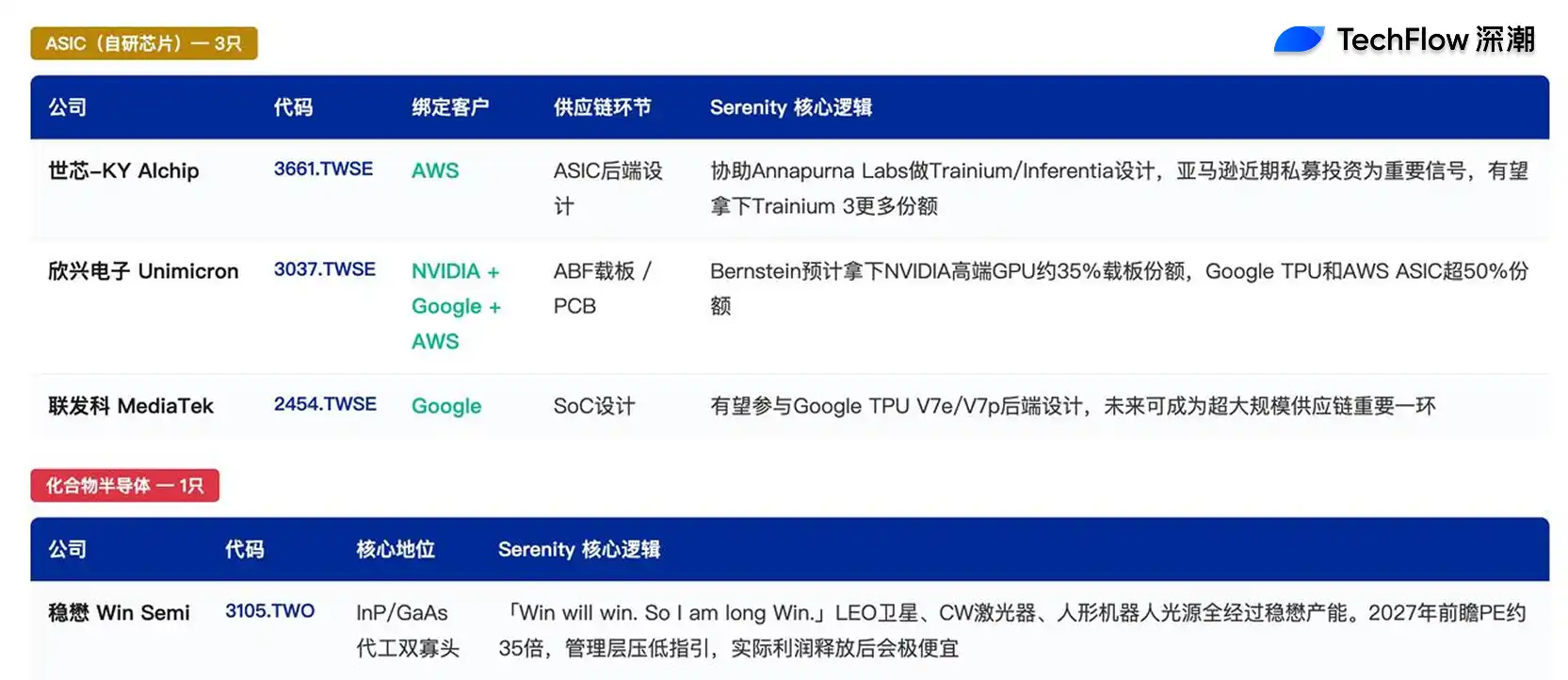
Alchip (3661.TWSE) is the most representative stock on this line. Founded in 2003 and headquartered in Taipei, Alchip specializes in advanced CMOS ASIC design and manufacturing. According to industry chain data compiled by Global Tech Research, Alchip primarily assists Amazon's Annapurna Labs with backend design for the AWS Trainium and Inferentia chip series. Current projects include Trainium 1 and Inferentia 2. Serenity recently stated that Alchip is expected to gain more market share in the design of AWS Trainium 3, especially as Amazon's recent private investment in Alchip is interpreted by the market as a significant signal. Alchip's collaboration with Ayar Labs in the CPO field also represents further expansion of its potential market.

Unimicron (3037.TWSE) is an ASIC beneficiary from the perspective of ABF substrates and PCBs. According to Gotrade News citing Bernstein's May 4th research report, Unimicron is expected to secure about 35% of the ABF substrate share for NVIDIA's high-end GPUs and over 50% share for ASIC chips like Google TPU and AWS Trainium. Bernstein listed TSMC and Unimicron as "the two most representative Taiwanese stocks in the Asian market's AI Capex cycle." Unimicron's Q1 2026 revenue grew 8% quarter-over-quarter, with a gross margin of 18%.

News of MediaTek's (2454.TWSE) collaboration with Google on TPUs is already widely circulated in the market. According to Global Tech Research analysis, MediaTek may participate in providing backend design support for future Google TPU V7e/V7p. Serenity recently noted that while some of this positive news is already partially reflected in the stock price, he believes MediaTek's future ASIC business growth is still worth continuous attention. In the coming years, MediaTek has the opportunity to become an extremely important part of the hyperscale supply chain for major US cloud providers.

These three Taiwanese companies bind to the core segments of hyperscalers' self-developed chips from three different dimensions: design services, substrate packaging, and SoC design.
Win: The Undervalued InP/GaAs Duopoly

Serenity's most resolute and explicitly stated holding among Taiwanese stocks is Win Semiconductor (3105.TWO).

Win is one of the world's leading compound semiconductor foundries, forming a duopoly with GlobalFoundries in InP (Indium Phosphide) and GaAs (Gallium Arsenide) foundry services. The market's traditional impression of Win comes from its relationship with the SpaceX Starlink and Broadcom (AVGO) supply chains.

Serenity's recent statement on X was: "Win will win. So I am long Win." Serenity's core judgment is that Win is one half of the InP and GaAs foundry duopoly. Future products for LEO (Low Earth Orbit) satellites like SpaceX Starlink, Continuous Wave (CW) lasers, and vision/radar light sources for humanoid robots will all utilize Win's foundry capacity.

He provided a valuation estimate: Win's forward P/E for 2027 is around 35x. While this may not seem cheap, he believes "management is intentionally guiding earnings low; the P/E will appear extremely cheap after actual profit realization." Win's business of assisting silicon photonics companies in expanding laser mass production capabilities is the future core growth engine in Serenity's view, and this part is not yet fully priced in by the market.

InP is the segment where Serenity first established a position in a US stock, AXTI, which he termed a "Hormuz Strait" type of investment. He compares InP substrates to "the oil of the future AI optical communication era." Win's position in Taiwanese stocks is the downstream foundry node of this industry chain.

Segments Serenity Did Not Mention But Essential for the Full Picture: Upstream Materials, Energy, Liquid Cooling

Serenity's 9 named Taiwanese stocks are concentrated in the midstream segments of CPO and ASIC. For a complete view of Taiwan's AI industry chain, upstream materials and downstream energy/liquid cooling sectors are equally indispensable. Serenity did not directly cover this part in his public remarks, but it cannot be omitted for a full understanding.

On the upstream materials side, TSMC itself (TSMC, 2330.TWSE) is the central node of the entire picture. According to Bernstein forecasts, TSMC's earnings will grow about 40% in 2026, with a compound annual growth rate of about 20% for 2027-2028; the company has set its 2026 capital expenditure guidance at the high end of the $52-56 billion range. In the upstream transmission chain of AI Capex, TSMC is both an amplifier and a throttle. Its capital expenditure direction directly determines the order rhythm for all downstream Taiwanese stocks in packaging & testing, substrates, inspection, connectors, etc.

On the energy and liquid cooling side, Taiwanese AI data centers are facing tangible power supply pressure. According to Reccessary's December 2025 report citing Taipower System Planning Director Yi Xuquan, global key grid equipment like transformers and gas turbines are in short supply. Gas turbine delivery lead times have extended from 2-3 years to 7-8 years, with prices doubling, and "grid construction speed simply cannot keep up." This supply-side bottleneck has created structural opportunities for three key Taiwanese stocks.

First, Delta Electronics (2308.TWSE), as the power management and integrated liquid cooling solution leader, has penetrated both the white space (IT computing) and grey space (power & cooling) scenarios of AI data centers. Second, AVC (3017.TWSE) is a global leader in thermal solutions, covering a full stack of technologies from cold plate liquid cooling to immersion cooling. Lastly, Auras Technology (3324.TWSE) focuses on liquid cooling module manufacturing and is a tier-1 supplier to NVIDIA. According to Goldman Sachs predictions, the global server cooling total addressable market will grow 111%, 77%, and 26% in 2025-2027, respectively, reaching $17.6 billion in 2027. This growth curve is synchronized with the CPO growth curve within the AI capital expenditure cycle.

The Real Risk is Not Cross-Strait Relations, But Hyperscale Cloud Service Providers' Capital Expenditures

Serenity's judgment on the overall risk of Taiwan's AI industry chain differs from the mainstream market narrative.

He recently stated that Taiwan's AI supply chain currently does not have a bubble, and the valuations of many Taiwanese companies are still relatively low compared to their US Nasdaq counterparts; geopolitical risks are overly amplified by the market because Taiwan is already an indispensable part of the global technology supply chain, and "no country would choose a zero-sum, large-scale supply chain disruption." Looking 7-10 years ahead, the US is building a domestic supply chain through companies like Intel, but there is no particularly significant systemic risk in the next 2-3 years.

He pointed out that the real risk worth tracking is the capital expenditures of hyperscale cloud service providers. The continuous expansion of investments by large cloud providers like Microsoft, Amazon, Google, Meta, and Oracle is the core driver of the current AI industry boom. "As long as these companies continue to increase AI infrastructure construction, Taiwan's supply chain will continue to benefit; but if hyperscale cloud service providers start cutting capital expenditures, Taiwan's AI supply chain may experience a relatively significant valuation adjustment."

Initial signs of a "stress test" for this judgment are beginning to appear.

Recent marginal changes in the market are worth noting as tracking clues. On June 3rd, Broadcom announced its Q2 FY2026 results. The Q3 FY2026 guidance for AI chip revenue was $16 billion, approximately $1.2 billion below the LSEG-compiled sell-side consensus estimate of $17.2 billion. Broadcom CEO Hock Tan also maintained the full-year AI semiconductor revenue guidance of $56 billion without raising it. The market interpreted the "lack of an upward revision" negatively. On June 5th, the Philadelphia Semiconductor Index (SOX) plunged 10.26%, its largest single-day drop since March 2020. On the same day, South Korea's KOSPI fell 5.54%, and on June 8th, KOSPI opened down 8.37%, triggering a trading halt.

However, the key reference point to watch currently is TSMC's 2026 capital expenditure, locked at the high end of the $52-56 billion range, showing no substantial reduction yet. The capital expenditure guidance from hyperscale cloud service providers themselves also remains on an upward revision track. Whether Serenity's predicted "real risk" is triggered depends on the capital expenditure guidance from Microsoft, Amazon, Google, Meta, and Oracle in their Q2 and Q3 2026 earnings reports. This is the core premise for the validity of Serenity's Taiwanese stock list and the most important marginal variable to track in the next quarter.


Пов'язані питання

QAccording to the article, what are the three main sub-sectors of the Taiwanese AI industrial chain that Serenity's highlighted stocks cover?

AThe three main sub-sectors are CPO (Co-packaged Optics), ASIC (Application-Specific Integrated Circuit), and compound semiconductors.

QWhat is the key time anchor supporting Serenity's focus on the CPO sector, and which TSMC platform is central to this timeline?

AThe key time anchor is TSMC's COUPE (Compact Universal Photonic Engine) platform, which is scheduled to enter mass production in 2026.

QIn Serenity's view, where does the real risk to the Taiwanese AI supply chain lie, not in geopolitics?

ASerenity believes the real risk lies in the capital expenditure trends of hyperscale cloud service providers (like Microsoft, Amazon, Google, Meta, Oracle). A cutback in their AI infrastructure spending could lead to significant valuation adjustments for the Taiwanese supply chain.

QName the three Taiwanese companies mentioned in the ASIC segment and the major hyperscalers they are respectively linked to.

A1. Alchip (Worldsemi-KY) is linked to AWS (Amazon Web Services) for its Trainium/Inferentia chips. 2. Unimicron (欣兴电子) is linked to Google TPU and AWS Trainium for ABF substrates. 3. MediaTek is linked to Google for potential involvement in TPU backend design support.

QWhich company does Serenity hold as his most firm and explicitly stated position in Taiwanese stocks, and what is its core business?

ASerenity's most firm position is in Win Semiconductor (稳懋). It is a leading compound semiconductor foundry, a duopoly in InP (Indium Phosphide) and GaAs (Gallium Arsenide) wafer manufacturing.

Пов'язані матеріали

La Liga Team Bets $1 Million Against Themselves Before Match: Does Using Prediction Markets for Insurance Comply with Sports Regulations?

A Spanish La Liga club, reportedly Osasuna, purchased insurance against relegation and was linked to a transaction of over $1 million on the prediction market platform Kalshi, betting against its own victory in a crucial season-ending match. While Osasuna confirmed buying €1.2 million insurance for a potential €6 million payout in case of relegation through broker Howden, it did not confirm involvement with Kalshi. The reported trade involved intermediaries like Game Point Capital and Greenlight Commodities, with quant firm Susquehanna as the counterparty. This incident highlights the blurring line between financial hedging and gambling in prediction markets. Such markets allow trading on future event outcomes, like sports results. In the US, Kalshi operates as a regulated event contract market under the CFTC. However, Spanish authorities recently initiated penalties against Kalshi and Polymarket, considering their activities unlicensed gambling. The case raises core questions about prediction markets: who can trade, how insider information is handled, and whether participants can influence outcomes, especially in sports where results are human-driven. While leagues like La Liga and Serie A have partnered with Polymarket in North America, the regulatory clash and potential for conflicts of interest, as seen in this club's alleged transaction, present significant challenges as prediction markets evolve toward institutional risk management.

Foresight News1 хв тому

La Liga Team Bets $1 Million Against Themselves Before Match: Does Using Prediction Markets for Insurance Comply with Sports Regulations?

Foresight News1 хв тому

From Shouting 150 Dollars to Liquidating HYPE in Just Three Days, How Much Credibility Does Arthur Hayes Have Left?

How much of Arthur Hayes's market credibility remains? Recently, the "godfather of crypto perpetual swaps" and BitMEX co-founder has faced public criticism, including accusations from on-chain investigator ZachXBT about creating exit liquidity for his followers. Starting last week, Hayes executed multiple sudden sell-offs. He had repeatedly publicly predicted the HYPE token would reach $150. After a $100,000 bet defending Hyperliquid on June 1st, he announced just three days later that he had completely sold his HYPE and NEAR holdings, successfully exiting near the peak. He also sold ZEC and WLD. His sale of WLD appeared to be a classic "pump and dump" maneuver. On June 3rd, he publicly set a $10 target for WLD, causing its price to surge over 35%. By June 6th, he announced he had sold his WLD, citing "anomalous" SpaceX pre-IPO price action, which triggered a sharp price drop. On June 9th, Hayes published a lengthy article explaining his actions, citing factors like rising energy costs and a potential AI bubble burst. Consequently, his family office, Maelstrom, now holds positions in US energy producers and only core crypto assets BTC and ETH, having sold AI-related stocks and non-core cryptocurrencies. This pattern is not new. In 2025, he similarly touted HYPE before selling it at what turned out to be a cycle peak, only to repurchase it at the next cycle's low. Similar scenarios played out with tokens like ETHFI and ENA. Long-term observers have developed a strategy: ignore Hayes's public statements but closely monitor his on-chain actions—be cautious following his buys, but decisively follow his sells. If he continues these tactics, especially as seen with the WLD case, his market credibility risks being permanently damaged. As Hayes himself admitted in his latest article, "I remain an unapologetic gambler."

marsbit19 хв тому

From Shouting 150 Dollars to Liquidating HYPE in Just Three Days, How Much Credibility Does Arthur Hayes Have Left?

marsbit19 хв тому

Fundraising is Like a Strange Dance: The 'Absurd Drama' of Silicon Valley Founders' Capital Raises

The article details a series of absurd and revealing anecdotes shared by Silicon Valley founders about their venture capital fundraising experiences, sparked by Greg Isenberg's story of pitching to a sleeping a16z partner. Founders describe surreal pitch meetings: one faced a barefoot, peanut-eating investor who offered triple the requested amount after 30 seconds; another performed a pitch in a VC's parked car; a founder discovered his audience understood no English beyond "yes." These stories highlight the often irrational and performative nature of fundraising. Beyond the absurdity, darker power imbalances are exposed. Stories include investors suggesting founders fire co-founders for their equity, blatant market misjudgments, disrespectful behavior from LPs, and discriminatory remarks. A debate also emerges around "Sequoia's" practice of splitting a round into two valuations. However, the thread isn't solely critical. Positive counter-narratives celebrate supportive VCs who offered crucial advice during crises, respected founders' timelines, and showed simple gestures of respect—like a partner personally fetching coffee before a major pitch. Ultimately, the collective sharing acts as a pressure release, illustrating that fundraising is a complex dance of power, trust, and sometimes sheer theater. It underscores that beyond capital, mutual respect and integrity remain the most enduring foundations of the founder-investor relationship.

marsbit32 хв тому

Fundraising is Like a Strange Dance: The 'Absurd Drama' of Silicon Valley Founders' Capital Raises

marsbit32 хв тому

Vitalik's Vision for the Next Evolution of On-Chain Finance: How to Reconstruct DeFi with an 'Options Mindset'?

Vitalik Buterin recently proposed a conceptual shift for DeFi: replacing traditional Collateralized Debt Positions (CDPs) and forced liquidations with an options-based mechanism. This aims to address key vulnerabilities in current DeFi lending. The traditional CDP model, foundational to protocols like MakerDAO and Aave, allows users to borrow against collateral but relies on real-time oracles and triggers sudden, mandatory liquidations during price volatility. This can cause cascading sell-offs, oracle manipulation risks, and significant MEV extraction, exacerbating market stress. Vitalik's alternative envisions splitting an asset like 1 ETH into two complementary components: one offering stable/index-like exposure and the other absorbing the opposite risk/reward. Instead of a hard liquidation threshold, a user's exposure to the target asset would gradually and smoothly deviate (following a near-quadratic curve) as the collateral price moves. The system would primarily depend on "slow oracles" for periodic settlement rather than instant price feeds. Key potential benefits include: the elimination of abrupt, forced liquidations; drastically reduced reliance on vulnerable real-time oracles; and inherent resistance to certain MEV exploits centered on liquidation auctions. The article posits that for Ethereum DeFi to maintain its relevance amid competition from faster, cheaper chains, it must compete on sophisticated financial engineering and robustness—not just transaction speed or yields. The core value proposition should shift towards offering users clearer, more manageable risk structures, greater autonomy, and resilience in extreme scenarios, moving DeFi from high-risk experimentation towards becoming reliable financial infrastructure.

marsbit1 год тому

Vitalik's Vision for the Next Evolution of On-Chain Finance: How to Reconstruct DeFi with an 'Options Mindset'?

marsbit1 год тому

Торгівля

Спот
Ф'ючерси

Популярні статті

Що таке GROK AI

Grok AI: Революція в розмовних технологіях ери Web3 Вступ У швидко змінюваному ландшафті штучного інтелекту Grok AI вирізняється як помітний проєкт, що поєднує сфери передових технологій та взаємодії з користувачами. Розроблений компанією xAI, яку очолює відомий підприємець Ілон Маск, Grok AI прагне переосмислити, як ми взаємодіємо зі штучним інтелектом. Оскільки рух Web3 продовжує процвітати, Grok AI має на меті використати потужність розмовного ШІ для відповіді на складні запитання, надаючи користувачам досвід, який є не лише інформативним, але й розважальним. Що таке Grok AI? Grok AI — це складний розмовний чат-бот, розроблений для динамічної взаємодії з користувачами. На відміну від багатьох традиційних систем ШІ, Grok AI охоплює ширший спектр запитів, включаючи ті, які зазвичай вважаються недоречними або виходять за межі стандартних відповідей. Основні цілі проєкту включають: Надійне міркування: Grok AI акцентує увагу на здоровому глузді, щоб надавати логічні відповіді на основі контекстуального розуміння. Масштабоване управління: Інтеграція допоміжних інструментів забезпечує моніторинг та оптимізацію взаємодій користувачів для покращення якості. Формальна верифікація: Безпека є пріоритетом; Grok AI впроваджує методи формальної верифікації для підвищення надійності своїх результатів. Розуміння довгого контексту: Модель ШІ відзначається здатністю зберігати та згадувати обширну історію розмов, що сприяє змістовним та контекстуально обізнаним дискусіям. Стійкість до атак: Зосереджуючись на покращенні своїх захистів від маніпульованих або зловмисних вхідних даних, Grok AI прагне зберегти цілісність взаємодій з користувачами. По суті, Grok AI — це не просто пристрій для отримання інформації; це занурюючий розмовний партнер, який заохочує динамічний діалог. Творець Grok AI Геній, що стоїть за Grok AI, — це ніхто інший, як Ілон Маск, особа, яка стала синонімом інновацій у різних сферах, включаючи автомобільну промисловість, космічні подорожі та технології. Під егідою xAI, компанії, що зосереджена на розвитку технологій ШІ на користь суспільства, бачення Маска прагне переосмислити розуміння взаємодій з ШІ. Лідерство та основоположна етика глибоко впливають на прагнення Маска розширити технологічні межі. Інвестори Grok AI Хоча конкретні деталі щодо інвесторів, які підтримують Grok AI, залишаються обмеженими, загальновідомо, що xAI, інкубатор проєкту, заснований і підтримується переважно самим Ілоном Маском. Попередні підприємства та активи Маска забезпечують надійну підтримку, що додатково зміцнює довіру до Grok AI та потенціал для зростання. Однак наразі інформація про додаткові інвестиційні фонди або організації, що підтримують Grok AI, не є доступною, що позначає область для потенційного майбутнього дослідження. Як працює Grok AI? Операційна механіка Grok AI є такою ж інноваційною, як і його концептуальна структура. Проєкт інтегрує кілька передових технологій, які сприяють його унікальним функціональним можливостям: Надійна інфраструктура: Grok AI побудований з використанням Kubernetes для оркестрації контейнерів, Rust для продуктивності та безпеки, і JAX для високопродуктивних числових обчислень. Ця трійка забезпечує ефективну роботу чат-бота, його масштабованість та швидке обслуговування користувачів. Доступ до знань у реальному часі: Однією з відмінних рис Grok AI є його здатність отримувати дані в реальному часі через платформу X — раніше відому як Twitter. Ця можливість надає ШІ доступ до останньої інформації, що дозволяє надавати своєчасні відповіді та рекомендації, які можуть бути пропущені іншими моделями ШІ. Два режими взаємодії: Grok AI пропонує користувачам вибір між “Розважальним режимом” та “Звичайним режимом”. Розважальний режим дозволяє більш ігровий та гумористичний стиль взаємодії, тоді як Звичайний режим зосереджується на наданні точних і правильних відповідей. Ця універсальність забезпечує індивідуальний досвід, що відповідає різним уподобанням користувачів. По суті, Grok AI поєднує продуктивність із залученням, створюючи досвід, який є одночасно збагачуючим і розважальним. Хронологія Grok AI Шлях Grok AI відзначений важливими етапами, які відображають його розвиток та етапи впровадження: Початковий розвиток: Фундаментальна фаза Grok AI тривала приблизно два місяці, протягом яких проводилося початкове навчання та налаштування моделі. Випуск бета-версії Grok-2: У значному досягненні була оголошена бета-версія Grok-2. Цей випуск представив дві версії чат-бота — Grok-2 та Grok-2 mini — кожна з яких оснащена можливостями для спілкування, кодування та міркування. Публічний доступ: Після бета-розробки Grok AI став доступним для користувачів платформи X. Ті, хто має акаунти, підтверджені номером телефону та активні принаймні сім днів, можуть отримати доступ до обмеженої версії, що робить технологію доступною для ширшої аудиторії. Ця хронологія відображає систематичний розвиток Grok AI від початку до публічної взаємодії, підкреслюючи його прагнення до постійного вдосконалення та взаємодії з користувачами. Ключові особливості Grok AI Grok AI охоплює кілька ключових особливостей, які сприяють його інноваційній ідентичності: Інтеграція знань у реальному часі: Доступ до актуальної та релевантної інформації відрізняє Grok AI від багатьох статичних моделей, забезпечуючи захоплюючий та точний досвід для користувачів. Універсальні стилі взаємодії: Пропонуючи різні режими взаємодії, Grok AI задовольняє різноманітні уподобання користувачів, запрошуючи до творчості та персоналізації у спілкуванні з ШІ. Передова технологічна основа: Використання Kubernetes, Rust та JAX надає проєкту надійну основу для забезпечення надійності та оптимальної продуктивності. Етичні міркування в дискурсі: Включення функції генерації зображень демонструє інноваційний дух проєкту. Однак це також піднімає етичні питання, пов'язані з авторським правом та поважним зображенням впізнаваних фігур — триваюча дискусія в спільноті ШІ. Висновок Як піонер у сфері розмовного ШІ, Grok AI втілює потенціал трансформаційних користувацьких досвідів в цифрову епоху. Розроблений компанією xAI та керований візією Ілона Маска, Grok AI інтегрує знання в реальному часі з передовими можливостями взаємодії. Він прагне розширити межі того, що може досягти штучний інтелект, зберігаючи при цьому акцент на етичних міркуваннях та безпеці користувачів. Grok AI не лише втілює технологічний прогрес, але й представляє нову парадигму спілкування в ландшафті Web3, обіцяючи залучити користувачів як глибокими знаннями, так і ігровою взаємодією. Оскільки проєкт продовжує розвиватися, він слугує свідченням того, що може досягти перетин технологій, творчості та людської взаємодії.

452 переглядів усьогоОпубліковано 2024.12.26Оновлено 2024.12.26

Що таке GROK AI

Що таке ERC AI

Euruka Tech: Огляд $erc ai та його амбіцій у Web3 Вступ У швидко змінюваному ландшафті технології блокчейн та децентралізованих додатків нові проекти з'являються часто, кожен з унікальними цілями та методологіями. Одним з таких проектів є Euruka Tech, який працює у широкій сфері криптовалют та Web3. Основна увага Euruka Tech, зокрема його токена $erc ai, зосереджена на представленні інноваційних рішень, розроблених для використання зростаючих можливостей децентралізованих технологій. Ця стаття має на меті надати всебічний огляд Euruka Tech, дослідження його цілей, функціональності, ідентичності його творця, потенційних інвесторів та його значення в ширшому контексті Web3. Що таке Euruka Tech, $erc ai? Euruka Tech характеризується як проект, який використовує інструменти та функціональність, що пропонуються середовищем Web3, зосереджуючи увагу на інтеграції штучного інтелекту у своїй діяльності. Хоча конкретні деталі про структуру проекту дещо неясні, він розроблений для покращення залучення користувачів та автоматизації процесів у крипто-просторі. Проект має на меті створити децентралізовану екосистему, яка не лише полегшує транзакції, але й включає прогностичні функції через штучний інтелект, звідси і назва його токена, $erc ai. Мета полягає в тому, щоб надати інтуїтивно зрозумілу платформу, яка сприяє розумнішим взаємодіям та ефективній обробці транзакцій у зростаючій сфері Web3. Хто є творцем Euruka Tech, $erc ai? На даний момент інформація про творця або засновницьку команду Euruka Tech залишається невизначеною та дещо непрозорою. Ця відсутність даних викликає занепокоєння, оскільки знання про бекграунд команди часто є важливим для встановлення довіри в секторі блокчейн. Тому ми класифікували цю інформацію як невідому, поки конкретні деталі не стануть доступними в публічному домені. Хто є інвесторами Euruka Tech, $erc ai? Аналогічно, ідентифікація інвесторів або організацій, які підтримують проект Euruka Tech, не надається через доступні дослідження. Аспект, який є критично важливим для потенційних зацікавлених сторін або користувачів, які розглядають можливість співпраці з Euruka Tech, - це впевненість, що походить від встановлених фінансових партнерств або підтримки від авторитетних інвестиційних компаній. Без розкриття інформації про інвестиційні зв'язки важко зробити всебічні висновки про фінансову безпеку або довговічність проекту. Відповідно до знайденої інформації, цей розділ також має статус невідомий. Як працює Euruka Tech, $erc ai? Незважаючи на відсутність детальних технічних специфікацій для Euruka Tech, важливо враховувати його інноваційні амбіції. Проект прагне використовувати обчислювальну потужність штучного інтелекту для автоматизації та покращення досвіду користувачів у середовищі криптовалют. Інтегруючи ШІ з технологією блокчейн, Euruka Tech має на меті надати такі функції, як автоматизовані угоди, оцінка ризиків та персоналізовані інтерфейси користувачів. Інноваційна суть Euruka Tech полягає в його меті створити безшовний зв'язок між користувачами та величезними можливостями, які пропонують децентралізовані мережі. Завдяки використанню алгоритмів машинного навчання та ШІ, він має на меті мінімізувати труднощі для нових користувачів і спростити транзакційні досвіди в рамках Web3. Ця симбіоз між ШІ та блокчейном підкреслює значення токена $erc ai, який виступає як міст між традиційними інтерфейсами користувачів та розвиненими можливостями децентралізованих технологій. Хронологія Euruka Tech, $erc ai На жаль, через обмежену інформацію про Euruka Tech ми не можемо представити детальну хронологію основних подій або досягнень у подорожі проекту. Ця хронологія, яка зазвичай є безцінною для відстеження еволюції проекту та розуміння його траєкторії зростання, наразі недоступна. Як тільки інформація про значні події, партнерства або функціональні доповнення стане очевидною, оновлення, безумовно, підвищать видимість Euruka Tech у крипто-сфері. Роз'яснення щодо інших проектів “Eureka” Варто зазначити, що кілька проектів та компаній мають схожу назву з “Eureka”. Дослідження виявило ініціативи, такі як AI-агент від NVIDIA Research, який зосереджується на навчанні роботів складним завданням за допомогою генеративних методів, а також Eureka Labs та Eureka AI, які покращують користувацький досвід в освіті та аналітиці обслуговування клієнтів відповідно. Однак ці проекти відрізняються від Euruka Tech і не повинні бути змішані з його цілями чи функціональністю. Висновок Euruka Tech, разом із його токеном $erc ai, представляє обіцяючого, але наразі невідомого гравця в ландшафті Web3. Хоча деталі про його творця та інвесторів залишаються невідомими, основна амбіція поєднання штучного інтелекту з технологією блокчейн є центром інтересу. Унікальні підходи проекту до сприяння залученню користувачів через передову автоматизацію можуть виділити його на фоні прогресу екосистеми Web3. Оскільки крипто-ринок продовжує еволюціонувати, зацікавлені сторони повинні уважно стежити за новинами, пов'язаними з Euruka Tech, оскільки розвиток задокументованих інновацій, партнерств або визначеного дорожньої карти може представити значні можливості в найближчому майбутньому. На даний момент ми чекаємо на більш суттєві інсайти, які можуть розкрити потенціал Euruka Tech та його позицію в конкурентному крипто-ландшафті.

433 переглядів усьогоОпубліковано 2025.01.02Оновлено 2025.01.02

Що таке ERC AI

Що таке DUOLINGO AI

DUOLINGO AI: Інтеграція вивчення мов з Web3 та інноваціями штучного інтелекту В епоху, коли технології змінюють освіту, інтеграція штучного інтелекту (ШІ) та блокчейн-мереж відкриває нові горизонти для вивчення мов. З'являється DUOLINGO AI та його асоційована криптовалюта, $DUOLINGO AI. Цей проект прагне об'єднати освітні можливості провідних платформ для вивчення мов з перевагами децентралізованих технологій Web3. У цій статті розглядаються ключові аспекти DUOLINGO AI, його цілі, технологічна структура, історичний розвиток та майбутній потенціал, зберігаючи чіткість між оригінальним освітнім ресурсом та цією незалежною криптовалютною ініціативою. Огляд DUOLINGO AI В основі DUOLINGO AI лежить прагнення створити децентралізоване середовище, де учні можуть отримувати криптографічні винагороди за досягнення освітніх етапів у мовній компетенції. Застосовуючи смарт-контракти, проект має на меті автоматизувати процеси перевірки навичок та розподілу токенів, дотримуючись принципів Web3, які підкреслюють прозорість та власність користувачів. Модель відрізняється від традиційних підходів до вивчення мов, акцентуючи увагу на структурі управління, що базується на спільноті, що дозволяє власникам токенів пропонувати поліпшення змісту курсів та розподілу винагород. Деякі з помітних цілей DUOLINGO AI включають: Гейміфіковане навчання: Проект інтегрує досягнення на блокчейні та невзаємозамінні токени (NFT), щоб представляти рівні мовної компетенції, сприяючи мотивації через захоплюючі цифрові винагороди. Децентралізоване створення контенту: Це відкриває можливості для викладачів та мовних ентузіастів вносити свої курси, сприяючи моделі розподілу доходів, яка вигідна всім учасникам. Персоналізація на основі ШІ: Використовуючи сучасні моделі машинного навчання, DUOLINGO AI персоналізує уроки, щоб адаптуватися до індивідуального прогресу навчання, подібно до адаптивних функцій, що є в усталених платформах. Творці проекту та управління Станом на квітень 2025 року команда, що стоїть за $DUOLINGO AI, залишається псевдонімною, що є поширеною практикою в децентралізованому криптовалютному середовищі. Ця анонімність має на меті сприяти колективному розвитку та залученню зацікавлених сторін, а не зосереджуватися на окремих розробниках. Смарт-контракт, розгорнутий на блокчейні Solana, зазначає адресу гаманця розробника, що свідчить про зобов'язання до прозорості щодо транзакцій, незважаючи на те, що особи творців залишаються невідомими. Згідно з його дорожньою картою, DUOLINGO AI прагне перетворитися на Децентралізовану Автономну Організацію (DAO). Ця структура управління дозволяє власникам токенів голосувати з важливих питань, таких як реалізація функцій та розподіл скарбниці. Ця модель узгоджується з етикою розширення прав і можливостей спільноти, що спостерігається в різних децентралізованих додатках, підкреслюючи важливість колективного прийняття рішень. Інвестори та стратегічні партнерства На даний момент немає публічно відомих інституційних інвесторів або венчурних капіталістів, пов'язаних з $DUOLINGO AI. Натомість ліквідність проекту в основному походить з децентралізованих бірж (DEX), що є різким контрастом до стратегій фінансування традиційних компаній у сфері освітніх технологій. Ця модель знизу вгору вказує на підхід, орієнтований на спільноту, що відображає зобов'язання проекту до децентралізації. У своєму білому документі DUOLINGO AI згадує про формування співпраці з неуточненими “блокчейн-освітніми платформами”, спрямованими на збагачення своїх курсів. Хоча конкретні партнерства ще не були розкриті, ці спільні зусилля натякають на стратегію поєднання інновацій блокчейну з освітніми ініціативами, розширюючи доступ та залучення користувачів у різноманітні навчальні напрямки. Технологічна архітектура Інтеграція ШІ DUOLINGO AI включає два основні компоненти на основі ШІ для покращення своїх освітніх пропозицій: Адаптивний навчальний двигун: Цей складний двигун навчається на основі взаємодій користувачів, подібно до власних моделей великих освітніх платформ. Він динамічно регулює складність уроків, щоб вирішувати конкретні проблеми учнів, зміцнюючи слабкі місця через цілеспрямовані вправи. Розмовні агенти: Використовуючи чат-боти на базі GPT-4, DUOLINGO AI надає платформу для користувачів, щоб брати участь у симульованих розмовах, сприяючи більш інтерактивному та практичному досвіду вивчення мови. Інфраструктура блокчейну Побудований на блокчейні Solana, $DUOLINGO AI використовує комплексну технологічну структуру, яка включає: Смарт-контракти для перевірки навичок: Ця функція автоматично нагороджує токенами користувачів, які успішно проходять тести на компетентність, підкріплюючи структуру стимулів для справжніх навчальних результатів. NFT значки: Ці цифрові токени позначають різні етапи, яких досягають учні, такі як завершення розділу курсу або оволодіння конкретними навичками, що дозволяє їм обмінюватися або демонструвати свої досягнення в цифровому форматі. Управління DAO: Члени спільноти, наділені токенами, можуть брати участь в управлінні, голосуючи за ключові пропозиції, що сприяє культурі участі, яка заохочує інновації в курсах та функціях платформи. Історичний хронологічний графік 2022–2023: Концептуалізація Основи DUOLINGO AI закладаються з створення білого документа, що підкреслює синергію між досягненнями ШІ у вивченні мов та децентралізованим потенціалом блокчейн-технологій. 2024: Бета-реліз Обмежений бета-реліз представляє пропозиції з популярних мов, винагороджуючи ранніх користувачів токенами в рамках стратегії залучення спільноти проекту. 2025: Перехід до DAO У квітні відбувається повний запуск основної мережі з обігом токенів, що спонукає обговорення в спільноті щодо можливих розширень на азійські мови та інші розробки курсів. Виклики та майбутні напрямки Технічні труднощі Незважаючи на свої амбітні цілі, DUOLINGO AI стикається з суттєвими викликами. Масштабованість залишається постійною проблемою, особливо в балансуванні витрат, пов'язаних із обробкою ШІ, та підтриманням чутливої, децентралізованої мережі. Крім того, забезпечення якості створення контенту та модерації в умовах децентралізованої пропозиції створює складнощі у підтримці освітніх стандартів. Стратегічні можливості Дивлячись у майбутнє, DUOLINGO AI має потенціал використовувати партнерства з мікрокреденційними академічними установами, надаючи блокчейн-верифіковані підтвердження мовних навичок. Крім того, розширення через різні блокчейни може дозволити проекту залучити ширші бази користувачів та додаткові екосистеми блокчейну, покращуючи його взаємодію та охоплення. Висновок DUOLINGO AI представляє інноваційне злиття штучного інтелекту та блокчейн-технологій, пропонуючи альтернативу, орієнтовану на спільноту, традиційним системам вивчення мов. Хоча його псевдонімна розробка та нова економічна модель несуть певні ризики, зобов'язання проекту до гейміфікованого навчання, персоналізованої освіти та децентралізованого управління освітлює шлях вперед для освітніх технологій у сфері Web3. Оскільки ШІ продовжує розвиватися, а екосистема блокчейну еволюціонує, ініціативи на кшталт DUOLINGO AI можуть переосмислити, як користувачі взаємодіють з мовною освітою, наділяючи спільноти та винагороджуючи залучення через інноваційні механізми навчання.

461 переглядів усьогоОпубліковано 2025.04.11Оновлено 2025.04.11

Що таке DUOLINGO AI

Обговорення

Ласкаво просимо до спільноти HTX. Тут ви можете бути в курсі останніх подій розвитку платформи та отримати доступ до професійної ринкової інформації. Нижче представлені думки користувачів щодо ціни AI (AI).

活动图片












