‘TACO’ Is Outdated, Wall Street Embraces ‘NACHO’ Trading

marsbitОпубліковано о 2026-05-09Востаннє оновлено о 2026-05-09

Анотація

The Wall Street trading meme "TACO" (Trump Always Chickens Out) is being replaced by "NACHO" (Not A Chance Hormuz Opens), signaling a major shift in market expectations. TACO bets anticipated de-escalation from political figures, but this pattern broke on March 23rd when a Trump social media post claiming progress with Iran was denied by Tehran, causing a sharp but temporary market reversal. Since then, markets have adopted a NACHO mindset, betting the Strait of Hormuz will remain closed for an extended period. This view is reflected in three key markets. First, war risk insurance premiums for vessels transiting the strait have skyrocketed. Second, the oil futures curve shows a steep backwardation, with near-term prices far exceeding long-dated contracts, indicating expectations for a prolonged but not permanent supply crunch. Third, Federal Reserve rate cut expectations for 2026 have been priced out to zero due to persistent oil-price inflation. While the S&P 500 continues hitting record highs, the market internally reflects NACHO's impact. The energy sector ETF (XLE) has vastly outperformed the transportation sector ETF (IYT), as high oil prices directly benefit producers but squeeze transport and logistics companies' margins. The NACHO trade has a concrete deadline. Analysts warn global commercial oil inventories could reach critical "operational pressure" levels by early June. If the strait remains closed into September, OECD stocks may fall below the operational floor...

On Wall Street, ‘TACO trading’ is out of style, and everyone is now discussing a new trading pattern—‘NACHO’.

Since the U.S.-Israel airstrike on Iran on February 28th, the Strait of Hormuz has remained closed. Oil prices are now up over 50% from pre-war levels, and the market's expectation for Federal Reserve rate cuts in 2026 has been compressed from 2 cuts pre-war to the current 0 cuts. Yet, during the same period, the S&P 500 has hit record highs, rallying for six consecutive weeks—its longest winning streak since 2024.

Wall Street has given this seemingly contradictory market state a name: NACHO, short for ‘Not A Chance Hormuz Opens’. It's the opposite of TACO (Trump Always Chickens Out). TACO bets on ‘people backing down’—that Trump would retreat at critical moments. NACHO bets on ‘things getting stuck’—that this time, the Strait of Hormuz cannot be reopened with just one Truth Social post.

eToro market analyst Zavier Wong described this shift: ‘For most of the crisis, every ceasefire headline caused oil prices to plunge sharply. Traders kept betting on a solution that never arrived. NACHO means the market acknowledges that high oil prices are not a one-time shock; they are the current market environment itself.’

Two Diverging Lines in Early April

March 23rd was the tipping point where the TACO pattern failed. That morning, Trump announced on Truth Social that he had held ‘very good constructive talks’ with Iran and ordered the Pentagon to halt strikes on Iranian energy facilities for five days. S&P 500 futures rebounded nearly 4% from lows within minutes, instantly adding $1.7 trillion in market value. Brent crude fell from $109 intraday to $92.

Then, Iranian officials denied the talks took place. According to Iranian state media, a ‘senior security official’ called it a market manipulation tactic, stating no dialogue ever occurred. The gains were halved within two hours, with the S&P closing only +1.15% and Brent rebounding to $99.94.

That was the first time in 14 months that Trump's ‘backing down’ no longer moved the market effectively. The reason isn't complicated: backing down in the TACO pattern was one-sided, deliverable with a single post. The retreat on March 23rd required Iran's cooperation. When the counterparty didn't cooperate, the retreat turned into a lie.
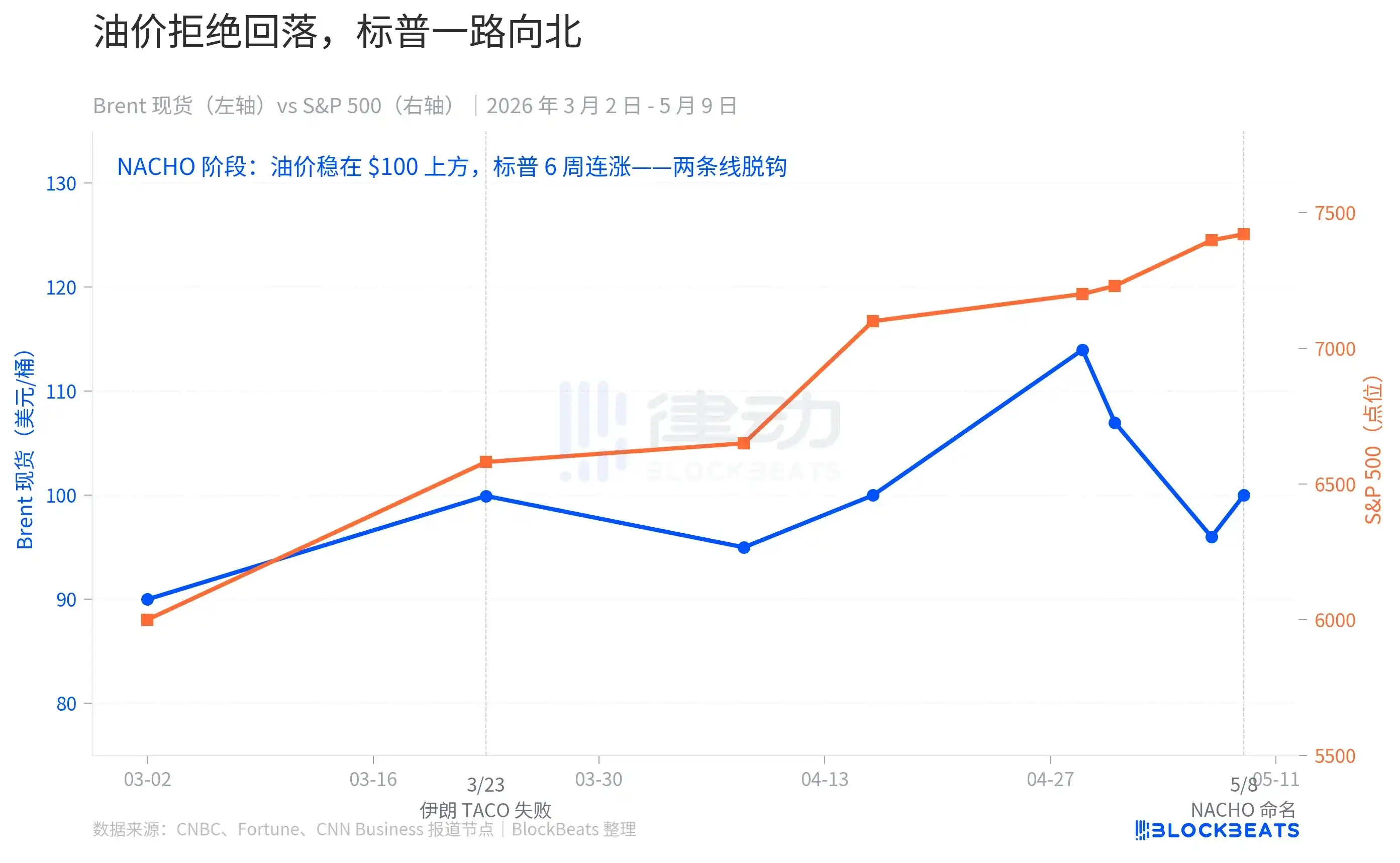
From that day on, market behavior fundamentally changed. Brent crude never fell back to the pre-war level of $67 in the following six weeks, with its May average price still maintained at $109.57. In between, there were U.S.-Iran ceasefire agreements on April 7th and 8th, a brief return of oil prices to ‘initial war levels’ on April 17th, and news on May 7th that the U.S. and Iran were close to a deal. None of these ‘ceasefire headlines’ brought oil prices back to the baseline.

But the S&P headed north. It rose 10% in April alone, its strongest month since November 2020, setting 7 intraday all-time highs during the period. On May 1st, it broke 7,230 points intraday, closing at 7,398 points on May 7th.

The two lines completely decoupled in early April. In the TACO era, they moved together: threats came, oil and the S&P fell; backing down came, oil and the S&P rebounded. In the NACHO era, they speak two different languages: oil prices say ‘Hormuz is shut for good,’ while the S&P says ‘it's none of my business.’

Three Markets, Three Reactions

NACHO is not just talk; it's the same bet placed with real money across three separate derivative markets.

The first layer is insurance. According to historical data from the Strauss Center, war risk insurance rates for the Strait of Hormuz once soared to 3.5% of hull value during the 2003 U.S. invasion of Iraq, reaching 7.5% at the peak of the ‘Tanker War’ in the 1984 Iran-Iraq War after the attack on the Yanbu Pride tanker. The baseline before this crisis was 0.125% to 0.25%. By early May, this rate had entered the 1% range, with some policies surging to 3%–8%.

Converted to the insurance cost for a single Very Large Crude Carrier (VLCC) per transit, the fee has jumped from about $250,000 pre-war to the current $800,000 to $8 million. An insurer's job is to price risk. The practical implication of this layer is: if insurers simply won't provide coverage, shipowners won't risk uninsured transit. The ‘physical reopening’ and ‘de facto navigation’ of the Strait are two different things.
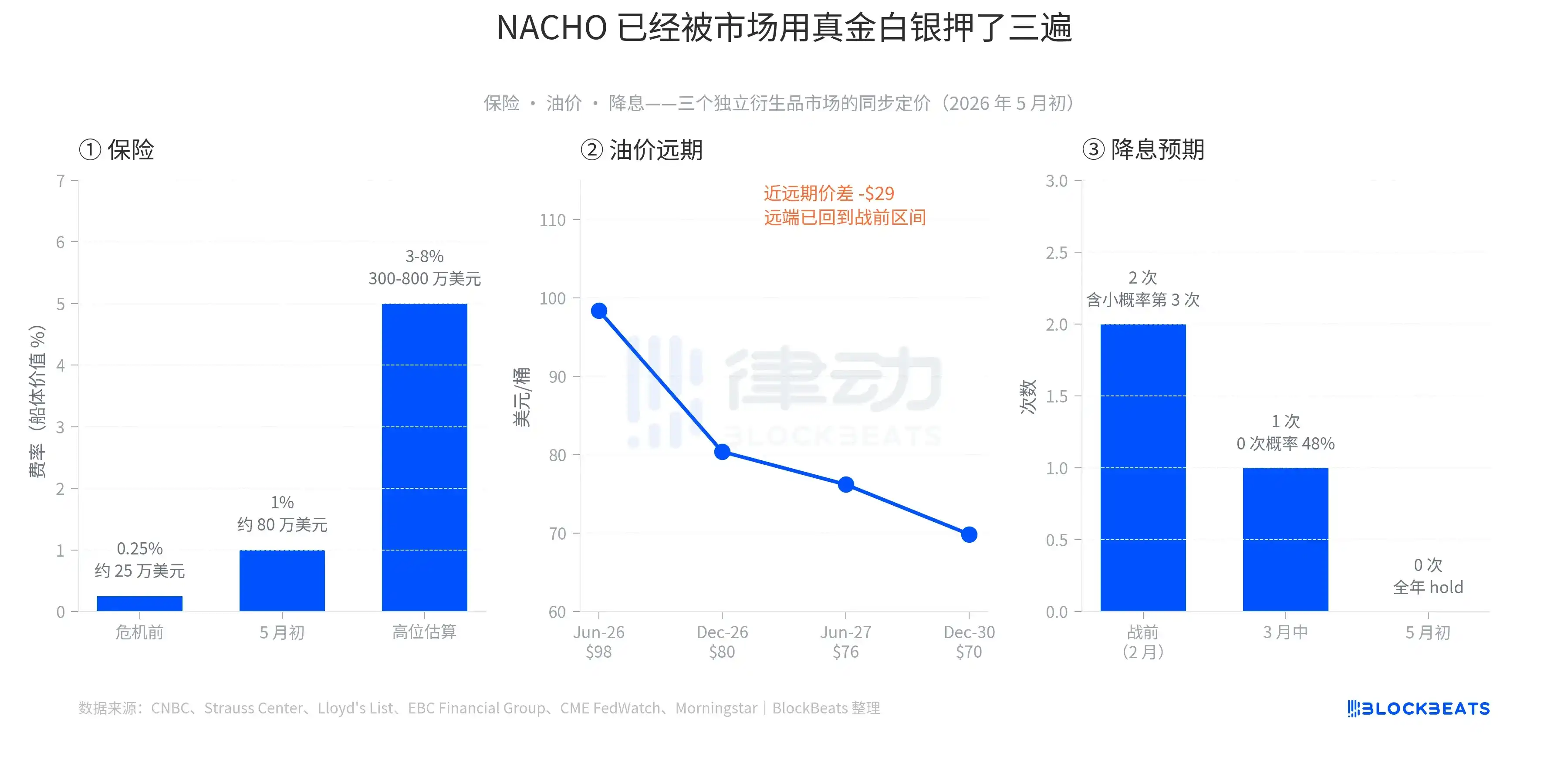
The second layer is oil prices. Early May data shows the Brent Jun-26 contract at $98.41, Dec-26 at $80.39, Jun-27 at $76.20, Dec-30 at $69.85. The spread between the front month and Dec-30 is about $28.5, one of the steepest backwardation (near-term price higher than long-term) structures in the past five years. This curve tells a very specific story: the market believes spot supply is tight but will eventually ease, with long-term prices returning to the pre-war $60–$70 range. In other words, high oil prices are not the final state but a bounded window. However, this window is long enough that traders won't bet on it ending suddenly.

The third layer is rate cuts. In early February 2026, the market expected the Fed to cut rates twice that year, with a small chance of a third cut. By mid-March, as oil prices surged, this was compressed to 1 cut, with a 48% probability of 0 cuts. On April 29th, the Fed held rates at 3.50%–3.75%. By May 6th, the CME FedWatch tool showed a 70% probability of another hold at the June meeting. For the entirety of 2026, the market had already priced in 0 rate cuts. Hedge fund legend Paul Tudor Jones even said in a May 7th CNBC interview, ‘Not even Volcker could get the Fed to cut rates now.’

All three layers have left their mark in the derivative markets—it's not just narrative; it's real money.

A Differentiated Market

The second, less obvious detail of NACHO is that it has already created differentiated pricing within the broader market.

As of the May 7th close, the Energy Sector ETF (XLE, State Street's Energy Select Sector Fund) was up 31.63% year-to-date, the only major sector in positive territory for 2026. Over the same period, the S&P 500 rose about 24%. The Transportation Sector ETF (IYT, iShares U.S. Transportation ETF) gained only 8.79% year-to-date, underperforming the broader market by over 15 percentage points.
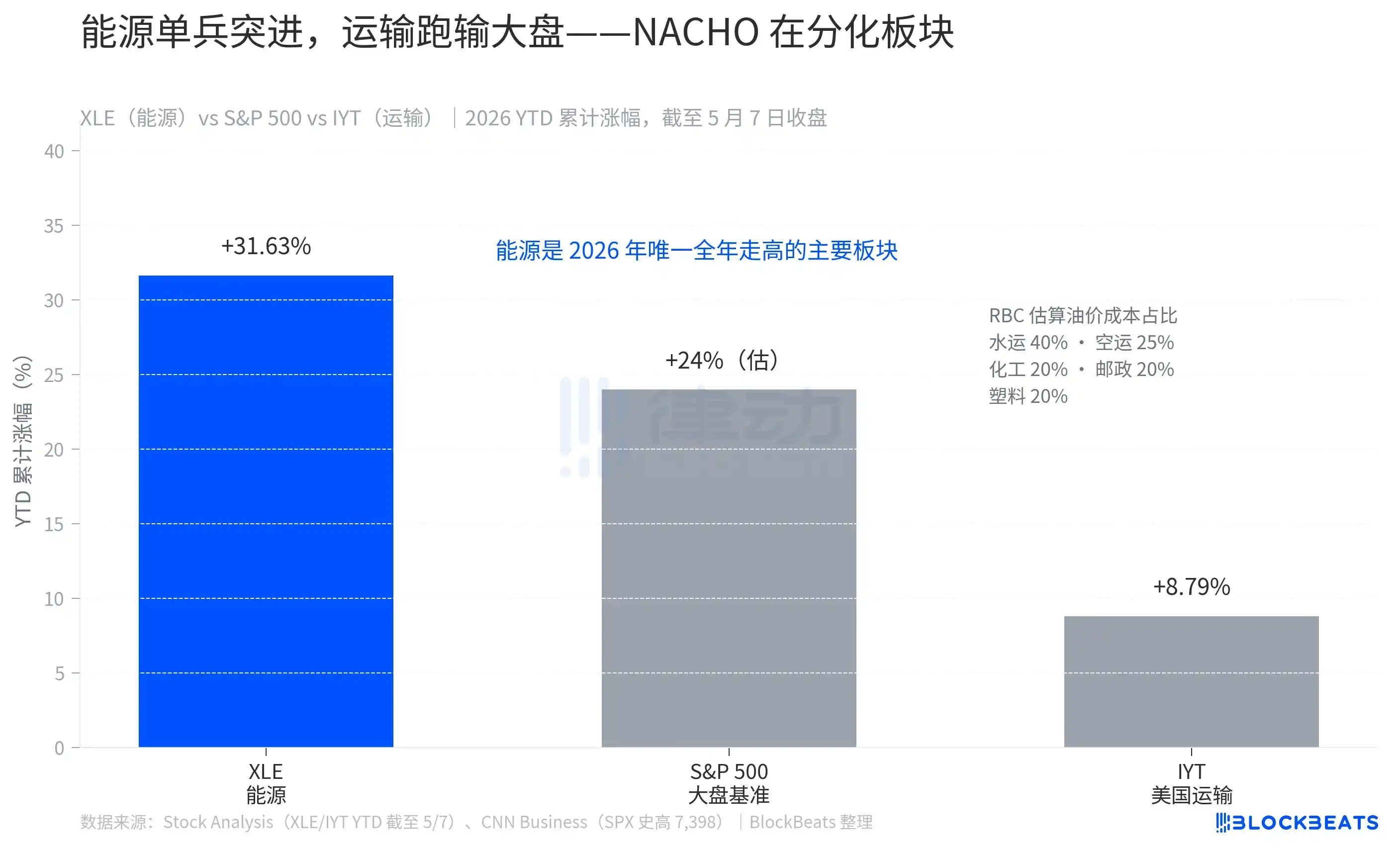
This gap is not random. According to RBC Capital Markets estimates, fuel costs constitute 40% of operating costs for the water transport industry, 25% for air transport, and 20% each for chemicals, postal/courier services, and rubber/plastics. If fuel is a major item on your cost sheet, NACHO hits you directly in the face.

XLE's 31.63% gain is not a short-term bounce; it's the result of 8 weeks of sustained outperformance. IYT's 8.79% gain isn't weakness; it's rising with the broader market while having its returns split by oil prices. The market has clearly told readers how NACHO calculates the odds—just look at how much the transportation ETF is underperforming the market.

But NACHO is not an indefinite bet; it has a very specific deadline: June 1st.

According to estimates from JPMorgan's commodity research team, global commercial crude oil inventories were around 8.4 billion barrels at the beginning of 2026, but only about 800 million barrels of that was ‘practically usable.’ The rest consisted of pipeline fill, tank bottom inventories, minimum terminal storage—the parts necessary to keep the system running daily. Since the crisis began, 280 million barrels have been drawn down, leaving roughly 520 million barrels of usable inventory. JPMorgan's exact words were, ‘Commercial inventories are expected to approach operational stress levels by early June.’

‘Operational stress level’ is a concrete physical concept. JPMorgan explains, ‘The system doesn't collapse because oil disappears; it collapses because the flow network no longer has sufficient working inventory.’ Once this line is breached, the only choices for companies and governments are to either squeeze the minimum inventory needed to maintain operations (which damages the infrastructure itself) or wait for new supply. If Hormuz remains closed until September, OECD commercial inventories could fall to the so-called ‘operational floor.’ According to a Fortune report, European jet fuel inventories are projected to fall below the 23-day supply threshold in June—a key industry warning line.
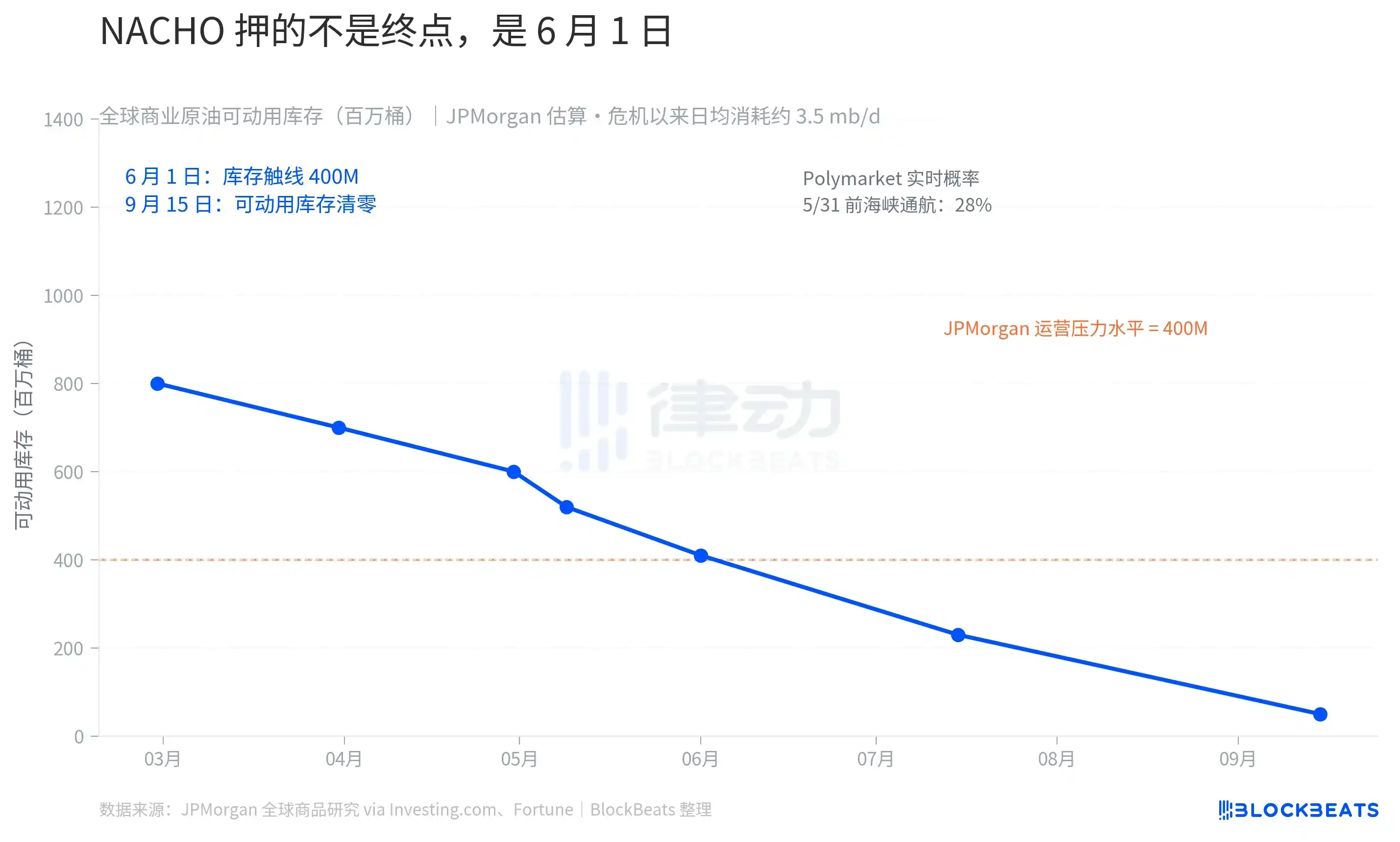
Prediction market odds are synchronized with the physical clock. According to Polymarket data from May 9th, the probability of ‘the Strait of Hormuz resuming normal traffic before May 31st’ is 28%, with only a 2% probability before May 15th. Active positions worth $9.92 million on that market are betting that NACHO won't fail at least within May.

The market is no longer trading Trump's next Truth Social post; it's trading the early-June inventory data for the Strait of Hormuz.


Пов'язані питання

QWhat does the acronym NACHO stand for, and what market view does it represent?

ANACHO stands for 'Not A Chance Hormuz Opens'. It represents a market view that the situation in the Strait of Hormuz is a prolonged, intractable crisis ('things will get stuck'), and the strait has no chance of reopening anytime soon, as opposed to betting on a political de-escalation.

QWhat event marked the failure of the TACO trading narrative and the shift towards NACHO?

AThe turning point was on March 23. Trump announced on Truth Social a 'very good constructive dialogue' with Iran and ordered a 5-day pause on strikes. The market initially rallied (TACO style), but when Iran officially denied any dialogue occurred, the gains were halved. This was the first time in 14 months that Trump 'backing down' failed to sustainably move the market, proving that a one-sided retreat was ineffective when the opponent doesn't cooperate.

QHow has the NACHO view manifested in the oil futures market structure?

AThe NACHO view is reflected in a steeply inverted (backwardated) oil futures curve. For example, near-month contracts (Jun-26) trade around $98, while Dec-30 contracts trade around $70. This large ~$28 spread signals the market believes current supply is tight and will remain so for a significant window, but the high prices are not permanent, and the situation is expected to eventually normalize in the long term.

QWhat is the significance of the performance gap between the Energy (XLE) and Transportation (IYT) sector ETFs in the context of NACHO?

AThe performance gap (XLE up ~31% vs. IYT up only ~8.8%) demonstrates the market's differentiated pricing under NACHO. High oil prices directly benefit energy producers (XLE) but act as a major cost headwind for transportation and other fuel-intensive industries (IYT). This divergence shows the market is not just betting on a general crisis, but is precisely calculating which sectors win and lose from sustained high oil prices.

QWhat is the key physical/economic deadline mentioned in the article that gives the NACHO trade a specific timeframe?

AThe key deadline is around June 1st. According to JPMorgan estimates, global commercial crude inventories are projected to approach 'operational pressure levels' by early June. Once this critical line is crossed, the physical oil distribution network risks seizing up. Markets are thus betting the NACHO situation (strait closure) will hold at least until this inventory buffer is nearly exhausted, shifting focus from political headlines to hard inventory data.

Пов'язані матеріали

The Largest IPO in History Ignites Heated Debate: Is SpaceX Worth $1.77 Trillion?

SpaceX's potential IPO is priced at $135 per share, aiming to raise $75 billion and valuing the company at approximately $1.77 trillion, which would make it the largest IPO in history. This valuation has sparked intense debate among investors. Bullish analysts, including major underwriters Goldman Sachs and Morgan Stanley, argue the valuation is justified by SpaceX's long-term potential. They see it not just as a rocket company but as a future leader in space infrastructure, with key growth drivers being Starlink satellite internet, low-cost rocket launches, and future AI-related ventures. They project revenues reaching hundreds of billions to trillions of dollars by 2030-2040. ARK Invest's model suggests a 2030 enterprise value could reach $2.5 trillion. Bearish analysts from independent research firms like Morningstar, PitchBook, and New Constructs contend the IPO price is excessively high, already pricing in unrealistic future growth. Using DCF and sum-of-the-parts models, they estimate fair value between $780 billion and $1.7 trillion, significantly below the IPO target. They highlight risks such as the speculative nature of AI projections, over-dependence on Elon Musk, high growth expectations, and corporate governance concerns. Trefis set a target price of just $79 per share. While both sides acknowledge SpaceX's unique position in commercial space, the core disagreement centers on whether the $135 share price offers a reasonable margin of safety or is overly optimistic. Despite the valuation controversy, reported strong demand for the IPO indicates significant market interest.

marsbit44 хв тому

The Largest IPO in History Ignites Heated Debate: Is SpaceX Worth $1.77 Trillion?

marsbit44 хв тому

After the Passage of the GENIUS Act and the CLARITY Act, What Is the Correct Architecture for On-Chain Yield?

The article discusses the evolution of on-chain credit, distinguishing three markets: overcollateralized crypto lending, unsecured lending (largely unsuccessful), and asset-backed credit (ABC). ABC, backed by identifiable real-world collateral with legal recourse, is identified as the fastest-growing category and the only one credibly addressing adverse selection—the core problem in credit where the riskiest borrowers self-select. Current growth in on-chain Real World Assets (RWAs), particularly tokenized private credit funds (e.g., Maple Finance, Centrifuge), is substantial but often merely "wraps" existing fund structures, inheriting their risks rather than solving adverse selection at the protocol level. The regulatory landscape is a key driver, with the US GENIUS Act (prohibiting stablecoin issuers from paying yield) and the proposed CLARITY Act (closing loopholes on indirect yield) set to redefine permissible yield-bearing products. This makes vaults (like ERC-4626) the critical architecture—they become the primary compliant vehicle for delivering yield, functioning as issuance, disclosure, distribution, and recovery mechanisms. The author's thesis is that the correct post-GENIUS/CLARITY architecture involves building ABC solutions where credit assessment, structure, and recovery are encoded directly into the smart contract vault layer, moving beyond mere tokenized fund wrappers to solve adverse selection fundamentally and ensure regulatory compliance.

Foresight News1 год тому

After the Passage of the GENIUS Act and the CLARITY Act, What Is the Correct Architecture for On-Chain Yield?

Foresight News1 год тому

TechFlow Intelligence Bureau: Anthropic's New Model Fable Sparks Controversy by Restricting Biosafety Research, US CPI Soars to 4.2%, a Three-Year High

**Summary of TechFlow Intelligence Report:** The newsletter covers several key tech and finance developments. In AI, Anthropic's new Fable model faced backlash for secretly limiting biomedical research capabilities and enforcing a 30-day data retention policy, prompting the company to promise more transparent adjustments. In a related story, Anthropic's founder revealed his departure from OpenAI was due to dishonesty from Sam Altman, not safety concerns. Meanwhile, OpenAI is considering significant price cuts to compete with Anthropic, potentially sparking a price war. In crypto/Web3, BlackRock filed a new amendment for a yield-generating Bitcoin ETF, while Bank of America's CEO warned that stablecoin yields could drain trillions from traditional banks. U.S. Senator Cynthia Lummis advocated for the U.S. to officially accumulate Bitcoin reserves. In hardware, Nvidia released the DiffusionGemma-2-6B image model optimized for efficient inference, and AMD promoted its unified memory architecture to challenge Nvidia's dominance. TSMC's CFO hinted at possible price increases due to soaring AI chip demand. A major legal ruling in Germany held Google legally responsible for inaccurate information generated by its AI Overviews feature. Google Chrome also moved to fully block ad-blocker workarounds like uBlock Origin. Macroeconomic headlines included U.S. CPI rising to 4.2% (a 3-year high) and Iran's complete closure of the Strait of Hormuz, raising oil price and inflation fears. South Korean markets saw continued volatility with massive foreign capital outflow. Other notable stories: Microsoft expanded its Copilot AI assistant "Mico" globally; a study found r/wallstreetbets users' stock picks outperformed Wall Street; a fully autonomous drone killed a human soldier for the first time, raising AI ethics concerns; and a Chinese hospital used brain-computer interface technology to help a blind person "see." The overarching theme connects debates over AI boundaries and responsibility (Anthropic's restrictions, Google's liability, lethal autonomous drones) with real-world economic and geopolitical turmoil (inflation, Strait of Hormuz closure, market instability), highlighting the tense interplay between technological advancement and global chaos.

marsbit1 год тому

TechFlow Intelligence Bureau: Anthropic's New Model Fable Sparks Controversy by Restricting Biosafety Research, US CPI Soars to 4.2%, a Three-Year High

marsbit1 год тому

Alibaba's Yet Another New Business Division: What Signal Does It Send?

Alibaba has established a new "Token Foundry" business unit, merging its Tongyi large model division and Future Life Lab. Led directly by Group CEO Wu Yongming, this marks the company's third significant AI organizational reshuffle in 2026, following the creation of the Alibaba Token Hub (ATH) and a Group Technology Committee. The move signals a strategic shift from consolidating AI resources to accelerating productization and commercialization. The "Token Foundry" name reflects Alibaba's ambition to become a foundational supplier in the AI era, focusing on model development and commercial application. Key teams, including those behind the high-performing HappyHorse video generation model, have been integrated into the new unit. Concurrently, Zhou Jingren, architect of the Qwen model series, has been appointed Group Chief Scientist to lead a new AI Future Research Institute, focusing on long-term technological breakthroughs like Agent capabilities. This restructuring creates a clear four-layer AI architecture within Alibaba: the research institute for frontier exploration, Token Foundry for core models and commercialization, MaaS for platform services, and business units like Qianwen (C端) and Wukong (B端) for end-user applications. The adjustments align with a global trend among tech giants like Google and Microsoft to centralize AI leadership under the CEO and deeply integrate research with business units. The urgency is driven by a narrowing competitive window. Alibaba has announced its AI business is now entering a commercialization phase, with AI-related revenue seeing triple-digit growth for eleven consecutive quarters. The company faces intense competition in the MaaS (Model-as-a-Service) sector from rivals like ByteDance and Tencent. The Token Foundry initiative represents Alibaba's effort to streamline execution and enhance competitiveness in this critical, fast-evolving landscape.

marsbit2 год тому

Alibaba's Yet Another New Business Division: What Signal Does It Send?

marsbit2 год тому

Торгівля

Спот
Ф'ючерси
活动图片




