T. Rowe Price expands crypto ETF strategy with up to 15 assets: Details

ambcryptoОпубліковано о 2026-03-17Востаннє оновлено о 2026-03-17

Анотація

T. Rowe Price has amended its filing with the SEC for its proposed actively managed crypto ETF, expanding its strategy to include a wider range of 5 to 15 digital assets. Beyond major cryptocurrencies like Bitcoin and Ethereum, the fund may invest in more volatile tokens such as Dogecoin, Shiba Inu, Solana, XRP, and SUI. The filing highlights a focus on security, with Anchorage Digital Bank serving as custodian, and initially uses a cash creation/redemption model. It also leaves open the possibility for future in-kind transactions and staking, pending regulatory clarity. This move reflects growing institutional interest in crypto and intensifying competition among asset managers to offer diversified products.

On the 16th of March, T. Rowe Price, an investment management company, filed an amended S-1 registration statement with the U.S. Securities and Exchange Commission (SEC), providing new details about its proposed Price Active Crypto ETF.

It is worth noting that T. Rowe Price first filed for the Price Active Crypto ETF with the U.S. SEC in October 2025.
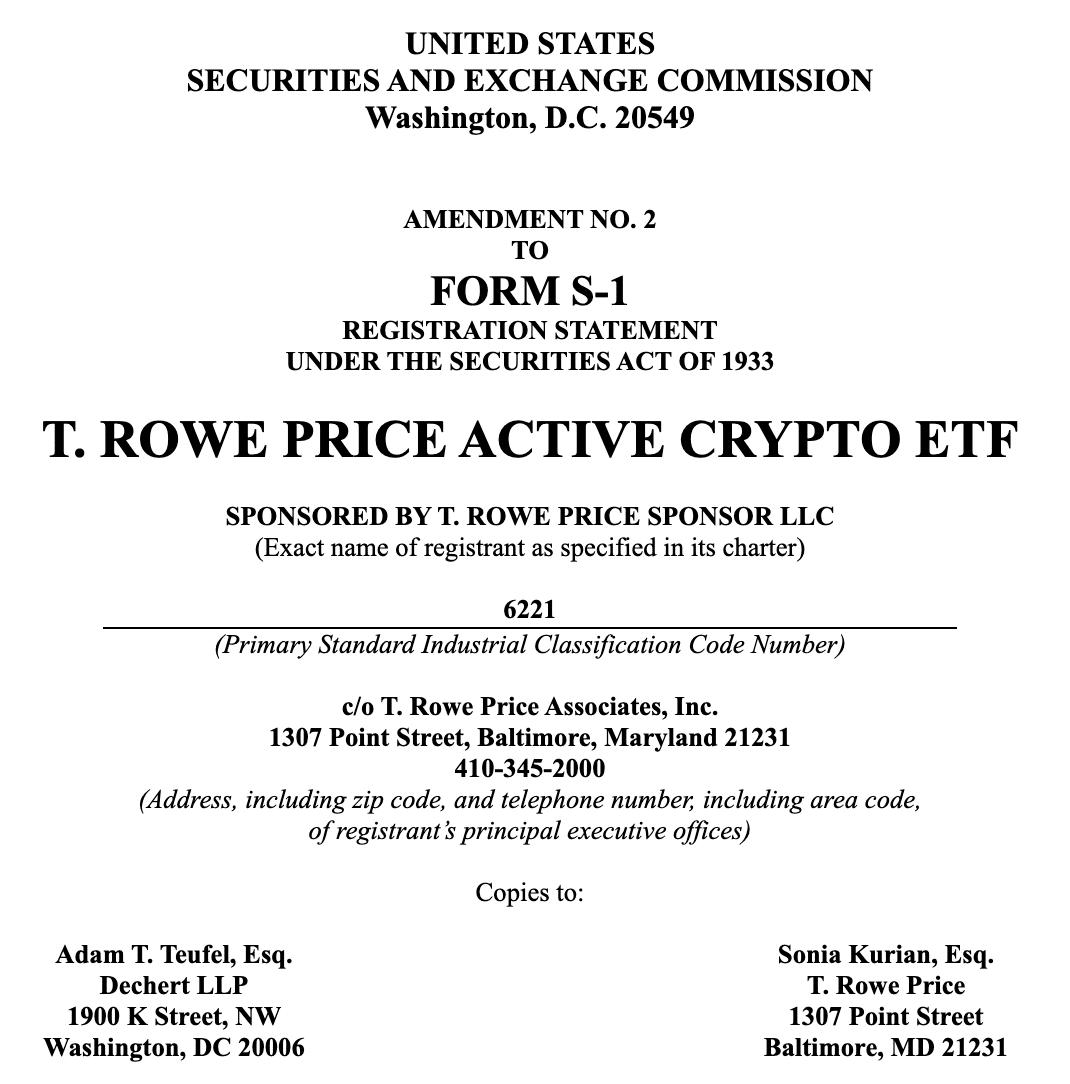
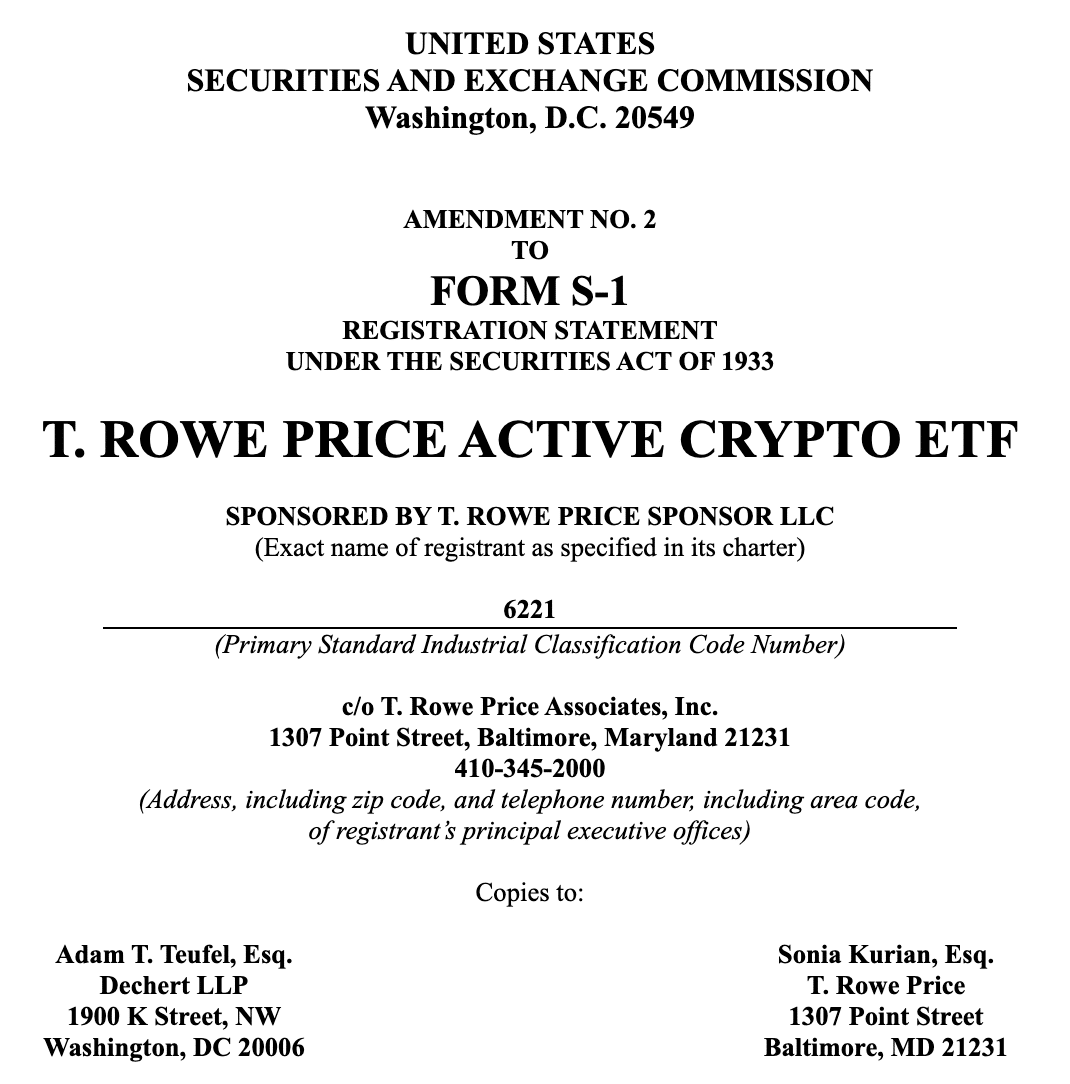
Source: SEC

T. Rowe amends its crypto ETF filing

The filing suggests that traditional financial firms may be becoming more open to crypto. Instead of focusing solely on major assets such as Bitcoin [BTC] and Ethereum [ETH], the firm is considering a broader strategy that includes more volatile tokens, such as Dogecoin [DOGE] and Shiba Inu [SHIB].

That said, the proposed ETF would be actively managed, meaning managers could shift investments among approximately five to fifteen digital assets depending on market conditions.

The list will also include altcoins such as Solana [SOL], Ripple [XRP], and SUI [Sui], aiming to generate returns by moving between assets rather than simply tracking a single cryptocurrency.

Several factors may explain why this shift is happening now. Regulatory clarity has improved with legislation such as the GENIUS Act, giving traditional firms greater confidence to enter the crypto market.

At the same time, competition is increasing. After the U.S. SEC approved Generic Listing Standards in 2025 to speed up approvals for crypto exchange-traded products, asset managers began racing to launch more diversified crypto ETFs.

How is this filing different from the October filing?

The firm’s amended structure reflects a strong focus on security and compliance. The digital assets will be stored with Anchorage Digital Bank, which will act as the custodian for the tokens.

Initially, the ETF will use a cash-based creation and redemption model, meaning investors will buy or sell shares using cash rather than exchanging cryptocurrencies directly.

However, the filing notes that the fund could permit “in-kind” transactions in the future if regulations permit.

In the future, the Fund may engage in in-kind creations and redemptions.

The fund will also use the FTSE Crypto U.S. Listed Index as a reference point to guide its investment decisions, while managers will retain flexibility to adjust the portfolio.

Moreover, the filing also mentions the possibility of staking. If introduced, this would allow the fund to generate additional income by supporting blockchain networks rather than relying solely on price gains.

However, T. Rowe Price said staking will only be considered once regulators and tax authorities provide clearer guidance. By working with Anchorage Digital as custodian, the firm is trying to ensure the fund meets strict regulatory standards.

Other ETF performance

The timing of T. Rowe Price’s filing update comes as the U.S. crypto ETF market shows mixed signals. At the time of writing, Bitcoin and Ethereum ETFs recorded net inflows of $199.4 million and $35.9 million, respectively, while investor interest in altcoins has become more mixed.

For example, Solana ETFs saw only about $2.1 million in inflows, while the XRP ETF recorded roughly $5.98 million in outflows.

Crypto ETF race intensifies

At the same time, competition among crypto ETF providers is intensifying, particularly on fees. Hashdex recently reduced the management fee for its Hashdex Nasdaq Crypto Index US ETF from 0.50% to 0.25%.

Additionally, large financial institutions are also starting to take stronger positions in the crypto market. Morgan Stanley, for instance, recently updated its filings as it prepares to expand access to digital assets for its wealth management clients.

Therefore, if approved, the Price Active Crypto ETF could represent another major step in the institutional adoption of digital assets.


Final Summary

  • By including altcoins such as Solana, XRP, and Sui, the fund highlights increasing institutional interest in diversified crypto strategies.
  • The proposal reflects intensifying competition in the crypto ETF market, as firms race to launch innovative and cost-efficient products.


Пов'язані питання

QWhat is the main update T. Rowe Price made to its crypto ETF filing on March 16th?

AT. Rowe Price filed an amended S-1 registration statement with the SEC, providing new details about its proposed Price Active Crypto ETF, including a broader strategy that could include up to 15 digital assets, such as more volatile tokens like Dogecoin and Shiba Inu.

QHow does the proposed Price Active Crypto ETF differ from a typical single-asset ETF?

AThe proposed ETF is actively managed, meaning managers can shift investments among approximately five to fifteen digital assets depending on market conditions, aiming to generate returns by moving between assets rather than simply tracking a single cryptocurrency.

QWhich company will serve as the custodian for the digital assets in T. Rowe Price's ETF?

AAnchorage Digital Bank will act as the custodian for the tokens in the proposed ETF.

QWhat regulatory development in 2025 helped speed up approvals for crypto exchange-traded products?

AThe U.S. SEC approved Generic Listing Standards in 2025 to speed up approvals for crypto exchange-traded products.

QWhat additional feature might the fund consider in the future, pending regulatory clarity?

AThe fund might consider staking in the future to generate additional income by supporting blockchain networks, but only once regulators and tax authorities provide clearer guidance.

Пов'язані матеріали

Winter for Crypto IPOs: Consensys and Ledger Withdraw Applications

The crypto IPO window is tightening significantly in 2026, marked by prominent companies delaying or pausing their public listing plans. Following a successful 2025 "harvest year" that saw Circle, Bullish, and Gemini go public amidst a bull market, the tide has turned. Consensys, developer of MetaMask, recently postponed its IPO until at least fall 2026. Hardware wallet leader Ledger also suspended its planned US listing due to unfavorable market conditions, with Kraken having previously delayed its own plans. This shift is driven by a cooling market in 2026, characterized by a significant Bitcoin price correction, declining trading volumes, and reduced investor risk appetite for crypto stocks. The poor post-IPO performance of 2025 listings like Circle and Bullish, which saw major share price declines, has heightened investor caution. This contrasts sharply with the current AI sector, where companies like SpaceX, OpenAI, and Anthropic are commanding massive valuations and investor enthusiasm based on narratives of stable, exponential growth. Crypto companies now face pressure to transition from hype-driven models to demonstrating reliable cash flows and robust compliance. While the paused IPO plans may lead to valuation resets and affect ecosystem liquidity, they also accelerate industry consolidation toward stronger, more compliant infrastructure players. A potential recovery in Bitcoin's price and clearer regulations could reopen the IPO window in the latter half of 2026.

marsbit3 год тому

Winter for Crypto IPOs: Consensys and Ledger Withdraw Applications

marsbit3 год тому

ChatGPT Can Manage Your Money for You. Would You Trust It with Your Bank Account?

OpenAI has launched a personal finance tool for ChatGPT, currently in preview for US-based ChatGPT Pro users. This feature allows users to connect their bank and investment accounts (via Plaid, supporting over 12,000 institutions) directly to ChatGPT. It analyzes transactions, generates visual dashboards, and offers conversational financial advice—such as budgeting or planning for major purchases—based on the user's actual data. This move follows OpenAI's acquisitions of fintech startups Roi and Hiro Finance, signaling a strategic push into vertical "super assistant" applications, similar to its earlier health-focused feature. However, the launch has sparked significant privacy concerns. Critics question the safety of granting such sensitive financial access to an AI, especially amid ongoing lawsuits alleging OpenAI shared user chat data with third parties like Meta and Google. OpenAI emphasizes that ChatGPT only reads data (no transaction capabilities), deletes it within 30 days if disconnected, and offers opt-out options for model training. Yet, trust remains a major hurdle. The trend reflects a broader industry shift: AI companies like Anthropic and Perplexity are also targeting high-value, data-rich domains like finance and health. While technically promising, the tool operates in a regulatory gray area—it provides personalized guidance but disclaims formal financial advice or liability. Ultimately, OpenAI's challenge is convincing users to trust an AI with their most private financial information.

marsbit3 год тому

ChatGPT Can Manage Your Money for You. Would You Trust It with Your Bank Account?

marsbit3 год тому

Торгівля

Спот
Ф'ючерси
活动图片




