T. Rowe Price expands crypto ETF strategy with up to 15 assets: Details

ambcryptoОпубліковано о 2026-03-17Востаннє оновлено о 2026-03-17

Анотація

T. Rowe Price has amended its filing with the SEC for its proposed actively managed crypto ETF, expanding its strategy to include a wider range of 5 to 15 digital assets. Beyond major cryptocurrencies like Bitcoin and Ethereum, the fund may invest in more volatile tokens such as Dogecoin, Shiba Inu, Solana, XRP, and SUI. The filing highlights a focus on security, with Anchorage Digital Bank serving as custodian, and initially uses a cash creation/redemption model. It also leaves open the possibility for future in-kind transactions and staking, pending regulatory clarity. This move reflects growing institutional interest in crypto and intensifying competition among asset managers to offer diversified products.

On the 16th of March, T. Rowe Price, an investment management company, filed an amended S-1 registration statement with the U.S. Securities and Exchange Commission (SEC), providing new details about its proposed Price Active Crypto ETF.

It is worth noting that T. Rowe Price first filed for the Price Active Crypto ETF with the U.S. SEC in October 2025.
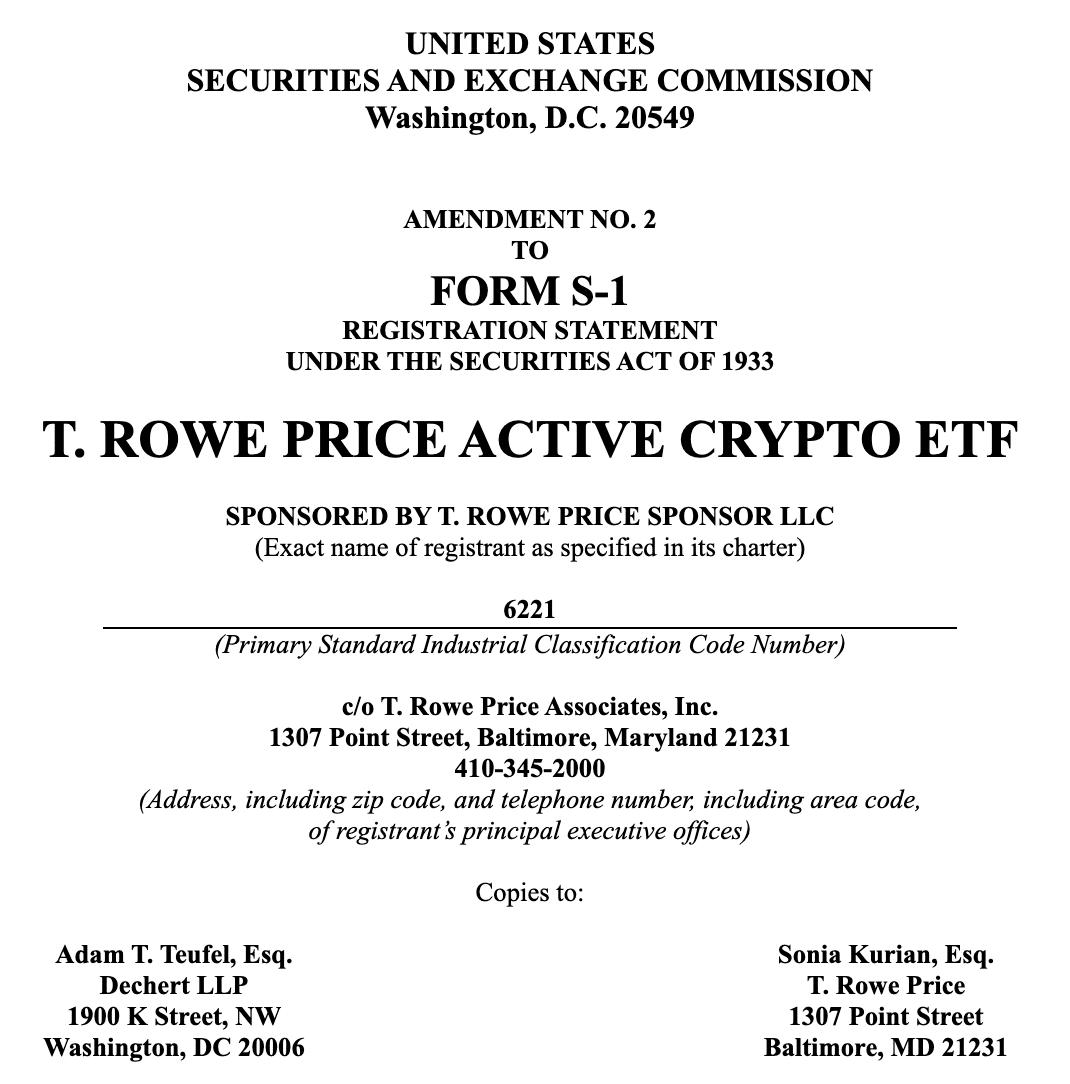
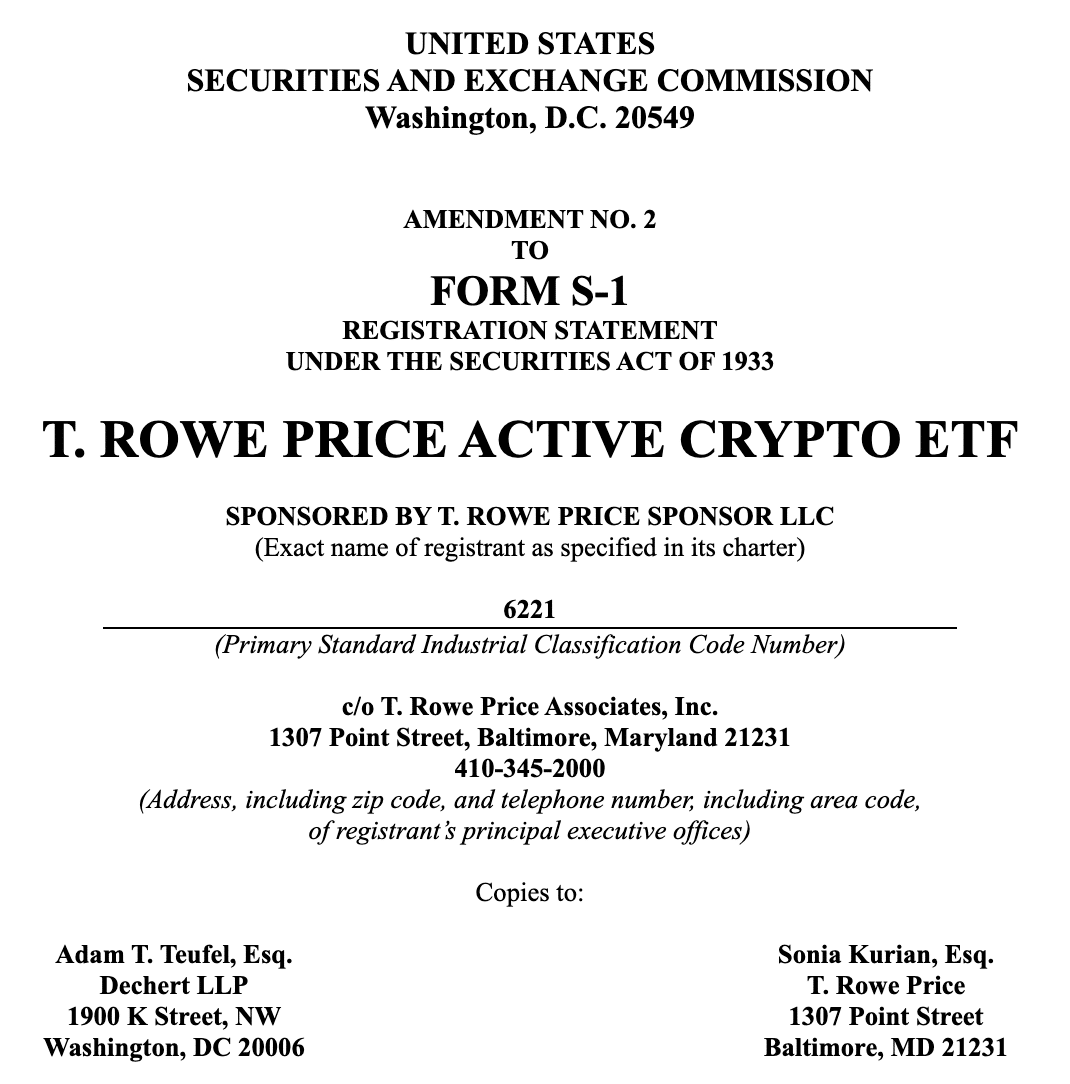
Source: SEC

T. Rowe amends its crypto ETF filing

The filing suggests that traditional financial firms may be becoming more open to crypto. Instead of focusing solely on major assets such as Bitcoin [BTC] and Ethereum [ETH], the firm is considering a broader strategy that includes more volatile tokens, such as Dogecoin [DOGE] and Shiba Inu [SHIB].

That said, the proposed ETF would be actively managed, meaning managers could shift investments among approximately five to fifteen digital assets depending on market conditions.

The list will also include altcoins such as Solana [SOL], Ripple [XRP], and SUI [Sui], aiming to generate returns by moving between assets rather than simply tracking a single cryptocurrency.

Several factors may explain why this shift is happening now. Regulatory clarity has improved with legislation such as the GENIUS Act, giving traditional firms greater confidence to enter the crypto market.

At the same time, competition is increasing. After the U.S. SEC approved Generic Listing Standards in 2025 to speed up approvals for crypto exchange-traded products, asset managers began racing to launch more diversified crypto ETFs.

How is this filing different from the October filing?

The firm’s amended structure reflects a strong focus on security and compliance. The digital assets will be stored with Anchorage Digital Bank, which will act as the custodian for the tokens.

Initially, the ETF will use a cash-based creation and redemption model, meaning investors will buy or sell shares using cash rather than exchanging cryptocurrencies directly.

However, the filing notes that the fund could permit “in-kind” transactions in the future if regulations permit.

In the future, the Fund may engage in in-kind creations and redemptions.

The fund will also use the FTSE Crypto U.S. Listed Index as a reference point to guide its investment decisions, while managers will retain flexibility to adjust the portfolio.

Moreover, the filing also mentions the possibility of staking. If introduced, this would allow the fund to generate additional income by supporting blockchain networks rather than relying solely on price gains.

However, T. Rowe Price said staking will only be considered once regulators and tax authorities provide clearer guidance. By working with Anchorage Digital as custodian, the firm is trying to ensure the fund meets strict regulatory standards.

Other ETF performance

The timing of T. Rowe Price’s filing update comes as the U.S. crypto ETF market shows mixed signals. At the time of writing, Bitcoin and Ethereum ETFs recorded net inflows of $199.4 million and $35.9 million, respectively, while investor interest in altcoins has become more mixed.

For example, Solana ETFs saw only about $2.1 million in inflows, while the XRP ETF recorded roughly $5.98 million in outflows.

Crypto ETF race intensifies

At the same time, competition among crypto ETF providers is intensifying, particularly on fees. Hashdex recently reduced the management fee for its Hashdex Nasdaq Crypto Index US ETF from 0.50% to 0.25%.

Additionally, large financial institutions are also starting to take stronger positions in the crypto market. Morgan Stanley, for instance, recently updated its filings as it prepares to expand access to digital assets for its wealth management clients.

Therefore, if approved, the Price Active Crypto ETF could represent another major step in the institutional adoption of digital assets.


Final Summary

  • By including altcoins such as Solana, XRP, and Sui, the fund highlights increasing institutional interest in diversified crypto strategies.
  • The proposal reflects intensifying competition in the crypto ETF market, as firms race to launch innovative and cost-efficient products.


Пов'язані питання

QWhat is the main update T. Rowe Price made to its crypto ETF filing on March 16th?

AT. Rowe Price filed an amended S-1 registration statement with the SEC, providing new details about its proposed Price Active Crypto ETF, including a broader strategy that could include up to 15 digital assets, such as more volatile tokens like Dogecoin and Shiba Inu.

QHow does the proposed Price Active Crypto ETF differ from a typical single-asset ETF?

AThe proposed ETF is actively managed, meaning managers can shift investments among approximately five to fifteen digital assets depending on market conditions, aiming to generate returns by moving between assets rather than simply tracking a single cryptocurrency.

QWhich company will serve as the custodian for the digital assets in T. Rowe Price's ETF?

AAnchorage Digital Bank will act as the custodian for the tokens in the proposed ETF.

QWhat regulatory development in 2025 helped speed up approvals for crypto exchange-traded products?

AThe U.S. SEC approved Generic Listing Standards in 2025 to speed up approvals for crypto exchange-traded products.

QWhat additional feature might the fund consider in the future, pending regulatory clarity?

AThe fund might consider staking in the future to generate additional income by supporting blockchain networks, but only once regulators and tax authorities provide clearer guidance.

Пов'язані матеріали

Annual Salary of Millions Competing for Electricians, Meta Rushes to Open Its Own Technical School

The AI boom is facing an unexpected bottleneck: a severe shortage of skilled construction workers and electricians. As tech giants like Meta, OpenAI, and Alphabet race to build massive data centers—such as OpenAI's $16 billion "Stargate" project—they are hitting a critical labor wall. The U.S. needs an estimated 130,000 more electricians, 240,000 construction workers, and 150,000 supervisors by 2030 for AI infrastructure alone, but tens of thousands of electrician jobs go unfilled each year. While AI companies offer high premiums, with electricians earning up to $280,000 annually, worker scarcity still causes massive losses—delays on a single project can cost $14.2 million per month. The complexity of building AI data centers, which require immense power (equivalent to powering hundreds of thousands of homes), sophisticated electrical systems, and advanced liquid cooling solutions, demands highly skilled technicians who are in short supply. To combat this, companies are investing heavily in training. Meta has committed $115 million to a free training school offering tuition, housing, and stipends, targeting 5,000 new workers. OpenAI is partnering with unions to secure skilled labor. These efforts are paying off, with a significant rise in Gen Z interest in trade schools over college. However, the power demands are staggering. AI data centers are driving a rapid surge in electricity consumption, projected to account for up to 12% of U.S. power use by 2028 and raising costs for consumers. Furthermore, the construction boom is project-based, leading to a potential future glut of trained workers once building peaks, which could depress wages industry-wide. The race for AI supremacy now depends as much on skilled hands as on advanced chips.

marsbit1 год тому

Annual Salary of Millions Competing for Electricians, Meta Rushes to Open Its Own Technical School

marsbit1 год тому

OpenAI No Longer Sells Its Most Expensive Model for Profit

OpenAI is shifting its business strategy away from promoting its most expensive, flagship models for every task. Recent price cuts—80% for GPT-5.6 Luna and 20% for Terra—signal a deeper change: the company now actively advises users that many tasks don't require the most powerful model. Instead, OpenAI recommends a tiered approach: use the high-end GPT-5.6 Sol for complex planning and analysis, then delegate execution to cheaper models like Luna. This mirrors moves by Anthropic, which recently launched Claude Opus 5 at half the price of its top model, Fable 5. Both companies are de-emphasizing flagship models as primary revenue drivers, using them instead for brand prestige and technological showcases. The industry is entering a "mass-market" phase, similar to automotive, where high-volume, cost-effective models handle daily operations and drive scale. OpenAI's price reductions are partly enabled by AI models themselves optimizing underlying code and infrastructure, creating a self-reinforcing cycle of efficiency gains and cost reduction. Competition is shifting from "who is smartest" to "who offers the best value." The goal is no longer selling individual models but fostering widespread API adoption and ecosystem lock-in. By making AI calls cheap and ubiquitous, companies like OpenAI aim to become the indispensable, utility-like infrastructure powering automated workflows—the "water and electricity" of software, quietly embedded everywhere.

marsbit1 год тому

OpenAI No Longer Sells Its Most Expensive Model for Profit

marsbit1 год тому

Торгівля

Спот
活动图片




