Swooping to Third Place, Rothera Disrupts Prediction Market Landscape

Odaily星球日报Опубліковано о 2026-06-22Востаннє оновлено о 2026-06-22

Анотація

The article "Rothera Shakes Up Prediction Market Landscape, Debuts at No. 3" details the rapid rise of Rothera, Robinhood's newly launched in-house prediction market platform. Originally, Robinhood acted as a major distribution channel for Kalshi, routing 25-35% of its user orders to Kalshi for execution, which involved revenue sharing. Rothera allows Robinhood to capture this value internally by migrating orders, particularly for events like the World Cup, to its own platform. This has led to explosive growth for Rothera, with weekly trading volume soaring from $21.9 million to $559 million in just two weeks, making it the third-largest prediction market behind Kalshi and Polymarket. Analysts estimate Robinhood's prediction market business could generate $10 billion in annual revenue, surpassing its crypto revenue peak. This growth represents a direct challenge to Kalshi, which is now seeking new distribution channels, including talks with investment banks for a potential IPO, to integrate its platform with institutional client networks. The key takeaway is a shift in the competitive landscape: success is increasingly defined not just by product offerings but by controlling the user distribution channels and value capture, as demonstrated by Rothera's swift ascent.

Original | Odaily Planet Daily (@OdailyChina)

Author | Azuma (@azuma_eth)

Last week, Odaily Planet Daily published an article titled "The First Prediction Market Concept Stock Has Emerged!", which mainly discussed how Robinhood is intercepting orders, which previously needed to be executed via Kalshi, by building its own prediction market, Rothera. This allows Robinhood to reduce revenue sharing with Kalshi and retain profits within its own ecosystem.

Although we anticipated that Rothera wouldn't face the cold start problems common among other competitors, its data performance over the past week still far exceeded our initial expectations. It's hard to imagine that a platform launched just half a month ago could directly soar to third place in the highly competitive prediction market sector, trailing only behind the two giants, Kalshi and Polymarket.
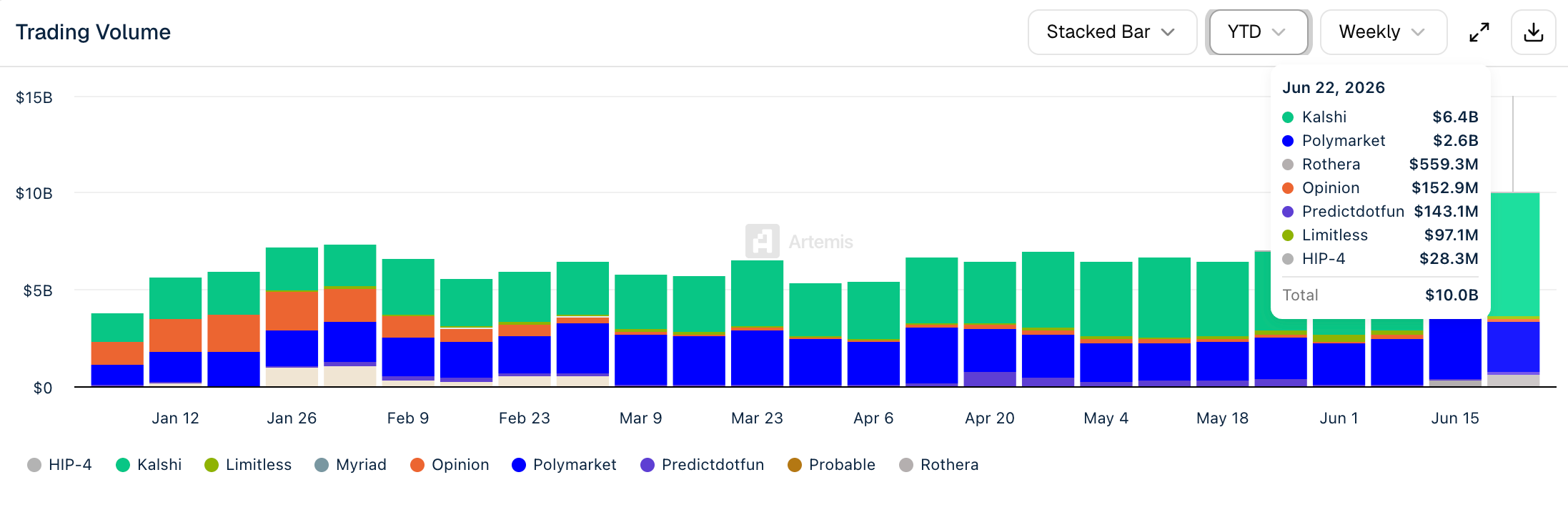
Data from Artemis shows that for the week ending June 8th, Rothera, as a new platform, had a weekly trading volume of only $21.9 million, still lagging significantly behind second-tier platforms like Opinion, Predict, and Limitless. However, for the week ending June 15th, Rothera's weekly trading volume directly jumped to third place in the industry, reaching $276 million. In the latest week ending June 22nd, Rothera's weekly trading volume increased to $559 million, nearly one-fifth of Polymarket's volume.

A Case of Atypical Growth (Can skip if you read the previous article)

It's important to clarify that Rothera's rise is essentially not driven by creating new incremental users (though some users may have joined due to the World Cup), but rather by the migration of existing orders, not the creation of new users.

Over the past year or so, Robinhood has been one of the most important distribution channels for Kalshi. Leveraging tens of millions of retail users and established stock, options, and cryptocurrency trading gateways, Robinhood directed a large volume of orders to Kalshi. Piper Sandler analysts previously estimated that trades completed through the Robinhood channel accounted for about 25%-35% of Kalshi's total trading volume.

The issue was that while these orders originated from Robinhood users, they didn't belong to Robinhood itself. Under the previous partnership model, Robinhood functioned more as a front-end traffic portal, while Kalshi was the infrastructure provider responsible for order matching, clearing, and settlement. Revenue generated from each trade needed to be shared between the two parties.

Rothera is Robinhood's weapon to break this revenue-sharing model. Since early this month, Robinhood has begun migrating some World Cup-related event contracts to be executed internally on Rothera. This means that a significant number of orders that might have previously flowed to Kalshi are now retained within Robinhood's own ecosystem.

Therefore, in a sense, the surge in Rothera's trading volume is less of a threat to other prediction markets like Polymarket, Predict, or Limitless, and more of a direct "siphon" of volume from Kalshi.

Robinhood's Value Capture

The most direct impact of Rothera's rapid growth is the strengthening of Robinhood's ability to capture value from prediction market-related orders on its platform.

According to Hood House, an investment research media outlet that has long tracked Robinhood, statistics based on public data show that as of June 20th, Robinhood's prediction market business collectively traded 34,700 contracts in a single day, corresponding to an estimated daily revenue of about $4.9 million.
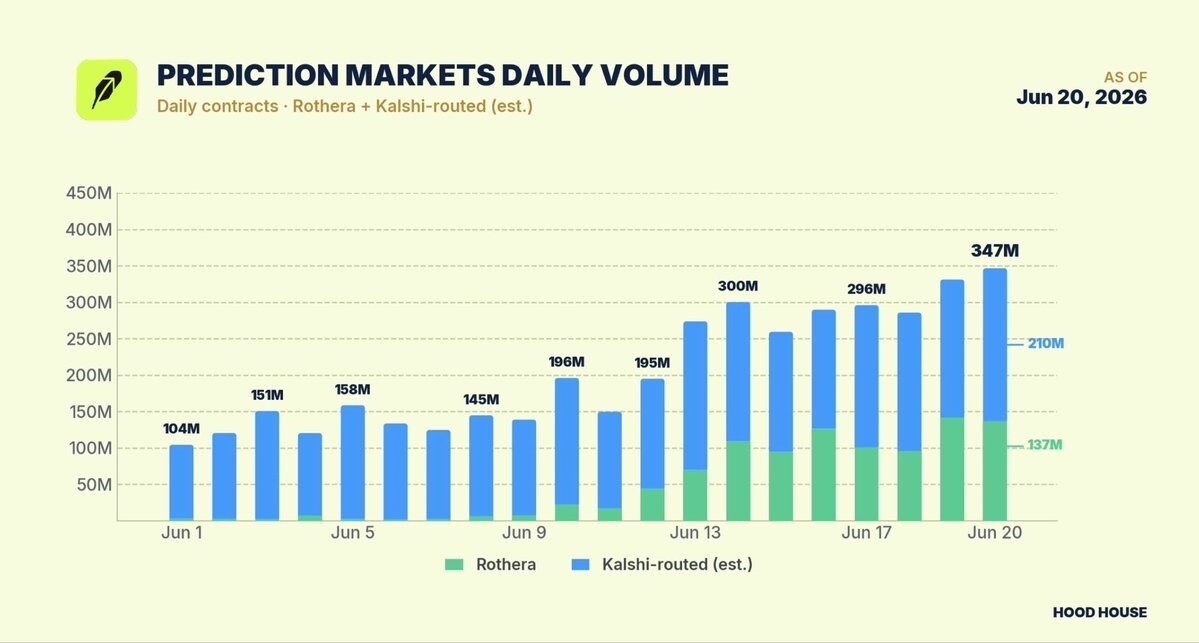
Hood House subsequently disclosed their calculation logic:

  • Rothera (primarily hosting World Cup-related markets) achieved a daily trading volume of 137 million contracts, corresponding to a trading value of approximately $47 million.
  • As a comparison, Kalshi's total daily trading volume was about 1.5 billion contracts, corresponding to a trading value of approximately $416 million. Excluding World Cup-related markets, Kalshi's trading volume was about 1 billion contracts, corresponding to a trading value of about $260 million.
  • Considering that Robinhood users are still estimated to contribute around 20% of Kalshi's non-World Cup market trading volume (conservative estimate), this means that approximately 210 million contracts and $52 million in trading volume from Kalshi's non-World Cup event contracts were completed through Robinhood.

Based on this, Hood House further made an aggressive projection, stating that if this growth rate continues, Robinhood's prediction market business has the potential to achieve revenue on the scale of billions of dollars this year. This figure even surpasses the historical peak of Robinhood's cryptocurrency-related revenue, which was approximately $900 million in 2025.

Kalshi's Counter Strategy: Finding New Channels

Faced with Rothera's rapid rise, Kalshi has clearly recognized the problem.

For Kalshi, Robinhood was both a partner and one of its most important sources of traffic. However, as Robinhood begins migrating more and more orders to its own platform, the relationship between the two has shifted to direct competition.

Recent news disclosed by The Information might reveal Kalshi's response strategy. Sources familiar with the matter revealed that Kalshi has begun early, informal discussions with several investment banks regarding a potential future IPO. More notably, Kalshi has made a specific demand in its communications with these banks: to be prioritized for underwriting roles in the future IPO, these institutions need to prioritize completing technical integration of their systems with Kalshi. This would enable their institutional clients to directly participate in trading event contracts on Kalshi's platform.

In other words, Kalshi is using the prospect of an IPO as an opportunity to seek new distribution channels, aiming to integrate prediction markets into the client networks of banks, brokerages, and other financial institutions. This might also represent a subtle shift in the competitive dynamics of the prediction market industry. In the past, the focus was on who could offer more contracts or design better products. Now, as prediction markets gradually integrate into the mainstream financial system, the focus of competition is shifting to another dimension: those who control the user gateway can more effectively control value.

The rise of Rothera has already demonstrated the significance of distribution capabilities. Swooping to third place seems effortless, and challenging Kalshi and Polymarket in the future might not seem like such a difficult task.


Пов'язані питання

QWhat is the main reason behind the rapid growth of Rothera's trading volume, according to the article?

AThe rapid growth of Rothera's trading volume is primarily attributed to a migration of existing orders rather than the creation of new users. Specifically, Robinhood has begun directing orders related to World Cup contracts, which previously would have been executed on Kalshi, to its own platform, Rothera.

QWhich two prediction market platforms are currently ranked ahead of Rothera in terms of trading volume?

AAccording to the article, the two prediction market platforms currently ranked ahead of Rothera are Kalshi and Polymarket.

QWhat strategy is Kalshi reportedly employing to counter the threat from Rothera?

AKalshi is reportedly seeking new distribution channels by engaging with investment banks for a potential future IPO. A key requirement in these discussions is that the banks must first integrate their systems with Kalshi's platform to allow their institutional clients direct access to trade event contracts on Kalshi.

QWhat significant change in the focus of competition within the prediction market industry does the article highlight?

AThe article highlights that the focus of competition is shifting from merely providing more contracts or better product design to controlling user access points. It emphasizes that whoever masters distribution channels and user entry points can more effectively capture value.

QWhat potential annual revenue for Robinhood's prediction market business is mentioned in the article, and how does it compare to its historical crypto revenue?

AThe article mentions an aggressive estimate that Robinhood's prediction market business has the opportunity to reach an annual revenue scale in the billions of dollars this year. This figure is suggested to potentially exceed the historical peak of Robinhood's crypto-related revenue, which was approximately $900 million in 2025.

Пов'язані матеріали

Open Systems Will Ultimately Prevail: Why Ethereum Is the Next Linux?

The article "Open Systems Will Ultimately Prevail: Why Ethereum Is the Next Linux?" argues that Ethereum, like Linux before it, will triumph over closed, proprietary systems in finance due to its open, permissionless, and credibly neutral nature. It draws a historical parallel: just as the open internet defeated corporate private networks and Linux outcompeted proprietary Unix systems, open financial infrastructure like Ethereum will surpass private blockchains. The core advantage lies in the "bazaar" development model (as described in Eric Raymond's "The Cathedral and the Bazaar"), where decentralized, permissionless innovation by a global community of developers outpaces the controlled "cathedral" approach of centralized entities. This model fosters rapid innovation, as seen with Ethereum standards like ERC-20 and applications like Uniswap, which were built without needing permission. Ethereum's key, irreplicable strength is its credible neutrality: transparent, equally applicable, immutable rules that allow anyone to participate. This ensures sovereign independence, meaning no single entity (company, government) can control or change its core rules—a critical feature for global financial infrastructure. In contrast, private blockchains and consortium chains (like SWIFT or various bank-led projects) suffer from platform risk, central control, and an inability to attract broad developer ecosystems, leading to frequent failures. The article notes that major institutions (e.g., BlackRock, JPMorgan, Coinbase, Robinhood) are already building on Ethereum or its Layer 2 networks, recognizing its security, developer ecosystem, and network effects. While critics argue finance requires accountable, controlled systems, the response is that compliance (KYC, regulations) can be built at the application layer on top of a neutral settlement layer like Ethereum, just as secure commerce was built on the open internet via HTTPS. Ultimately, the thesis is that attempting to build walled-garden, proprietary financial networks is a flawed strategy that stifles innovation. The winning approach is to build applications on top of open, credibly neutral infrastructure like Ethereum, which is poised to become the foundational settlement layer for global finance.

Foresight News7 хв тому

Open Systems Will Ultimately Prevail: Why Ethereum Is the Next Linux?

Foresight News7 хв тому

The Computing Power Dilemma in the Sino-US AI Rivalry

The Sino-US AI rivalry faces a fundamental bottleneck: the widening compute power gap. While Chinese AI chip companies have seen investment surges, their current focus remains largely on the less demanding inference market. The real challenge lies in the high-end training chip sector, crucial for developing cutting-edge large language models (LLMs), where Nvidia holds a near-monopoly. The compute disparity is stark. US tech giants like Meta, Google, and xAI command massive GPU clusters, enabling them to train trillion-parameter models rapidly. Estimates suggest US data center count and total compute capacity significantly outstrip China's. This "brute force" advantage allows for faster model iteration and exploration of larger parameter scales, with top US models reportedly leading their Chinese counterparts by 8 to 15 months. Chinese alternatives, such as Huawei's Ascend and others from companies like Moore Thread and Biren, are emerging. They show promise in inference and some training scenarios, closing the performance gap with mid-range Nvidia products. However, the core hurdle extends beyond raw chip performance to the entrenched software ecosystem, exemplified by Nvidia's CUDA platform. The path forward involves "walking on two legs": navigating import restrictions while heavily investing in the domestic chip industry. Though still in a catch-up phase, China's vast market, talent pool, and capital are fostering progress. The ultimate test is whether Chinese firms can build a competitive hardware-software ecosystem to power the next generation of AI.

marsbit13 хв тому

The Computing Power Dilemma in the Sino-US AI Rivalry

marsbit13 хв тому

He Kaiming's Team's New Work: After Deleting VAE and Private Data, Text-to-Image Generation Becomes Even Stronger

KaiMing He's team introduces **MiniT2I**, a minimalist text-to-image (T2I) model that challenges the complexity of mainstream approaches. It eliminates components commonly considered essential: the VAE encoder-decoder, AdaLN conditioning mechanisms, auxiliary losses, private training data, and post-training alignment stages like RL/DPO. Instead, it uses a pure flow-matching objective trained directly on RGB pixels. The model employs a simplified **MM-JiT** Transformer architecture. It removes AdaLN blocks for conditioning and instead prepends two lightweight text adapter blocks to a standard pre-norm Transformer, allowing frozen T5 text features to adapt to the denoiser. Training follows a two-stage, LLM-like paradigm using only public datasets: pre-training on LLaVA-recaptioned CC12M for coverage, followed by fine-tuning on ~120k high-quality image-text pairs. With just 258M parameters (B/16), MiniT2I achieves competitive scores (0.87 on GenEval, 84.2 on DPG-Bench), outperforming larger pixel-space models. Scaling to 912M parameters (L/16) yields results comparable to SD3-Medium (~2B parameters) in style, composition, and imagination, though it lags in text rendering and named entities due to public data limitations. Key advantages include lower computational cost (~570 GFLOPs vs. ~1379 for latent models) and architectural simplicity. Acknowledged limitations include patch boundary artifacts in pixel space, side effects of high CFG scales, resolution ceilings for sequences longer than 1024 tokens, and the aforementioned data bottlenecks. The work demonstrates that high-performance T2I generation is possible with a radically simplified, publicly reproducible baseline.

marsbit18 хв тому

He Kaiming's Team's New Work: After Deleting VAE and Private Data, Text-to-Image Generation Becomes Even Stronger

marsbit18 хв тому

The Insurance Industry Faces Its Biggest Competitor: Are Prediction Markets the "Barbarians at the Gate"?

The insurance industry, long a stable "ballast" in the economy, may face a significant challenge from the rise of prediction markets, which are beginning to function as a new form of risk hedging and insurance. Platforms like Kalshi and Polymarket are demonstrating their utility in areas traditionally dominated by insurers. Examples include Kalshi's partnership with sports insurance broker Game Point Capital to offer more cost-effective hedging for NBA team performance bonuses, and Polymarket's collaboration with real estate platform Parcl, allowing users to hedge against housing price fluctuations in major US cities. A New York bar also used Kalshi to hedge a marketing promotion tied to an NBA game outcome, highlighting prediction markets' potential for small business risk management. These markets offer advantages over traditional insurance and sports betting in transparency, liquidity, and flexibility. They allow information monetization across a wider range of events, act as neutral platforms rather than direct counterparties, and provide clearer pricing. A historical precedent is the "Mattress Mack" marketing campaigns, which used sports betting for large-scale customer refunds, but prediction markets offer a more systematic and accessible model. Experts like SIG CEO Jeff Yass see their potential for efficient, parameter-based risk sharing, such as for weather-related property damage. However, challenges remain, including liquidity issues, unclear regulatory boundaries, and potential manipulation of event outcomes. Despite these hurdles, prediction markets represent a growing competitive force for both traditional gambling platforms and segments of the insurance industry.

marsbit19 хв тому

The Insurance Industry Faces Its Biggest Competitor: Are Prediction Markets the "Barbarians at the Gate"?

marsbit19 хв тому

Торгівля

Спот
Ф'ючерси
活动图片