Suspending IPO but Accelerating Expansion: Kraken's 'Strategic Retreat for Advancement'

比推Опубліковано о 2026-03-19Востаннє оновлено о 2026-03-19

Анотація

Kraken has paused its IPO plans, initially filed confidentially with the SEC in November 2025, citing unfavorable market conditions. The decision comes amid a significant crypto market downturn, with Bitcoin falling over 52% from its October 2025 high and total market capitalization dropping 42.5%. Other recently listed crypto firms like Gemini and Bullish also saw steep stock declines. Despite the IPO delay, Kraken continues to expand its services. Recent initiatives include a partnership with Nasdaq to develop tokenized stocks, approval for a Federal Reserve master account enabling direct access to Fedwire, and the launch of new products like crypto-backed loans and regulated tokenized stock perpetual futures. Financially, Kraken’s parent company Payward reported strong 2025 results with a 33% increase in adjusted revenue and 26% growth in adjusted EBITDA. However, regulatory developments and ongoing market volatility have created uncertainty, leading Kraken to adopt a wait-and-see approach. The move reflects broader industry challenges as crypto firms navigate shifting regulations and investor sentiment while expanding beyond pure trading into diversified financial services.

Author: Nicky, Foresight News

Original Title: Kraken Suspends IPO Plans, Can Exchanges Not Navigate Bull and Bear Markets?


On March 18, according to CoinDesk, cryptocurrency exchange Kraken has temporarily shelved its IPO plans after confidentially submitting an application to the U.S. Securities and Exchange Commission in November 2025. Sources indicated that the company may reconsider when market conditions improve. This decision follows the surge in crypto company listings in 2025—firms like Circle, Bullish, and Gemini collectively raised $146 billion last year, making Kraken's pause particularly notable.

Kraken's suspension of its IPO is closely tied to the current downturn in the crypto market. According to Bitget data, Bitcoin's price has been declining since hitting an all-time high of $126,200 on October 6, 2025, dropping to around $60,000 by February 6, 2026, a maximum decline of over 52%. As of March 19, it is still hovering near $70,000. During the same period, the total market capitalization of cryptocurrencies shrank from $4.23 trillion to $2.43 trillion, a decrease of 42.5%.

Coinbase, a bellwether for crypto in the U.S. stock market, also experienced significant volatility. After reaching a historic high of $444.6 on July 18, 2025, its stock price fell to a near one-year low of $139.36 on February 12, 2026, a maximum drop of 68.65%. It closed at $202.29 on March 18, with a market cap of $53.42 billion, but market confidence has not fully recovered.

Other recently listed crypto companies are also facing severe challenges. Since its listing on September 12, 2025, Gemini's stock price has fallen from its first-day close of $32 to a low of $5.57 on February 23, 2026, a decline of nearly 82.6%. It closed at $5.96 on March 18, with a market cap of approximately $701 million.

Bullish, after listing on August 13, 2025, saw its stock price drop from $68 to a historic low of $24.79 on February 5, 2026, a decline of 63.5%. It closed at $38.28 on March 18, with a market cap of $5.754 billion.
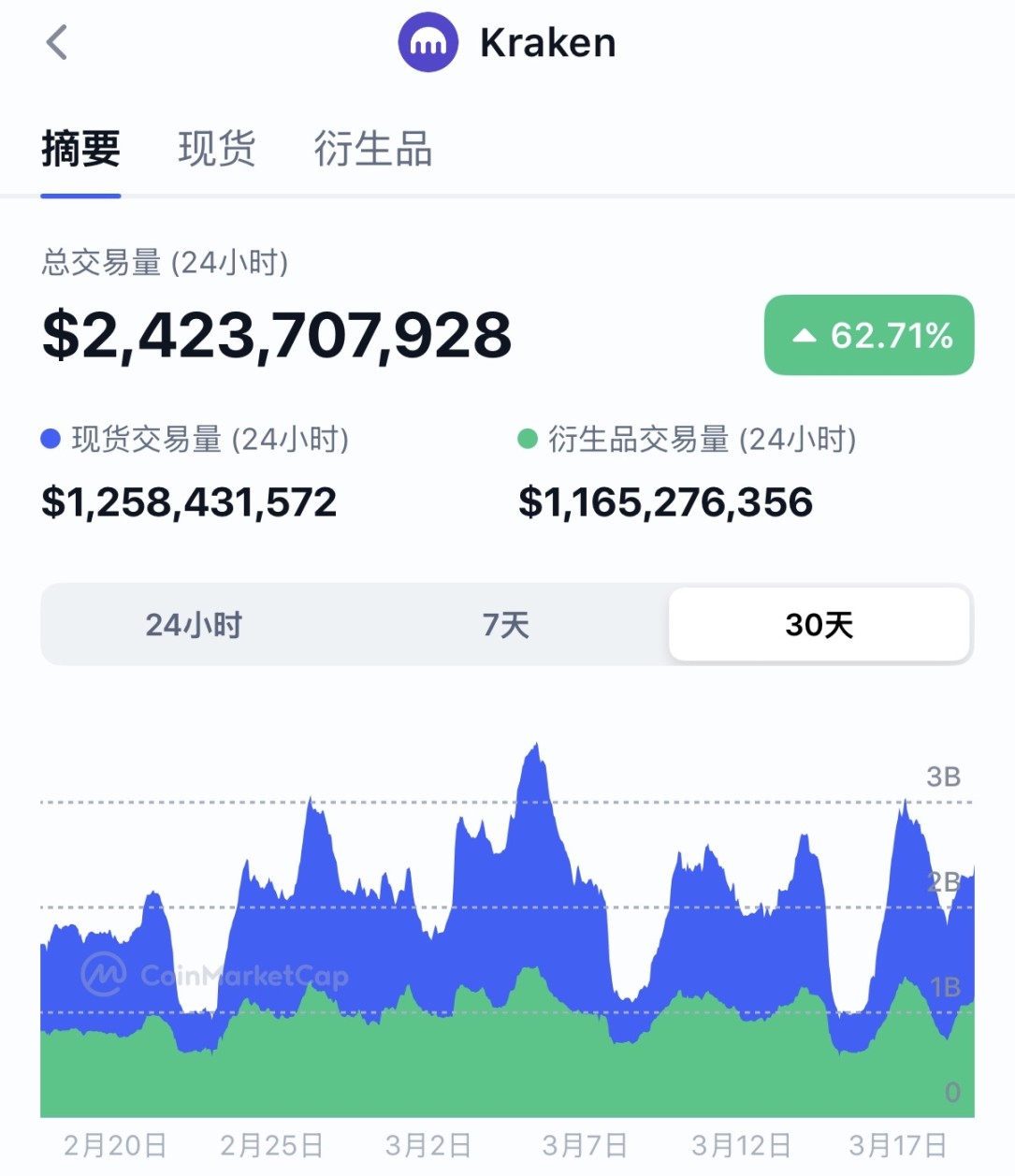
In terms of business scale, Kraken ranks in the middle globally among exchanges. According to CoinMarketCap data, Kraken's spot trading volume in the last 24 hours is approximately $1.2 billion, ranking 14th globally; its derivatives trading volume is about $1.1 billion, ranking 10th. In comparison, Coinbase's spot trading volume in the last 24 hours is around $1.86 billion, ranking second globally, while Binance leads with over $10 billion in spot trading volume and $65.18 billion in derivatives trading volume.

Financially, Kraken's parent company Payward reported 2025 results with adjusted revenue of $2.2 billion, a 33% year-over-year increase; adjusted EBITDA grew 26% to $531 million. Trading business revenue accounted for 47% of total revenue, with the remainder coming from non-trading businesses such as custody, payments, and financing. Total annual trading volume increased 34% to $2 trillion, platform assets grew 12% to $48.5 billion, and the number of customer accounts rose 50% to 5.7 million.

Despite the IPO plans being shelved, Kraken has been active in business expansion and regulatory compliance in recent months. On March 9, 2026, Nasdaq announced a partnership with Kraken to develop tokenized stocks and exchange-traded products, expected to launch in early 2027, focusing on using blockchain technology to streamline corporate governance processes.

On March 4, Kraken received approval for a Federal Reserve master account, becoming the first cryptocurrency company to access the Fed's core payment system, allowing direct use of the Fedwire interbank payment network. On February 25, the company launched its crypto asset staking loan service Flexline, enabling professional traders to access liquidity without selling their holdings. On February 24, Kraken announced the launch of regulated tokenized stock perpetual futures contracts, available to qualified non-U.S. users in over 110 countries, with initial products covering tokenized versions of major indices like the S&P 500 and Nasdaq 100.

Changes in the regulatory environment have added uncertainty to Kraken's path to listing. On March 18, the U.S. Securities and Exchange Commission and the Commodity Futures Trading Commission jointly issued interpretive guidance clarifying the classification standards for crypto assets, ending over a decade of regulatory ambiguity. This document provides clearer compliance guidance for the market but also means companies need to reassess how their business structures align with regulatory requirements. Meanwhile, cryptocurrency market structure legislation advancing in Congress is expected to pass in 2026, further clarifying the regulatory归属 of digital assets.

Kraken's decision to pause its IPO reflects the structural challenges crypto companies face in capital markets. On one hand, the industry is expanding from pure cryptocurrency trading to broader financial services, including stock trading, tokenized assets, and payment infrastructure; on the other hand, market volatility and regulatory uncertainty make investors cautious about valuing such assets.

For the entire cryptocurrency industry, Kraken's delayed listing may signal a turning point. Laura Katherine Mann, a partner at international law firm White & Case, previously noted that 2025 was a test year for crypto company IPOs, and 2026 would be the key node to test the long-term sustainability of digital asset IPOs. The market is judging whether crypto IPOs are a sustainable asset class or a cyclical trade that only during bullish markets. In the current market environment, Kraken's choice to wait for a more opportune moment may be a more prudent strategy.

It is worth noting that other leading players in the crypto industry are also actively adjusting their strategies to adapt to market changes. On March 19, Kris Marszalek, CEO of crypto trading platform Crypto.com, announced that the company is全面推进 its AI transformation, integrating AI tools and talent to enhance operational scale and precision. As part of this strategic adjustment, the company has targeted a reduction of about 12% of positions不适应 the new landscape.


Twitter:https://twitter.com/BitpushNewsCN

Bitpush TG Discussion Group:https://t.me/BitPushCommunity

Bitpush TG Subscription: https://t.me/bitpush

Original Link:https://www.bitpush.news/articles/7621233

Пов'язані питання

QWhy did Kraken decide to pause its IPO plans according to the article?

AKraken paused its IPO plans due to the current downturn in the cryptocurrency market and unfavorable market conditions, with the possibility of reconsidering when conditions improve.

QWhat significant partnership did Kraken announce in March 2026 regarding tokenized assets?

AIn March 2026, Kraken announced a partnership with Nasdaq to develop tokenized stocks and exchange-traded products, leveraging blockchain technology to simplify corporate governance processes.

QHow did the performance of other recently listed crypto companies like Gemini and Bullish compare in the market?

AGemini's stock price fell nearly 82.6% from its first-day close, while Bullish experienced a 63.5% decline from its IPO price, both reflecting severe market challenges.

QWhat regulatory development in the U.S. was highlighted as adding uncertainty to crypto asset classification?

AThe SEC and CFTC jointly issued interpretive guidance clarifying the classification standards for crypto assets, ending over a decade of regulatory ambiguity and requiring companies to reassess their compliance.

QHow does Kraken's business diversification strategy extend beyond cryptocurrency trading?

AKraken has expanded into services such as custody, payments, financing, crypto-asset staking loans, and regulated tokenized stock perpetual futures, aiming to become a broader financial services provider.

Пов'язані матеріали

From Gas Limit to 'Keyed Nonces', How to Understand the Next Step in Ethereum Scalability?

Ethereum’s scalability efforts are shifting toward a user-centric approach—focusing not only on higher TPS, but on translating technical upgrades into lower costs, smoother operations, and better wallet experiences. Two recent developments highlight this direction: - **Raising the Gas Limit to 200 million**: Following the Fusaka upgrade that increased it to 60 million, a consensus has formed around a potential future increase to 200 million. This would boost Ethereum’s execution capacity, but it is planned alongside other upgrades—such as ePBS, Block-Level Access Lists (BAL), and EIP-8037—to manage state growth and keep node operation viable for average participants. - **Keyed Nonces (EIP-8250)**: This proposal aims to improve how transactions are queued. Instead of a single linear nonce per account, it introduces multiple independent nonce domains. This prevents different types of transactions—such as private payments, session keys, or batch operations—from blocking each other. Vitalik Buterin views this as a foundational step toward better privacy support and more flexible state scalability. Together, these upgrades are part of a broader move to push complexity from wallets, DApps, and relays back into the protocol layer. For everyday users, this means future Ethereum interactions could become less congested, more intuitive, and safer—especially as core improvements in account abstraction, cross-L2 interoperability, and node decentralization continue to progress. Ultimately, Ethereum is evolving to handle not just more transactions, but more varied and complex on-chain use cases while preserving its decentralized foundation.

marsbit8 хв тому

From Gas Limit to 'Keyed Nonces', How to Understand the Next Step in Ethereum Scalability?

marsbit8 хв тому

Leaving OpenAI, How Much Has Their Net Worth Increased?

Former OpenAI employees have collectively accrued near-trillion dollar valuations through ventures and investments, charting AI's future. The article highlights two main paths: founding high-value companies like Anthropic and Perplexity, or applying insider insights as investors. Leopold Aschenbrenner exemplifies the investor path. After being fired from OpenAI, he leveraged firsthand knowledge of AI's massive energy demands to make hugely successful public market bets on nuclear and fuel cell companies, practicing "cross-industry cognitive arbitrage." Other alumni, like the Zero Shot VC fund founders, use their technical foresight for early-stage investing. Their key advantage lies not just in picking winners, but in knowing which technical approaches are likely dead ends—a "veto list" derived from internal OpenAI experience. Angel investing within the network, as seen with Mira Murati and Sam Altman, operates on deep, pre-existing understanding of a founder's capabilities, reducing due diligence to near zero. This creates an ecosystem bound by a shared belief in AGI's imminent arrival, differing from networks like the "PayPal Mafia" which were built on shared past struggles. The shift of these builders to investors signals a profound conviction: their situational awareness of the AI landscape is now so clear that deploying capital based on that judgment is more efficient than building themselves. They are allocating bets on the future they helped shape from the inside.

marsbit19 хв тому

Leaving OpenAI, How Much Has Their Net Worth Increased?

marsbit19 хв тому

Countdown to the AI Bull Market? Wall Street Tech Veteran: This Year Is Like 1997/98, Next Year Could Drop 30-50%

"AI Bull Market Countdown? Wall Street Veteran: This Year Feels Like 1997/98, Next Year Could Drop 30-50%" In an interview, veteran tech analyst Dan Niles draws parallels between the current AI boom and the 1997-98 period of the internet boom, suggesting the bull run isn't over yet. The core new driver is identified as "Agentic AI," which performs multi-step tasks and consumes vastly more computing power than conversational AI. This shift is expected to boost demand for cloud infrastructure and benefit CPU makers like Intel and AMD, potentially pressuring GPU leader Nvidia. However, Niles warns of significant short-term overbought conditions in semiconductors. His central warning is for a potential major market correction of 30-50% starting in early 2027. Drivers include a slowdown from high growth comparables, the outsized capital demands of companies like OpenAI, and a wave of massive tech IPOs sucking liquidity from the market. A J.P. Morgan survey of 56 global investors aligns with this view, finding that 54% expect a >30% U.S. stock correction by 2027. Among mega-cap tech, Niles favors Google due to its full-stack AI capabilities and cash flow, expresses concern about Meta's user growth, and sees potential for Apple's AI Siri and foldable iPhone. Niles advises investors to be nimble, hold significant cash, and closely monitor the conflicting signals from equities, oil prices, and bond yields, which he believes cannot all be correct simultaneously.

marsbit52 хв тому

Countdown to the AI Bull Market? Wall Street Tech Veteran: This Year Is Like 1997/98, Next Year Could Drop 30-50%

marsbit52 хв тому

Торгівля

Спот
Ф'ючерси
活动图片





