Supported by 20+ Institutions: How Does Sui's New Primitive Hashi Rewrite the Rules of Bitcoin Financial Trust?

marsbitОпубліковано о 2026-04-15Востаннє оновлено о 2026-04-15

Анотація

Sui has introduced Hashi, a new decentralized Bitcoin (BTC)抵押原语 (primitive) designed to enable trust-minimized and secure use of native BTC in DeFi on the Sui blockchain, backed by over 20 major institutions. Hashi allows users to抵押 Bitcoin without transferring custody to centralized entities. BTC remains on the Bitcoin network in a dedicated address, while a抵押凭证 is generated on Sui. This凭证, representing the locked BTC, can be used in Sui's smart contracts for lending, borrowing, and other DeFi activities. The system relies on Sui validators for security, with a Guardian Layer for additional protection against risks like validator collusion. Key to Hashi is its role as a "primitive"—a foundational building block for developers. It provides a standardized interface to integrate native BTC抵押 capabilities into applications like lending protocols, structured products, and RWA strategies, reducing development barriers. Institutional support spans custody (e.g., BitGo, Cobo), trading (e.g., FalconX, Bullish), security (e.g., OtterSec, Certora), and protocols (e.g., Suilend, Scallop). This ecosystem support aims to facilitate large-scale institutional BTC adoption into DeFi upon mainnet launch. Hashi addresses core trust issues in Bitcoin金融 by prioritizing non-custodial security, transparency, and composability, potentially unlocking Bitcoin's $1.4 trillion market cap for decentralized finance without sacrificing user control.

Author: Deep Tide TechFlow

While market attention is being drawn away by U.S. stocks, AI, and gold, Sui recently announced a new move:

Hashi, a Bitcoin collateral primitive based on Sui, is about to launch and has garnered support from top-tier institutions.

Bitcoin finance, a topic that has been discussed for a long time but remains unresolved:

As the largest on-chain asset treasury with a market cap exceeding $1.4 trillion, the proportion of Bitcoin used in DeFi is still less than 0.22%.

The core reason it remains unresolved is not due to insufficient functionality but the wrong premise of trust. In many past attempts, users were often misled—you thought your Bitcoin was in your hands, but it was actually on someone else’s ledger. The collapses of Celsius, Voyager, Genesis, and other projects have repeatedly sounded the alarm for the logic of "sacrificing trust for efficiency."

Especially synthetic Bitcoin, although it has attracted a considerable number of retail users, this structure has failed to convert a large amount of Bitcoin into DeFi capital and cannot attract institutions and large asset holders who require stronger guarantees.

This is precisely the important opportunity for the launch of Sui’s new developer primitive Hashi:

Reconstructing the most critical trust base for Bitcoin finance.

Enabling native BTC collateral to be organized more transparently in Sui’s smart contract environment—no wrapping, no synthesizing, no handing over keys to any centralized entity—and turning this capability into directly reusable interfaces.
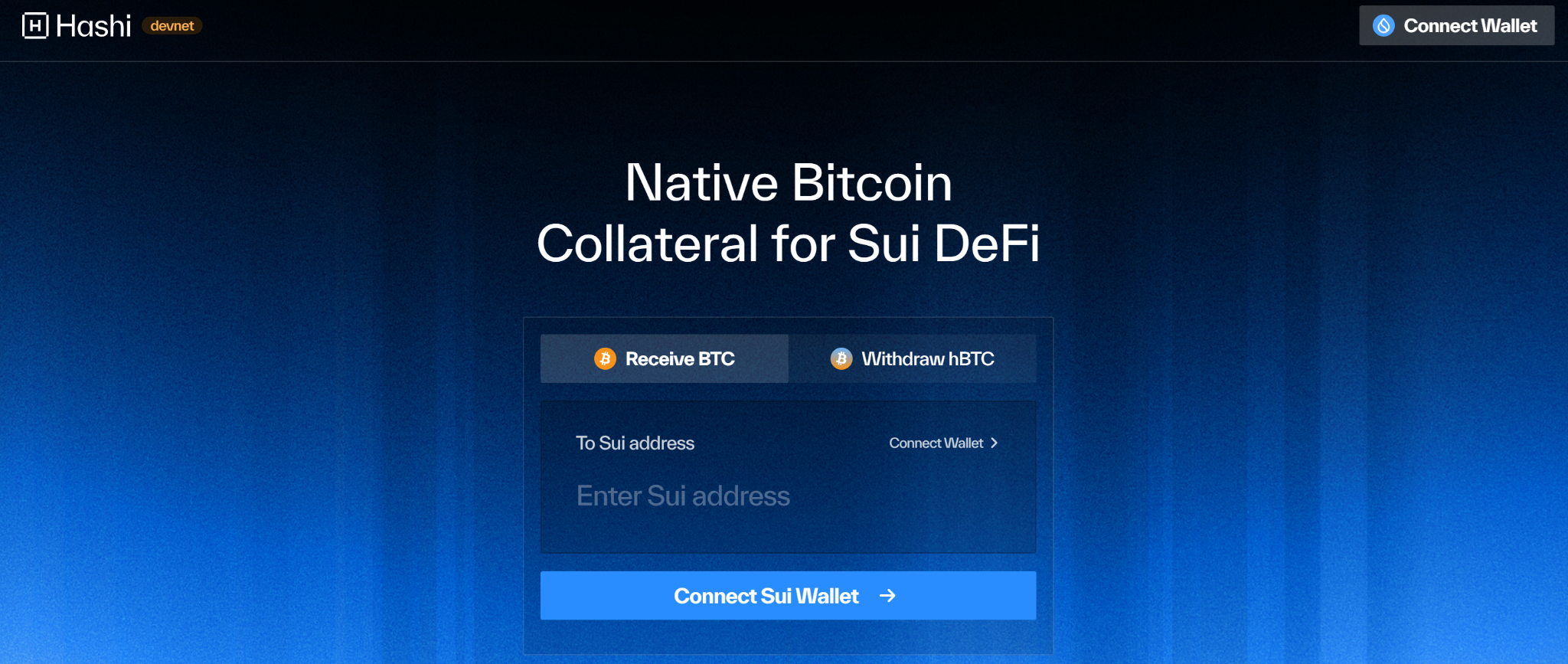
Hashi Native BTC Programmability: BTC Stays on the Chain, Collateral Rights Enter the Sui Network

The design philosophy of Hashi can be summarized in one sentence:

Assets remain on the Bitcoin network, rights exist on the Sui network—both occur simultaneously without interference.

Suppose you have one Bitcoin and want to use it as collateral to borrow some USDC.

In most past solutions:

You either deposit BTC into a centralized platform to obtain a borrowing limit or accept Wrapped BTC. Your Bitcoin, at some point, must be handed over to someone else, essentially trading "trust in an entity" for "programmability."

With Hashi:

  • Deposit: Users deposit BTC into a dedicated address (a unique Bitcoin deposit address generated by Hashi for their Sui address). The private key for this address does not belong to any single entity but is collectively managed by the validators on the Sui network. The BTC can only be moved if enough validators reach a consensus. This means no single entity can run away with your money unless they control more than one-third of the entire Sui validator network.
  • Proof Generation: Validators simultaneously monitor the Bitcoin network. Once they confirm your BTC is locked in, a corresponding collateral proof is generated on the Sui chain. This proof is not a newly issued token or a wrapped asset; it is an on-chain certificate proving that a real BTC is locked, and you are its owner.
  • As Collateral: With this proof, you can borrow money, participate in DeFi, or set up yield strategies in Sui’s smart contracts. All rules are written in code and executed automatically, with no room for interference.
  • Repayment and Withdrawal: After repayment, validators automatically release the native BTC on the Bitcoin mainnet through MPC threshold signatures, which can be withdrawn to any Bitcoin address without manual intervention.
  • Guardian Layer: To prevent extreme situations (such as validator collusion), Hashi additionally introduces a Guardian Layer as a secondary check and backup protection, primarily monitoring large withdrawals or abnormal thresholds to prevent potential systemic risks.
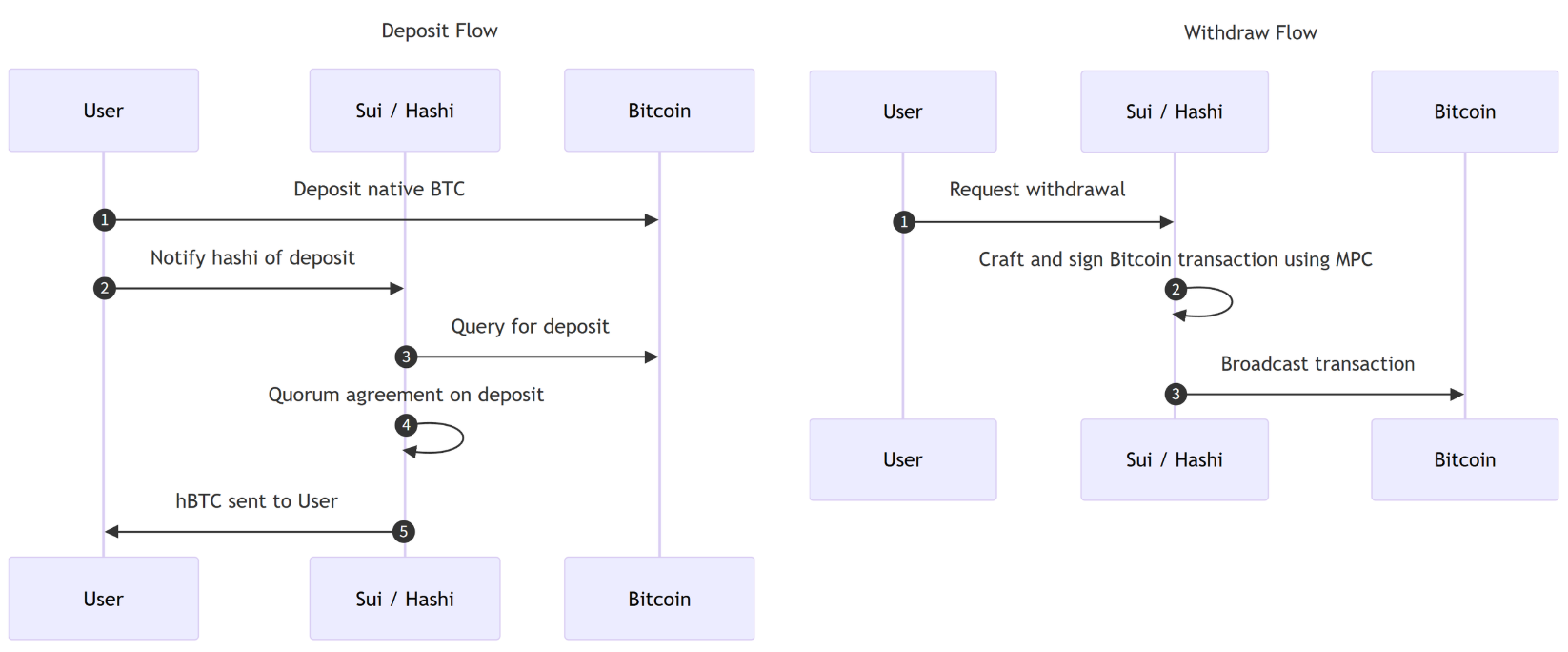
Throughout the entire lifecycle:

BTC always remains on the Bitcoin mainnet and is not moved into any platform’s internal account;

No single centralized entity has exclusive control of the private key;

What circulates on Sui is the collateral right backed by real BTC, reopening the programmability of native BTC;

And the only entities users need to trust are the validator network and the smart contract.
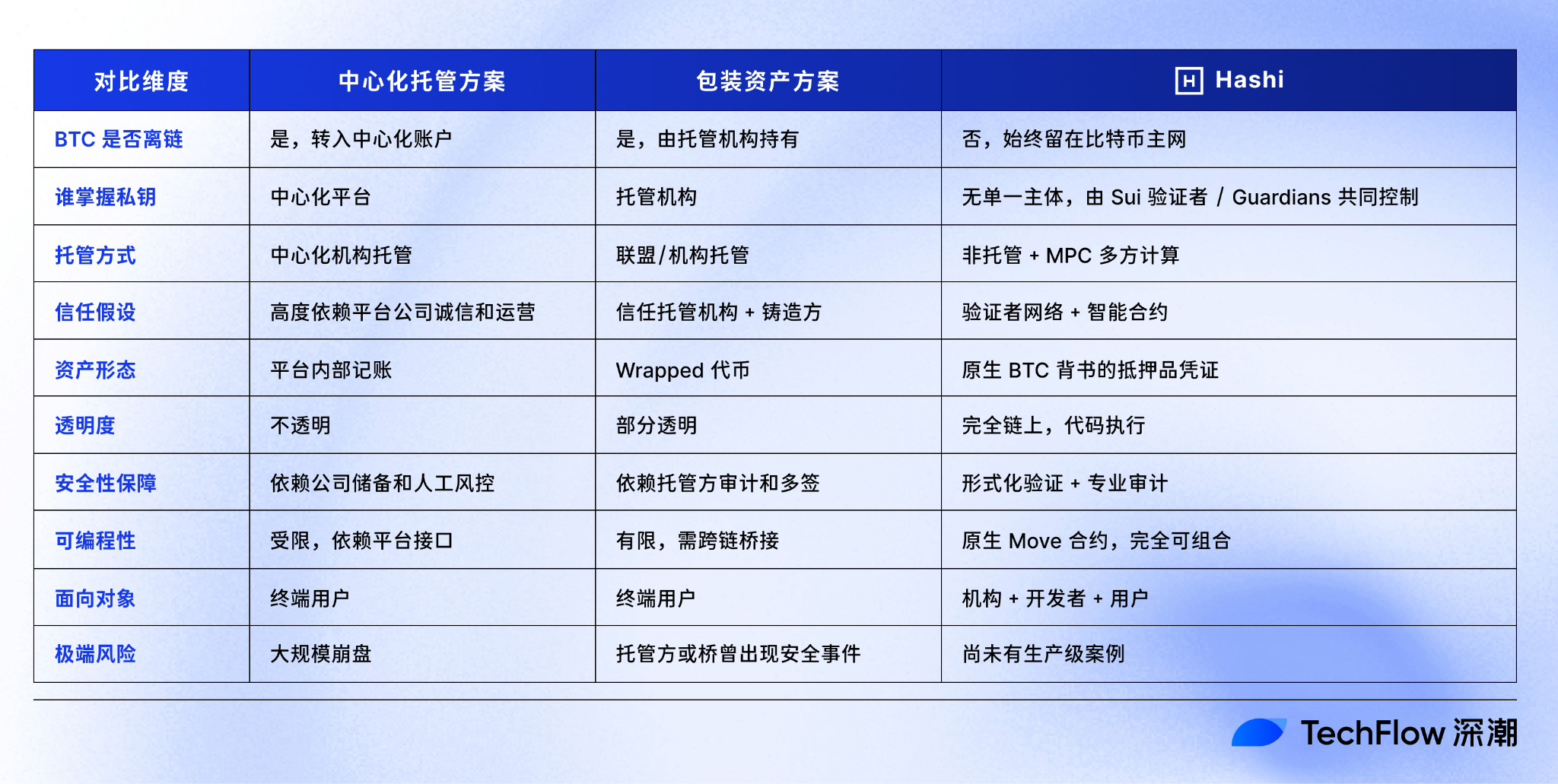
Simply put, Hashi is committed to enabling the collateral relationship of native BTC to be directly recognized by the on-chain financial system, with minimal trust placed in centralized entities.

During stable market conditions, users may perceive little difference, but in extreme situations like platform collapses or liquidity crises, it is the difference between whether your BTC is still there or not.

Not a Product, but a "Primitive": A Directly Reusable "Standard Brick"

From a design perspective, Hashi is a more decentralized, trust-minimized, and secure transparent Bitcoin financial solution.

However, if Hashi is understood solely as a single "solution," its most potential aspect might be missed.

It is important to note that for a long time, Sui has been striving to evolve from "a chain" to "a complete set of developer infrastructure." Whether it’s launching Walrus, Seal, or Nautilus, the goal has been to achieve full-stack nativity from execution, storage, permission control to off-chain computation, providing convenience for developers and building the necessary foundation for ecosystem prosperity.

This time, facing Bitcoin finance is no exception.

According to the official definition:

Hashi is the first decentralized Bitcoin collateral primitive developed by Mysten Labs, allowing developers to actively handle UTXOs from the Bitcoin network in Sui’s native smart contract language.

The key word is "primitive."

In the context of blockchain and DeFi, a primitive often refers to a fundamental building block or underlying infrastructure component. It is like a "standard brick" in Lego:

It is not an end product for ordinary users but a basic module for developers to build products.

Just as TCP/IP is not an app but all apps run on it; Hashi is not a product, but lending platforms, yield strategies, and structured products can all be built on it.

In other words, Hashi does not provide a closed financial service but an underlying capability, enabling native BTC to become collateral that Sui smart contracts can directly call.

As for what this collateral is used for, how it is used, and under what rules, Hashi does not interfere—it leaves it to the contracts, developers, and the market.
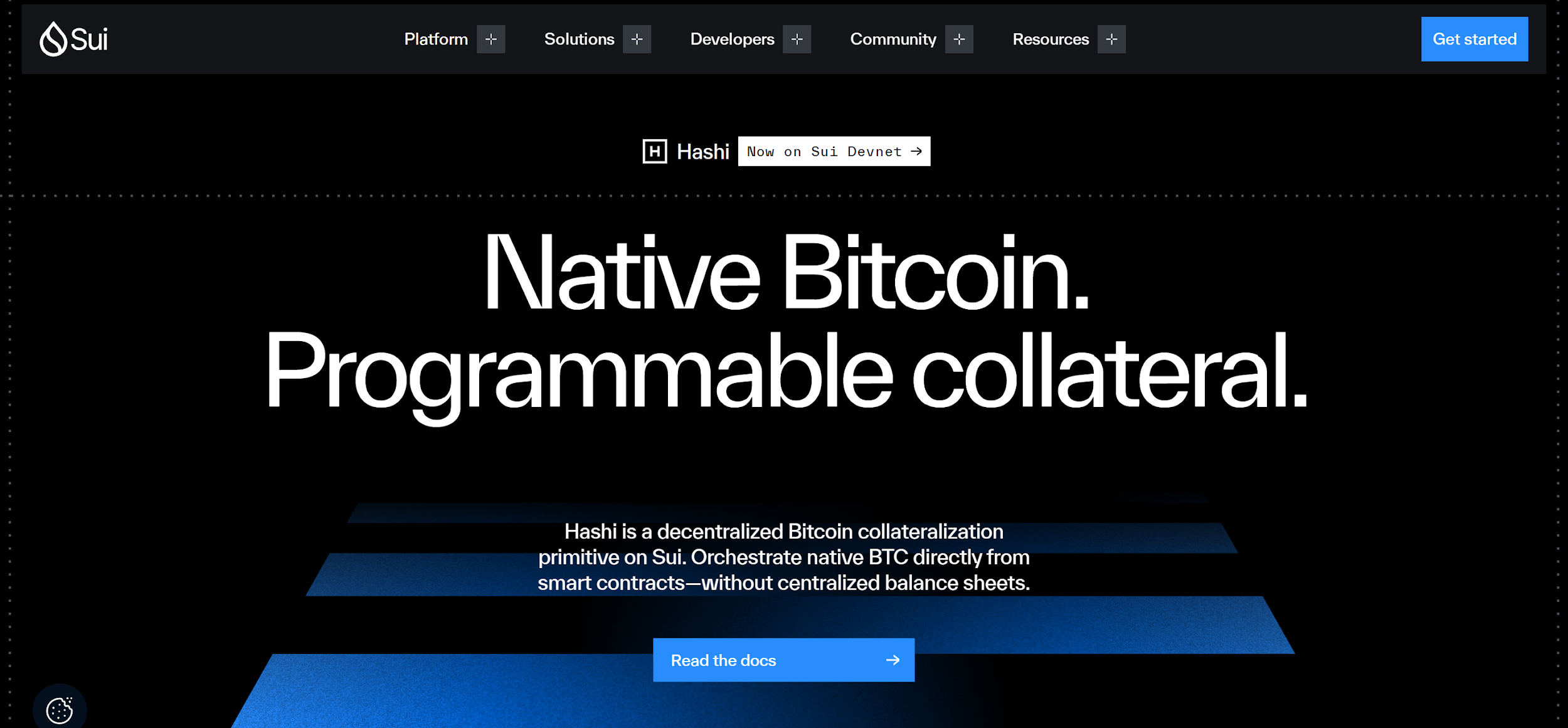
Before Hashi, if developers wanted to build a protocol with BTC as collateral, they faced numerous challenges: either accept the trust risks of centralized custody or implement the complex logic of native BTC collateral from scratch.

As a primitive, Hashi turns this difficult problem into a directly reusable interface.

Now, when building specific products, developers can directly call the mechanisms provided by Hashi, enabling their protocols to inherently possess native BTC collateral capabilities without having to solve underlying problems again, significantly reducing development barriers and time costs.

Users, whether institutional or retail, will, through products built on Hashi, for the first time truly gain the ability to earn yields with Bitcoin without giving up control over it. In the initial phase, lending will be the first use case for Hashi, allowing BTC to be lent out or used as collateral to borrow stablecoins. In the future, Hashi’s scenarios will gradually expand to vaults, insurance, structured products, credit derivatives, and RWA yield strategies.

Bitcoin is the asset with the broadest global consensus and deepest liquidity, but in the past, this wealth was almost invisible to the on-chain financial world: it is massive but not programmable; it is valuable but cannot be directly perceived and called by smart contracts.

Therefore, when Hashi turns the native BTC collateral capability into an interface that any developer can directly call, the upper-layer application space it can leverage far exceeds any specific product or protocol.

And the correctness of this judgment is already answered by the extensive institutional support Hashi has received.

Institutional Day One Support: Building a Complete Ecosystem Around Hashi

Currently, Hashi is live on Sui Devnet, primarily for developer testing and auditing, and has not yet entered the production environment. However, it has already received explicit support commitments from several leading industry institutions.

In terms of infrastructure: Including BitGo, Blockdaemon, Cobo, Ledger, and other major institutions, directly bridging institutional BTC from cold storage into on-chain collateral scenarios.

In terms of trading and liquidity: Including FalconX, Bullish, CF Benchmarks, and other major institutions, providing Hashi with reliable pricing, liquidity exits, and institutional-grade counterparty support.

In terms of security and compliance: Multiple teams, including security auditing firm OtterSec, smart contract formal verification security company Certora, and cryptography and zero-knowledge proof research and engineering team Asymptotic, have chosen to support Hashi and will conduct smart contract audits, formal verification, cryptography, and zero-knowledge proof research before Hashi’s mainnet launch.

At the same time, projects including Suilend, Scallop, NAVI Protocol, Matrixdock, and Bluefin have announced they will integrate Hashi to unleash on-chain financial potential, enabling retail and institutional users to quickly access BTC collateral lending experiences.

In addition, Soter Insure, a provider of institutional-grade insurance solutions, has announced a partnership with Hashi to bring built-in institutional-grade insurance mechanisms as a risk protection layer.

These institutions represent thousands of billions of dollars in Bitcoin nominal value and mature compliance infrastructure. Their commitment to integration at the Hashi Devnet stage means that once Hashi officially launches, large-scale institutional Bitcoin assets will have the practical conditions to enter on-chain scenarios.

At the same time, looking at these 20+ institutions together, an interesting fact emerges: they almost cover every环节 of a complete Bitcoin financial ecosystem:

From Bitcoin security custody, on-chain collateral, price pricing, liquidity support, lending protocols, yield strategies, RWA integration, to security audits and user entry, an end-to-end chain has already taken shape.

In other words, behind this list of supporters, a complete ecosystem map of Bitcoin finance围绕 the Hashi primitive will be ready from day one of Hashi’s mainnet launch.

Conclusion

Of course, Hashi is still in the Devnet stage. It has not yet undergone long-term testing in the mainnet environment, with real asset scale and extreme market fluctuations. Its production-level performance still needs time to verify. The path of Bitcoin finance will not immediately become smooth just because a new primitive emerges.

However, judging from the integration commitments of over 20 leading institutions in custody, liquidity, security, and protocol layers from day one, market recognition of this path is clear enough.

The story of Bitcoin finance has been told for many years, but the real breakthrough point has never been about "what can be done" but "why trust."

Past solutions, whether centralized custody or wrapped assets, essentially required users to make the same choice: either give up control for yield or hold the keys but be excluded from on-chain finance.

Hashi attempts to rewrite the question itself: making the collateral capability of native BTC an underlying interface that developers can directly call, enabling Bitcoin’s sleeping trillion-dollar treasury to be truly "seen" by the smart contract world in a non-custodial, verifiable, and composable way for the first time.

Reconstructing trust is often harder than stacking functions.

If the endgame of Bitcoin finance is to make Bitcoin truly the native collateral of on-chain finance, then what Hashi is doing may be laying the first pile for this bridge.


Пов'язані питання

QWhat is Hashi and how does it aim to change Bitcoin financial trust rules?

AHashi is a decentralized Bitcoin collateral primitive developed on Sui that enables native BTC to be used as programmable collateral in DeFi without requiring users to relinquish custody to centralized entities. It reconstructs the trust foundation by allowing BTC to remain on the Bitcoin network while its collateral rights are represented on Sui, managed collectively by validators without single-point control.

QHow does Hashi's deposit and抵押 process work technically?

AUsers deposit BTC into a unique Bitcoin address generated by Hashi for their Sui address. The private key of this address is collectively managed by Sui validators, requiring consensus for any movement. Validators monitor the Bitcoin network, confirm the deposit, and issue a抵押凭证 on Sui, which serves as proof of locked BTC. This凭证 can then be used in Sui's smart contracts for DeFi activities like borrowing.

QWhy is Hashi described as a 'primitive' rather than a product?

AHashi is termed a 'primitive' because it functions as a foundational building block or底层 infrastructure component for developers, not an end-user product. It provides a reusable interface that allows developers to integrate native BTC collateral capabilities directly into their applications (e.g., lending platforms, yield strategies) without rebuilding the complex underlying logic, thereby reducing development barriers and costs.

QWhich types of institutions have supported Hashi, and what roles do they play?

AHashi has garnered support from over 20 institutions across custody and infrastructure (e.g., BitGo, Cobo), trading and liquidity (e.g., FalconX, Bullish), security and compliance (e.g., OtterSec, Certora), and DeFi protocols (e.g., Suilend, Scallop). These institutions provide essential services like secure custody, liquidity, auditing, and integration, forming a comprehensive ecosystem for Bitcoin financial services on Sui.

QWhat are the potential risks or limitations of Hashi mentioned in the article?

AHashi is still in the Devnet phase and has not yet been tested in a mainnet environment with real assets and extreme market conditions. Its production-level performance requires further validation. Additionally, while it minimizes trust in centralized entities, it still relies on Sui validators and smart contract security, with a Guardian Layer added as a secondary check for risks like validator collusion.

Пов'язані матеріали

Polymarket's "2028 Presidential Election" Volume King Is... LeBron James???

An article from Odaily Planet Daily, authored by Azuma, discusses a peculiar phenomenon observed on the prediction market platform Polymarket regarding the "2028 US Presidential Election" event. Despite having a real-time probability of less than 1%, unlikely candidates such as NBA star LeBron James (with $48.41 million in trading volume), celebrity Kim Kardashian ($33.84 million), and even ineligible figures like Elon Musk ($23.14 million) and New York City Mayor Zohran Mamdani ($18.39 million) account for approximately 70% of the total trading volume. In contrast, high-probability candidates like Vice President JD Vance ($10.58 million), California Governor Gavin Newsom ($15.71 million), and Secretary of State Marco Rubio ($9.32 million) have significantly lower trading activity. The article explains that this counterintuitive trend is not driven by irrational speculation but by rational strategies. Polymarket offers a 4% annualized holding reward for certain markets, including the 2028 election, to maintain long-term pricing accuracy. This yield exceeds the current 5-year US Treasury rate (3.98%), attracting large investors ("whales") to hold "NO" shares on low-probability candidates for risk-free returns. Additionally, some users utilize a platform feature that allows converting a set of "NO" shares into corresponding "YES" shares for better liquidity or pricing efficiency, rather than directly buying "YES" shares for their preferred candidates. Thus, the seemingly absurd trading activity is strategically motivated.

marsbit1 год тому

Polymarket's "2028 Presidential Election" Volume King Is... LeBron James???

marsbit1 год тому

Dialogue with ViaBTC CEO Yang Haipo: Is the Essence of Blockchain a Libertarian Experiment?

"ViaBTC CEO Yang Haipo: Blockchain as a Hardcore Libertarian Experiment" In a deep-dive interview, ViaBTC CEO Yang Haipo reframes the essence of blockchain, arguing it is not merely a new technology or infrastructure but a hardcore libertarian experiment. This experiment, born from the 2008 financial crisis and decades of cypherpunk ideology, tests a fundamental question: to what extent can freedom and self-organization exist without centralized trust? The discussion highlights the experiment's verified outcomes. On one hand, it has proven its core value of censorship resistance, providing critical financial lifelines for entities like WikiLeaks and individuals in hyperinflationary or sanctioned countries via tools like stablecoins. However, Yang points out a key paradox: the most successful product, USDT, is itself a centralized compromise, showing users prioritize a less-controlled pipeline over pure decentralization. On the other hand, the experiment has exposed the severe costs of this freedom—a "dark forest" without safeguards. Events like the collapses of LUNA, Celsius, and FTX, resulting in massive wealth destruction and prison sentences for founders, underscore the system's fragility and the inherent risks of an unregulated environment. Yang observes that despite decentralized protocols, human nature inevitably recreates centralized power structures, speculative frenzies, and narrative-driven cycles (from ICOs to Meme coins), where emotion and belonging often trump technological substance. Looking forward, he believes blockchain's future is significant but niche. Its real value lies in serving specific, real-world needs for financial sovereignty and bypassing traditional controls, not as a universal infrastructure replacing all centralized systems. For the average participant, Yang's crucial advice is to cultivate independent judgment. True freedom is not holding a crypto wallet, but possessing a mind resilient to groupthink and narrative hype in a high-risk, often irrational market.

marsbit1 год тому

Dialogue with ViaBTC CEO Yang Haipo: Is the Essence of Blockchain a Libertarian Experiment?

marsbit1 год тому

Торгівля

Спот
Ф'ючерси

Популярні статті

Що таке BITCOIN

Розуміння HarryPotterObamaSonic10Inu (ERC-20) та його позиції у крипто-просторі Останніми роками ринок криптовалют спостерігав за зростанням популярності мем-коінів, які привертають інтерес не тільки трейдерів, але й тих, хто шукає спілкування та розважальну цінність. Серед цих унікальних токенів є HarryPotterObamaSonic10Inu (ERC-20), інтригуючий проект, що поєднує культурні посилання з тканинами криптовалюти. Ця стаття досліджує ключові аспекти HarryPotterObamaSonic10Inu, вивчаючи його механізми, спільноту та його взаємодію з ширшим крипто-ландшафтом. Що таке HarryPotterObamaSonic10Inu (ERC-20)? Як випливає з його назви, HarryPotterObamaSonic10Inu є мем-коіном, побудованим на блокчейні Ethereum, класифікованим за стандартом ERC-20. На відміну від традиційних криптовалют, які можуть підкреслювати практичну корисність або інвестиційний потенціал, цей токен процвітає завдяки розважальній цінності та силі своєї спільноти. Проект спрямований на створення середовища, де зацікавлені користувачі можуть об'єднуватися, ділитися ідеями та брати участь у заходах, натхненних різноманітними культурними явищами. Однією з примітних особливостей HarryPotterObamaSonic10Inu є нульовий податок на транзакції. Цей привабливий елемент має на меті заохочувати торгівлю та участь у спільноті, позбавлену додаткових витрат, які можуть відлякувати дрібних трейдерів. Загальна пропозиція монет становить один мільярд токенів, що позначає намір підтримувати суттєву циркуляцію в межах спільноти. Творець HarryPotterObamaSonic10Inu (ERC-20) Походження HarryPotterObamaSonic10Inu дещо окутане таємницею; деталі про творця залишаються невідомими. Розвиток цього токена позбавлений впізнаваної команди або чіткої стратегії, що не є рідкістю в секторі мем-коінів. Натомість проект виник органічно, а його розвиток значною мірою залежить від ентузіазму та участі його спільноти. Інвестори HarryPotterObamaSonic10Inu (ERC-20) Щодо зовнішніх інвестицій та підтримки, HarryPotterObamaSonic10Inu також залишається невизначеним. Токен не зазначає жодних відомих інвестиційних фондів або значної організаційної підтримки. Натомість життєва сила проекту полягає в його базовій спільноті, яка інформує про його зростання та стійкість через колективні дії та залученість у крипто-просторі. Як працює HarryPotterObamaSonic10Inu (ERC-20)? Як мем-коін, HarryPotterObamaSonic10Inu функціонує передусім поза традиційними рамками, що часто регулюють вартість активів. Є кілька відмінних аспектів, що визначають, як працює проект: Транзакції без податку: Завдяки відсутності податкових зборів на транзакції, користувачі можуть вільно купувати та продавати токен, не турбуючись про приховані витрати. Залучення спільноти: Проект процвітає завдяки взаємодії спільноти, використовуючи соціальні медіа для створення шуму та сприяння залученню. Обговорення, обмін контентом та залученість є ключовими елементами, що допомагають розширити його охоплення та зміцнити лояльність серед прихильників. Відсутність практичної корисності: Слід зазначити, що HarryPotterObamaSonic10Inu не пропонує конкретної корисності в рамках фінансової екосистеми. Натомість він класифікується як токен, що призначений в основному для розваги та спільнотних активностей. Культурне посилання: Токен кмітливо вплітає елементи популярної культури, щоб привернути інтерес, зв'язуючи з ентузіастами мемів та крипто-стежками. HarryPotterObamaSonic10Inu ілюструє, як мем-коіни функціонують інакше, ніж традиційні криптовалютні проекти, увійшовши на ринок як інноваційні соціальні конструкти, а не утилітарні активи. Хронологія HarryPotterObamaSonic10Inu (ERC-20) Історія HarryPotterObamaSonic10Inu відзначена кількома значними етапами: Створення: Токен виник з вірусного мему, захопивши уяву багатьох крипто-ентузіастів. Конкретні дати створення недоступні, що підкреслює його органічний розвиток. Лістинг на біржах: HarryPotterObamaSonic10Inu з'явився на різних біржах, дозволяючи зручніший доступ і торгівлю спільноти. Ініціативи залучення спільноти: Ведення діяльності, спрямованої на покращення взаємодії спільноти, включаючи конкурси, кампанії в соціальних мережах та створення контенту від фанатів та прихильників. Плани на майбутнє: Дорожня карта проекту включає запуск колекції NFT, мерчандайзинг та електронну комерцію, пов'язану з його культурними темами, що далі залучає спільноту та намагається додати більше вимірів до його екосистеми. Ключові моменти про HarryPotterObamaSonic10Inu (ERC-20) Спільнотний підхід: Проект надає пріоритет колективному внеску та креативності, забезпечуючи, щоб участь користувачів була в центрі його розвитку. Класифікація як мем-коін: Це є його епігенез розважальної криптовалюти, що відрізняється від традиційних інвестиційних інструментів. Жодного прямого відношення до Bitcoin: Незважаючи на схожість у назві, HarryPotterObamaSonic10Inu є відмінним і не має жодного зв’язку з Bitcoin або іншими усталеними криптовалютами. Зосередженість на співпраці: HarryPotterObamaSonic10Inu створено для того, щоб надати простір для співпраці та обміну історіями серед його власників, забезпечуючи шлях для творчості та спільного зв'язку. Перспективи на майбутнє: Амбіція розширитися за межі початкової концепції в NFT та мерчандайз відкриває шлях для проекту потенційно потрапити в більш мейнстрімні сфери цифрової культури. Оскільки мем-коіни продовжують захоплювати уяву спільноти криптовалют, HarryPotterObamaSonic10Inu (ERC-20) вирізняється своїми культурними зв'язками та орієнтованим на спільноту підходом. Хоча він може не відповідати типовій моделі утилітарного токена, його суть полягає в радощах і товариськості, що підтримуються серед його прихильників, підкреслюючи еволюційну природу криптовалют в усе більш цифрову епоху. Оскільки проект продовжує розвиватися, важливо спостерігати за тим, як динаміка спільноти вплине на його траєкторію в постійно змінюваному ландшафті технології блокчейн.

1.7k переглядів усьогоОпубліковано 2024.04.01Оновлено 2024.12.03

Що таке BITCOIN

Як купити BTC

Ласкаво просимо до HTX.com! Ми зробили покупку Bitcoin (BTC) простою та зручною. Дотримуйтесь нашої покрокової інструкції, щоб розпочати свою криптовалютну подорож.Крок 1: Створіть обліковий запис на HTXВикористовуйте свою електронну пошту або номер телефону, щоб зареєструвати обліковий запис на HTX безплатно. Пройдіть безпроблемну реєстрацію й отримайте доступ до всіх функцій.ЗареєструватисьКрок 2: Перейдіть до розділу Купити крипту і виберіть спосіб оплатиКредитна/дебетова картка: використовуйте вашу картку Visa або Mastercard, щоб миттєво купити Bitcoin (BTC).Баланс: використовуйте кошти з балансу вашого рахунку HTX для безперешкодної торгівлі.Треті особи: ми додали популярні способи оплати, такі як Google Pay та Apple Pay, щоб підвищити зручність.P2P: Торгуйте безпосередньо з іншими користувачами на HTX.Позабіржова торгівля (OTC): ми пропонуємо індивідуальні послуги та конкурентні обмінні курси для трейдерів.Крок 3: Зберігайте свої Bitcoin (BTC)Після придбання Bitcoin (BTC) збережіть його у своєму обліковому записі на HTX. Крім того, ви можете відправити його в інше місце за допомогою блокчейн-переказу або використовувати його для торгівлі іншими криптовалютами.Крок 4: Торгівля Bitcoin (BTC)Легко торгуйте Bitcoin (BTC) на спотовому ринку HTX. Просто увійдіть до свого облікового запису, виберіть торгову пару, укладайте угоди та спостерігайте за ними в режимі реального часу. Ми пропонуємо зручний досвід як для початківців, так і для досвідчених трейдерів.

4.3k переглядів усьогоОпубліковано 2024.12.12Оновлено 2025.03.21

Як купити BTC

Що таке $BITCOIN

ЦИФРОВЕ ЗОЛОТО ($BITCOIN): Комплексний аналіз Вступ до ЦИФРОВОГО ЗОЛОТА ($BITCOIN) ЦИФРОВЕ ЗОЛОТО ($BITCOIN) — це проект на основі блокчейну, що працює в мережі Solana, який має на меті поєднати характеристики традиційних дорогоцінних металів з інноваціями децентралізованих технологій. Хоча він має таку ж назву, як і Bitcoin, який часто називають “цифровим золотом” через його сприйняття як засобу збереження вартості, ЦИФРОВЕ ЗОЛОТО є окремим токеном, розробленим для створення унікальної екосистеми в ландшафті Web3. Його мета — позиціонувати себе як життєздатний альтернативний цифровий актив, хоча деталі щодо його застосувань і функціональностей все ще розробляються. Що таке ЦИФРОВЕ ЗОЛОТО ($BITCOIN)? ЦИФРОВЕ ЗОЛОТО ($BITCOIN) — це токен криптовалюти, спеціально розроблений для використання в блокчейні Solana. На відміну від Bitcoin, який виконує широко визнану роль зберігання вартості, цей токен, здається, зосереджується на більш широких застосуваннях і характеристиках. Помітні аспекти включають: Інфраструктура блокчейну: Токен побудований на блокчейні Solana, відомому своєю здатністю обробляти швидкі та низьковартісні транзакції. Динаміка постачання: ЦИФРОВЕ ЗОЛОТО має максимальне постачання, обмежене 100 квадрильйонами токенів (100P $BITCOIN), хоча деталі щодо його обігового постачання наразі не розголошуються. Утиліта: Хоча точні функціональності не викладені, є вказівки на те, що токен може бути використаний для різних застосувань, потенційно пов'язаних з децентралізованими додатками (dApps) або стратегіями токенізації активів. Хто є творцем ЦИФРОВОГО ЗОЛОТА ($BITCOIN)? На даний момент особа творців і команди розробників, що стоять за ЦИФРОВИМ ЗОЛОТОМ ($BITCOIN), залишається невідомою. Ця ситуація є типовою для багатьох інноваційних проектів у сфері блокчейну, особливо тих, що пов'язані з децентралізованими фінансами та феноменом мем-коінів. Хоча така анонімність може сприяти культурі, орієнтованій на спільноту, вона посилює занепокоєння щодо управління та підзвітності. Хто є інвесторами ЦИФРОВОГО ЗОЛОТА ($BITCOIN)? Доступна інформація вказує на те, що ЦИФРОВЕ ЗОЛОТО ($BITCOIN) не має жодних відомих інституційних спонсорів або помітних венчурних капіталовкладень. Проект, здається, працює за моделлю “рівний до рівного”, зосереджуючись на підтримці та прийнятті спільноти, а не на традиційних шляхах фінансування. Його активність і ліквідність переважно розташовані на децентралізованих біржах (DEX), таких як PumpSwap, а не на встановлених централізованих торгових платформах, що ще більше підкреслює його підхід знизу вгору. Як працює ЦИФРОВЕ ЗОЛОТО ($BITCOIN) Операційні механізми ЦИФРОВОГО ЗОЛОТА ($BITCOIN) можна детальніше розглянути на основі його дизайну блокчейну та характеристик мережі: Механізм консенсусу: Використовуючи унікальний proof-of-history (PoH) Solana в поєднанні з моделлю proof-of-stake (PoS), проект забезпечує ефективну валідацію транзакцій, що сприяє високій продуктивності мережі. Токеноміка: Хоча конкретні дефляційні механізми не були детально описані, велике максимальне постачання токенів вказує на те, що воно може задовольняти мікротранзакції або нішеві випадки використання, які ще потрібно визначити. Інтероперабельність: Існує потенціал для інтеграції з більш широкою екосистемою Solana, включаючи різні платформи децентралізованих фінансів (DeFi). Однак деталі щодо конкретних інтеграцій залишаються невизначеними. Хронологія ключових подій Ось хронологія, яка підкреслює значні віхи, пов'язані з ЦИФРОВИМ ЗОЛОТОМ ($BITCOIN): 2023: Початкове розгортання токена відбувається на блокчейні Solana, позначене його адресою контракту. 2024: ЦИФРОВЕ ЗОЛОТО набуває видимості, оскільки стає доступним для торгівлі на децентралізованих біржах, таких як PumpSwap, що дозволяє користувачам торгувати ним проти SOL. 2025: Проект спостерігає спорадичну торгову активність і потенційний інтерес до ініціатив, очолюваних спільнотою, хоча на даний момент не зафіксовано жодних значних партнерств або технічних досягнень. Критичний аналіз Сильні сторони Масштабованість: Основна інфраструктура Solana підтримує високі обсяги транзакцій, що може підвищити утиліту $BITCOIN у різних сценаріях транзакцій. Доступність: Потенційно низька торгова ціна за токен може привабити роздрібних інвесторів, сприяючи більш широкій участі завдяки можливостям дробового володіння. Ризики Відсутність прозорості: Відсутність публічно відомих спонсорів, розробників або процесу аудиту може викликати скептицизм щодо стійкості та надійності проекту. Волатильність ринку: Торгова активність сильно залежить від спекулятивної поведінки, що може призвести до значної волатильності цін і невизначеності для інвесторів. Висновок ЦИФРОВЕ ЗОЛОТО ($BITCOIN) постає як цікавій, але неоднозначний проект у швидко розвиваючійся екосистемі Solana. Хоча він намагається використати наратив “цифрового золота”, його відхід від встановленої ролі Bitcoin як засобу збереження вартості підкреслює необхідність чіткішого розмежування його передбачуваної утиліти та структури управління. Майбутнє прийняття та адаптація, ймовірно, залежатиме від вирішення поточної непрозорості та більш чіткого визначення його операційних та економічних стратегій. Примітка: Цей звіт охоплює синтезовану інформацію, доступну станом на жовтень 2023 року, і можуть відбутися події, що виходять за межі дослідницького періоду.

75 переглядів усьогоОпубліковано 2025.05.13Оновлено 2025.05.13

Що таке $BITCOIN

Обговорення

Ласкаво просимо до спільноти HTX. Тут ви можете бути в курсі останніх подій розвитку платформи та отримати доступ до професійної ринкової інформації. Нижче представлені думки користувачів щодо ціни BTC (BTC).

活动图片