Supply Side Decides Fate: The Global Game of Tin, Antimony, Tungsten, Molybdenum and China's Core Position

marsbitОпубліковано о 2026-01-26Востаннє оновлено о 2026-01-26

Анотація

This article analyzes the global supply dynamics and China's pivotal role in four critical strategic metals: tin, antimony, tungsten, and molybdenum. It argues that control over supply is paramount, often determining market stability, and that these "small metals" can rapidly evolve into strategic resources due to technological breakthroughs, as seen with lithium. The analysis highlights extreme supply concentration for each metal. Tin supply is heavily impacted by production halts in Myanmar's Wa State, a key supplier to China, the world's top refined tin producer. Antimony production is dominated by China, Tajikistan, and Russia. China overwhelmingly leads tungsten production (83% of global supply) but faces constraints from depleting high-grade ores. Molybdenum supply is also highly concentrated, with China holding a dominant position not only in production (42%) and reserves (39%) but also as the largest consumer, creating a self-sufficient industrial loop. A recurring theme is China's unique "resource endowment + production advantage" in these sectors, making them core strategic minerals. The piece underscores that geopolitical factors and supply chain security are key drivers of value reassessment for these metals, with their status as bargaining chips in global relations likely to intensify.

Author: Insightful Commentary

Some time ago, I was strongly recommended a few stocks related to minor metals. Looking back, I can only say it was a great tip. We shouldn't start researching only after getting stuck in a position; we should do our research *before* getting stuck. Hence, I recently started a new series: metal and mineral research, to examine the landscape of various minor metals.

Sometimes, market rumors are quite interesting. For instance, a few days ago, there was talk about increased explosives imports in Myanmar's Wa State, and immediately the price of tin dropped a bit. This hints at a potential supply-side story.

[Reminder: Fundamentals are just fundamentals; they are not meant to guide trading decisions.]

So-called minor metals aren't necessarily small, especially as a foundation for industrial transformation. Once a technological breakthrough occurs, a minor metal can very likely become a strategic metal.

For example, before becoming an "energy metal," the lithium market was not large, primarily used in glass, ceramics, lubricating greases, and other fields. But with the explosive growth of the new energy vehicle and energy storage industries, lithium, as a core raw material for power batteries, saw its demand and market size expand dramatically, fundamentally changing its status.

Magnesium is currently a relatively clear candidate to be the next minor metal listed on futures exchanges. The current global magnesium market is roughly at the million-ton level, mainly used as an aluminum alloy additive, for die-cast parts, etc. In the future, if magnesium sees major breakthroughs in lightweight materials (like automobiles, aerospace) or batteries, leading to orders-of-magnitude increases in production and consumption, it could very well be upgraded to a base metal or an independent category.

I remember vividly a segment from a previous Huaxia dialogue with Everbright's Qiu Suo on the non-ferrous market:

"Strategic minor metals, such as rare earths, tungsten-molybdenum, cobalt, nickel, tin—the value of these varieties will continue to be revalued. The core logic is the backdrop of global competition. Even if China-US competition eases temporarily, in the long run, the competitive nature of strategic metals will only intensify. These metals must meet two conditions: either strong scarcity or concentrated supply chains.

For example, cobalt: the Democratic Republic of Congo is the main supplier, and it uses cobalt supply as an important bargaining chip; pricing involves strong political factors. Another example is Indonesia's nickel and tin; global reliance on Indonesia is very high, and their inherent scarcity is prominent. They are very likely to become core varieties in the next round of competition. These varieties are either at a bottom, or their value hasn't been fully realized yet; there's significant room for revaluation in the future."

This year's strong performance in non-ferrous metals, aside from macro monetary reasons, is importantly due to the huge challenges faced by global supply chain security (especially for resources, mineral resource security).

China, as early as 2016, clarified its strategic mineral layout through top-level design: The State Council issued the "National Mineral Resources Plan (2016-2020)", using "ensuring national economic security, defense security, and the development needs of strategic emerging industries" as the core criteria, formally listing 24 minerals including chromium, aluminum, nickel, tungsten, tin, antimony, cobalt, lithium, rare earths, zirconium, crystalline graphite, petroleum, natural gas, shale gas, coal, coalbed methane, uranium, gold, iron, molybdenum, copper, phosphorus, potash, and fluorite into the strategic mineral catalog. This includes multiple core strategic metals, laying a solid resource foundation for the high-quality development of related industries.

China possesses "resource endowment + production advantage" in the four mineral areas of tungsten, antimony, tin, and molybdenum. Tungsten, antimony, tin, and molybdenum are China's four major strategic advantage minerals. Let's look at the supply of these four types of minerals.

I. Tin Supply Side Ore Types

The primary source of tin supply is cassiterite (SnO2, tin oxide), the main natural form of tin, accounting for over 95% of global tin ore resources. There are also smaller amounts of sulfide ores like stannite (Cu2FeSnS4), but their economic value is relatively low. Cassiterite is processed through beneficiation to produce tin concentrate, which is then smelted via pyrometallurgical or hydrometallurgical methods to produce refined tin.
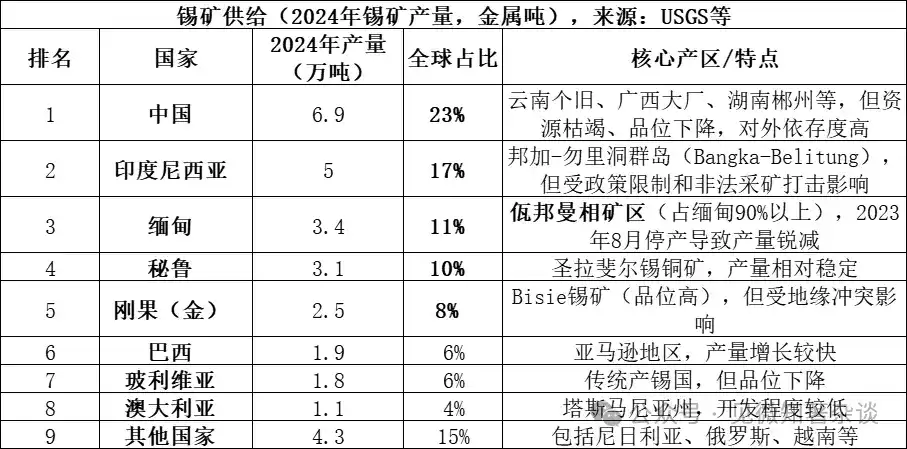
2025 data is not fully released yet, but due to continued production halts in Myanmar's Wa State, production is expected to further drop below 20,000 tons, its share falling to around 7%. The top five producing countries account for 69% combined, the top eight account for 85% combined, indicating highly concentrated supply.

Myanmar's Wa State has a huge impact on the tin industry chain, primarily because:

1) Historical Supply Volume: Before the August 2023 production halt, Myanmar's normal annual production was about 50,000-60,000 tons (15-20% of global supply), with the Wa State region accounting for over 90% of Myanmar's total production, i.e., an annual supply of about 45,000-54,000 tons. This volume equates to one-sixth of global supply; a sudden halt created a huge gap.

2) Crucial for Chinese Tin Exports: China is the world's largest refined tin producer (45% of global production), but domestic mine resources are depleted, making it heavily reliant on imports. Myanmar was once China's largest source of tin concentrate imports; in 2022, about 36,000 metric tons of tin-in-concentrate were imported from Myanmar, accounting for 60-70% of China's total imports. The Wa State halt directly caused shortages for Chinese smelters.

3) High Uncertainty in Resuming Production: Although Wa State began the resumption process in 2025, affected by policy, equipment, rainy season, and other factors, the actual resumption progress is far below expectations. As of the end of 2025, monthly exports averaged only 2,000-3,000 physical tons (approx. 1,000-1,500 metal tons), far below the pre-halt monthly average of 3,000 metal tons.

4) Amplifies Global Supply-Demand Tight Balance: The global tin market has long been in a tight supply-demand balance (reserve-to-production ratio only 15 years); any minor fluctuation in a major supplier is amplified by the market. Wa State's "halt-slow resumption" process became the core driver for the sustained high tin prices in 2024-2025.

Tin ore is rarely found alone; it is often associated with various metal and non-metal minerals.

Deposits related to intermediate-acidic granites: This is the most important tin deposit type. In skarn-type (e.g., Hunan's Shizhuyuan deposit) and cassiterite-sulfide-type deposits (e.g., Yunnan's Gejiu, Guangxi's Dachang deposits), tin is often closely associated with tungsten, molybdenum, bismuth, copper, lead, zinc, silver, etc., forming large-scale polymetallic ore fields. In pegmatite-type deposits, tin tends to be associated with rare elements like niobium, tantalum, lithium, beryllium, rubidium, cesium.

Placer tin deposits: Formed by the weathering, transport, and enrichment of primary tin deposits. Besides cassiterite, placer deposits often also enrich heavy minerals like native gold, wolframite, monazite, rutile, fergusonite, making comprehensive utilization of placer tin deposits highly valuable.

II. Antimony Supply Side Ore Types

The primary source of antimony supply is stibnite (Sb2S3, antimony sulfide), the main antimony ore in nature, accounting for over 80% of global antimony ore resources. There are also smaller amounts of secondary minerals like valentinite (Sb2O3, antimony trioxide). Stibnite is processed through beneficiation to produce antimony concentrate, which is then smelted via pyrometallurgical or hydrometallurgical methods to produce metallic antimony or antimony compounds.
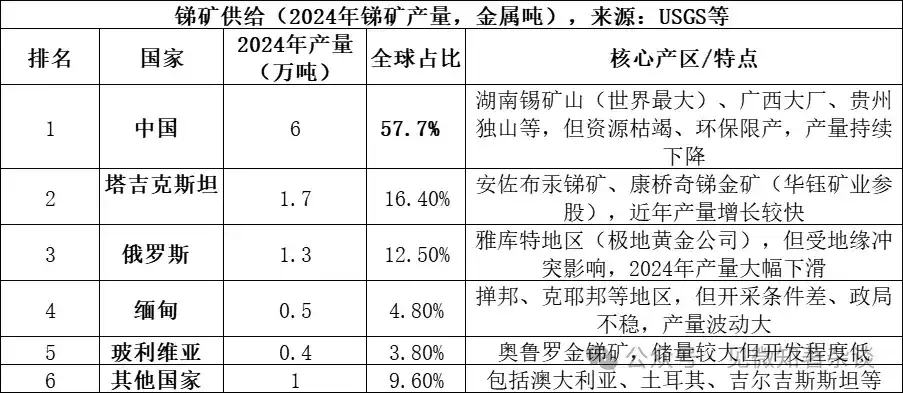
The top three producing countries (China, Tajikistan, Russia) account for 86.6% combined, indicating highly concentrated supply. Although China's production share is over half, it has significantly decreased from the 90% share in 2010, mainly due to tightened environmental policies and resource depletion.

Antimony ore associations:

Mainly found in medium-low temperature hydrothermal environments: The vast majority of economically valuable antimony deposits form under medium-low temperature hydrothermal conditions. In this environment, stibnite often precipitates along with cinnabar (mercury), pyrite, quartz, and other minerals, forming typical low-temperature hydrothermal deposits.

Characteristic associations by type: 1) In the famous Xikuangshan Antimony Mine in Hunan, stibnite is associated with pyrite, orpiment, realgar, cinnabar, calcite, quartz, etc.; 2) When antimony mineralization overlaps with gold or tungsten mineralization, higher-value complex deposits like antimony-gold-tungsten are formed.

III. Tungsten Supply Side Ore Types

The primary sources of tungsten supply are scheelite (CaWO4, calcium tungstate) and wolframite ((Fe,Mn)WO4, iron-manganese tungstate), the two main ore forms of tungsten in nature. Among them, scheelite accounts for over 70% of global tungsten resources, wolframite accounts for 25-30%. Scheelite is mostly found in skarn-type deposits, wolframite mostly in high-temperature hydrothermal quartz vein-type deposits. Both are processed through beneficiation to produce tungsten concentrate (≥65% WO3 content), which is then smelted via pyrometallurgical or hydrometallurgical methods to produce ammonium paratungstate (APT), tungsten oxide, or metallic tungsten.
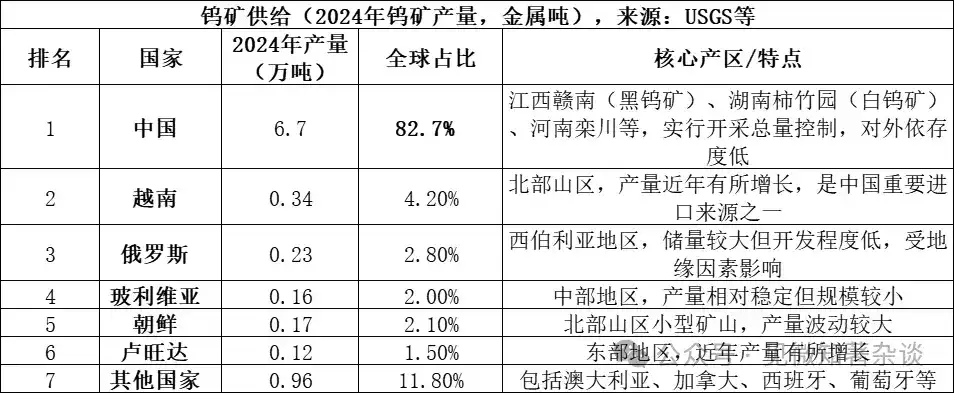
Tungsten market supply structure:

1) China dominates supply, but growth is weak: China is not only the largest tungsten producer (83% of global production) but also holds about 52% of global tungsten ore reserves. However, domestic tungsten mining is strictly managed by total control quotas. Although the 2024 mining quota was set at 114,000 tons, actual production was 127,000 tons, indicating that over-mining has been effectively controlled. Simultaneously, long-term mining has depleted high-grade ores, and the original ore grade continues to decline, constraining supply growth from the source.

2) Limited new supply overseas: In 2024, global tungsten mine production outside China was about 14,000 metal tons, from scattered sources. Important new supply mainly comes from projects like the Bakuta Tungsten Mine in Kazakhstan, but these represent a small share of global supply and are unlikely to change the China-dominated supply structure in the short term.

3) Recycled tungsten is an important supplement: Besides primary ore, recycled tungsten scrap (e.g., used hard metals) is also an important supply source. Currently, about 35% of global tungsten supply comes from recycled materials, although China's recycling rate and product quality still lag behind international advanced levels.

Tungsten ore associations:

Quartz vein-type and greisen-type deposits: These deposits are typically associated with granite intrusions. Associated minerals are very rich; besides wolframite, cassiterite, molybdenite, bismuthinite, beryl, topaz, tourmaline, etc., are common. They often occur in quartz veins at the top of granite bodies or in nearby country rock.

Skarn-type deposits: These deposits form at the contact zone between intermediate-acidic intrusive rocks and carbonate rocks (like limestone), primarily containing scheelite. Their associated mineral assemblage differs from quartz vein types, often closely associated with sulfides like chalcopyrite, galena, sphalerite, as well as molybdenite. The Shizhuyuan deposit in Chenzhou, Hunan, is a world-class example, enriching tungsten, tin, molybdenum, bismuth, beryllium, fluorite, and other resources simultaneously.

IV. Molybdenum Supply Side Ore Types

The primary source of molybdenum supply is molybdenite (MoS2, molybdenum disulfide), the main and most economically valuable molybdenum ore in nature. Molybdenite is often associated with copper, tungsten, and other metals in porphyry-type deposits. The ore is processed through beneficiation to produce molybdenum concentrate (typically requiring ≥85% MoS2 content), which is then processed through roasting or hydrometallurgical methods to produce molybdenum oxide (technical molybdenum oxide), ferromolybdenum, ammonium molybdate, and other products, used subsequently in steel alloys, chemicals, and other fields.
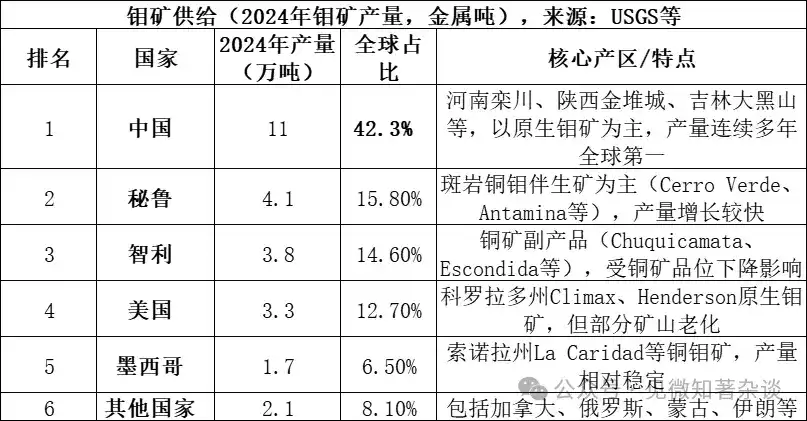
The top five producing countries (China, Peru, Chile, USA, Mexico) account for 91.9% combined, indicating highly concentrated supply; global molybdenum reserves in 2024 were about 15 million tons, with Chinese reserves at 5.9 million tons (39.3% share), and a reserve-to-production ratio of about 57 years.

China holds a triple position in the molybdenum market: "resources + production + consumption":

1) Resource Endowment Advantage: China holds nearly 40% of global molybdenum reserves (5.9 million tons in 2024), primarily primary molybdenum deposits, with large deposit scales and relatively high grades (e.g., Luanchuan molybdenum mine average grade around 0.1%), giving it a resource endowment superior to most countries.

2) Absolute Production Dominance: China's molybdenum production accounts for over 42% of the global total and has ranked first globally for many consecutive years. Unlike metals like tin or antimony, China's molybdenum industry does not rely on imports; raw material self-sufficiency exceeds 90%, differing from the tin market where China depends on imports from Myanmar.

3) Complete Industrial Chain: China possesses a complete industrial chain from mining, beneficiation, to smelting and deep processing (ferromolybdenum, molybdenum powder, molybdenum chemicals). Leading companies like China Molybdenum Co., Ltd. (CMOC) and Jinduicheng Molybdenum Co., Ltd. possess global competitiveness.

4) Consumption Market: China is also the world's largest molybdenum consumer (2024 consumption about 130,000 tons, over 45% of global total),主要用于钢铁合金 (over 70% of consumption), forming a closed-loop system of self-production and self-consumption.

5) A large portion of global molybdenum is a by-product of copper mining: The ore grades of many large porphyry copper mines are declining. Several major copper mines may reach end-of-life by the mid-2030s, which will constrain future molybdenum supply growth.

Molybdenum ore associations:

Porphyry Molybdenum / Porphyry Copper Deposits: This is the world's most important molybdenum deposit type. In porphyry copper deposits (e.g., Dexing Copper Mine), molybdenum (molybdenite) is closely associated with copper sulfides as a by-product. In porphyry molybdenum deposits (e.g., Henan's Luanchuan, Shaanxi's Jinduicheng), molybdenum is the primary product but is often associated with elements like tungsten and rhenium.

Skarn-type deposits: These deposits form at the contact zone between intermediate-acidic intrusive rocks and carbonate rocks. Here, molybdenite is often closely associated with scheelite, forming a molybdenum-tungsten combination (e.g., Hunan's Shizhuyuan deposit), and can also be associated with various metal sulfides.

Quartz vein-type and greisen-type deposits: These deposits are typically associated with granite. In wolframite-quartz veins, molybdenite is often present as an associate, along with possible bismuthinite, arsenopyrite, and other minerals.
Пов'язані питання

QWhat are the four strategic advantage minerals of China mentioned in the article, and why are they considered strategic?

AThe four strategic advantage minerals of China are tungsten, antimony, tin, and molybdenum. They are considered strategic because China possesses a combination of 'resource endowment + production advantage' in these minerals, and they are crucial for national economic security, defense security, and the development of strategic emerging industries.

QHow did the shutdown of the Wa State region in Myanmar impact the global tin market?

AThe shutdown of Myanmar's Wa State region had a massive impact because it historically supplied 4.5-5.4 million metal tons of tin annually, accounting for about 15-20% of global supply. This sudden halt created a significant supply gap, exacerbated China's reliance on imported tin ore (as Myanmar was its largest source), and became the core driver for sustained high tin prices in 2024-2025 due to the global market's existing tight supply-demand balance.

QWhat is the primary source of molybdenum supply and what type of deposits is it commonly associated with?

AThe primary source of molybdenum supply is molybdenite (MoS2). It is most commonly associated with porphyry-type deposits, where it is often found as a co-product with copper in porphyry copper deposits or as the main product in porphyry molybdenum deposits, frequently accompanied by elements like tungsten and rhenium.

QBesides China, which countries are major producers of antimony, and how concentrated is the supply?

ABesides China, the other major producers of antimony are Tajikistan and Russia. The supply is highly concentrated, with the top three producing countries (China, Tajikistan, Russia) collectively accounting for 86.6% of global production.

QWhat significant change has occurred in China's role in the global antimony market since 2010 according to the article?

AChina's dominance in the global antimony market has significantly decreased since 2010. While it still produces over half of the world's antimony, its share has fallen dramatically from a 90% production share in 2010. This decline is primarily due to tighter environmental policies and the depletion of domestic resources.

Пов'язані матеріали

Торгівля

Спот
Ф'ючерси

Популярні статті

Що таке $S$

Розуміння SPERO: Комплексний огляд Вступ до SPERO Оскільки ландшафт інновацій продовжує еволюціонувати, виникнення технологій web3 та криптовалютних проектів відіграє ключову роль у формуванні цифрового майбутнього. Один з проектів, який привернув увагу в цій динамічній сфері, — це SPERO, позначений як SPERO,$$s$. Ця стаття має на меті зібрати та представити детальну інформацію про SPERO, щоб допомогти ентузіастам та інвесторам зрозуміти його основи, цілі та інновації в рамках web3 та крипто-сектору. Що таке SPERO,$$s$? SPERO,$$s$ — це унікальний проект у криптопросторі, який прагне використати принципи децентралізації та технології блокчейн для створення екосистеми, що сприяє залученню, корисності та фінансовій інклюзії. Проект розроблений для полегшення взаємодії між користувачами новими способами, надаючи їм інноваційні фінансові рішення та послуги. У своїй основі SPERO,$$s$ прагне надати можливості індивідам, забезпечуючи інструменти та платформи, які покращують користувацький досвід у криптовалютному просторі. Це включає в себе можливість більш гнучких методів транзакцій, сприяння ініціативам, що підтримуються спільнотою, та створення шляхів для фінансових можливостей через децентралізовані додатки (dApps). Основна концепція SPERO,$$s$ обертається навколо інклюзивності, прагнучи зменшити розриви в традиційній фінансовій системі, використовуючи переваги технології блокчейн. Хто є творцем SPERO,$$s$? Особистість творця SPERO,$$s$ залишається дещо невідомою, оскільки є обмежені публічно доступні ресурси, що надають детальну інформацію про його засновників. Ця відсутність прозорості може бути наслідком зобов'язання проекту до децентралізації — етики, яку багато проектів web3 поділяють, ставлячи колективні внески вище за індивідуальне визнання. Зосереджуючи обговорення навколо спільноти та її колективних цілей, SPERO,$$s$ втілює суть наділення без виділення конкретних осіб. Таким чином, розуміння етики та місії SPERO є більш важливим, ніж ідентифікація єдиного творця. Хто є інвесторами SPERO,$$s$? SPERO,$$s$ підтримується різноманітними інвесторами, починаючи від венчурних капіталістів до ангельських інвесторів, які прагнуть сприяти інноваціям у крипто-секторі. Зосередження цих інвесторів зазвичай узгоджується з місією SPERO — пріоритет надається проектам, які обіцяють технологічний прогрес у суспільстві, фінансову інклюзію та децентралізоване управління. Ці інвесторські фонди зазвичай зацікавлені в проектах, які не лише пропонують інноваційні продукти, але й позитивно впливають на спільноту блокчейн та її екосистеми. Підтримка з боку цих інвесторів підкріплює SPERO,$$s$ як значного конкурента в швидко змінюваній сфері крипто-проектів. Як працює SPERO,$$s$? SPERO,$$s$ використовує багатогранну структуру, яка відрізняє його від традиційних криптовалютних проектів. Ось деякі ключові особливості, які підкреслюють його унікальність та інноваційність: Децентралізоване управління: SPERO,$$s$ інтегрує моделі децентралізованого управління, надаючи користувачам можливість активно брати участь у процесах прийняття рішень щодо майбутнього проекту. Цей підхід сприяє відчуттю власності та відповідальності серед членів спільноти. Корисність токена: SPERO,$$s$ використовує свій власний криптовалютний токен, розроблений для виконання різних функцій в екосистемі. Ці токени дозволяють здійснювати транзакції, отримувати винагороди та полегшувати послуги, що пропонуються на платформі, підвищуючи загальну залученість та корисність. Шарова архітектура: Технічна архітектура SPERO,$$s$ підтримує модульність та масштабованість, що дозволяє безперешкодно інтегрувати додаткові функції та додатки в міру розвитку проекту. Ця адаптивність є надзвичайно важливою для збереження актуальності в постійно змінюваному крипто-ландшафті. Залучення спільноти: Проект підкреслює ініціативи, що підтримуються спільнотою, використовуючи механізми, які стимулюють співпрацю та зворотний зв'язок. Підтримуючи сильну спільноту, SPERO,$$s$ може краще задовольняти потреби користувачів та адаптуватися до ринкових тенденцій. Фокус на інклюзію: Пропонуючи низькі комісії за транзакції та зручні інтерфейси, SPERO,$$s$ прагне залучити різноманітну базу користувачів, включаючи осіб, які раніше не брали участі в крипто-просторі. Це зобов'язання до інклюзії узгоджується з його загальною місією наділення через доступність. Хронологія SPERO,$$s$ Розуміння історії проекту надає важливі уявлення про його розвиток та етапи. Нижче наведено пропоновану хронологію, що відображає значні події в еволюції SPERO,$$s$: Етап концептуалізації та ідеації: Початкові ідеї, що стали основою SPERO,$$s$, були сформовані, тісно пов'язані з принципами децентралізації та фокусом на спільноті в індустрії блокчейн. Запуск білого паперу проекту: Після концептуального етапу був випущений комплексний білий папір, що детально описує бачення, цілі та технологічну інфраструктуру SPERO,$$s$, щоб залучити інтерес та зворотний зв'язок від спільноти. Створення спільноти та ранні залучення: Активні зусилля були спрямовані на створення спільноти ранніх прихильників та потенційних інвесторів, що полегшило обговорення цілей проекту та отримання підтримки. Подія генерації токенів: SPERO,$$s$ провів подію генерації токенів (TGE) для розподілу своїх рідних токенів серед ранніх прихильників та встановлення початкової ліквідності в екосистемі. Запуск початкового dApp: Перший децентралізований додаток (dApp), пов'язаний з SPERO,$$s$, став доступним, дозволяючи користувачам взаємодіяти з основними функціями платформи. Постійний розвиток та партнерства: Безперервні оновлення та вдосконалення пропозицій проекту, включаючи стратегічні партнерства з іншими учасниками блокчейн-простору, сформували SPERO,$$s$ у конкурентоспроможного та еволюціонуючого гравця на крипто-ринку. Висновок SPERO,$$s$ є свідченням потенціалу web3 та криптовалют для революціонізації фінансових систем та наділення індивідів. Завдяки зобов'язанню до децентралізованого управління, залучення спільноти та інноваційно спроектованих функцій, він прокладає шлях до більш інклюзивного фінансового ландшафту. Як і з будь-якими інвестиціями в швидко змінюваному крипто-просторі, потенційним інвесторам та користувачам рекомендується ретельно досліджувати та обдумано взаємодіяти з поточними подіями в SPERO,$$s$. Проект демонструє інноваційний дух крипто-індустрії, запрошуючи до подальшого дослідження його численних можливостей. Хоча подорож SPERO,$$s$ ще триває, його основні принципи можуть справді вплинути на майбутнє того, як ми взаємодіємо з технологією, фінансами та один з одним у взаємопов'язаних цифрових екосистемах.

73 переглядів усьогоОпубліковано 2024.12.17Оновлено 2024.12.17

Що таке $S$

Що таке AGENT S

Агент S: Майбутнє автономної взаємодії в Web3 Вступ У постійно змінюваному ландшафті Web3 та криптовалюти інновації постійно переосмислюють, як люди взаємодіють з цифровими платформами. Один з таких новаторських проектів, Агент S, обіцяє революціонізувати взаємодію людини з комп'ютером через свою відкриту агентну структуру. Прокладаючи шлях для автономних взаємодій, Агент S прагне спростити складні завдання, пропонуючи трансформаційні застосування в штучному інтелекті (ШІ). Це детальне дослідження заглиблюється в складності проекту, його унікальні особливості та наслідки для сфери криптовалюти. Що таке Агент S? Агент S є революційною відкритою агентною структурою, спеціально розробленою для вирішення трьох основних викликів в автоматизації комп'ютерних завдань: Набуття специфічних знань у галузі: Структура інтелектуально навчається з різних зовнішніх джерел знань та внутрішнього досвіду. Цей подвійний підхід дозволяє їй створити багатий репозиторій специфічних знань у галузі, покращуючи її продуктивність у виконанні завдань. Планування на довгих горизонтах завдань: Агент S використовує планування з підкріпленням досвіду, стратегічний підхід, який полегшує ефективний розподіл та виконання складних завдань. Ця функція значно підвищує її здатність ефективно та результативно управляти кількома підзавданнями. Обробка динамічних, неоднорідних інтерфейсів: Проект представляє Інтерфейс Агент-Комп'ютер (ACI), інноваційне рішення, яке покращує взаємодію між агентами та користувачами. Використовуючи багатомодальні великі мовні моделі (MLLMs), Агент S може безперешкодно орієнтуватися та маніпулювати різноманітними графічними інтерфейсами користувача. Завдяки цим новаторським функціям Агент S надає надійну структуру, яка вирішує складнощі, пов'язані з автоматизацією людської взаємодії з машинами, прокладаючи шлях для численних застосувань у ШІ та за його межами. Хто є творцем Агент S? Хоча концепція Агент S є фундаментально новаторською, конкретна інформація про його творця залишається невідомою. Творець наразі невідомий, що підкреслює або початкову стадію проекту, або стратегічний вибір зберегти засновників у таємниці. Незважаючи на анонімність, акцент залишається на можливостях та потенціалі структури. Хто є інвесторами Агент S? Оскільки Агент S є відносно новим у криптографічній екосистемі, детальна інформація про його інвесторів та фінансових спонсорів не задокументована. Відсутність публічно доступних відомостей про інвестиційні фонди або організації, що підтримують проект, викликає питання щодо його фінансової структури та дорожньої карти розвитку. Розуміння підтримки є критично важливим для оцінки стійкості проекту та потенційного впливу на ринок. Як працює Агент S? В основі Агент S лежить передова технологія, яка дозволяє йому ефективно функціонувати в різних умовах. Його операційна модель побудована навколо кількох ключових функцій: Взаємодія з комп'ютером, подібна до людської: Структура пропонує розширене планування ШІ, прагнучи зробити взаємодії з комп'ютерами більш інтуїтивними. Імітуючи людську поведінку при виконанні завдань, вона обіцяє підвищити досвід користувачів. Наративна пам'ять: Використовується для використання високорівневого досвіду, Агент S використовує наративну пам'ять для відстеження історій завдань, тим самим покращуючи свої процеси прийняття рішень. Епізодична пам'ять: Ця функція надає користувачам покрокові інструкції, дозволяючи структурі пропонувати контекстуальну підтримку в міру виконання завдань. Підтримка OpenACI: Завдяки можливості працювати локально, Агент S дозволяє користувачам зберігати контроль над своїми взаємодіями та робочими процесами, узгоджуючи з децентралізованою етикою Web3. Легка інтеграція з зовнішніми API: Його універсальність і сумісність з різними платформами ШІ забезпечують те, що Агент S може безперешкодно вписатися в існуючі технологічні екосистеми, роблячи його привабливим вибором для розробників та організацій. Ці функціональні можливості колективно сприяють унікальному положенню Агент S у крипто-просторі, оскільки він автоматизує складні, багатоступеневі завдання з мінімальним втручанням людини. У міру розвитку проекту його потенційні застосування в Web3 можуть переосмислити, як відбуваються цифрові взаємодії. Хронологія Агент S Розробка та етапи Агент S можуть бути узагальнені в хронології, яка підкреслює його значні події: 27 вересня 2024 року: Концепція Агент S була представлена в комплексній науковій статті під назвою “Відкрита агентна структура, яка використовує комп'ютери як людина”, що демонструє основи проекту. 10 жовтня 2024 року: Наукова стаття була опублікована на arXiv, пропонуючи детальне дослідження структури та її оцінки продуктивності на основі бенчмарку OSWorld. 12 жовтня 2024 року: Було випущено відеопрезентацію, що надає візуальне уявлення про можливості та особливості Агент S, ще більше залучаючи потенційних користувачів та інвесторів. Ці маркери в хронології не лише ілюструють прогрес Агент S, але й вказують на його прихильність до прозорості та залучення громади. Ключові моменти про Агент S У міру розвитку структури Агент S кілька ключових характеристик виділяються, підкреслюючи її новаторський характер та потенціал: Інноваційна структура: Розроблена для забезпечення інтуїтивного використання комп'ютерів, подібного до людської взаємодії, Агент S пропонує новий підхід до автоматизації завдань. Автономна взаємодія: Здатність автономно взаємодіяти з комп'ютерами через GUI означає стрибок до більш інтелектуальних та ефективних обчислювальних рішень. Автоматизація складних завдань: Завдяки своїй надійній методології він може автоматизувати складні, багатоступеневі завдання, роблячи процеси швидшими та менш схильними до помилок. Безперервне вдосконалення: Механізми навчання дозволяють Агенту S покращуватися на основі минулого досвіду, постійно підвищуючи свою продуктивність та ефективність. Універсальність: Його адаптивність до різних операційних середовищ, таких як OSWorld та WindowsAgentArena, забезпечує його здатність служити широкому спектру застосувань. Оскільки Агент S займає своє місце в ландшафті Web3 та криптовалюти, його потенціал покращити можливості взаємодії та автоматизувати процеси означає значний прогрес у технологіях ШІ. Завдяки своїй інноваційній структурі Агент S є прикладом майбутнього цифрових взаємодій, обіцяючи більш безперешкодний та ефективний досвід для користувачів у різних галузях. Висновок Агент S представляє собою сміливий крок вперед у поєднанні ШІ та Web3, з можливістю переосмислити, як ми взаємодіємо з технологією. Хоча проект все ще на ранніх стадіях, можливості для його застосування є величезними та переконливими. Завдяки своїй комплексній структурі, що вирішує критичні виклики, Агент S прагне вивести автономні взаємодії на передній план цифрового досвіду. У міру того, як ми заглиблюємося в сфери криптовалюти та децентралізації, проекти, подібні до Агент S, безсумнівно, відіграватимуть ключову роль у формуванні майбутнього технологій та співпраці людини з комп'ютером.

553 переглядів усьогоОпубліковано 2025.01.14Оновлено 2025.01.14

Що таке AGENT S

Як купити S

Ласкаво просимо до HTX.com! Ми зробили покупку Sonic (S) простою та зручною. Дотримуйтесь нашої покрокової інструкції, щоб розпочати свою криптовалютну подорож.Крок 1: Створіть обліковий запис на HTXВикористовуйте свою електронну пошту або номер телефону, щоб зареєструвати обліковий запис на HTX безплатно. Пройдіть безпроблемну реєстрацію й отримайте доступ до всіх функцій.ЗареєструватисьКрок 2: Перейдіть до розділу Купити крипту і виберіть спосіб оплатиКредитна/дебетова картка: використовуйте вашу картку Visa або Mastercard, щоб миттєво купити Sonic (S).Баланс: використовуйте кошти з балансу вашого рахунку HTX для безперешкодної торгівлі.Треті особи: ми додали популярні способи оплати, такі як Google Pay та Apple Pay, щоб підвищити зручність.P2P: Торгуйте безпосередньо з іншими користувачами на HTX.Позабіржова торгівля (OTC): ми пропонуємо індивідуальні послуги та конкурентні обмінні курси для трейдерів.Крок 3: Зберігайте свої Sonic (S)Після придбання Sonic (S) збережіть його у своєму обліковому записі на HTX. Крім того, ви можете відправити його в інше місце за допомогою блокчейн-переказу або використовувати його для торгівлі іншими криптовалютами.Крок 4: Торгівля Sonic (S)Легко торгуйте Sonic (S) на спотовому ринку HTX. Просто увійдіть до свого облікового запису, виберіть торгову пару, укладайте угоди та спостерігайте за ними в режимі реального часу. Ми пропонуємо зручний досвід як для початківців, так і для досвідчених трейдерів.

1.3k переглядів усьогоОпубліковано 2025.01.15Оновлено 2025.03.21

Як купити S

Обговорення

Ласкаво просимо до спільноти HTX. Тут ви можете бути в курсі останніх подій розвитку платформи та отримати доступ до професійної ринкової інформації. Нижче представлені думки користувачів щодо ціни S (S).

活动图片