Stuck Polymarket: The Real Test After Riding the Traffic Boom Has Arrived

Odaily星球日报Опубліковано о 2026-04-27Востаннє оновлено о 2026-04-27

Анотація

Polymarket, a leading prediction market platform, is facing significant technical challenges as its growth outpaces its current infrastructure on Polygon. Users are experiencing laggy transactions, unresponsive orders, and delayed confirmations, severely impacting the trading experience. In response, DeFi Engineering VP Josh Stevens outlined a comprehensive engineering overhaul. The plan includes reducing on-chain data delays, fixing order cancellation issues, rebuilding the central limit order book (CLOB), improving website performance, and developing a unified SDK and API. A major revelation was the ongoing "chain migration," indicating a potential move away from Polygon. The core issue is that Polymarket has evolved from a simple prediction market into a high-frequency trading platform, making Polygon's limitations—such as block space, gas fees, and block time—a ceiling for further growth. The migration is not just a simple chain switch but a fundamental rebuild of its trading system to support more complex products like perpetual contracts (Perps). This announcement has sparked competition among chains like Solana, Sui, and Algorand, all vying to host Polymarket. For Polygon, losing this key application, which contributes significantly to its gas fee revenue, would be a major setback. The real test for Polymarket is no longer attracting users but proving it can provide a stable, reliable trading environment that retains them.

Original | Odaily Planet Daily (@OdailyChina)

Author | Asher (@Asher_ 0210)
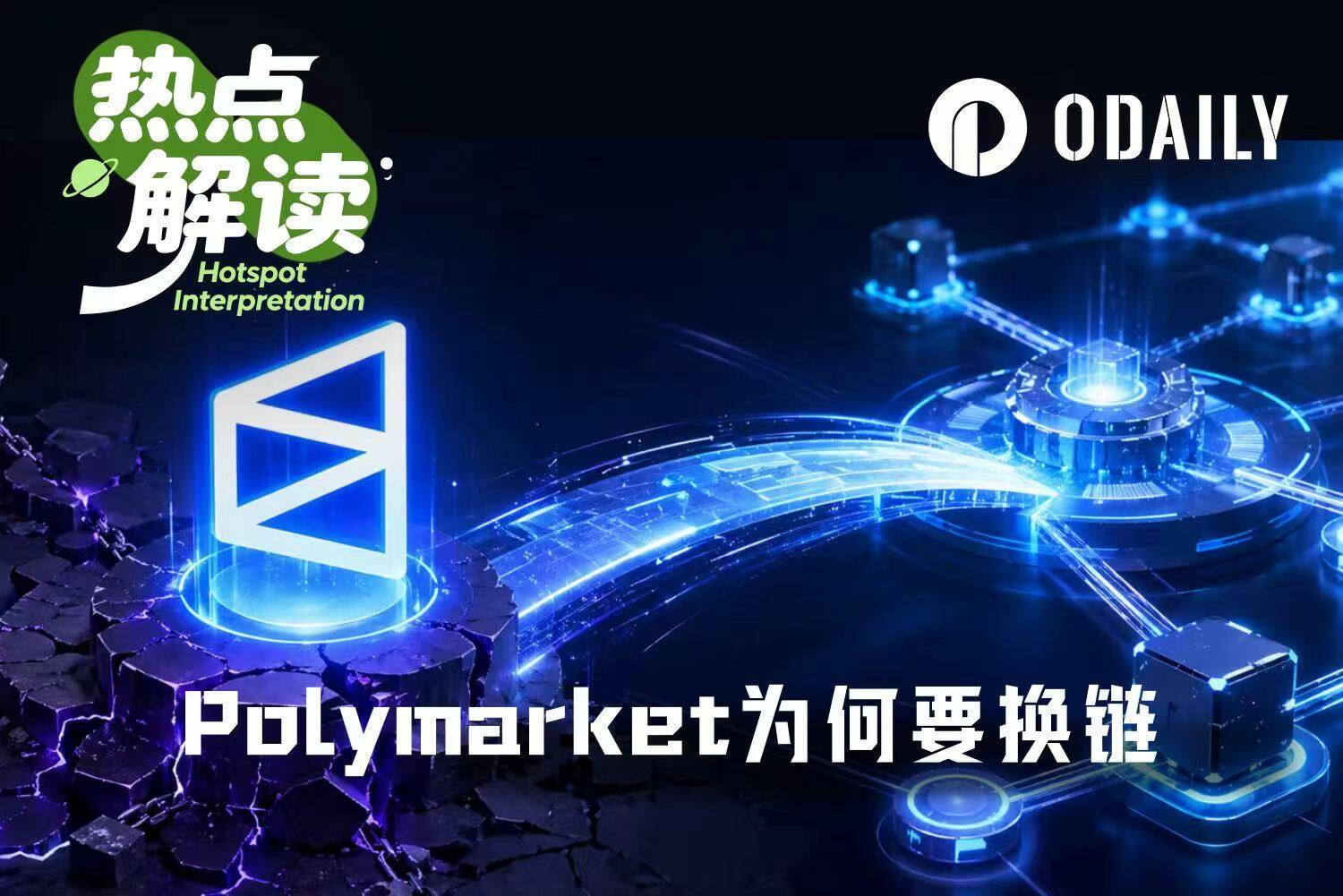
Last weekend, Josh Stevens, DeFi Engineering Vice President of Polymarket, published a lengthy post directly addressing the most pressing issue currently facing this prediction market leader: the trading experience on Polymarket has noticeably deteriorated recently.

For average users, this feeling is more direct: prices are displayed on the page, but clicking yields no response; orders are submitted but results are迟迟不来; sometimes after refreshing multiple times, they find the transaction never went through. What should be a light operation has become laggy, hesitant, and even makes users unsure if their purchase was successful.

Stevens also admitted in his post that Polymarket's growth has far exceeded the capacity of its existing infrastructure, and the team had not prepared adequately for scaling. Subsequently, he outlined a comprehensive engineering improvement plan, including reducing on-chain data latency, fixing order cancellation issues, rebuilding the CLOB, improving website performance, launching a unified SDK and API, and advancing Perps.

But what quickly captured the market's focus was one relatively short yet重磅 statement: Polymarket is advancing "chain migration." In other words, Polymarket is planning to change its blockchain.

Changing chains isn't simply moving an application from one chain to another or building a new public chain; it signifies that Polymarket is重新选择 its underlying trading environment. When a prediction market starts operating like an exchange, the underlying public chain is no longer just the background; it becomes the ceiling.

When Polygon Shifts from a Cost-Effective Option to a Growth Cap

Polymarket running on Polygon in its early days was not a wrong choice. For a prediction market still validating demand, Polygon was cheap, lightweight, and allowed users to complete transactions and settlements at low cost.

But today's Polymarket is no longer a low-frequency betting product. Users aren't just occasionally buying an event outcome; they are trading expectations in constantly changing probability prices. Prices need updating, orders need matching, positions need adjusting, settlements need keeping up. The closer the product resembles a trading platform, the harder it is to hide the problems of the underlying chain.

This is the root cause of the recent poor experience. Price delays, order cancellations, slow transaction confirmations might have been minor, occasional issues in the early stages; but when Polymarket carries higher-frequency trading behavior, these problems directly become growth bottlenecks. What trading platforms fear most isn't a lack of features, but users starting to doubt whether they can execute trades smoothly.

Therefore, the more block space, lower Gas fees, and shorter block times mentioned by Stevens aren't just technical parameters; they are the survival conditions for Polymarket's next phase. It no longer needs a chain that is "good enough," but rather a set of underlying infrastructure capable of handling trading scale.

In other words, the real reason Polymarket is considering a chain change isn't that Polygon suddenly became unusable, but that Polymarket has evolved from a prediction market application into a system closer to an exchange. Polygon has thus shifted from a cost-effective option to a growth cap.

More Than Just a Chain Change: What Polymarket Really Needs to Redo is the Trading System

If one only looks at the term "chain migration," it's easy to interpret this update as a simple chain迁移. But judging from the roadmap announced by Stevens, what Polymarket is changing is not just the underlying blockchain, but the entire trading system.

The most critical item is the rebuilding of the CLOB. The CLOB can be simply understood as the core order book system of a trading platform, responsible for accepting orders, matching trades, and forming market depth. Stevens特别强调 that CLOB V2 is not a complete rewrite and won't单独解决 performance and stability issues; what's truly important is that Polymarket is rebuilding the CLOB from scratch.

This also indicates that Polymarket clearly understands that changing chains can only improve the settlement environment; it cannot replace the upgrade of the trading system itself. If the order book, matching engine, interfaces, and risk control capabilities don't keep up, even if the underlying chain becomes faster, the user experience won't truly improve.

Hence, the other actions in this roadmap become understandable. Reducing on-chain data latency, fixing transaction cancellations, improving website performance, launching a unified SDK and a single WebSocket API are essentially not scattered patches but are补全 the fundamental capabilities a trading platform must possess.

More importantly, Perps are on the way. Stevens mentioned that Polymarket's perpetual contracts will use全新 contracts, and the backend will also be built from scratch in Rust. For Polymarket, this means what it will carry next might not just be event trading, but higher-frequency, more complex financial products closer to those on exchanges.

Therefore, the chain change is only the most visible step in this reconstruction. The real change is that Polymarket is moving from a prediction market application towards a set of trading infrastructure. What it needs to solve next isn't just "which chain to run on," but "whether it can operate as stably as an exchange."

Polymarket Hasn't Decided Its Destination Yet, But Public Chains Have Already Started the Competition

Polymarket merely mentioned "chain migration," but the competition surrounding it has already begun.

After Stevens' post, multiple public chains including Solana, Sui, Algorand, MegaETH, and Sonic have extended olive branches. The keywords they emphasize are almost identical: lower fees, faster confirmations, higher performance, and an underlying environment more suitable for trading scenarios.

For any chain, Polymarket is not an ordinary application; it already has real users, real trading volume, and real market influence. Being able to host Polymarket would bring not only on-chain activity but also a benchmark case that can prove the chain's infrastructure capabilities to the market.

The pressure is especially direct for Polygon. Polymarket has long been one of the most important applications in the Polygon ecosystem. Recent market statistics show that Polymarket contributes millions of dollars in weekly Gas fees to Polygon, accounting for even more than half of Polygon's transaction fee income in some periods. In other words, Polymarket is not a "nice-to-have" ecosystem application but a significant source of on-chain revenue and real usage scenarios for Polygon.

Therefore, Polygon cannot afford not to be concerned. Faced with the signal of a potential chain change from Polymarket, Polygon has stated that it is still working with Polymarket to address the pain points and has not received formal migration notice. This statement, on one hand, aims to stabilize market sentiment, and on the other hand, indicates that Polygon does not want to lose one of the most important applications in its ecosystem.

However, the issue is that what Polymarket might need now is no longer just "optimizing the experience a bit." More block space, lower Gas, shorter block times—these demands point towards a重新选择 of the underlying trading environment. Polygon certainly still wants to keep Polymarket, but while other public chains are competing for it with performance, cost, and customization capabilities, Polymarket has already gained the leverage to重新选择 its underlying public chain.

After Scale Comes the Real Test for Polymarket

For Polymarket, having reached this point, the most difficult phase is just beginning. In the early growth stages of a product, the market discusses whether there is demand; when it truly achieves scale, growth pushes all the hidden backend problems to the forefront. Trading delays, order cancellations, settlement issues—in the short term, they affect the experience of a single order; in the long term, they erode users' patience to continue trading on the platform.

Therefore, what truly matters in this chain change isn't which chain Polymarket ultimately chooses, but whether it can transform the post-growth pressure into more stable trading capabilities. In the past, it proved that prediction markets can attract enough people; next, it needs to prove that when users truly start trading frequently and consistently, the system can still stably handle it. The first half of the prediction market is about bringing people in; the second half is about making those who stay dare to keep trading.


Пов'язані питання

QWhat is the main issue currently facing Polymarket according to the article?

APolymarket is experiencing significantly degraded trading performance, including price delays, unresponsive orders, and failed transactions, due to its infrastructure being unable to handle its recent growth.

QWhat major technical change is Polymarket considering to address its scaling problems?

APolymarket is considering a 'chain migration,' meaning it is evaluating a move to a different underlying blockchain to gain more block space, lower gas fees, and shorter block times.

QBeyond a potential chain migration, what core system is Polymarket rebuilding?

APolymarket is rebuilding its Central Limit Order Book (CLOB), which is the core system responsible for handling orders and matching trades, to create a more robust trading infrastructure.

QWhy was Polygon initially a good choice for Polymarket, and why is it now a limitation?

APolygon was initially a good choice because it was cheap and lightweight, suitable for validating demand. It is now a limitation because Polymarket has evolved into a high-frequency trading platform, and Polygon's infrastructure has become a ceiling for its growth, unable to support the required transaction scale and speed.

QWhich blockchain projects have expressed interest in attracting Polymarket for its potential migration?

ASeveral blockchain projects, including Solana, Sui, Algorand, MegaETH, and Sonic, have expressed interest and highlighted their lower fees, faster confirmations, and higher performance as being suitable for Polymarket's trading needs.

Пов'язані матеріали

Has Hook Summer Really Arrived? sato, Lo0p, FLOOD Ignite the New Narrative of Uniswap v4

"Hook Summer" Arrives? Sato, Lo0p, FLOOD Ignite Uniswap v4 Narrative Amidst a slight market recovery, attention within the Ethereum ecosystem has shifted to Meme coins built on Uniswap v4's Hook protocol. Following ASTEROID, tokens like sato, sat1, Lo0p, and FLOOD have become market focal points, with market caps ranging from millions to tens of millions, bringing concentrated liquidity to a narrative-dry market. Uniswap v4 Hooks are "plugin smart contracts" that allow developers to inject custom logic at key points in a liquidity pool's lifecycle (initialization, adding/removing liquidity, swaps, etc.), making the AMM programmable. Recent representative projects include: * **sato**: Market cap peaked over $38M; uses a v4 curve mechanism for minting/burning, locking ETH as reserve. * **sat1**: Market cap briefly exceeded $10M, positioning as an "optimized sato," but later declined significantly. * **Lo0p**: Market cap neared $6.6M; a "lending AMM protocol" allowing users to borrow ETH against deposited LO0P tokens without immediate selling pressure. * **FLOOD**: Market cap approached $6M; channels trading reserves into Aave v3 to generate yield, which is retained in the pool. The emergence of these Hook-based tokens could drive long-term growth for the Uniswap ecosystem by attracting users and liquidity to v4 pools. Combined with Uniswap's activated fee switch (partially used to burn UNI), the long-term outlook for UNI appears positive. However, short-term UNI price appreciation is not directly guaranteed. Factors include the sustainability and lifecycle of these new tokens, their price volatility, overall market conditions, and regulatory pressures. Currently, Uniswap v4's TVL ($595M) lags behind v3 and v2, indicating Hook adoption still requires time to mature. In summary, the Hook ecosystem serves as "long-term nourishment" for UNI, but acts more as a "catalyst" than a direct "booster" in the short term. Note: These are early-stage experimental tokens and may carry unknown risks.

marsbit21 хв тому

Has Hook Summer Really Arrived? sato, Lo0p, FLOOD Ignite the New Narrative of Uniswap v4

marsbit21 хв тому

Has Hook Summer Truly Arrived? sato, Lo0p, FLOOD Ignite the New Uniswap v4 Narrative

With the broader market showing signs of recovery, a new wave of interest has emerged around Ethereum-based meme coins. Following ASTEROID, tokens like sato, sat1, Lo0p, and FLOOD, built upon the Uniswap v4 Hook protocol, are capturing market attention. Their market capitalizations range from millions to tens of millions of dollars, injecting much-needed focused liquidity into a market lacking narratives. This article explores whether this trend signifies an incoming "Hook Summer" and its potential impact on UNI's price. Hooks are essentially plug-in smart contracts for Uniswap v4 liquidity pools, allowing developers to inject custom logic at key points in a pool's lifecycle (like initialization, adding/removing liquidity, swaps). This transforms the AMM into programmable building blocks. Key highlighted projects include: * **sato**: Peaked over $38M market cap. It utilizes a v4 curve for minting/burning; buying locks ETH as reserve to mint new tokens, while selling redeems ETH from the reserve and burns tokens. * **sat1**: Market cap briefly exceeded $10M, promoted as an "optimized sato," but later declined significantly. * **Lo0p**: Reached nearly $6.6M. It's a lending AMM protocol where buying LO0P tokens locks them as collateral, allowing users to borrow ETH from the pool reserve at 40% LTV, aiming to improve capital efficiency for idle ETH in LPs. * **FLOOD**: Peaked near $6M. Its mechanism directs asset reserves from buys into Aave v3 to generate yield, with fees and interest retained in the pool to potentially influence the token's price long-term. In the long term, the development of the Hook ecosystem can attract users and liquidity to Uniswap v4, benefiting UNI's fundamentals—especially combined with the recent activation of the protocol fee switch, where a portion of fees is used to burn UNI. However, in the short term, these Hook-based tokens are unlikely to directly drive significant UNI price appreciation. Their impact is moderated by factors like token sustainability, price volatility, and broader market and regulatory conditions. Currently, Uniswap v4's TVL ($595M) still trails behind v2 and v3, indicating adoption and growth will take time. The article concludes that while the Hook ecosystem provides long-term "nourishment" for UNI, its short-term role is more of a "catalyst" than a "booster." Readers are cautioned that these are early-stage experimental tokens and may carry unknown risks.

Odaily星球日报33 хв тому

Has Hook Summer Truly Arrived? sato, Lo0p, FLOOD Ignite the New Uniswap v4 Narrative

Odaily星球日报33 хв тому

Interview with Michael Saylor: I Did Say I Would Sell Bitcoin, But Never a Net Sale

Interview with Michael Saylor: I Said We'd Sell Bitcoin, But Never Be a Net Seller In a recent podcast, MicroStrategy Executive Chairman Michael Saylor clarified the company's stance on potentially selling Bitcoin. Following MicroStrategy's earnings call statement about being prepared to sell BTC to fund dividends for its STRC (Strategic) credit product, Saylor emphasized the distinction between selling and being a "net seller." Saylor explained the core business model: MicroStrategy sells credit instruments like STRC and uses the proceeds to buy Bitcoin, which is viewed as "digital capital" expected to appreciate around 30-40% annually. A portion of these capital gains can then be used to pay the dividends on the credit products. He stressed that even if the company sells some Bitcoin for dividends, it simultaneously buys much more with new credit issuance. For example, after raising $3.2 billion from STRC sales in April, the dividend obligation was only $80-90 million, making the company a net buyer. The clarification aims to counter market narratives questioning the value of Bitcoin on MicroStrategy's balance sheet if it were never sold, and to dismiss claims of a "Ponzi scheme." Saylor reiterated his personal philosophy for investors: "Don't be a net seller of bitcoin" and ensure your Bitcoin holdings increase each year. Saylor also discussed Bitcoin's role as the foundation for "digital credit," noting that STRC has become the largest and most liquid preferred stock issue in the U.S., offering high risk-adjusted returns (Sharpe ratio). He highlighted Bitcoin's deep liquidity, stating that even large purchases by MicroStrategy do not move the market significantly, which is driven by macro factors, geopolitical tensions, and capital flows from ETFs and credit products. Finally, Saylor reflected on his early inspiration from sci-fi books, which motivated his path to MIT, and maintained his fundamental thesis on Bitcoin remains unchanged: it is superior digital capital enabling superior digital credit.

链捕手38 хв тому

Interview with Michael Saylor: I Did Say I Would Sell Bitcoin, But Never a Net Sale

链捕手38 хв тому

Торгівля

Спот
Ф'ючерси
活动图片