Strategy raised $730M in 2 weeks and bought 0 Bitcoin – The market is asking why

ambcryptoОпубліковано о 2026-07-21Востаннє оновлено о 2026-07-21

Анотація

Strategy, a company known for its Bitcoin accumulation strategy, has raised $730 million in two weeks but has not purchased any Bitcoin, instead adding $225 million to its cash reserves, bringing its total cash holdings to $3.2 billion. This marks a second consecutive week of no Bitcoin purchases, deviating from its long-standing playbook of raising capital to buy BTC. The market is questioning this strategic shift, speculating whether it's a deliberate pause to strengthen the balance sheet and await better conditions or a forced move due to market constraints. A key factor is Strategy's STRC index, which remains below the critical $100 level, limiting its ability to raise fresh capital for Bitcoin purchases via its ATM program. This pause in Bitcoin accumulation has put both MSTR stock and the STRC index under increased scrutiny, with investors debating if the company is now at the mercy of market conditions.

Usually, a growing cash pile is considered a bullish signal for a public company.

In Strategy’s case, its decision to add another $225 million to its USD holdings, bringing total cash reserves to $3.2 billion, should have been a positive signal for shareholders.

The logic is straightforward: the more cash Strategy has on hand, the greater its capacity to deploy capital, whether that’s buying more Bitcoin or funding other strategic initiatives.

Notably, this is where Strategy’s STRC index comes into play. Technically, despite gaining 2.12% this week, STRC is still trading nearly 15% below the key $100 level.

As long as it stays below that mark, Strategy’s ability to raise fresh capital through its ATM program for additional Bitcoin purchases remains constrained.
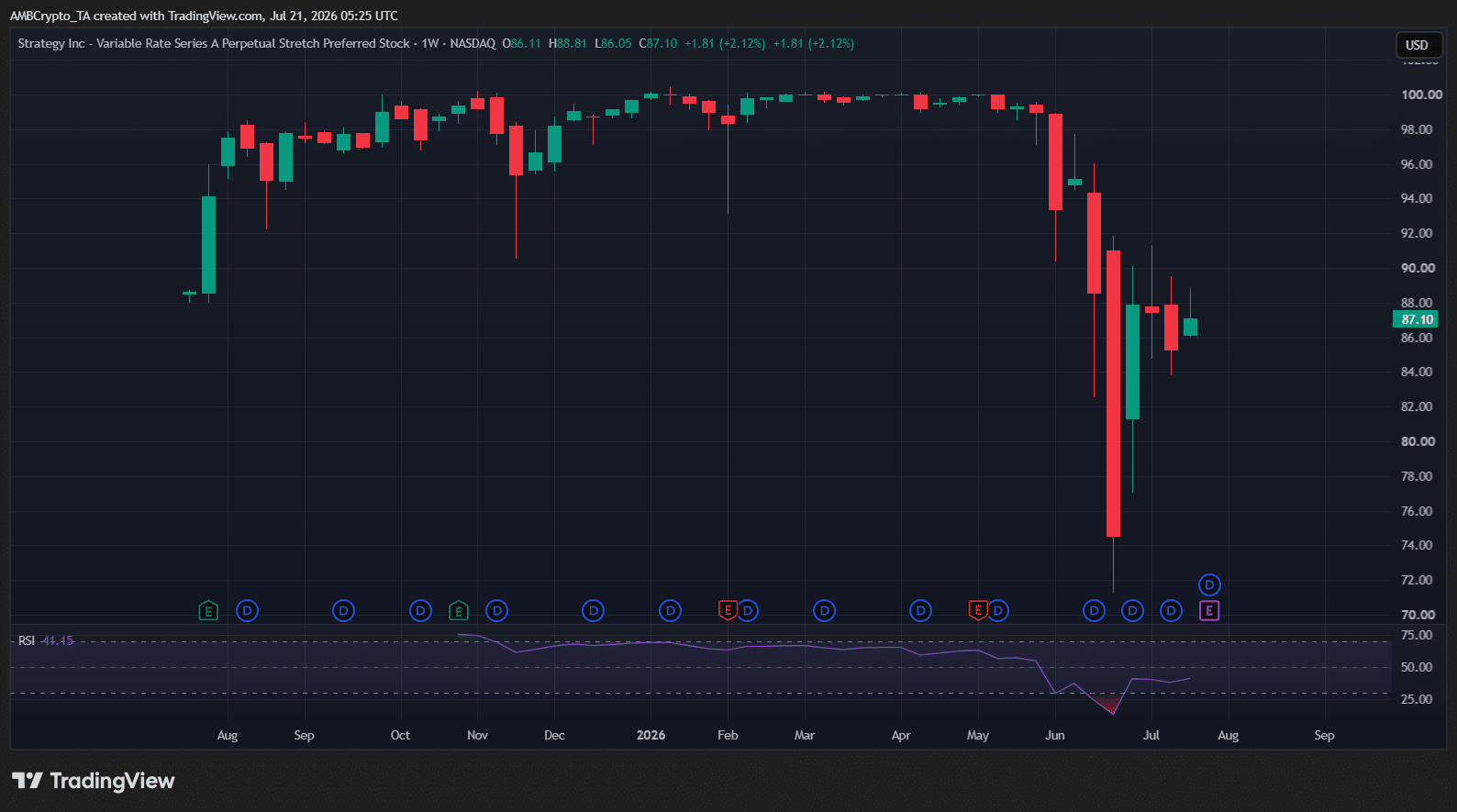
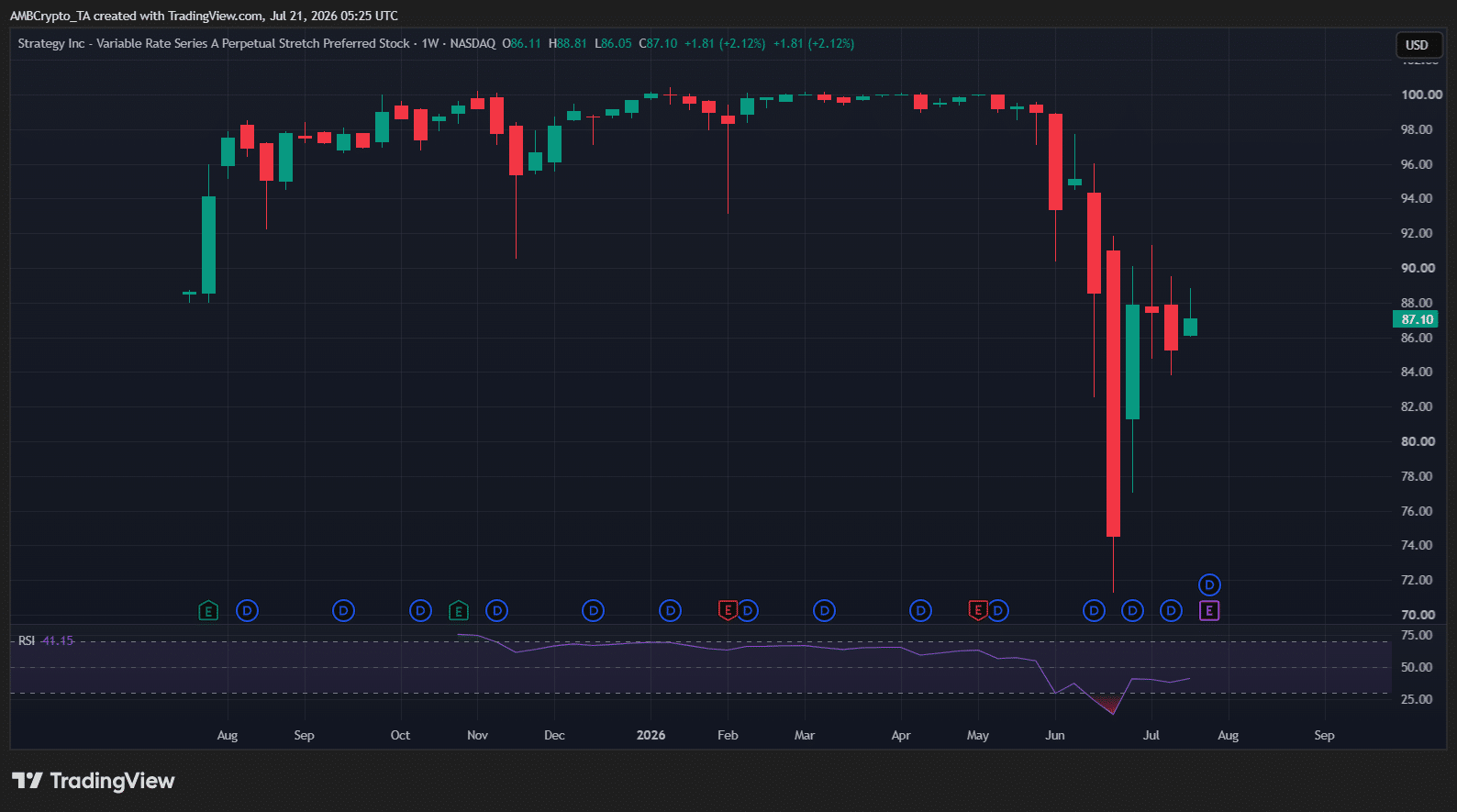
Source: TradingView (STRC/USD)

Against this backdrop, MSTR’s decision to increase its USD reserves could be less about preparing for an immediate BTC purchase and more about reinforcing confidence in STRC.

With $3.2 billion in cash (enough to cover 22 months of dividends), the market thinks Strategy has built a sizable liquidity buffer.

If this is the strategy, it could be a signal that Strategy is prioritizing balance sheet strength and liquidity stability while waiting for better conditions to resume aggressive Bitcoin accumulation.

That said, this move hasn’t escaped market scrutiny. While it looks like a strategic pause, investors are increasingly questioning why Strategy keeps raising capital without adding to its Bitcoin [BTC] stack, raising the question: Is Strategy now at the mercy of the market?

Bitcoin’s strategy under the spotlight

Strategy has officially skipped its Bitcoin purchase for the second consecutive week.

For years, the playbook was simple – raise capital, buy BTC, and announce the purchase on Monday. Last week, Strategy raised $263 million by selling its own stock but didn’t buy a single Bitcoin.

The week before, it raised another $467 million, and again, no BTC purchase. Instead, the company has built its cash reserves.

Why does this matter? For the market, raising capital without buying BTC is starting to look like a break from Strategy’s long-standing playbook. Critics argue MSTR shareholders continue to face dilution while Bitcoin accumulation has stalled, putting both MSTR and STRC under greater scrutiny.

As a result, investors are beginning to question whether Strategy is deliberately preserving liquidity as part of its Bitcoin bet.
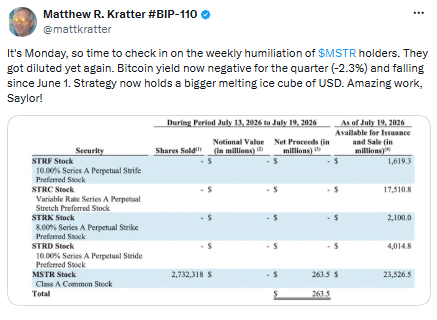
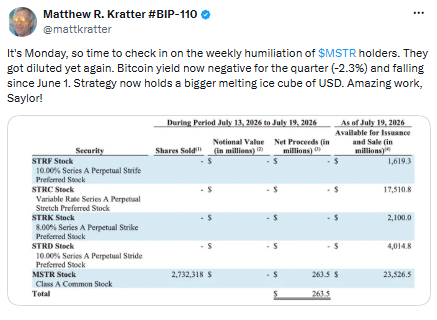
Source: X

Or whether current market conditions are simply forcing its hand.

Either way, the latest $225 million addition to Strategy’s cash reserves has added to the uncertainty surrounding both MSTR and STRC.

If Strategy’s Bitcoin buying is becoming increasingly market-driven, it could mark a key shift in Bitcoin’s H2 narrative as risk-off sentiment continues to dominate.


Final Summary

  • Strategy added another $225 million to its cash reserves instead of buying Bitcoin.
  • The move has sparked a debate about the company’s next move.

Пов'язані питання

QWhy has Strategy's decision to raise $730 million and not buy Bitcoin sparked market scrutiny?

AStrategy's decision has sparked scrutiny because it breaks from its long-standing playbook of raising capital and immediately buying Bitcoin. This pause in accumulation, combined with shareholder dilution from stock sales, leads investors to question the company's strategy and whether it is prioritizing liquidity over aggressive Bitcoin acquisition.

QWhat is the significance of the STRC index trading below the $100 level for Strategy?

AAs long as the STRC index trades below the key $100 level, Strategy's ability to raise fresh capital through its At-The-Market (ATM) stock offering program for additional Bitcoin purchases remains constrained. This technical factor limits one of its primary fundraising mechanisms for buying more BTC.

QAccording to the article, what are the two possible interpretations of Strategy building its cash reserves instead of buying Bitcoin?

AThe two interpretations are: 1) Strategy is deliberately preserving liquidity, prioritizing balance sheet strength and stability while waiting for better market conditions to resume aggressive Bitcoin buying. 2) Current market conditions, possibly risk-off sentiment and the STRC price level, are simply forcing its hand, making it more market-driven than strategic.

QHow much cash does Strategy now hold, and what does the market think this large reserve represents?

AStrategy now holds $3.2 billion in cash reserves. The market views this as a sizable liquidity buffer, enough to cover 22 months of dividends, which could reinforce confidence in the STRC index while the company awaits favorable conditions.

QWhat key shift in Bitcoin's H2 (second half of the year) narrative could Strategy's actions signal?

AIf Strategy's Bitcoin buying is becoming increasingly dependent on or reactive to market conditions (like the STRC price), it could mark a key shift in Bitcoin's H2 narrative towards one dominated by risk-off sentiment and market-driven corporate strategies, rather than aggressive, consistent accumulation regardless of price.

Пов'язані матеріали

In Jinjiang, Fujian, a Storage Super Unicorn Lies Quiet

In Fujian's Jinjiang, a city known for sportswear, lies a quiet semiconductor giant: Fujian Jinhua Integrated Circuit Co. (JHICC). Once a promising domestic DRAM manufacturer alongside Yangtze Memory and ChangXin Memory Technologies (CXMT), its journey was derailed in 2018 when the U.S. placed it on an Entity List and filed criminal charges for alleged trade secret theft. This halted production for years. A turning point came in February 2024 when a U.S. federal court found JHICC not guilty. However, it had lost crucial time. While CXMT soared to become a top-valued A-share company in 2024, JHICC, with an estimated valuation of 80 billion RMB, was just restarting. Its current output is primarily customized DDR4 chips, not the advanced DDR5/HBM demanded for AI, but it still benefits from the broader memory chip upcycle. JHICC's story is tied to Chen Zhengkun, a veteran engineer who left Micron to lead the venture. Founded in 2016 with state-backed funding, JHICC partnered with Taiwan's UMC to develop DRAM technology. Rapid progress was cut short by the U.S. actions, which Micron initiated, partly due to its heavy reliance on the Chinese market. Post-sanctions, Chen's team worked to rebuild the production line with reduced reliance on U.S. technology. According to its records, JHICC achieved small-scale production and revenue growth under immense pressure. It now focuses on the stable "niche" DRAM market (e.g., TVs, routers) with a monthly capacity of ~40,000 wafers, aiming for 60,000 by 2026. It holds over 1,000 patents but remains on the Entity List. For Jinjiang, investing in JHICC was a bold industrial leap. The local government provided unwavering financial and logistical support during the crisis, helping the company survive. JHICC has become the anchor for a growing local semiconductor cluster. Though its scale lags behind domestic peers, JHICC's persistence symbolizes a hard-won foothold in a global market long dominated by Samsung, SK Hynix, and Micron. Having missed one boom, it seeks a place in the new AI-driven memory supercycle.

marsbit2 год тому

In Jinjiang, Fujian, a Storage Super Unicorn Lies Quiet

marsbit2 год тому

Торгівля

Спот
活动图片





