Strategy Maintains Nasdaq 100 Spot Despite MSCI Drama — Details

bitcoinistОпубліковано о 2025-12-14Востаннє оновлено о 2025-12-14

Анотація

Strategy (formerly MicroStrategy) has retained its position in the Nasdaq 100 index following its latest annual reshuffle, despite the risk of potential exclusion from MSCI’s indexes. The company, the largest corporate holder of Bitcoin, survived the rebalancing while several other firms were added or removed. However, MSTR’s stock price has declined nearly 25% over the past month. Amid these developments, global index provider MSCI is considering excluding companies with significant crypto holdings from its indices. In response, Strategy’s leadership has engaged with MSCI, arguing that the firm is not merely a passive Bitcoin holder but an active software company with a strategic financial approach. They support consistent eligibility criteria but oppose MSCI’s proposal to delist firms with over 50% digital asset exposure. Analysts warn that such a move could result in significant outflows for Strategy.

Strategy (formerly MicroStrategy) has kept its place in the Nasdaq 100 during this year’s reshuffling—its first since joining the index in a similar event last December. This comes as a piece of good news as the Bitcoin corporate buyer contends with the risk of possible exclusion from Morgan Stanley Capital International (MSCI)’s indexes.

MSTR Survives First Nasdaq 100 Reshuffling

On Friday, December 12, Reuters revealed that Strategy (with the ticker MSTR), the largest corporate holder of Bitcoin, survived its first Nasdaq 100 rebalancing since joining the index. As its name suggests, the Nasdaq 100 tracks the performance of 100 of the largest non-financial companies listed on the Nasdaq stock exchange.

According to the report, this reshuffling saw Biogen, CDW, GlobalFoundries, Lululemon, On Semiconductor, and Trade Desk lose their places in the index. At the same time, Alnylam Pharmaceuticals, Ferrovial, Insmed, Monolithic Power Systems, Seagate, and Western Digital made it into the Nasdaq 100.

These changes to the Nasdaq 100 index are expected to come into effect on Monday, December 22.

Despite the positive nature of this development, the MSTR price closed the day on a nearly 4% decline, which has been the theme for the stock as of late. According to the latest market data, the Strategy stock is down by almost 25% in the past month.

Strategy Urges MSCI To Reconsider Index Criteria

Furthermore, this positive event comes at a time when other index providers are reevaluating their inclusion criteria. As Bitcoinist earlier reported, global index provider MSCI stated that it is considering the exclusion of companies with business models that focus heavily on holding crypto assets.

However, Strategy’s cofounder and chairman, Michael Saylor, stated that his firm is not merely a passive Bitcoin holding entity but rather a software firm with a proactive financial strategy. According to Saylor, the firm is in discussions with MSCI regarding its plans to exclude companies whose crypto holdings exceed 50% of total assets from its indices.

In a recent letter endorsed by Saylor and CEO Phong Le, Strategy voiced its support for MSCI’s intentions to establish consistent eligibility criteria across its indices. Nevertheless, the firm urged MSCI to reconsider its plan to delist companies with over 50% digital asset holdings from its Global Investable Market Indexes.

While Saylor has countered their evaluation, saying an exclusion “won’t make any difference,” JP Morgan analysts estimate that Strategy alone might face outflows of up to $2.8 billion as a direct consequence of MSCI’s decision.

The price of MSTR on a daily timeframe | Source: MSTR chart on TradingView


Пов'язані питання

QWhat is the main reason Strategy (MSTR) remained in the Nasdaq 100 index during the recent reshuffling?

AStrategy maintained its place in the Nasdaq 100 because it met the index's criteria as one of the largest non-financial companies on the Nasdaq exchange, despite other companies being removed.

QWhich companies were removed from the Nasdaq 100 index in the reshuffling mentioned in the article?

ABiogen, CDW, GlobalFoundries, Lululemon, On Semiconductor, and Trade Desk were removed from the Nasdaq 100 index.

QWhat risk is Strategy currently facing from MSCI, and how is the company responding?

AStrategy faces potential exclusion from MSCI indexes due to its significant Bitcoin holdings. The company is urging MSCI to reconsider its criteria, arguing it is a software firm with a proactive financial strategy, not just a passive crypto holder.

QWhat financial impact does JP Morgan analysts predict for Strategy if MSCI excludes it from its indexes?

AJP Morgan analysts estimate that Strategy could face outflows of up to $2.8 billion if MSCI excludes it from its indexes.

QHow has Strategy's stock performance been recently, according to the article?

AStrategy's stock has declined nearly 25% in the past month, closing nearly 4% down on the day the reshuffling news was announced.

Пов'язані матеріали

$120 Million Vanishes Overnight! Crypto's 'Steadiest Giant' Stumbles in South America

Summary: Tether's $120 million Bitcoin mining venture in Uruguay, initiated in May 2023, was abruptly shut down in July 2025 when the national power utility UTE cut off electricity. The project, developed in partnership with local firm Microfin in Florida province, was touted as a model for leveraging the country's nearly 98% renewable energy grid. The collapse stemmed from a fundamental contract dispute over electricity supply. Tether interpreted the agreed power volume as a "minimum guaranteed supply," expecting to request more as the mining operation expanded. UTE, however, viewed it as a "strict maximum cap." This disagreement led to frequent power curtailments for the 24/7 mining facility, causing significant revenue loss from lost computing power. Following the 2025 election of left-wing President Yamandú Orsi and a management change at UTE, negotiations broke down. Microfin stopped paying electricity bills in May 2025, formally notified UTE of contract termination in June, and did not attend a final meeting where UTE presented a revised contract. By the July 25 power cut, Microfin's debt approached $5 million. The operation ceased, laying off 30 of its 38 local staff, with all outstanding debts settled by December 2025. The failure highlights key risks for heavy-asset overseas investments: Uruguay's green energy proved not to be cheap energy, especially after the 2024 Bitcoin halving squeezed industry profits. Furthermore, political changes can swiftly alter utility company policies, undermining the long-term regulatory stability critical for such projects. While financially absorbable for Tether, the incident underscores that operational success depends on unambiguous contracts and genuine cost advantages, not just technological scale.

marsbit9 хв тому

$120 Million Vanishes Overnight! Crypto's 'Steadiest Giant' Stumbles in South America

marsbit9 хв тому

Is Bitcoin Price Lagging? Record Global M2 Money Supply Could Be a Springboard for BTC's Rise

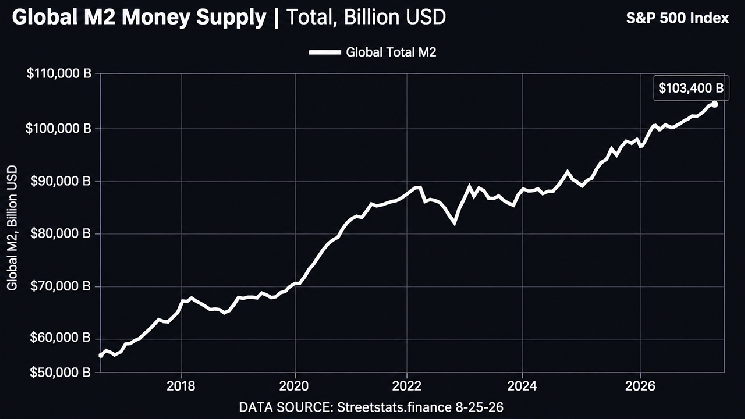
Bitcoin Price Lagging? Record Global Money Supply M2 Could Springboard BTC Growth The global money supply (M2) is expanding rapidly, similar to global debt. The US M2, representing all money circulating in its economy, has reached a record $23.16 trillion. Combined with figures from major economies like the Eurozone, China, and Japan, the global M2 is approximately $103 trillion. Some estimates, however, place it closer to $195 trillion. This surge in liquidity is significant because excess capital often seeks higher returns in assets like precious metals, stocks, and cryptocurrencies. Bitcoin's recent price surge above $81,000 has brought the global M2 metric back into focus. Following a sharp rise in early August after a US Treasury bond buyback announcement, BTC still trades about 37% below its October 2025 all-time high exceeding $126,000. This gap presents a potential "catch-up" trade thesis. Bitcoin's fixed supply of 21 million contrasts with governments' ability to print fiat currency, making scarce assets like BTC attractive if monetary expansion continues. Historically, Bitcoin's bull cycles in 2017-2018 and 2020-2021 coincided with M2 expansion and increased liquidity. Over the past year, the correlation seemed broken as M2 grew while Bitcoin's price fell sharply from its peak. Observers believe fresh dollars may have remained locked in cash-favorable investments. Some, like Ash Crypto, now suggest a long-awaited alignment between Bitcoin and M2 may be starting, especially as a weakening US Dollar Index this month has seen assets like gold and Bitcoin surge. A softer dollar pressures cash havens and prompts holders to act. While record M2 doesn't guarantee higher Bitcoin prices, a sustained influx of liquidity, a weak dollar, and capital flowing into alternative assets could trigger a catch-up rally sooner than expected. However, changes in these conditions could lead to the opposite outcome.

cryptonews.ru34 хв тому

Is Bitcoin Price Lagging? Record Global M2 Money Supply Could Be a Springboard for BTC's Rise

cryptonews.ru34 хв тому

Blockchain Capital Partner: Tokenization Will Reshape the Underlying Structure of Capital Markets

"Blockchain Capital partner Aleks Larsen argues that tokenization will fundamentally restructure capital markets by solving a costly 'packaging' problem in finance. Currently, assets like mortgages, private equity, and stocks exist in fragmented, incompatible systems, creating huge friction and slowing capital flow. Tokenization introduces a standardized, machine-readable interface for assets—akin to shipping containers for finance. Just as containerization standardized global trade, enabling massive efficiency gains and economic growth, tokens standardize financial rights. This allows platforms, lenders, and custodians to interact with assets directly on a shared network without rebuilding infrastructure for each one. Stablecoins demonstrate this potential, processing volumes rivaling Visa with far lower cost and faster settlement. Beyond payments, tokenization is expanding to assets like U.S. Treasuries, commodities, and private credit, now totaling nearly $400 billion on-chain. This shift changes financial service access: instead of depending on relationships with institutions, services become accessible based on the asset's tokenized properties themselves. DeFi protocols like Aave exemplify this, where assets meeting criteria can be used as collateral programmatically. Ultimately, tokenization will reorganize capital markets around open networks of specialized services, lowering barriers to entry and reducing costs. This could unlock global capital for currently underserved assets—small receivables, regional infrastructure, emerging market credit—integrating them into a seamless, programmable financial system. Combined with AI, tokenization promises to make capital allocation more efficient, transparent, and globally accessible, reshaping how economic value is created and distributed."

marsbit38 хв тому

Blockchain Capital Partner: Tokenization Will Reshape the Underlying Structure of Capital Markets

marsbit38 хв тому

Торгівля

Спот
活动图片