Story Co-Founder Defends Token Unlock Delays; Why Long-Term Scaling Matters For $MAXI

bitcoinistОпубліковано о 2026-02-09Востаннє оновлено о 2026-02-09

Анотація

Story Protocol co-founder S.Y. Lee defends delayed token unlocks, arguing that extended vesting periods prevent premature sell pressure and support long-term protocol development. This approach prioritizes sustainable growth over short-term liquidity. Similarly, meme coin project Maxi Doge ($MAXI) emphasizes high-conviction holding through staking rewards, a 'Leverage King' culture, and planned utility features. Having raised over $4.5M in presale, it aims to build a resilient, engaged community by incentivizing long-term participation and reducing launch-day sell pressure.

In a market sector often defined by impatience and ‘up-only’ demands, Story Protocol co-founder S.Y. Lee has taken a contrarian stance: slower is better. Addressing the recent controversy surrounding delayed token unlocks, Lee defended the decision to extend vesting cliffs.

His argument? Premature liquidity often strangles protocol development before it achieves escape velocity. In a recent interview with CoinDesk, Lee pointed to Worldcoin’s extended lockups as a successful precedent, suggesting that longer runways prevent the rampant sell pressure that historically capsizes early-stage infrastructure projects.

That signals a fundamental shift in how crypto capital creates value. The era of ‘fair launch’ farming, where liquidity is mercenary and fleeting, is giving way to high-conviction retention models. Lee’s defense highlights a crucial friction point: retail traders want immediate access, but sustainable ecosystems require entrenched capital. By prioritizing long-term alignment over short-term liquidity events, Story is betting that patience pays a higher yield than speed.

This pivot toward strength accumulation rather than quick exits isn’t isolated to infrastructure layers. It’s beginning to permeate the high-octane world of meme coins, where community conviction is the only true fundamental. While Story locks up tokens to build IP rails, a new contender, Maxi Doge, is locking in value through a culture of ‘1000x leverage’ mentality and heavy staking incentives.

Just as Story demands patience for protocol health, Maxi Doge ($MAXI) demands grit for portfolio health, positioning itself as the counter-narrative to low-effort, low-reward trading.

Maxi Doge Brings ‘Never Skip Leg Day’ Mentality to Meme Sector

While Story Protocol focuses on intellectual property, Maxi Doge effectively tokenizes market resilience. The project operates under a distinct philosophy: ‘Never skip leg day, never skip a pump.’

In a sector cluttered with derivative dog coins that collapse at the first sign of volatility, $MAXI is engineered to mirror the psychology of high-conviction traders. It addresses a specific retail pain point, the lack of whale-sized conviction, by gamifying the holding process through a culture of strength and heavy leverage.

The project differentiates itself through its planned utility that reinforces holding behavior. Future features like holder-only trading competitions and a ‘Maxi Fund’ treasury are designed to deepen liquidity rather than drain it.

The ‘Leverage King’ culture isn’t just marketing fluff; it’s a mechanism to filter out weak hands. It creates a community base that mirrors the long-term alignment S.Y. Lee advocates for at the protocol level. By integrating viral gym-bro humor with actual financial incentives, the project creates a feedback loop where community engagement directly correlates with token stability.
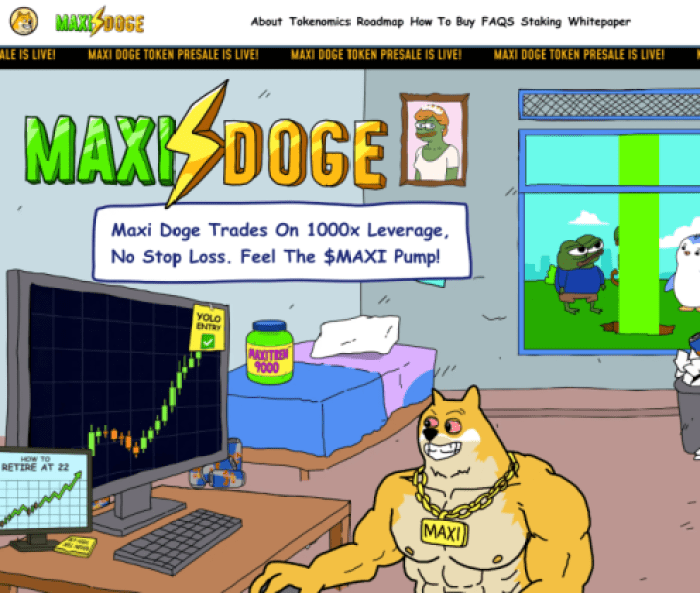
Plus, the ecosystem includes planned partner events with futures platform integrations, allowing top ROI hunters to compete for leaderboard rewards. That turns passive holding into active participation. The risk here for casual observers? Dismissing the aesthetic as pure satire.

Beneath the ‘beefcake’ branding lies a structured economy designed to outperform the original $DOGE by rewarding those who grind through the bear and bull cycles alike.

EXPLORE THE HEAVYWEIGHT DIVISION AT MAXI DOGE

Whale Activity and Staking Rewards Signal High Conviction

The market’s appetite for this high-conviction model is visible in the on-chain data. Maxi Doge has raised over $4.5M. That significant figure suggests retail and institutional interest is coalescing around the project before it hits open markets. With tokens currently priced at $0.0002803, early entrants are positioning themselves ahead of the public listing, betting on the project’s ability to capture the ‘gym-bro’ meme niche. If you want to know more check out our ‘What is Maxi Doge?‘ guide.

Smart money seems to be validating this thesis. On-chain data from Etherscan shows 2 whale wallets each accumulated $314K. Although not a sign of success, this level of capital injection during a presale phase is rare for standard meme coins and implies that sophisticated actors see value beyond the hype.

To lock in this capital, Maxi Doge uses a dynamic staking APY, with daily planned automatic smart contract distributions derived from a 5% staking allocation pool. This setup mirrors the delayed gratification model defended by Story Protocol’s founders, rewarding users who commit their assets to the network for up to one year. By incentivizing a lock-up of supply, the project aims to reduce sell pressure on launch day, creating a firmer floor price than competitors relying solely on viral momentum.

CHECK OUT THE $MAXI PRESALE

This article is for informational purposes only and does not constitute financial advice. Cryptocurrencies are high-risk assets; invest only what you can afford to lose.

Пов'язані питання

QWhat is the main argument made by Story Protocol co-founder S.Y. Lee regarding token unlock delays?

AS.Y. Lee argues that slower token unlocks and extended vesting cliffs are beneficial because premature liquidity often strangles protocol development before it achieves escape velocity. He believes longer runways prevent rampant sell pressure that can capsize early-stage projects, prioritizing long-term alignment over short-term liquidity events.

QHow does Maxi Doge ($MAXI) differentiate itself from other meme coins in the market?

AMaxi Doge differentiates itself by tokenizing market resilience and promoting a high-conviction 'Never skip leg day' mentality. It gamifies the holding process through features like holder-only trading competitions, a 'Maxi Fund' treasury, and staking incentives, aiming to create a community with long-term alignment and reduce sell pressure.

QWhat on-chain data indicates significant interest in Maxi Doge before its public listing?

AOn-chain data shows that Maxi Doge has raised over $4.5M in its presale, with two whale wallets each accumulating $314K worth of tokens. This level of capital injection during the presale phase is rare for standard meme coins and suggests both retail and institutional interest.

QHow does Maxi Doge's staking mechanism work to incentivize long-term holding?

AMaxi Doge uses a dynamic staking APY with daily automatic smart contract distributions derived from a 5% staking allocation pool. This rewards users who commit their assets to the network for up to one year, reducing sell pressure on launch day and creating a firmer floor price.

QWhat is the core philosophy behind Maxi Doge's approach to the meme coin sector?

AMaxi Doge's core philosophy is 'Never skip leg day, never skip a pump,' which emphasizes market resilience and high-conviction trading. It aims to counter low-effort, low-reward trading by fostering a culture of strength, leverage, and active community participation through financial incentives and gamified holding.

Пов'язані матеріали

STRC Breaks Below $95: Why Does It Continue to Depeg? Is There Default Risk?

"STRC Falls Below $95: Why the Persistent Depegging and Is There Default Risk?" The article discusses the recent decline in the price of STRC, a perpetual preferred stock issued by Strategy (MSTR) designed to trade around a $100 par value. As of publication, STRC traded at $94.65, raising market concerns. STRC is described as a high-yield cash flow product, offering an 11.50% annual dividend paid monthly. Its "preferred" status grants it priority over common stock for dividends and in liquidation. Key reasons cited for the price depegging include: 1. **Bitcoin's Price Drop:** MSTR's assets are heavily tied to Bitcoin (BTC), which fell over 21% from its recent high, pressuring all Strategy-related products. 2. **Competitive Pressure:** Rival Strive Asset Management's similar product, SATA, offers daily dividends and has maintained its $100 par value with a ~13% yield. In response, Strategy has proposed changing STRC's dividend frequency from monthly to bi-weekly, pending shareholder vote. 3. **Technical Selling:** A break below $100 may have triggered algorithmic selling and stop-losses, exacerbating the decline. Regarding default risk, the analysis suggests it is currently low. Strategy founder Michael Saylor confirmed the June 2026 dividend rate remains at 11.50% with no cuts or suspensions. The company's massive reserve of 843,706 BTC provides a significant backstop for its obligations. Industry opinions are mixed. Some analysts view the BTC holdings as reliable support for dividends, while critics like Peter Schiff warn of potential dividend cuts leading to price crashes and lawsuits. Others highlight inflation risk and the company's ability to reduce dividends without a formal default. In summary, STRC's drop is attributed to BTC volatility, competition, and technical factors. While immediate default risk appears contained, the product faces challenges from market conditions and competitive dynamics.

marsbit42 хв тому

STRC Breaks Below $95: Why Does It Continue to Depeg? Is There Default Risk?

marsbit42 хв тому

AI Trading Cools, South Korean Stocks Plunge 1.8%, Spot Gold Rises 1%, Bitcoin Dives

A sell-off in AI-related stocks, triggered by Broadcom's disappointing earnings forecast, sent shockwaves through global markets. South Korea's KOSPI led Asia's decline, plunging 1.8% as the risks from concentrated chip stock gains and surging leveraged investments came to the fore. The tech-heavy Nasdaq 100 futures fell 0.5% following Broadcom's 14% after-hours plunge, which signaled a slower-than-expected transition to AI clients. This pullback extended Wall Street's weakness, halting the S&P 500's nine-day rally amid hawkish Fed signals and renewed Middle East tensions. South Korean authorities convened an emergency meeting, pledging "immediate measures" against market volatility and warning of record-high stock margin debt. The adjustment rippled across assets: Bitcoin fell to around $64,000, its lowest since February, while safe-haven gold rose 1% on bargain hunting. Oil prices dipped on Middle East ceasefire news. Market analysts noted the sell-off was driven by profit-taking after massive gains, particularly in chip stocks like Samsung and SK Hynix, which now dominate the KOSPI. Wall Street banks are divided on Korea's outlook, with Goldman Sachs raising its target while Citigroup and others warn of overvaluation and a potential bubble. Bridgewater's Ray Dalio noted that great technological shifts often create bubbles. Meanwhile, Fed officials' hints at potential future rate hikes added to the cautious mood ahead of key U.S. jobs data.

华尔街日报1 год тому

AI Trading Cools, South Korean Stocks Plunge 1.8%, Spot Gold Rises 1%, Bitcoin Dives

华尔街日报1 год тому

Seeking Alpha's Hot Article: Why Might the U.S. Stock Market Crash in June?

In a recent Seeking Alpha article, financial professor and analyst Damir Tokic argues that the US stock market may be poised for a significant crash in June 2026. The core thesis centers on a "mega-bubble" in equities, particularly within the technology sector, which has driven the S&P 500 to near-record valuations, with a Shiller P/E ratio exceeding 40—a level comparable to the 2000 dot-com bubble. Tokic identifies two primary catalysts for a potential collapse. First, he points to unsustainable market exuberance fueled by what he terms the "Trump Stimulus"—massive AI capital expenditure by tech giants, which he believes is politically driven and cannot last. Second, and more urgently, he highlights the escalating Iran war as a critical threat. The ongoing closure of the Strait of Hormuz has created a severe global energy supply crunch. Strategic petroleum reserves are projected to hit critically low operational levels by June, potentially causing oil prices to spike above $200 per barrel and triggering a severe, supply-driven inflationary shock. This scenario, Tokic warns, would force the Federal Reserve's hand. Despite currently maintaining a dovish bias, the Fed would likely be compelled to officially pivot to a hawkish stance at its June FOMC meeting to combat soaring inflation and bond yields. He contends that such a shift—or even a failure to act, which would destroy Fed credibility—could be the trigger that punctures the market bubble. The resulting downturn, he concludes, could rival the bear markets of 2000 and 2008, advising investors to prepare for a major correction.

marsbit1 год тому

Seeking Alpha's Hot Article: Why Might the U.S. Stock Market Crash in June?

marsbit1 год тому

Торгівля

Спот
Ф'ючерси
活动图片