Stop Paying Attention to These Zombie Projects

marsbitОпубліковано о 2026-02-11Востаннє оновлено о 2026-02-11

Анотація

The crypto market in 2025 is marked by extreme contradictions: while over 20 million tokens have been launched, more than 57% have failed. A new wave of "zombie projects"—backed by top VCs and listed on major exchanges—continues to operate with minimal product development or real-world utility. This analysis highlights several疑似僵尸化 projects: - **Sleepless AI**: Once a Binance Labs incubator star, its token fell 99% from its peak. It promises AI-driven emotional companions but shows no substantial technical updates or iOS/Android app launches, raising suspicions of being a repackaged Web2 product. - **Hooked Protocol**: Its Learn-to-Earn model initially attracted users through subsidies, but token value collapsed 99% after incentives faded. Its shift to "AI-powered education" appears more like marketing than tangible tech progress. - **Saga**: Positioned as a "one-click chain launch" solution, it pivoted repeatedly between gaming and AI narratives due to lack of adoption. A $7M security breach and 99% token drop further eroded trust. - **Dymension**: Despite claiming 10,000+ RollApps, most show no activity. TVL remains low at $1.3M, and the token price dropped 99%, reflecting a ghost ecosystem. Zombie projects persist due to: 1. Capital-driven listings prioritizing narrative over substance. 2. Opaque team backgrounds enabling low-exit accountability. 3. "Narrative parasitism"—rebranding to chase trends without real development. In 2026, investors must pr...

Author: Chloe, ChainCatcher

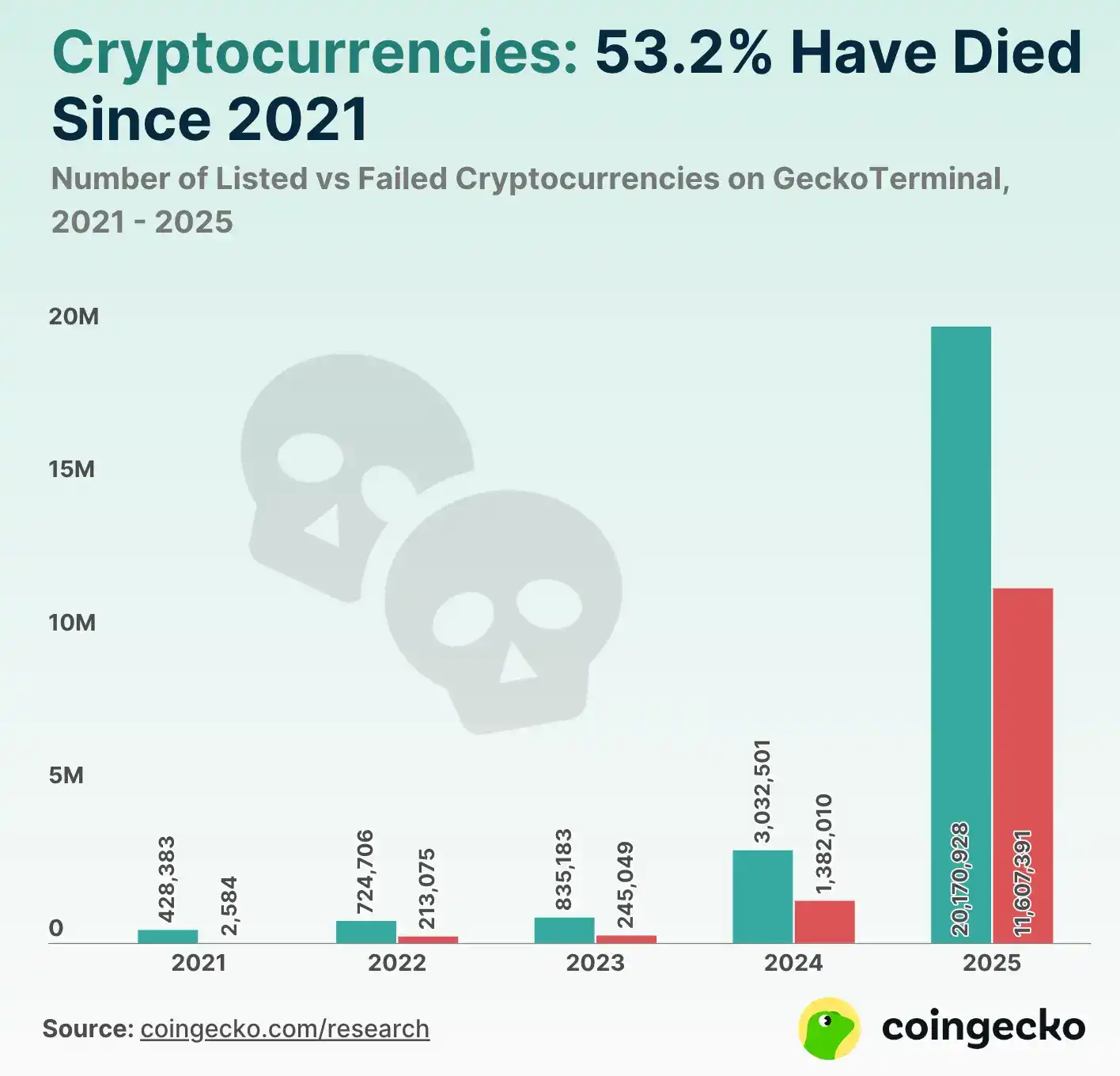
The crypto market in 2025 witnessed an extreme industry contradiction: according to GeckoTerminal statistics, while the total number of token-launching projects surpassed the 20 million mark, over 57% of them met their demise. Amid this brutal elimination race, a more insidious type of "zombie project" is spreading. They boast backing from top-tier capital and leading exchanges, frequently pivot their narratives to chase hot trends, yet are nearly stagnant in terms of actual product delivery, technological development, and ecosystem building.

This article will deeply analyze疑似 zombie-fying projects like Sleepless AI, Hooked Protocol, Saga, and Dymension, examining their operational characteristics. In 2026, the ability to see through narrative fog and identify signs of zombification has become a essential survival skill for investors.

Launching a Token Means "Job Done"? Project Decline and Zombification Phenomenon

In the early stages of blockchain development, the definition of "Zombie Coins" was relatively straightforward: long-term dormancy, loss of trading liquidity, vanished development teams, lack of community participation, etc. However, with the maturation of capital markets and the deep involvement of venture capital, a more隐蔽 absurd phenomenon has emerged in recent years.

Data shows that in 2021, the number of token-launching projects on GeckoTerminal was only 428,000, but by the end of 2025, this number had skyrocketed to 20.17 million. Behind this explosive growth, a staggering 53% of projects met their end. Simultaneously, hidden within this high turnover, high淘汰 rate are大量 "zombified" projects. They trade on exchanges, post social media announcements daily, but there exists a huge gap in actual product delivery, on-chain activity, and ecosystem development.
Sleepless AI: Parasitizing the AI Narrative? R&D and Delivery Disconnect

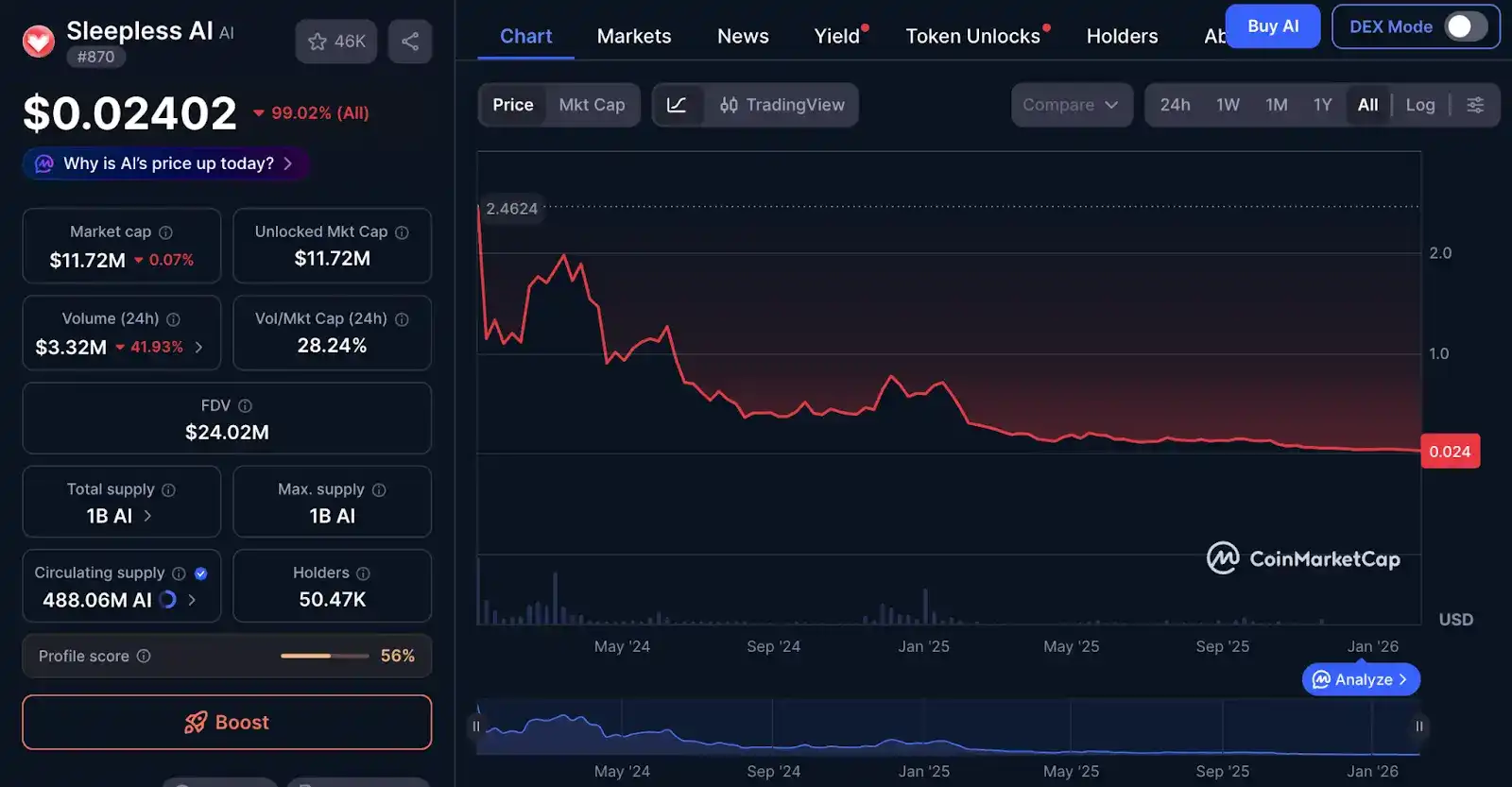
Sleepless AI was once a market darling, not only selected as a standout in Binance Labs' sixth season incubation program but also debuted gloriously on Binance Launchpool's 42nd edition under the光环 of "Web3+AI Virtual Companion." However, entering 2026, its market performance has diverged sharply from its initial热度: the token price has retreated from its historical high of $2.46 to around $0.024, a drop of 99%.
1. Technical Transparency and R&D Progress Disconnect: Although the project touts the use of AIGC and large language models (LLM) to create a deep emotional support experience, its technical transparency is lacking. Observing through public channels, the project almost lacks trackable code update records or iterative versions of core algorithms. More concerning for investors is that the Web Dapp originally scheduled for Q2 2025 has an unclear progress status至今.

2. Inefficient Execution of Mobile Strategy: In the "mobile-first" application era, Sleepless AI's product落地 process appears relatively lagging. Its flagship product "HIM" as of early 2026 still hasn't successfully launched on the iOS App Store or Google Play Store; the official website still only offers Android APK downloads. For a project aiming for mass adoption, this development efficiency severely limits user growth and market trust.

3. Narrative Rebranding and Insider Doubts: Accompanying the product stagnation are deep market doubts about the project's本质. Market observers have put forward the view that the project is疑似 a "narrative rebranding" of an old Web2 game, meaning it repackaged itself with AI concepts and leveraged capital connections to强行 latch onto the AI trend's热度 to secure Binance Labs' investment and Launchpool's流量红利. Although such claims are often anonymous, combined with its weak technical delivery and token price collapse, this phenomenon of "narrative parasitism" has become an important reference indicator for investors in 2026 to identify疑似 zombie projects.

Hooked Protocol: Ecological Dilemma After Incentives Dry Up

Hooked Protocol once emerged rapidly in the Web3 social learning track with its Learn-to-Earn model, securing investment from Binance Labs and Sequoia China, and launching as Binance's 29th Launchpad project. However, as token distribution entered its mid-to-late stages and subsidy红利 gradually faded, the project now faces severe tests of "real user retention" and "ecological substance".

1. From Learn-to-Earn to Incentive Dependency Dilemma: Hooked Protocol's initial success relied heavily on the流量 effect of Binance Launchpad and a strong token subsidy mechanism. This model can quickly换取 huge user numbers initially, but when the HOOK token price fell nearly 99% from its high, the growth game sustained by subsidies loses its appeal. History has repeatedly shown: after TGE, when incentives disappear, "massive user numbers" lacking rigid demand often rapidly shrink.

2. "Marketing-Oriented" Tendency in Narrative Transformation: Entering 2025, Hooked attempted to transform into an "AI-driven learning ecosystem" and "educational infrastructure." Although officially stated to be co-developing courses with 3-7 top universities and launching the Hooked Coursera Hub in August 2025 in collaboration with over 74 Web3 projects, these moves seem more like "brand endorsements" at the marketing level. Compared to the impressive list of partners, its substantive breakthroughs at the technical底层 appear lackluster.

Hooked Protocol's current state reveals a core challenge for Web3 application projects to a certain extent: if a project's vitality relies on token incentives and cannot transform into原生 demand with business resilience, it will struggle to escape the fate of大幅 token price decline, even zombification. The current low币价 and potentially shrinking ecological activity are the negative feedback after subsidy-driven prosperity.

Saga: Dual Blows of Lack of Market Demand and Security Vulnerabilities

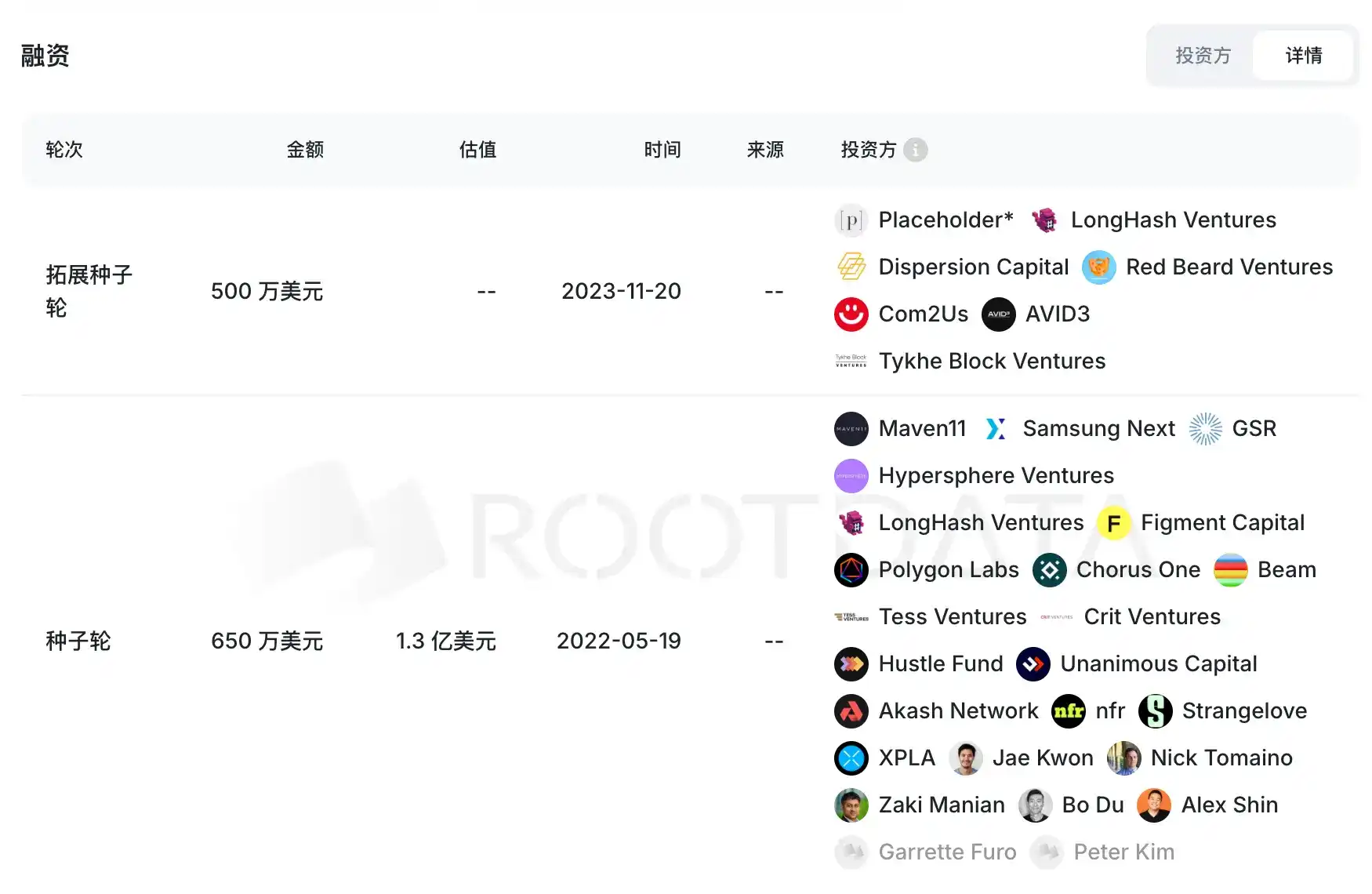
Saga represents another path to zombification: the shovel seller can't find miners. With the grand vision of "one-click chain launch," Saga successfully attracted over $1000 in financing from top institutions like Placeholder, GSR, and Samsung Next, and also successfully launched as the 51st project on Binance Launchpool. However, this powerful automated chain-launching tool seems somewhat misplaced when tested against real market demand.
1. Frequent "Pivoting" Exposes Ecological Anxiety: Over the past two years, Saga has shown极高的 narrative flexibility, but also暴露出其生态核心缺陷. From initially promoting itself as a gaming-specific chain with over 350 partner projects, to later pivoting to an AI infrastructure narrative, this frequent narrative shifting essentially reflects the growth anxiety arising from the lack of落地 applications in its old ecosystem.

If its core technology "Chainlet" had genuine market demand, it should theoretically drive token buybacks through developers' continuous renewals. However, the reality is that Saga's partner list, though long,始终 lacks blockbuster project support. Most partners remain in the early exploration stage, unable to contribute substantial economic driving force to the protocol.

2. Fatal Blow to Security Credibility: For infrastructure, technical security is its bottom line. SagaEVM suffered a $7 million vulnerability attack in January this year, with the stablecoin $D depegging to $0.75, and TVL evaporating from approximately $37 million to $12 million. This is undoubtedly a severe blow for a project positioning itself as infrastructure.

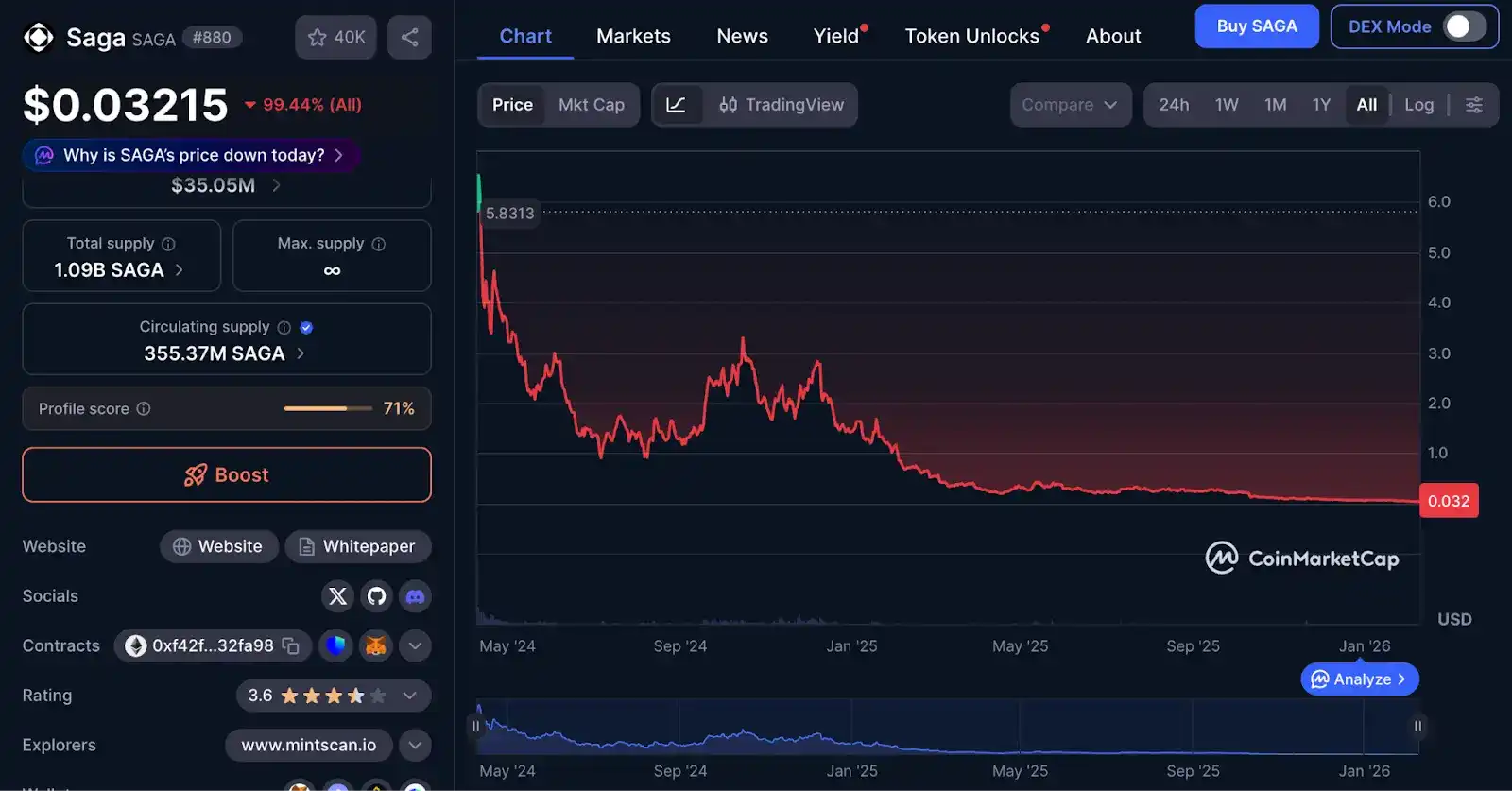
When grand narratives fail to translate into ecological data, and technical security is flawed, the market's feedback is often merciless. The native token SAGA price has fallen from its 2024 high of $6 to around $0.032 currently.
Dymension: Data Ghost Town Under a Grand Architecture

Dymension's script is highly similar to Saga's. Its proposed RollApp concept is quite attractive in theoretical architecture, but in the face of actual data in 2026, it更像是一座宏伟的鬼城 (a grand ghost town). Although Dymension attempts to establish a benchmark for a modular settlement layer, the real vitality of its ecosystem falls far short of expectations.

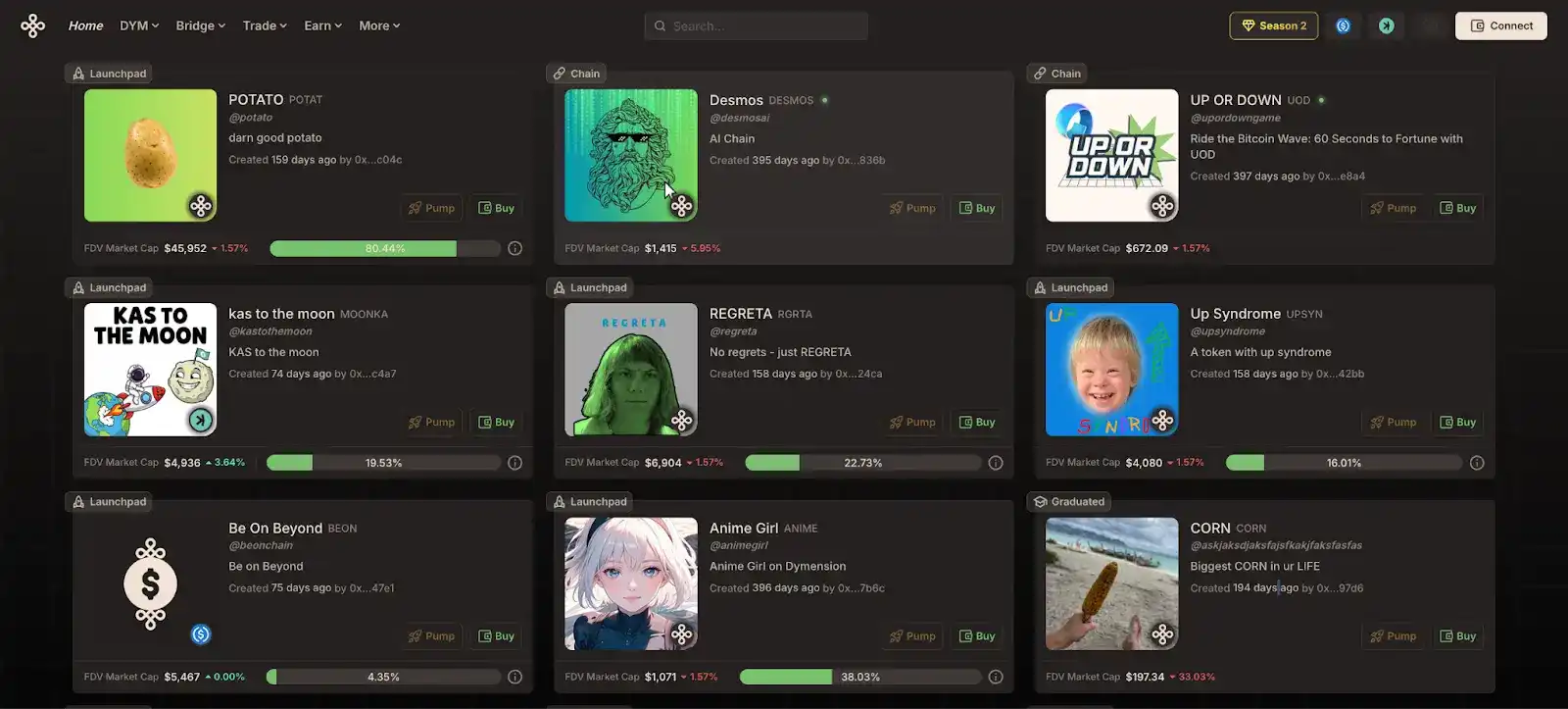
1. RollApp Network Activity Disconnect: Dymension once claimed to have deployed over 10,000 RollApps within its ecosystem. However, this data prosperity essentially stems from the lowered barriers to "issuing tokens and launching chains." The vast majority of deployed RollApps have no sustained on-chain transactions or substantial output beyond the initial token issuance, and many have even disappeared.
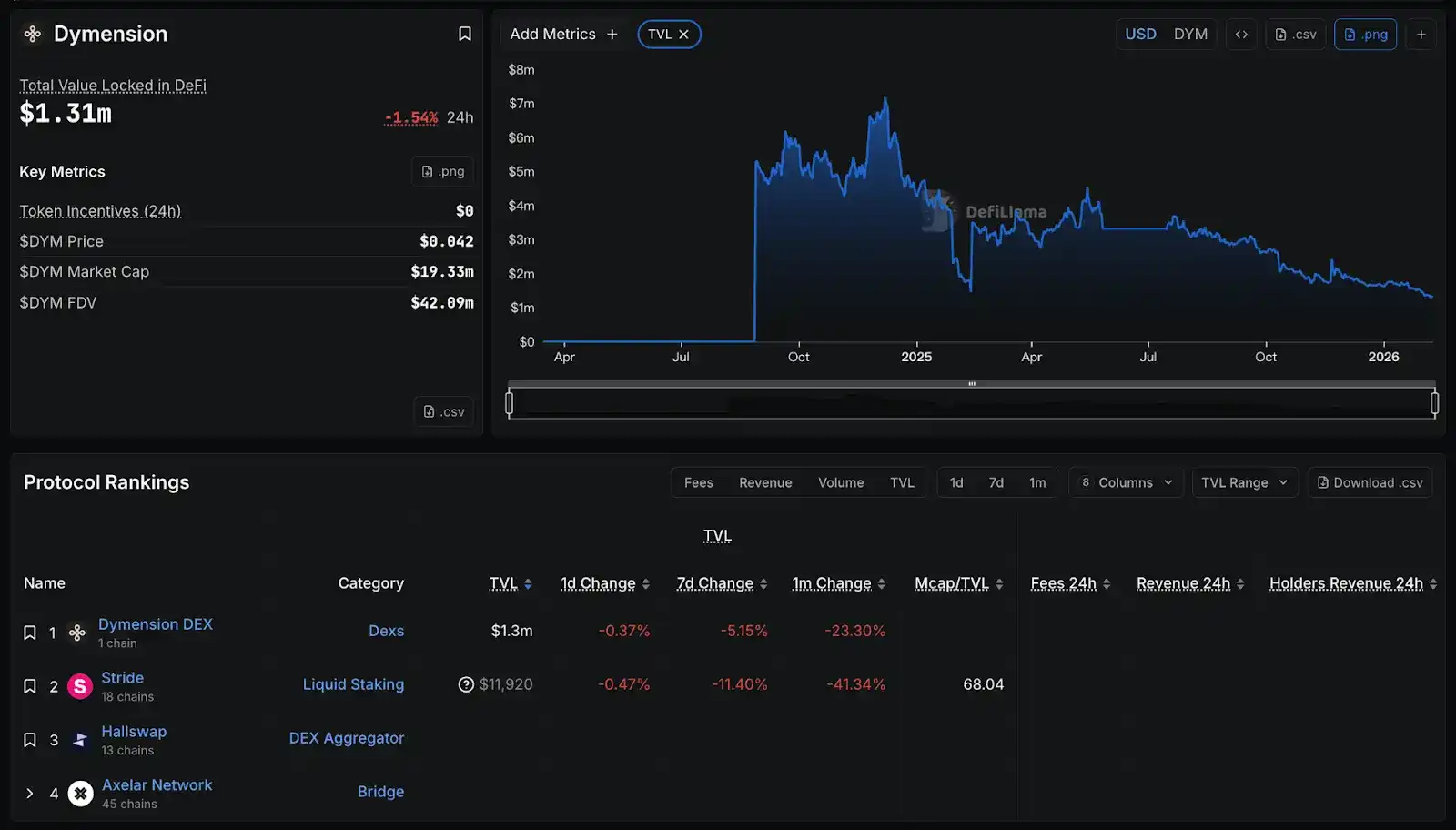
2. Dysfunctional Economic Function of Infrastructure: When Launchpad and development kits fail to transform into a thriving digital economy, the infrastructure itself falls into value exhaustion. Dymension's main DEX projects and ecosystem TVL performance are both unsatisfactory. The current overall TVL is only $1.3M, forming a stark contrast with the market's initial expectation of it being a "modular leader" at token launch.
极

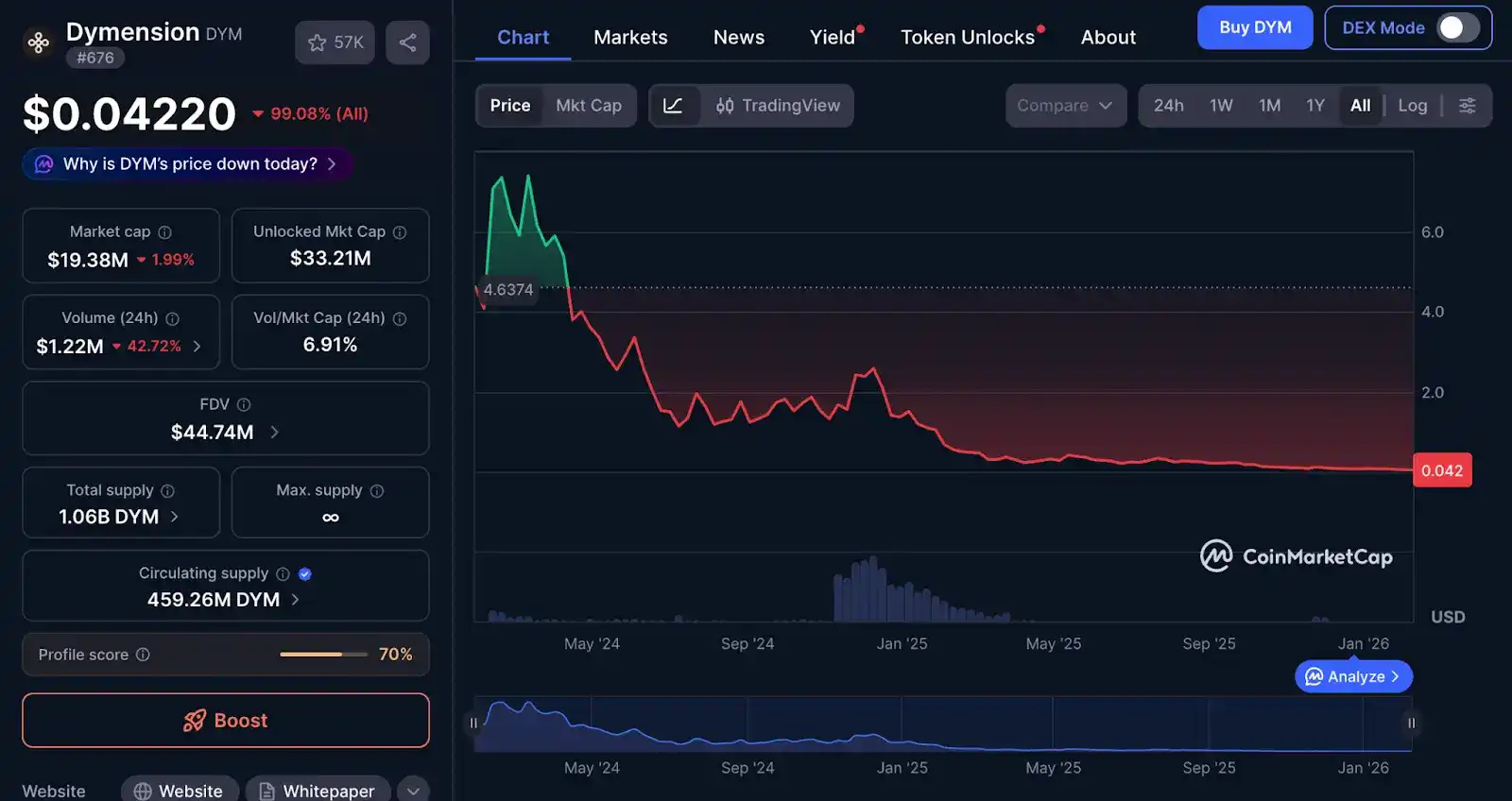
When the infrastructure primarily runs zombie applications and the overall ecosystem performance is拉垮 (lacking), the native token DYM price is inevitably corrected by the market. The current FDV is $45M, and the token price has fallen 99% from its high of $6, now只剩 (only remaining at) $0.042.
Why Are "Zombie" Projects Proliferating?

The reason these projects can maintain a superficial "vitality" stems from deep-seated structural issues within the Web3 industry.

1. Capitalized Listing Power Structure: In recent years, the listing path for many projects has not originated from substantial technological breakthroughs but has highly relied on "capital, vested interests, and narrative packaging." Pushed forward by the combined force of VCs and internal executives, these projects enter top exchanges through精美 packaging and刷出来的 (fabricated) testnet data. Once the token unlock is complete, teams often lose motivation for further development.

2.模糊的团队背景 (Ambiguous Team Backgrounds): A common characteristic among some zombie projects is that the background of the core operators and technical leaders is extremely模糊 (ambiguous). This "black box" operational model not only allows the project team to avoid credible accountability when encountering technical bottlenecks or security vulnerabilities but also provides them with very low exit costs. It enables the operating team to quickly rebrand, discreetly reposition in a new narrative after one project stalls, and repeatedly消耗 (consume) market credit.

3. Narrative Parasitism Capability: Zombie projects often possess a strong ability for "narrative parasitism." Whenever market热点 (hot topics) shift, these projects with little substantive progress often conduct "announcement-style pivots" to align with the new narrative. This not only increases the identification cost for investors but also分散 (disperses) scarce liquidity into unproductive shells, from which they can蹭热度 (ride the hype) and attract speculative capital.

Conclusion: Investors Should Seek the True Bottom Line of Value in 2026

Facing a prosperous market woven from twenty million token-launching projects, investors' core logic must change. In 2026, identifying zombie projects is no longer just a bonus skill but a defensive necessity. Below are three core indicators to help readers identify them:

First, the verifiability of the team and technical delivery: Avoid projects with unclear team information, no GitHub commit history, low roadmap fulfillment rates, and slow product distribution. Second, the substance of the data: Distinguish between "subsidy-driven activity" and "organic demand." Check if users show retention willingness after token subsidies are removed. Finally, be wary of projects that change their core focus every three months. Genuine innovation requires deep cultivation; frequent narrative switches usually掩盖 (mask) the failure of the old business.

As the crypto market matures, the industry needs projects that consistently deliver both before and after token launches, genuinely bring value to the industry, and solve market pain points.


Пов'язані питання

QWhat is the main contradiction observed in the 2025 crypto market according to the article?

AThe main contradiction is that while the total number of token issuance projects exceeded 20 million, over 57% of them failed, and a more insidious type of 'zombie project' is emerging, which has backing from top-tier capital and major exchanges but shows near stagnation in actual product delivery, technology development, and ecosystem building.

QWhat are the three key indicators the article suggests for investors to identify zombie projects in 2026?

AThe three key indicators are: 1. Verifiability of the team and technical delivery—avoid projects with unclear team backgrounds, no GitHub commit history, low roadmap fulfillment, and slow product distribution. 2. The substance—distinguish between 'subsidy-driven activity' and 'native demand' by checking if retention persists after token incentives end. 3. Be wary of projects that frequently change their core narrative every few months, as this often masks the failure of previous ventures.

QWhy did Sleepless AI's market performance decline significantly, as per the analysis?

ASleepless AI's market performance declined by 99% from its all-time high due to a lack of technical transparency and development progress (e.g., no trackable code updates or delayed Web Dapp launch), inefficient execution of its mobile strategy (failure to launch on major app stores), and market skepticism about its narrative, with allegations that it was a repackaged Web2 project leveraging AI hype for capital and exchange benefits.

QWhat core challenge does Hooked Protocol's situation reveal about Web3 application projects?

AHooked Protocol's situation reveals the core challenge that if a project's viability relies solely on token incentives rather than transforming into a business with resilient native demand, it is likely to suffer from token price collapse and zombification once subsidies diminish, as seen with its 99% price drop and potentially shrinking ecosystem activity.

QWhat structural problems in the Web3 industry contribute to the proliferation of zombie projects?

AThe proliferation of zombie projects is fueled by structural problems such as: 1. Capital-driven listing power structures, where projects rely on VC backing and narrative packaging rather than technical merit to get listed on exchanges. 2. Opaque team backgrounds, allowing low exit costs and rebranding opportunities. 3. Narrative parasitism, where projects frequently pivot to new hot topics without substantive progress, increasing investor identification costs and dispersing liquidity.

Пов'язані матеріали

After Three Consecutive Quarters of Decline, Can the Crypto Market Find a Window for Stabilization in Q3?

The cryptocurrency market has just concluded its worst-performing quarter since 2022, with total capitalization dropping 12.6% to $2.1 trillion. All core metrics indicate capital is leaving the sector, not just rotating within it. Bitcoin fell 14.2% and Ethereum dropped 25.4% in Q2, breaking their previous correlation with US tech stocks. A key driver is the reversal in US spot Bitcoin ETF flows, which saw a net outflow of approximately $4.67 billion in Q2, including a record monthly outflow near $4.5 billion in June. While recent data suggests long-term holders are accumulating again, sustained ETF outflows mean continued selling pressure. Market focus is now singularly on the Federal Reserve. The upcoming July FOMC meeting is seen as the most critical event for Q3. A dovish signal could support Bitcoin reclaiming a $68,000-$84,000 range, while a hawkish stance might establish a new trading band around $50,000-$56,000. Additionally, regulatory uncertainty persists, with the progress of the crucial *CLARITY Act* stalling in the Senate, reducing its perceived 2026 passage probability to 40-45%. Despite the broad downturn, a few sectors showed growth. Prediction markets saw nominal volume surge 48.7% year-over-year to $113.8 billion, and tokenized collectibles transaction volume rose 143% quarterly to $1.4 billion. The Real-World Asset (RWA) tokenization sector also continued steady growth, now representing ~$28.1 billion in on-chain value. The market's foundation for an extreme crash appears limited, with Bitcoin price hovering near its 200-week moving average. However, the trading paradigm has shifted from narrative-driven speculation to decisions based on price action, policy developments, and interest rate expectations, making a broad sentiment-driven rally unlikely in the near term.

marsbit1 год тому

After Three Consecutive Quarters of Decline, Can the Crypto Market Find a Window for Stabilization in Q3?

marsbit1 год тому

BIT Trading Moment: BTC Still Suppressed by Weekly 200 EMA, Rejection May Restart Decline; Storage and Semiconductors that Surged Last Night Begin Falling in Evening Trading

**Crypto & Stock Market Wrap: Bitcoin Tests Resistance, Stocks Retreat After AI Surge** Bitcoin consolidates around $66,000, facing key resistance near $68,000—an area seen as a major psychological and technical hurdle where previous rallies have failed. Analysts note the cryptocurrency is caught between its 200-week moving average (~$63,333) and 200-week EMA (~$68,328). A clear break above $68k is needed to signal a stronger bullish trend, while a rejection could lead to a retest of $63k support. Market sentiment remains cautious, with low futures open interest pointing to a low-liquidity rebound rather than a full bull market. Bitcoin spot ETFs saw another $203 million inflow. US stock futures pointed lower after a strong Tuesday session led by a massive rebound in semiconductors and memory stocks. The rally was fueled by renewed optimism about AI-driven hardware demand, with Micron, SanDisk, and SK Hynix surging. However, those gains reversed in pre-market trading. Super Micro Computer (SMCI) soared over 20% after hours on strong guidance and a record backlog. Other standouts included Rocket Lab and nuclear energy plays Oklo and X-Energy. Rising oil prices (Brent above $91) and climbing Treasury yields (10-year near 4.64%), however, are reigniting inflation concerns and acting as a headwind for equities. In Asia, markets were mixed. South Korea's KOSPI pared early gains to close slightly higher as semiconductor stocks like SK Hynix gave back initial surges. Japan's Nikkei edged lower as the yen hit a fresh 38-year low against the dollar, raising fears of potential market intervention. Key events to watch include the Samsung Galaxy launch, AMD's AI event, and a slew of major tech earnings from Alphabet, Tesla, and IBM after the close on Wednesday, followed by the ECB meeting and Intel's earnings on Thursday.

marsbit1 год тому

BIT Trading Moment: BTC Still Suppressed by Weekly 200 EMA, Rejection May Restart Decline; Storage and Semiconductors that Surged Last Night Begin Falling in Evening Trading

marsbit1 год тому

Former CFTC Chairman, Circle President Tarbert: Preaching Long-Termism While Cashing Out $30 Million Himself

Former CFTC Chairman and Circle President Heath Tarbert has consistently advocated for a long-term vision in public, urging patience from investors as Circle’s stock price has fallen significantly from its peak. However, it has been revealed that since Circle’s IPO, Tarbert has continuously sold his CRCL shares through pre-arranged trading plans, cashing out approximately $30 million, without making any public market purchases. This contrast between his public messaging and personal actions has drawn criticism. Tarbert joined Circle in July 2023 as Chief Legal Officer, leveraging his regulatory experience to help guide the company through its IPO and expansion. Despite promoting stablecoins as long-term infrastructure, he established a 10b5-1 trading plan just before Circle went public, leading to substantial stock sales over the following year. In March 2026, he initiated another plan to sell more shares. His career trajectory highlights a pattern of moving between high-level regulatory roles and influential positions in the financial sector. After resigning as CFTC Chairman in early 2021, he joined Citadel Securities as Chief Legal Officer just 27 days later, during a period of intense regulatory scrutiny for the firm. He later joined Circle, aiding its efforts to navigate regulatory challenges for its public listing. While Tarbert's expertise in policy and compliance is valuable to companies like Circle, his actions—advocating long-term confidence while personally divesting—raise questions about the alignment between his public statements and his private financial decisions, leaving investors who followed his advice to bear the market risks.

marsbit2 год тому

Former CFTC Chairman, Circle President Tarbert: Preaching Long-Termism While Cashing Out $30 Million Himself

marsbit2 год тому

Gate Research Institute: The 'Wall Street-ization' Wave of Crypto Financial Products – Competition or Integration?

The article titled "Gate Research Institute: Are Crypto Financial Products Sparking a 'Wall Street' Wave—Competition or Convergence?" explores the evolving relationship between the crypto ecosystem and traditional finance (TradFi). The piece begins by reflecting on Bitcoin's original 2009 vision of decentralization, disintermediation, and moving away from banks. It then contrasts this with the 2024 landscape, where key crypto assets like Bitcoin are increasingly held through Wall Street products like ETFs issued by giants like BlackRock. The article questions whether this signifies that TradFi is systematically taking over the rights to issue, price, custody, and distribute crypto financial assets. The core argument is that this is not a zero-sum takeover but rather a bidirectional convergence where each side addresses the other's weaknesses. Crypto offers 24/7 global markets, programmable settlement, and open access but lacks compliant channels, institutional-grade custody, deep fiat liquidity, and mainstream distribution. TradFi possesses these but is constrained by legacy systems, limited operating hours, and slow settlement. Two primary convergence paths are highlighted: * **Path A (CEX to TradFi):** Exemplified by Gate, which has progressed from offering tokenized stocks and CFDs to providing direct, real stock trading (US, Hong Kong, South Korea) within its platform, using USDT. * **Path B (TradFi to Crypto):** Exemplified by Robinhood, which has integrated crypto trading, acquired exchanges like Bitstamp, and is moving traditional assets like stocks onto the blockchain via tokenization and its own Layer 2. Both paths are ultimately competing to become the next-generation, unified financial account—a "super account" where users can seamlessly trade cryptocurrencies, stocks, ETFs, RWA (Real World Assets), and tokenized treasury products in one interface. The growth of RWA and tokenized treasuries (e.g., BlackRock's BUIDL) is presented as the asset-layer fusion, providing stable, yield-bearing assets on-chain and acting as a bridge between the two worlds. In conclusion, the "Wall Street-ization" of crypto is framed as a mutual transformation. Decentralized ideals persist in the protocol layer, while at the application layer, a more efficient, global, and accessible unified capital market is emerging from this convergence. The future competition lies not between crypto exchanges and stockbrokers, but between platforms vying to offer the most comprehensive asset coverage, liquidity, and user experience within a single account.

marsbit2 год тому

Gate Research Institute: The 'Wall Street-ization' Wave of Crypto Financial Products – Competition or Integration?

marsbit2 год тому

Торгівля

Спот
活动图片




