With the rapid development of on-chain derivatives trading, the demand for competitive and gamified trading products among Crypto traders is continuously growing.
More and more traders, in addition to simply seeking profits, also hope to validate their strategies and risk management capabilities in a fair environment. However, there is still a significant gap in the current market for competitive trading products—traditional trading competitions are inherently biased towards large capital players, while Prop Trading Challenge platforms often require longer evaluation cycles with higher participation barriers, making it difficult to meet the fast-paced needs of the Crypto market.
Against this backdrop, the decentralized contract trading platform DeriW officially launched Edge Hour on March 24—a competitive product centered around "time-limited trading challenges," aiming to provide a new competitive experience with shorter cycles and lower barriers.
Hands-On Experience: Faster-Paced, More Direct Trading Competition
From a product positioning perspective, Edge Hour can be seen as the Crypto version of a Prop Trading Challenge, but with innovative upgrades tailored to the Crypto market. The entire process has a lower barrier (minimum $5), faster pace (1-8 hours), more controllable costs (losses are limited to entry fees), and more substantial profits (2-10x rewards).
In the actual experience, users first need to select the challenge duration (1, 2, 4, or 8 hours), entry fee ($5 - $500), and reward level (2-10x). After selection, the interface directly displays the profit target and maximum drawdown limit. Users can then immediately start the challenge and trade perpetual contracts such as BTC and ETH within the specified time. If the account position reaches the profit target without hitting the drawdown line, the challenge is successfully completed.
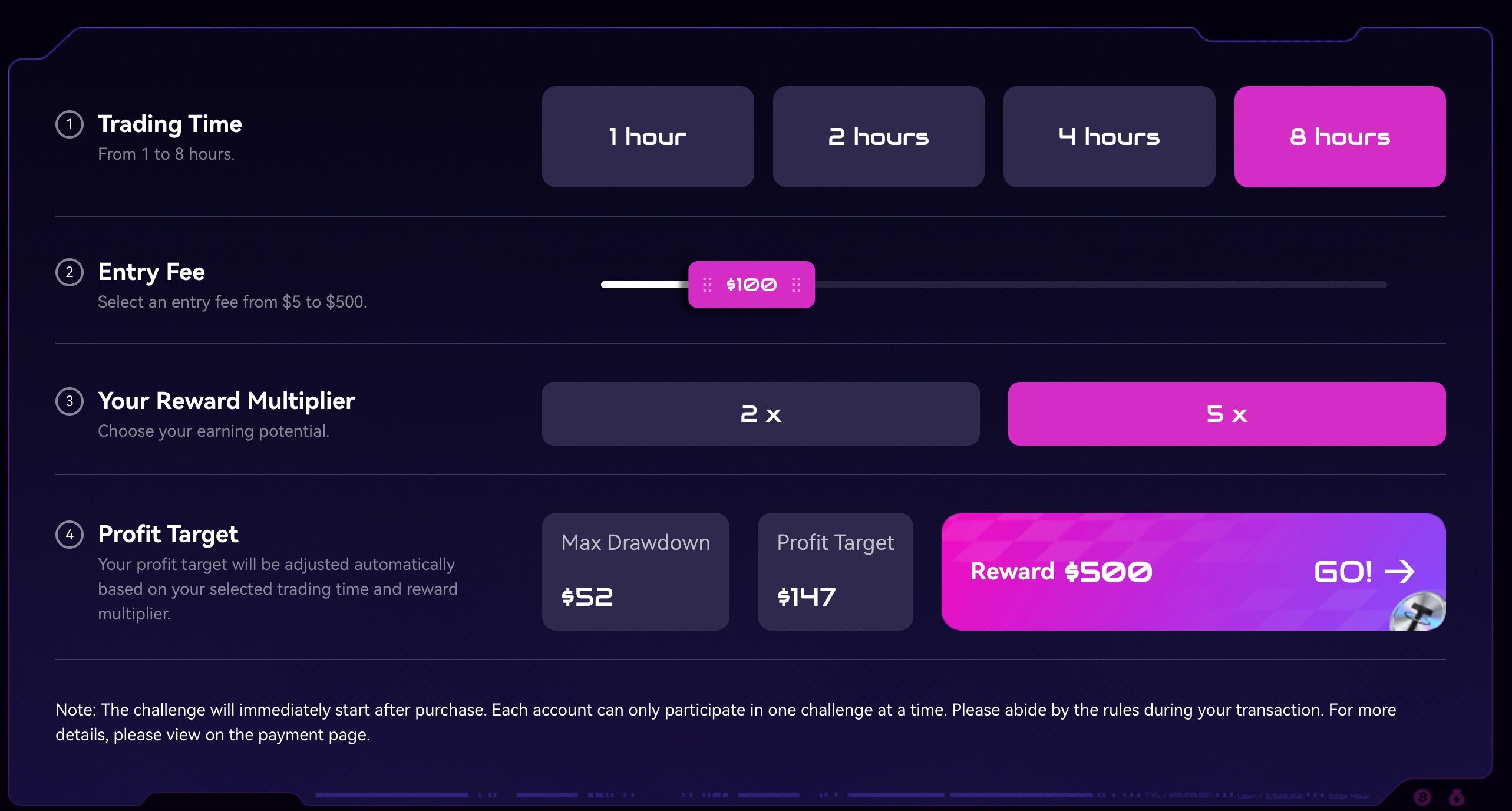
As shown in the figure above, when I selected an 8-hour challenge cycle, a $100 entry fee, and a 5x reward, Edge Hour automatically provided a profit target of $147 and a drawdown limit of $52. This means that if I succeed in the challenge, I can receive a $500 reward; if I fail, I only lose the $100 entry fee.
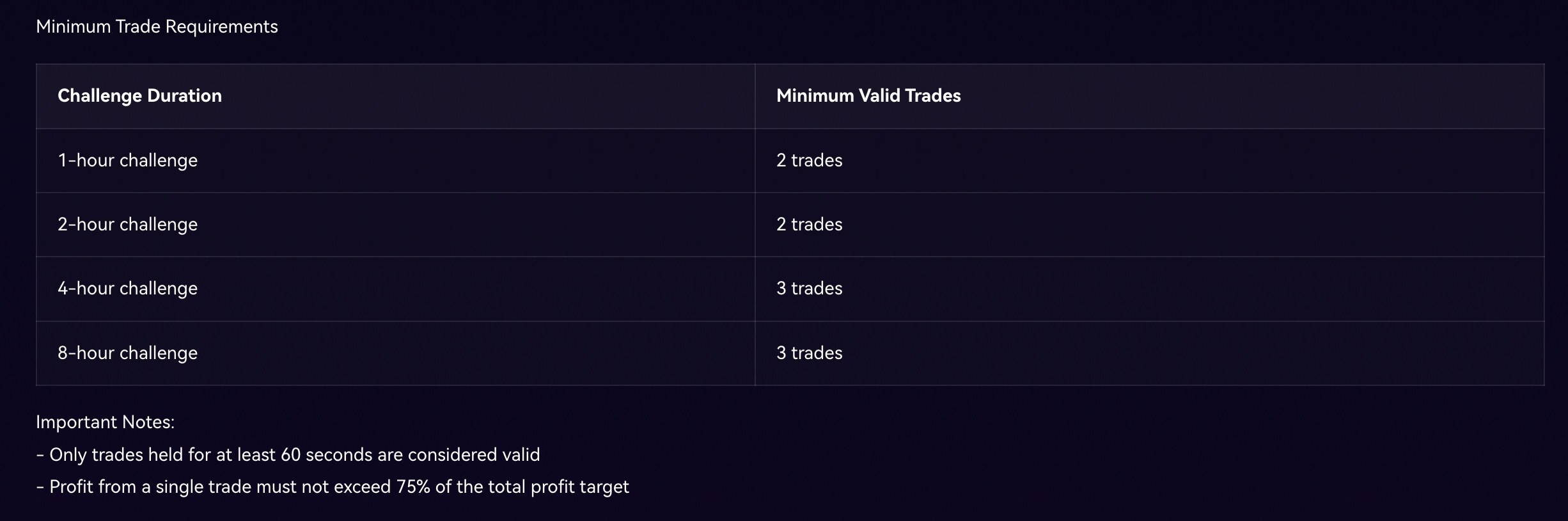
It is worth noting that to minimize speculative users and mere "luck-based" participants, Edge Hour requires users to hold each position for at least 60 seconds. Additionally, users with different challenge durations have different minimum trade requirements (as shown in the figure below), and the profit from a single trade cannot exceed 75% of the total profit target.
As for the reward mechanism, Edge Hour's challenges and settlements are executed publicly and transparently on-chain. After the challenge ends, rewards are directly distributed to the user's wallet, and all transaction records are verifiable.
Overall, the participation process and profit structure of Edge Hour are very clear—"Investment ➡️ Challenge ➡️ Success ➡️ Multiplier Returns." The logic is intuitive and full of competitive fun.
Six Core Advantages: Rewarding True Skill Players
Around Edge Hour, DeriW has designed the product across multiple dimensions to provide traders with a competitive environment where they can best demonstrate their trading abilities while ensuring fairness and transparency, and rewarding true "experts" with超额 rewards.
Specifically, Edge Hour's core advantages are reflected in the following six points.
- Fair Competitive Environment: Edge Hour provides all participants with the same virtual trading capital of 10,000 USDT, eliminating unfair factors caused by differences in capital scale. Under this mechanism, victory or defeat is entirely determined by trading skills and risk control capabilities. Compared to traditional leaderboard-type trading competitions, large capital users no longer have a natural advantage, and small capital traders also have a fair chance to compete. At the same time, all transaction data is recorded on-chain and verifiable, further ensuring transparent and trustworthy results.
- Low Barrier, High Return: Edge Hour lowers the participation barrier to an extremely low level, with a minimum participation fee of only 5 USDT. The user's risk is capped at the loss of the entry fee, but they can obtain reward multipliers of 2-10x. This structure allows traders to test strategies at a very low cost while having high profit potential, significantly reducing the barrier to entry.
- Shorter Competition Cycles: Traditional trading competitions often suffer from long cycles and waiting times, while Edge Hour offers four challenge duration options: 1 hour, 2 hours, 4 hours, and 8 hours. Users can choose to participate based on their schedule and receive feedback within hours, greatly improving participation efficiency.
- Focus on True Trading Ability: Edge Hour ensures that competition results are driven by genuine trading skills through multiple rules: each trade must be held for at least 60 seconds; single-trade profits cannot exceed 75% of the target; there are requirements for the minimum number of trades and maximum drawdown limits. These rules aim to avoid high-frequency scalping and one-time gambling behaviors, ensuring the challenge reflects complete trading strategies.
- Social Referrals: Edge Hour supports participants inviting friends during the challenge. Inviters can receive additional rewards, while invitees can get time extensions and fee discounts, thereby driving ecosystem growth through social dissemination. This design combines trading competition with social referrals, enhancing user engagement.
- Technical Guarantee: This is DeriW's real trump card. Edge Hour runs on DeriW Chain (a Layer3 network based on Arbitrum Orbit), featuring millisecond-level matching speed, zero Gas fees, high concurrency processing capacity (80,000 TPS), and on-chain transparent settlement, ensuring a smooth and fair challenge process.
Meeting Diverse Trading Needs, Filling Market Gaps
From a broader perspective, the launch of Edge Hour actually reflects the evolution of the Crypto trading ecosystem towards greater diversification.
In the early stages, Crypto trading mainly revolved around spot trading and long-term holdings. Subsequently, derivative tools such as perpetual contracts gradually became popular, and the market entered an era of high-frequency and leveraged trading. As the user structure changes, trading demands have further diversified—some pursue long-term investment, some prefer short-term volatility, and others hope to validate their strategic abilities in a fair competitive environment.
However, there is still a significant gap in the current market for such "trading skill verification" products. On one hand, traditional trading competitions are more inclined towards "capital scale competition." The leaderboard mechanism often gives large capital users a natural advantage, making it difficult for small capital traders with excellent strategies to stand out in long-cycle competitions. On the other hand, while Prop Trading Challenges emphasize skill assessment, their long cycles and complex rules make it difficult to meet the fast-paced nature of the Crypto market.
Edge Hour, however, carves out a new path between the two. By providing a unified starting point of 10,000 USDT in virtual capital, Edge Hour eliminates differences in capital scale, making trading skills the only variable. Through 1-8 hour challenge cycles, Edge Hour allows trading results to be quickly verified. The on-chain transparent settlement mechanism ensures the entire competition process is publicly verifiable and tamper-proof.
From this perspective, Edge Hour is not just a product feature innovation; it also introduces a new paradigm for trading competition in the Crypto market—participating at a low cost, completing challenges in a short time, and determining results based on trading ability rather than capital size.
The emergence of this model also signifies that the form of trading products is upgrading from "mere trading tools" to a comprehensive experience of "trading + competition + social interaction," and Edge Hour is a representative attempt under this trend.
A New Direction for Decentralized Trading
For DeriW, the launch of Edge Hour not only enriches its product matrix but also further strengthens its differentiated positioning in the decentralized derivatives track.
Over the past few years, competition among decentralized trading platforms has mainly revolved around liquidity, fees, and performance. As the market matures, user experience and product form innovation are becoming new dimensions of competition. In other words, whoever can provide a more engaging, fair, and entertaining trading environment is more likely to attract the new generation of trading users.
Against this backdrop, Edge Hour was born—it integrates trading skill verification, risk control training, and competitive experience, making trading no longer an isolated operational behavior but an interactive experience that can be participated in, compared, and shared. Industry trading demands will continue to细分, and user structures will keep evolving. Short-cycle, skill-oriented trading competition products like Edge Hour may become an important component of the next phase of the Crypto trading ecosystem, and DeriW will also use Edge Hour to accelerate its evolution from a "trading platform" to a "trading ecosystem."






