| |
|
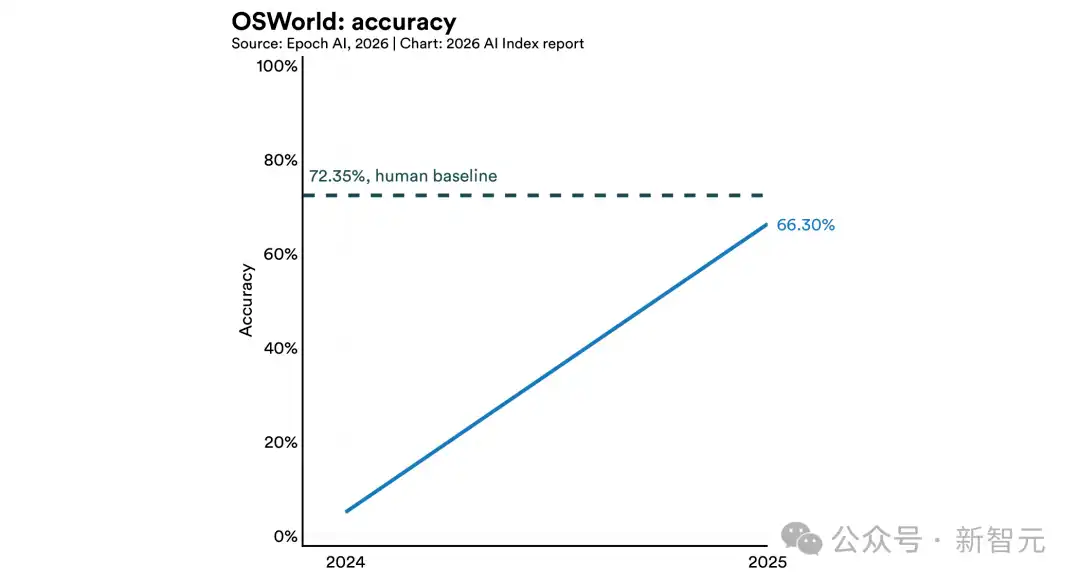
Also, in agent tasks, in the OSWorld test, frontier AI strength (66.3%) is approaching the human baseline.
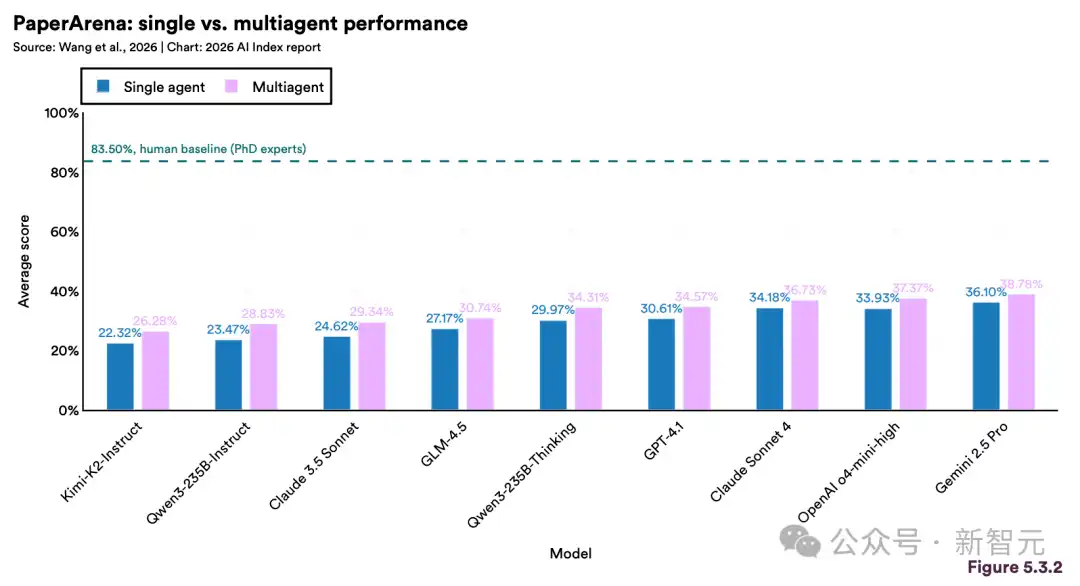
However, in the PaperArena test专门评估科研逻辑, the strongest AI-powered Agent scored only 39%, half the capability of a PhD student.
But this unevenness doesn't stop companies from integrating AI into production lines.
Another number from the AI Index is that the global enterprise AI adoption rate has reached 88%. Ninety percent of companies have integrated AI into some workflow.
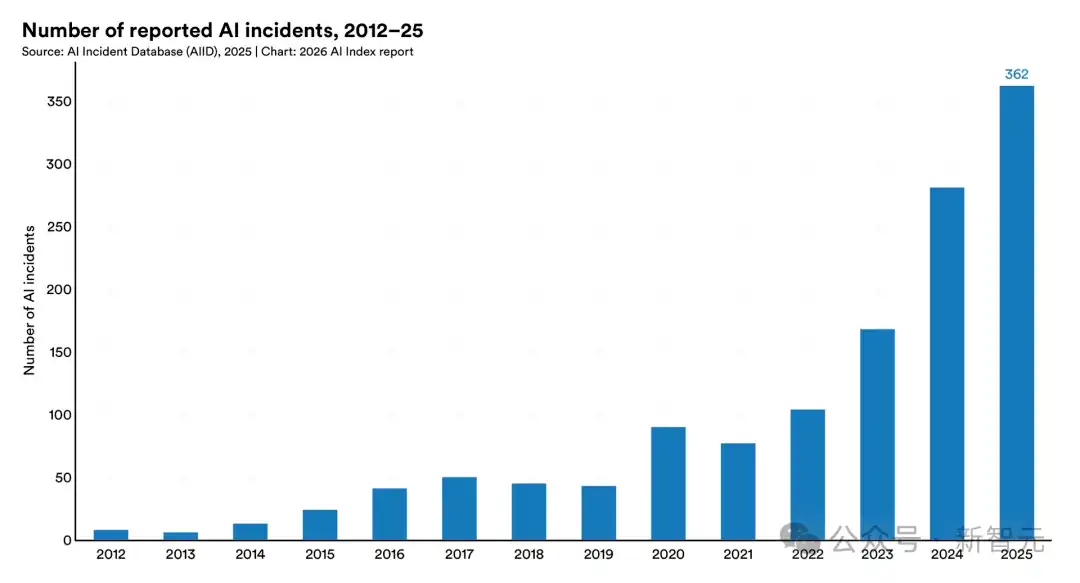
The cost is rising simultaneously. Recorded AI-related incidents increased from 233 in 2024 to 362.
Money is Accelerating: $581.7 Billion Poured into AI
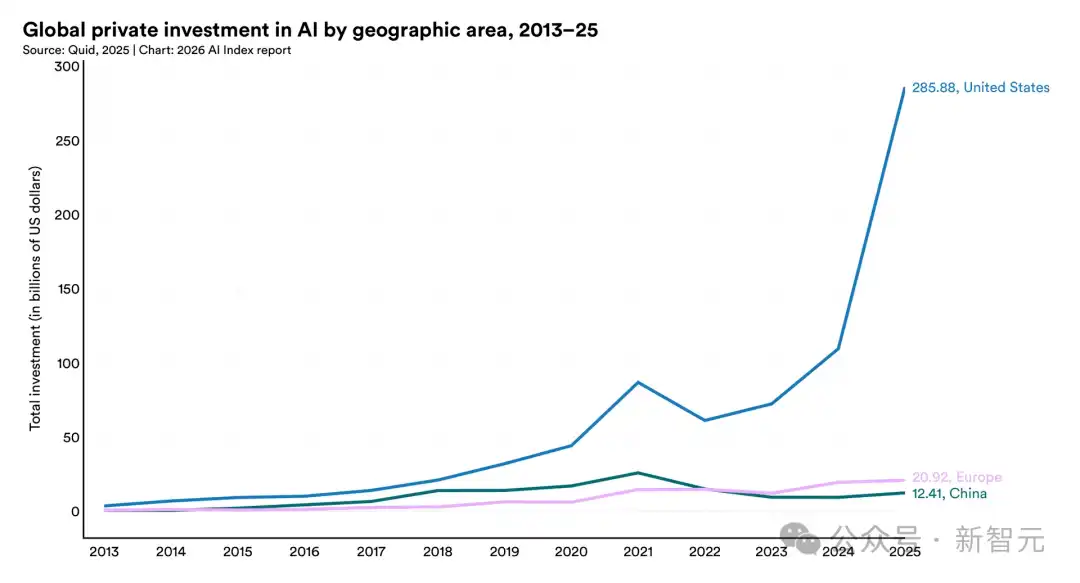
Global corporate AI investment in 2025 reached $581.7 billion, a year-on-year increase of 130%.其中, private investment was $344.7 billion, up 127.5% year-on-year.
Both curves almost doubled.
By country, the US is in a league of its own. US private AI investment in 2025 was $285.9 billion. And it added 1,953 AI startups in one year, also more than 10 times the number of the second-ranked country.
Money is accelerating into the US. But another core US resource is moving in the opposite direction.
People are Flowing Out: AI Researchers Entering the US Fell 89%
There's a set of numbers that makes one pause.
From 2017 to now, the number of AI researchers and developers entering the US has fallen by 89%.
More critically, this decline is accelerating. In the past year alone, the drop was 80%.
The US still has the highest density of AI researchers globally, but the inflow tap is tightening.
The curves of money and people are starting to反向. This is a situation not seen in the past decade.
Computing Power Rose 30-Fold in 3 Years, Lifelines in One Company's Hands
The AI capability curve is accelerating, but the computing power curve behind it is running even faster.
From 2021 to now, global AI computing power has increased 30-fold. Over the past three years, it has tripled every year.
This curve is supported by a few companies.
NVIDIA's GPUs alone account for over 60% of the world's AI computing power. Amazon and Google rank second and third with their own chips, but combined they are far behind NVIDIA.
And almost all these chips come from one foundry, TSMC. The steeper the computing power curve, the narrower the lifeline.
Meanwhile, the cost is also increasing.
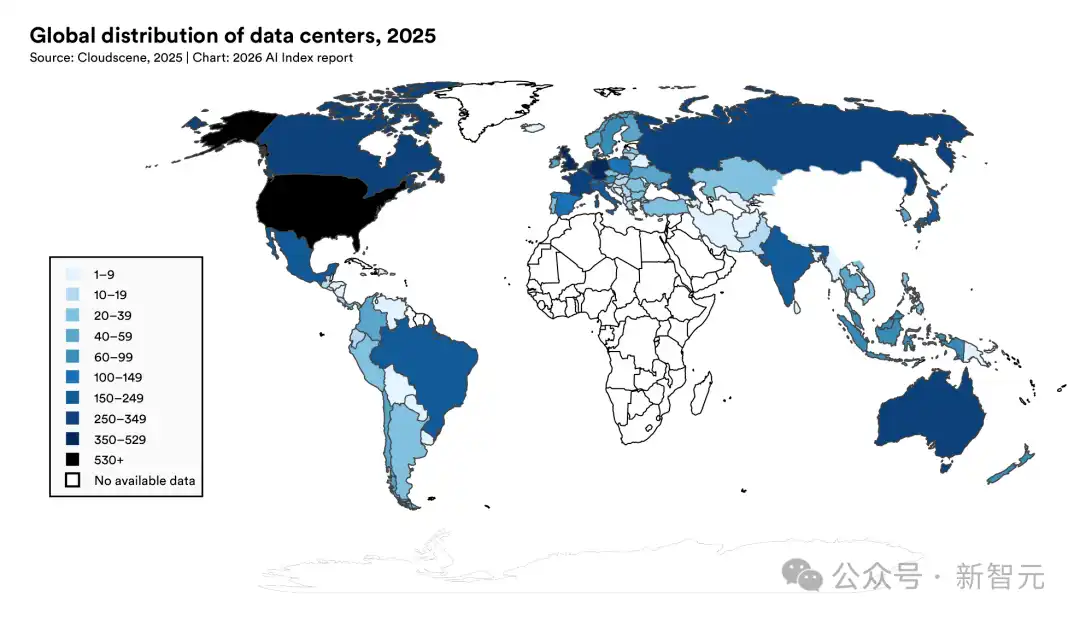
The total power of global AI data centers has reached 29.6 GW, equivalent to New York State's entire peak electricity demand. The estimated carbon emission for one training run of xAI Grok 4 is 72,816 tons of CO2 equivalent, equal to the tailpipe emissions of 17,000 cars driving for a year.
Where data centers are built, where electricity comes from, where chips are produced—these three questions have become the most headache-inducing issues on every AI company CEO's desk this year.
Generative AI Penetrated 53% in Three Years, Chinese Workplace Usage Exceeds 80%
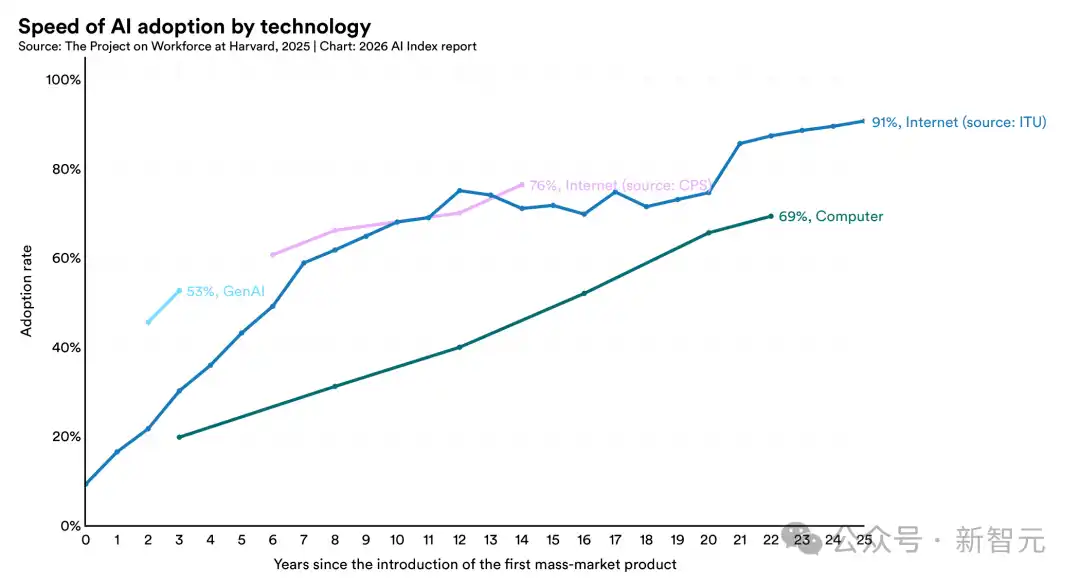
Generative AI reached a global population penetration rate of 53% within three years.
This speed is faster than personal computers, faster than the internet.
But penetration speed is highly correlated with country. Singapore 61%, UAE 54%, both ahead of the US. The US ranks only 24th among the surveyed countries, with a penetration rate of 28.3%.
If we change the dimension from consumers to the workplace, the contrast is greater.
Another set of data in the report shows that in 2025, 58% of employees globally had already started using AI regularly at work. But in five countries—China, India, Nigeria, UAE, Saudi Arabia—this proportion exceeded 80%.
China's workplace AI penetration rate is already more than 20 percentage points higher than the global average.
Even more interesting is consumer value.
AI Index estimates that by early 2026, generative AI tools create $172 billion in value annually for US consumers. From 2025 to 2026, the median value per user tripled.
The vast majority of users are still using the free version.
Entry-Level Positions Sharply Reduced, 22-25 Year-Old Dev Jobs Slashed 20%
The part of the entire AI Index that might be most沉默 for Chinese readers is probably the section on youth employment.
The number of employed software developers aged 22 to 25 has fallen by about 20% since 2024.
During the same period, older peer groups actually grew.
Not just development roles. Other high-AI-exposure industries like customer service are also showing the same pattern.
More worrying are the results of corporate surveys. Respondent executives generally expect future layoffs to be larger than in the past few months.
This isn't about the macro unemployment rate; it's about entry-level positions being precisely cut off.
If the first job is gone, the entire career ladder loses a rung. The long-term impact of this is something no one can calculate yet.
AI is Rewriting the Way Science is Done
If the employment section is cold, the science section is hot.
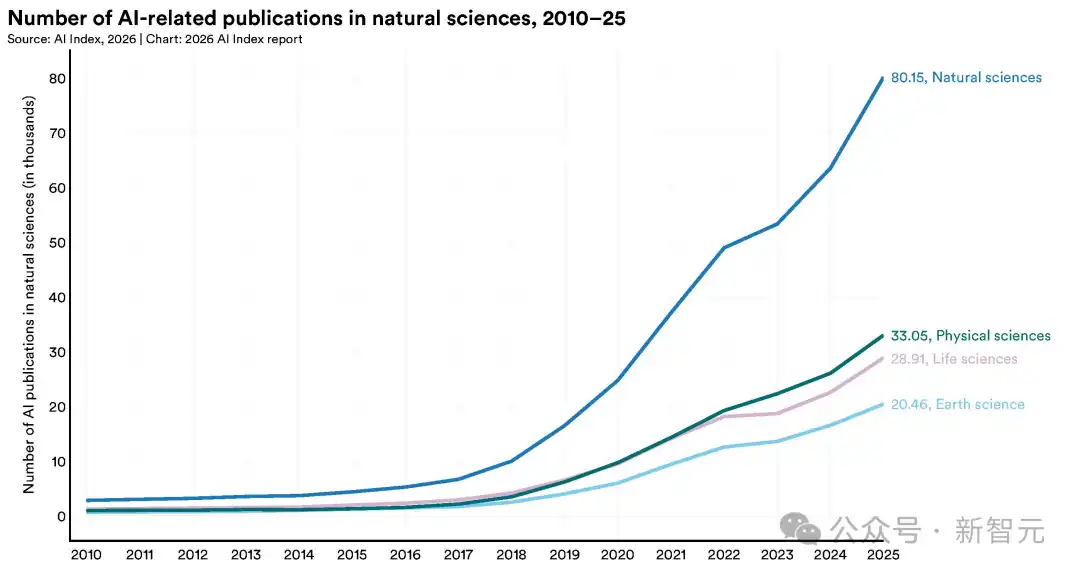
AI-related papers in natural sciences, physical sciences, and life sciences grew by 26% to 28% year-on-year in 2025.
Specifically in application, this year for the first time an AI completely ran an end-to-end weather forecasting process. From raw meteorological observation data directly outputting final forecasts for temperature, wind speed, humidity, with no traditional numerical models介入.
AI is moving from "helping you write papers" "helping you calculate numbers" to "making discoveries itself".
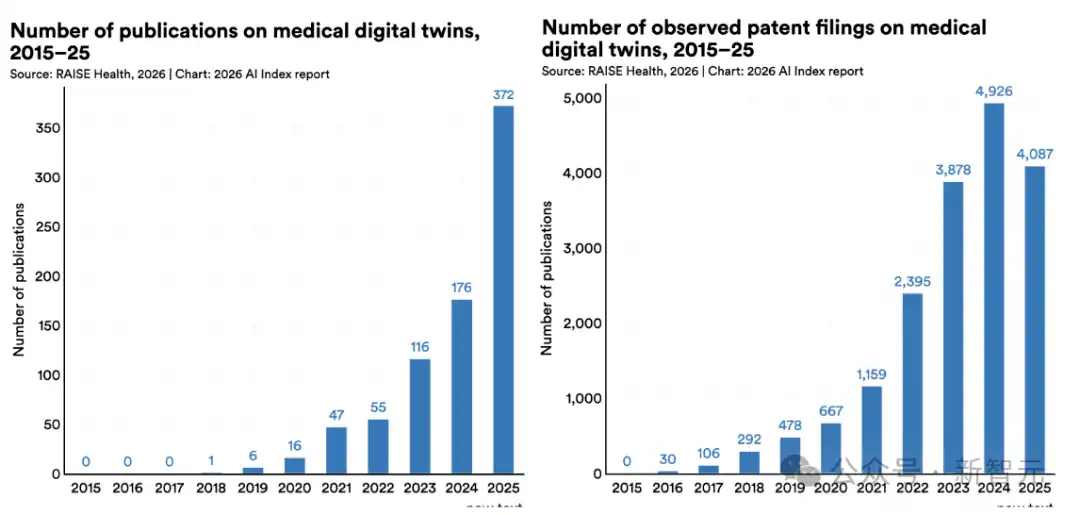
It's the same in hospitals. In 2025, many hospitals began deploying AI tools that can automatically generate clinical records from consultation dialogues. Doctors in multiple hospital systems reported that time spent writing medical records was reduced by up to 83%, with significant decreases in burnout.
But the same index pours cold water on medical AI. A review of over 500 clinical AI studies found that nearly half relied on exam-style datasets, and only 5% used real clinical data.
AI can reduce doctors' typing time, that's certain. AI's clinical value on real patients currently has many question marks.
Self-Learning Wave Explodes Globally, Formal Education Has Fallen Behind
Formal education can't keep up with AI.
4/5 of US high school and college students now use AI to complete school assignments. But only half of secondary schools have AI usage policies, and only 6% of teachers think these policies are clear.
Students are running ahead, teachers are still in place, rules haven't appeared yet.
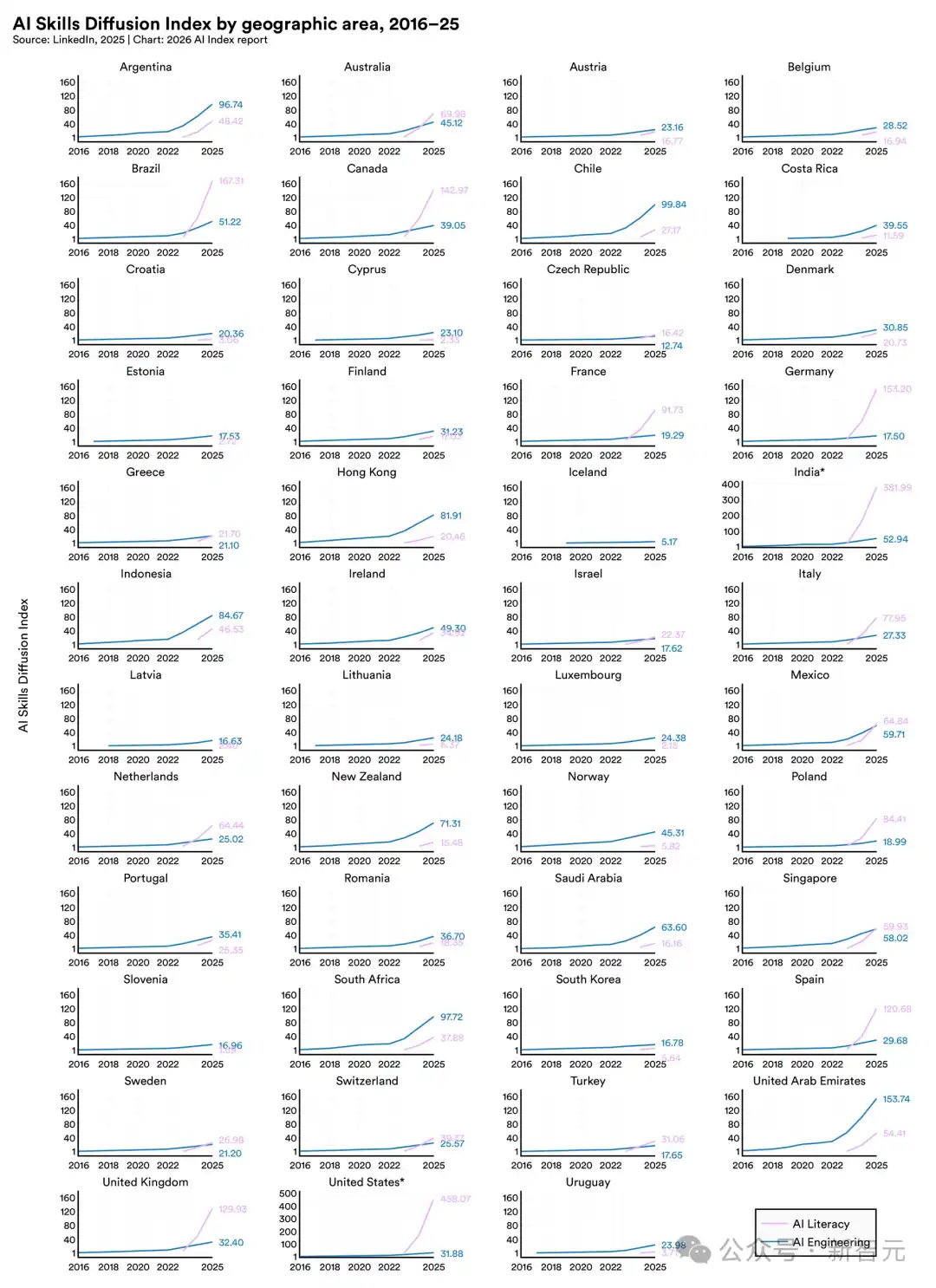
While formal education falls behind, the self-learning wave is exploding globally. It says the three countries with the fastest growth in learning AI engineering skills are the UAE, Chile, and South Africa.
Not the US, not Europe.
The steepest part of the skill curve is growing in places no one is looking.
Strongest Models Become the Most Opaque, Experts and Public are分裂
The strongest models are becoming the most opaque models.
The Foundation Model Transparency Index's average score fell from 58 last year to 40 this year. The AI Index directly点名, Google, Anthropic, OpenAI have all stopped公开 the training data scale and training duration of their latest models.
Of the 95 most representative models released last year, 80 did not公开 training code.
Public sentiment has also become more complex.
Globally, the proportion believing AI's benefits outweigh the risks rose from 52% to 59%. But during the same period, the proportion feeling nervous about AI rose from 50% to 52%.
Both directions are growing simultaneously.
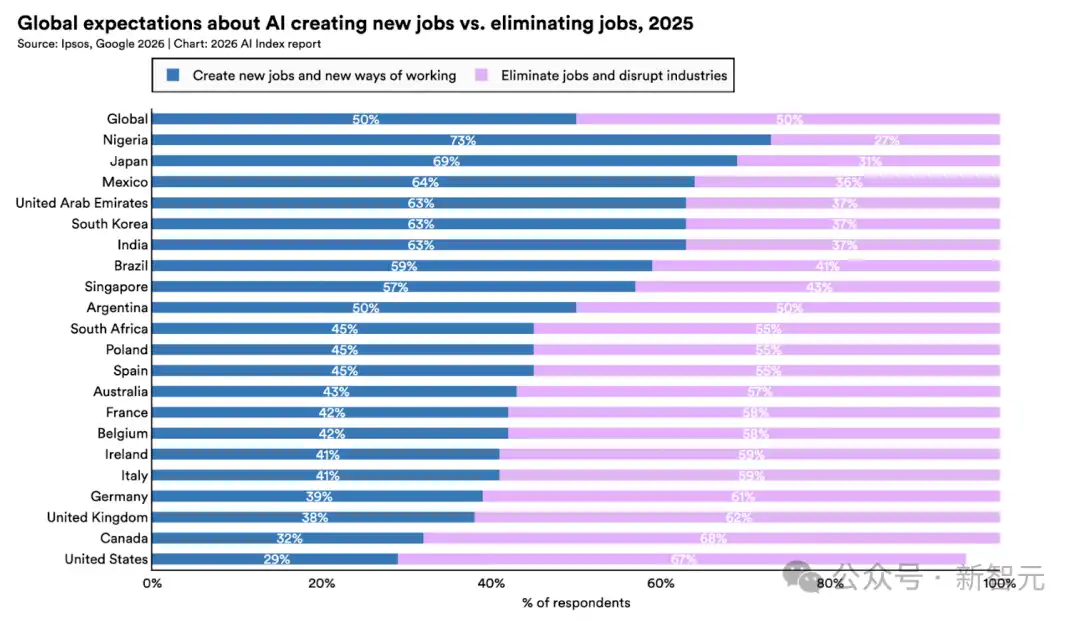
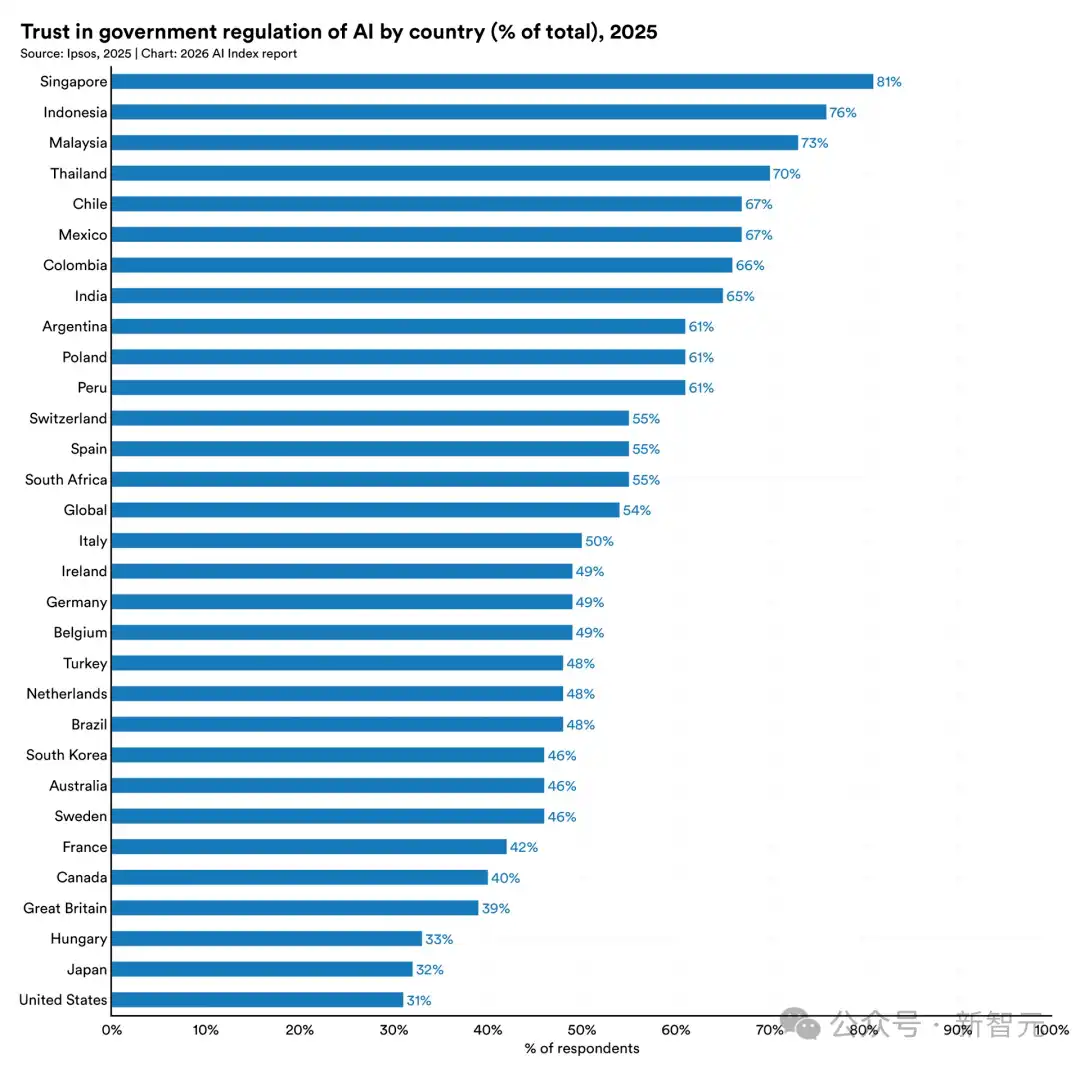
The most分裂 is the US. Only 33% of Americans think AI will make their jobs better, the global average is 40%. Americans' trust in their own government to regulate AI is the lowest among surveyed countries, 31%.
Singaporeans' trust in their government to regulate AI is 81%.
After the recent incident at Sam Altman's house was袭击, Silicon Valley insiders were "surprised to find" that ordinary people in the Instagram comments were not sympathetic, some even felt "it should be more intense".
They didn't realize things had gotten this bad.
The Pew and Ipsos data cited in the report show that the perception gap between experts and the public on the impact of AI on employment, healthcare, economy, etc.,普遍 exceeds 30 percentage points, with the largest gap reaching 50 percentage points.
On one side, the curves in the lab are soaring; on the other, ordinary people's unease is accumulating.
There is no bridge in between.
In Conclusion
The 423-page report has hundreds of charts, but it really only draws one picture.
The horizontal axis is time, the vertical axis is capability.
The model capability curve is flying, the computing power curve is flying, the investment curve is flying, the adoption rate curve is flying. Everything else is stagnating or moving downward.
This is the entire content of the 2026 AI Index.
AI is accelerating. Everything else is decoupling.
If you are in this industry, the question to ask now is not "what will the future be like", but "which curve are you standing on".
Пов'язані питання
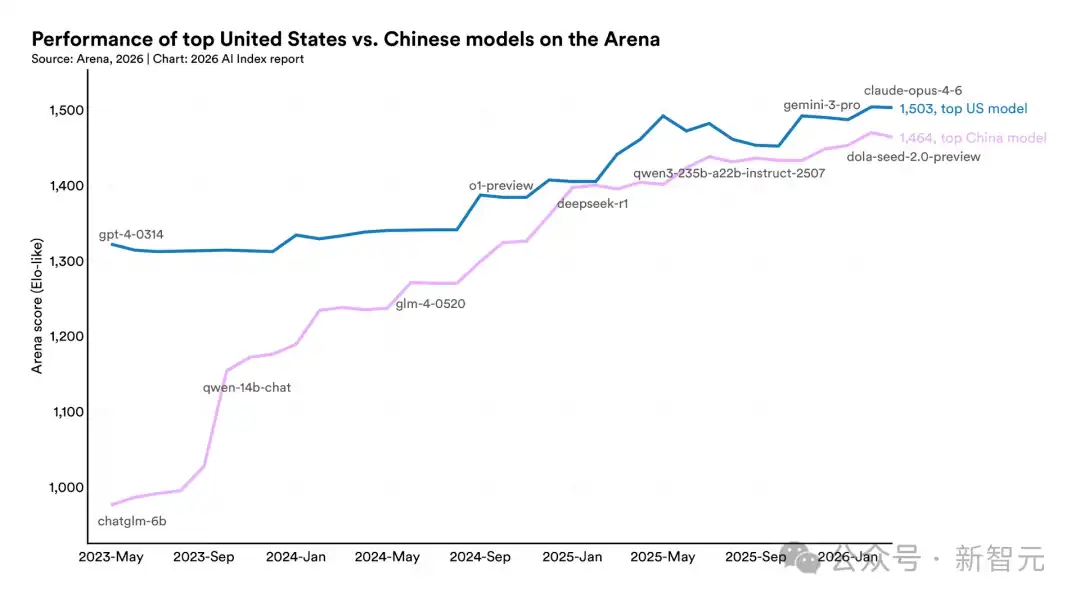
QWhat is the performance gap between the top AI models of the US and China according to the Stanford AI Index Report 2026?
AThe performance gap between the top AI models of the US and China has narrowed to just 2.7%.
QWhich Chinese institutions or companies are ranked in the global top 10 for AI models?
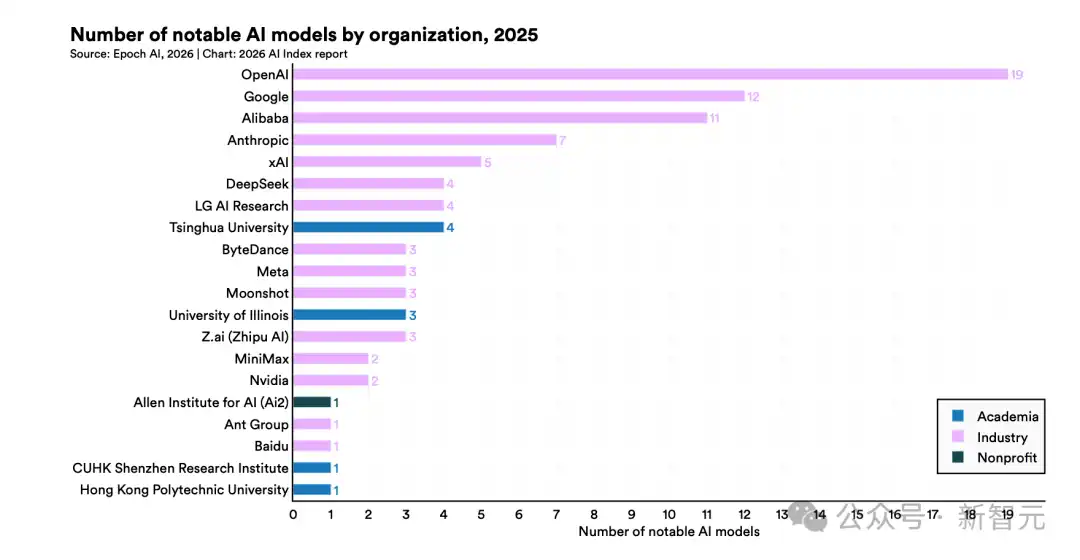
AAlibaba, DeepSeek, Tsinghua University, and ByteDance are the Chinese institutions and companies ranked in the global top 10.
QWhat percentage of the world's top AI models in the past year came from industry rather than academia?
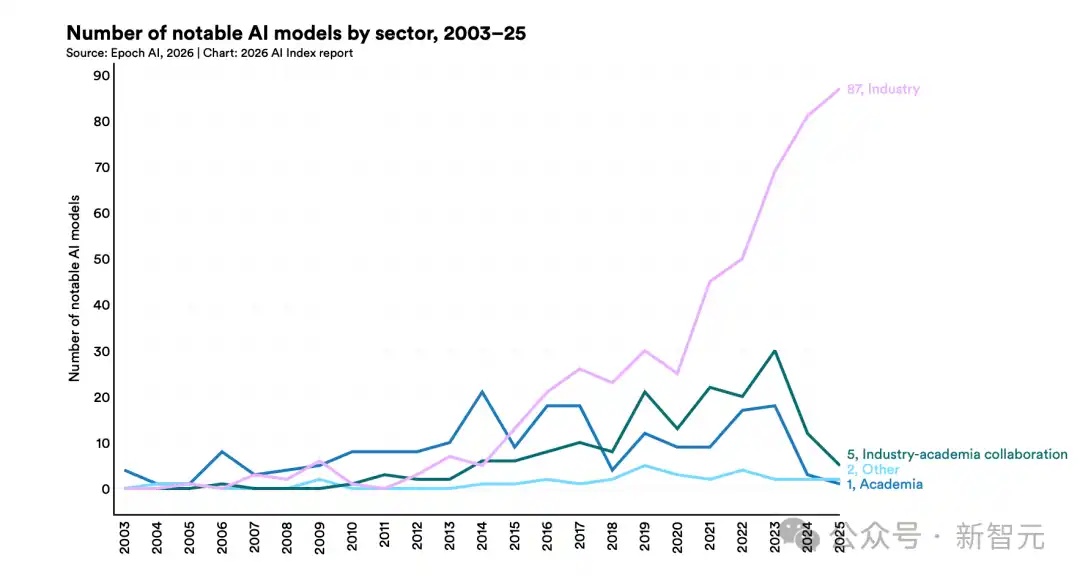
AOver 90% of the world's top AI models in the past year came from industry, not academia or government labs.
QWhat significant negative impact on employment is highlighted in the report, particularly for a specific age group?
AEmployment for software developers aged 22-25 has decreased by approximately 20% since 2024, as entry-level positions are being disproportionately affected.
QWhat is the term used in the report to describe the uneven and inconsistent development of AI capabilities?
AThe term used to describe the uneven development of AI capabilities is 'jagged frontier' (锯齿前沿).
Пов'язані матеріали
Waterdrip Capital CEO's In-depth Reflection: What is the Crypto Industry Losing?
The CEO of Waterdrip Capital provides a critical assessment of the current state of the crypto industry. He observes a landscape where Web3 token projects are failing en masse, leading to widespread legal actions. Major centralized exchanges (CEX), despite high trading volumes, have lost their influence over asset issuance and pricing, resembling traditional brokers. Many venture capital firms have exited due to a lack of viable exit strategies, with some resorting to or tolerating market manipulation.
Key failures are highlighted: the collapses of FTX and Luna shattered institutional trust, while leading CEXs prioritized short-term gains through listing low-quality projects, damaging the industry's long-term credibility. A controversial point is the critique of Ethereum's shift to Proof-of-Stake (PoS), arguing it forfeited a strategic opportunity to become a global, blockchain-based AI compute network under Proof-of-Work (PoW).
Despite the challenges, the author identifies two potential catalysts for a new cycle of prosperity: the U.S. officially adopting Bitcoin as a strategic reserve asset, or the emergence of a massive, value-generating on-chain application with hundreds of millions of users. He concludes that most other developments may only lead to cyclical rebounds rather than signaling a transformative new era.
marsbit15 хв тому

marsbit15 хв тому
Why Zhang Yiming Spends 50% of His Time on Seed?
Why does Zhang Yiming devote 50% of his time to Seed, ByteDance's core AI research team, while the company’s high-profile AI products like Doubao appear less dominant in the current market? An analysis reveals that ByteDance, historically a leader in defining trends (e.g., TikTok, Toutiao), has not set major AI industry agendas in the first half of the year, instead following competitors in areas like Agent and productivity tools.
ByteDance’s strategy diverges from peers like Tencent and Alibaba, who are integrating AI into holistic productivity systems. While Doubao is highly successful—with 382 million MAU and leading revenue—its very success may create inertia, focusing iterations on improving the AI assistant rather than pioneering disruptive new entry points like Agent-native desktops.
Zhang Yiming’s deep investment in Seed, a team of 300+ top researchers from firms like Google DeepMind, signals a long-term bet on foundational model capabilities as the ultimate competitive moat, reminiscent of ByteDance's past wins through superior underlying tech (e.g., recommendation algorithms). However, in the fast-evolving AI era, superior foundational models risk being outpaced by rapid shifts in product-level interaction paradigms and user habits. Zhang is essentially applying his principle of "delayed gratification" to corporate strategy, gambling that Seed’s breakthroughs will eventually make it the indispensable infrastructure for all AI applications, regardless of which product leads the user interface. The core question remains: is the AI era a race for the best product or the most powerful underlying infrastructure? The answer will define ByteDance’s future position.
marsbit24 хв тому

marsbit24 хв тому
From 'Speculative Asset' to 'The Next Generation Financial Infrastructure', Crypto is Growing a New TradFi World
From "Speculative Asset" to "Next-Generation Financial Infrastructure": Crypto Is Evolving into a New TradFi World
Looking back, the crypto industry has long focused on identifying the "next asset to pump." However, starting around 2026, several developments across different sectors began converging. Stablecoin market cap approached $300 billion, entering a global payments adoption phase. DTCC initiated its first live tokenized asset conversions, while prediction markets expanded into regulated exchanges and brokerages. Simultaneously, AI Agents began using stablecoins autonomously for payments.
These seemingly disparate trends share a common thread: the issuance, custody, trading, payment, and settlement capabilities built by the crypto industry over the past decade are now opening to broader financial activities and machine-driven economies. This suggests crypto is maturing beyond a purely speculative market, building a foundational infrastructure layer beneath it.
This simultaneous progress occurs because the core components of a new financial system—stablecoins as programmable money APIs, RWA tokenization for traditional assets, prediction markets for price discovery on future events, and AI Agents as new economic actors—have developed independently and are now beginning to interconnect. These elements form the building blocks of a next-generation financial infrastructure.
This emerging infrastructure features multi-layered capabilities: 1) Asset issuance and tokenization for a wider range of assets. 2) 24/7 programmable payments and settlement, simplifying global transfers. 3) Continuous trading and price discovery, providing real-time market signals for both humans and software. 4) Advanced identity, permissions, and authorization systems suitable for institutions and AI. 5) Growing connections to real-world legal and regulatory frameworks, providing greater clarity for traditional participants.
This shift is reflected in changing funding sources, with more revenue now coming from real-world business flows, an expanding set of participants (including corporate systems and autonomous agents), and more nuanced regulatory discussions focused on rules and boundaries rather than outright prohibition.
However, significant challenges remain. Technical confirmation is not legal finality; liability and governance for AI-driven payments are unclear; fragmentation across networks persists; privacy solutions for institutions are needed; and the system currently lacks mature frameworks for credit, insurance, and complex risk management found in traditional finance.
In conclusion, 2026 marks a pivotal point where several previously independent pieces of the crypto puzzle started to connect. While far from complete, it signifies crypto's crucial step towards becoming a low-friction, global execution layer for real assets, traditional institutions, and intelligent software, built beneath its vibrant speculative markets.
marsbit1 год тому

marsbit1 год тому
Robinhood Chain Welcomes Major Player: What Signals Does Uniswap's "Pools" Launch Send?
Uniswap is reportedly developing "Pools," a token launch platform, on Robinhood Chain. This move signals a strategic expansion from its core DEX functionality into the asset issuance space. The platform is expected to feature two main launch models: "Crowd Launch," a fair auction mechanism, and "Instant Launch," which utilizes a bonding curve for immediate trading. This integration aims to streamline the token launch process, combining fundraising, liquidity bootstrapping, and trading into a single protocol.
By deploying on Robinhood Chain, Uniswap seeks to tap into Robinhood's large retail user base, potentially bridging traditional finance users with DeFi applications. The development reflects a broader trend of DEXs evolving into comprehensive on-chain financial infrastructure. While the official launch is pending, market speculation has already sparked the creation of unofficial meme tokens. Ultimately, Pools represents Uniswap's ambition to redefine Web3 project launches and solidify its role as a foundational layer for the on-chain economy.
marsbit2 год тому

marsbit2 год тому
Supporters of Bitcoin BIP-110 Update Have Prepared a 'Last Resort' Plan If the Proposal Is Not Adopted: It Could Radically Change BTC's Value
Supporters of the BIP-110 update for Bitcoin have prepared a contingency plan in case the proposal is not adopted, a move that could radically alter BTC's value. Developer Chris Guida has adapted a proof-of-work code originally created by Luke Dashjr in 2017 for the current version of Bitcoin Knots. This adaptation is described as a last-resort measure to be activated if miners do not signal readiness for BIP-110. The proposal itself is a soft fork aimed at temporarily limiting the storage of arbitrary data in Bitcoin transactions. It introduces stricter limits on new transaction outputs, OP_RETURN fields, and witness data, with rules designed to expire after approximately one year.
Guida stated this option needs to remain open if miners were to "conspire to betray Bitcoin." Should the contingency code be used, it could change Bitcoin's current mining algorithm. This change would likely prevent existing ASIC miners from generating blocks on the new chain, leading to a large-scale reorganization of the Bitcoin mining network. Luke Dashjr, another Bitcoin Knots developer, contributed to the code and expressed hope it would not be needed, but sees its existence as useful for a potential crisis. A supporter known as Mechanic argued that the mere possibility of a proof-of-work change could act as a deterrent, emphasizing that Bitcoin's rules should be set by participants and node operators, not miners. While miner signals are tracked for BIP-110 activation, data from the proposal's official tracking page indicates support remains limited.
cryptonews.ru4 год тому

cryptonews.ru4 год тому
Популярні статті
Розуміння SPERO: Комплексний огляд Вступ до SPERO Оскільки ландшафт інновацій продовжує еволюціонувати, виникнення технологій web3 та криптовалютних проектів відіграє ключову роль у формуванні цифрового майбутнього. Один з проектів, який привернув увагу в цій динамічній сфері, — це SPERO, позначений як SPERO,$$s$. Ця стаття має на меті зібрати та представити детальну інформацію про SPERO, щоб допомогти ентузіастам та інвесторам зрозуміти його основи, цілі та інновації в рамках web3 та крипто-сектору. Що таке SPERO,$$s$? SPERO,$$s$ — це унікальний проект у криптопросторі, який прагне використати принципи децентралізації та технології блокчейн для створення екосистеми, що сприяє залученню, корисності та фінансовій інклюзії. Проект розроблений для полегшення взаємодії між користувачами новими способами, надаючи їм інноваційні фінансові рішення та послуги. У своїй основі SPERO,$$s$ прагне надати можливості індивідам, забезпечуючи інструменти та платформи, які покращують користувацький досвід у криптовалютному просторі. Це включає в себе можливість більш гнучких методів транзакцій, сприяння ініціативам, що підтримуються спільнотою, та створення шляхів для фінансових можливостей через децентралізовані додатки (dApps). Основна концепція SPERO,$$s$ обертається навколо інклюзивності, прагнучи зменшити розриви в традиційній фінансовій системі, використовуючи переваги технології блокчейн. Хто є творцем SPERO,$$s$? Особистість творця SPERO,$$s$ залишається дещо невідомою, оскільки є обмежені публічно доступні ресурси, що надають детальну інформацію про його засновників. Ця відсутність прозорості може бути наслідком зобов'язання проекту до децентралізації — етики, яку багато проектів web3 поділяють, ставлячи колективні внески вище за індивідуальне визнання. Зосереджуючи обговорення навколо спільноти та її колективних цілей, SPERO,$$s$ втілює суть наділення без виділення конкретних осіб. Таким чином, розуміння етики та місії SPERO є більш важливим, ніж ідентифікація єдиного творця. Хто є інвесторами SPERO,$$s$? SPERO,$$s$ підтримується різноманітними інвесторами, починаючи від венчурних капіталістів до ангельських інвесторів, які прагнуть сприяти інноваціям у крипто-секторі. Зосередження цих інвесторів зазвичай узгоджується з місією SPERO — пріоритет надається проектам, які обіцяють технологічний прогрес у суспільстві, фінансову інклюзію та децентралізоване управління. Ці інвесторські фонди зазвичай зацікавлені в проектах, які не лише пропонують інноваційні продукти, але й позитивно впливають на спільноту блокчейн та її екосистеми. Підтримка з боку цих інвесторів підкріплює SPERO,$$s$ як значного конкурента в швидко змінюваній сфері крипто-проектів. Як працює SPERO,$$s$? SPERO,$$s$ використовує багатогранну структуру, яка відрізняє його від традиційних криптовалютних проектів. Ось деякі ключові особливості, які підкреслюють його унікальність та інноваційність: Децентралізоване управління: SPERO,$$s$ інтегрує моделі децентралізованого управління, надаючи користувачам можливість активно брати участь у процесах прийняття рішень щодо майбутнього проекту. Цей підхід сприяє відчуттю власності та відповідальності серед членів спільноти. Корисність токена: SPERO,$$s$ використовує свій власний криптовалютний токен, розроблений для виконання різних функцій в екосистемі. Ці токени дозволяють здійснювати транзакції, отримувати винагороди та полегшувати послуги, що пропонуються на платформі, підвищуючи загальну залученість та корисність. Шарова архітектура: Технічна архітектура SPERO,$$s$ підтримує модульність та масштабованість, що дозволяє безперешкодно інтегрувати додаткові функції та додатки в міру розвитку проекту. Ця адаптивність є надзвичайно важливою для збереження актуальності в постійно змінюваному крипто-ландшафті. Залучення спільноти: Проект підкреслює ініціативи, що підтримуються спільнотою, використовуючи механізми, які стимулюють співпрацю та зворотний зв'язок. Підтримуючи сильну спільноту, SPERO,$$s$ може краще задовольняти потреби користувачів та адаптуватися до ринкових тенденцій. Фокус на інклюзію: Пропонуючи низькі комісії за транзакції та зручні інтерфейси, SPERO,$$s$ прагне залучити різноманітну базу користувачів, включаючи осіб, які раніше не брали участі в крипто-просторі. Це зобов'язання до інклюзії узгоджується з його загальною місією наділення через доступність. Хронологія SPERO,$$s$ Розуміння історії проекту надає важливі уявлення про його розвиток та етапи. Нижче наведено пропоновану хронологію, що відображає значні події в еволюції SPERO,$$s$: Етап концептуалізації та ідеації: Початкові ідеї, що стали основою SPERO,$$s$, були сформовані, тісно пов'язані з принципами децентралізації та фокусом на спільноті в індустрії блокчейн. Запуск білого паперу проекту: Після концептуального етапу був випущений комплексний білий папір, що детально описує бачення, цілі та технологічну інфраструктуру SPERO,$$s$, щоб залучити інтерес та зворотний зв'язок від спільноти. Створення спільноти та ранні залучення: Активні зусилля були спрямовані на створення спільноти ранніх прихильників та потенційних інвесторів, що полегшило обговорення цілей проекту та отримання підтримки. Подія генерації токенів: SPERO,$$s$ провів подію генерації токенів (TGE) для розподілу своїх рідних токенів серед ранніх прихильників та встановлення початкової ліквідності в екосистемі. Запуск початкового dApp: Перший децентралізований додаток (dApp), пов'язаний з SPERO,$$s$, став доступним, дозволяючи користувачам взаємодіяти з основними функціями платформи. Постійний розвиток та партнерства: Безперервні оновлення та вдосконалення пропозицій проекту, включаючи стратегічні партнерства з іншими учасниками блокчейн-простору, сформували SPERO,$$s$ у конкурентоспроможного та еволюціонуючого гравця на крипто-ринку. Висновок SPERO,$$s$ є свідченням потенціалу web3 та криптовалют для революціонізації фінансових систем та наділення індивідів. Завдяки зобов'язанню до децентралізованого управління, залучення спільноти та інноваційно спроектованих функцій, він прокладає шлях до більш інклюзивного фінансового ландшафту. Як і з будь-якими інвестиціями в швидко змінюваному крипто-просторі, потенційним інвесторам та користувачам рекомендується ретельно досліджувати та обдумано взаємодіяти з поточними подіями в SPERO,$$s$. Проект демонструє інноваційний дух крипто-індустрії, запрошуючи до подальшого дослідження його численних можливостей. Хоча подорож SPERO,$$s$ ще триває, його основні принципи можуть справді вплинути на майбутнє того, як ми взаємодіємо з технологією, фінансами та один з одним у взаємопов'язаних цифрових екосистемах.
248 переглядів усьогоОпубліковано 2024.12.17Оновлено 2024.12.17

Агент S: Майбутнє автономної взаємодії в Web3 Вступ У постійно змінюваному ландшафті Web3 та криптовалюти інновації постійно переосмислюють, як люди взаємодіють з цифровими платформами. Один з таких новаторських проектів, Агент S, обіцяє революціонізувати взаємодію людини з комп'ютером через свою відкриту агентну структуру. Прокладаючи шлях для автономних взаємодій, Агент S прагне спростити складні завдання, пропонуючи трансформаційні застосування в штучному інтелекті (ШІ). Це детальне дослідження заглиблюється в складності проекту, його унікальні особливості та наслідки для сфери криптовалюти. Що таке Агент S? Агент S є революційною відкритою агентною структурою, спеціально розробленою для вирішення трьох основних викликів в автоматизації комп'ютерних завдань: Набуття специфічних знань у галузі: Структура інтелектуально навчається з різних зовнішніх джерел знань та внутрішнього досвіду. Цей подвійний підхід дозволяє їй створити багатий репозиторій специфічних знань у галузі, покращуючи її продуктивність у виконанні завдань. Планування на довгих горизонтах завдань: Агент S використовує планування з підкріпленням досвіду, стратегічний підхід, який полегшує ефективний розподіл та виконання складних завдань. Ця функція значно підвищує її здатність ефективно та результативно управляти кількома підзавданнями. Обробка динамічних, неоднорідних інтерфейсів: Проект представляє Інтерфейс Агент-Комп'ютер (ACI), інноваційне рішення, яке покращує взаємодію між агентами та користувачами. Використовуючи багатомодальні великі мовні моделі (MLLMs), Агент S може безперешкодно орієнтуватися та маніпулювати різноманітними графічними інтерфейсами користувача. Завдяки цим новаторським функціям Агент S надає надійну структуру, яка вирішує складнощі, пов'язані з автоматизацією людської взаємодії з машинами, прокладаючи шлях для численних застосувань у ШІ та за його межами. Хто є творцем Агент S? Хоча концепція Агент S є фундаментально новаторською, конкретна інформація про його творця залишається невідомою. Творець наразі невідомий, що підкреслює або початкову стадію проекту, або стратегічний вибір зберегти засновників у таємниці. Незважаючи на анонімність, акцент залишається на можливостях та потенціалі структури. Хто є інвесторами Агент S? Оскільки Агент S є відносно новим у криптографічній екосистемі, детальна інформація про його інвесторів та фінансових спонсорів не задокументована. Відсутність публічно доступних відомостей про інвестиційні фонди або організації, що підтримують проект, викликає питання щодо його фінансової структури та дорожньої карти розвитку. Розуміння підтримки є критично важливим для оцінки стійкості проекту та потенційного впливу на ринок. Як працює Агент S? В основі Агент S лежить передова технологія, яка дозволяє йому ефективно функціонувати в різних умовах. Його операційна модель побудована навколо кількох ключових функцій: Взаємодія з комп'ютером, подібна до людської: Структура пропонує розширене планування ШІ, прагнучи зробити взаємодії з комп'ютерами більш інтуїтивними. Імітуючи людську поведінку при виконанні завдань, вона обіцяє підвищити досвід користувачів. Наративна пам'ять: Використовується для використання високорівневого досвіду, Агент S використовує наративну пам'ять для відстеження історій завдань, тим самим покращуючи свої процеси прийняття рішень. Епізодична пам'ять: Ця функція надає користувачам покрокові інструкції, дозволяючи структурі пропонувати контекстуальну підтримку в міру виконання завдань. Підтримка OpenACI: Завдяки можливості працювати локально, Агент S дозволяє користувачам зберігати контроль над своїми взаємодіями та робочими процесами, узгоджуючи з децентралізованою етикою Web3. Легка інтеграція з зовнішніми API: Його універсальність і сумісність з різними платформами ШІ забезпечують те, що Агент S може безперешкодно вписатися в існуючі технологічні екосистеми, роблячи його привабливим вибором для розробників та організацій. Ці функціональні можливості колективно сприяють унікальному положенню Агент S у крипто-просторі, оскільки він автоматизує складні, багатоступеневі завдання з мінімальним втручанням людини. У міру розвитку проекту його потенційні застосування в Web3 можуть переосмислити, як відбуваються цифрові взаємодії. Хронологія Агент S Розробка та етапи Агент S можуть бути узагальнені в хронології, яка підкреслює його значні події: 27 вересня 2024 року: Концепція Агент S була представлена в комплексній науковій статті під назвою “Відкрита агентна структура, яка використовує комп'ютери як людина”, що демонструє основи проекту. 10 жовтня 2024 року: Наукова стаття була опублікована на arXiv, пропонуючи детальне дослідження структури та її оцінки продуктивності на основі бенчмарку OSWorld. 12 жовтня 2024 року: Було випущено відеопрезентацію, що надає візуальне уявлення про можливості та особливості Агент S, ще більше залучаючи потенційних користувачів та інвесторів. Ці маркери в хронології не лише ілюструють прогрес Агент S, але й вказують на його прихильність до прозорості та залучення громади. Ключові моменти про Агент S У міру розвитку структури Агент S кілька ключових характеристик виділяються, підкреслюючи її новаторський характер та потенціал: Інноваційна структура: Розроблена для забезпечення інтуїтивного використання комп'ютерів, подібного до людської взаємодії, Агент S пропонує новий підхід до автоматизації завдань. Автономна взаємодія: Здатність автономно взаємодіяти з комп'ютерами через GUI означає стрибок до більш інтелектуальних та ефективних обчислювальних рішень. Автоматизація складних завдань: Завдяки своїй надійній методології він може автоматизувати складні, багатоступеневі завдання, роблячи процеси швидшими та менш схильними до помилок. Безперервне вдосконалення: Механізми навчання дозволяють Агенту S покращуватися на основі минулого досвіду, постійно підвищуючи свою продуктивність та ефективність. Універсальність: Його адаптивність до різних операційних середовищ, таких як OSWorld та WindowsAgentArena, забезпечує його здатність служити широкому спектру застосувань. Оскільки Агент S займає своє місце в ландшафті Web3 та криптовалюти, його потенціал покращити можливості взаємодії та автоматизувати процеси означає значний прогрес у технологіях ШІ. Завдяки своїй інноваційній структурі Агент S є прикладом майбутнього цифрових взаємодій, обіцяючи більш безперешкодний та ефективний досвід для користувачів у різних галузях. Висновок Агент S представляє собою сміливий крок вперед у поєднанні ШІ та Web3, з можливістю переосмислити, як ми взаємодіємо з технологією. Хоча проект все ще на ранніх стадіях, можливості для його застосування є величезними та переконливими. Завдяки своїй комплексній структурі, що вирішує критичні виклики, Агент S прагне вивести автономні взаємодії на передній план цифрового досвіду. У міру того, як ми заглиблюємося в сфери криптовалюти та децентралізації, проекти, подібні до Агент S, безсумнівно, відіграватимуть ключову роль у формуванні майбутнього технологій та співпраці людини з комп'ютером.
867 переглядів усьогоОпубліковано 2025.01.14Оновлено 2025.01.14
Ласкаво просимо до HTX.com! Ми зробили покупку Sonic (S) простою та зручною. Дотримуйтесь нашої покрокової інструкції, щоб розпочати свою криптовалютну подорож.Крок 1: Створіть обліковий запис на HTXВикористовуйте свою електронну пошту або номер телефону, щоб зареєструвати обліковий запис на HTX безплатно. Пройдіть безпроблемну реєстрацію й отримайте доступ до всіх функцій.ЗареєструватисьКрок 2: Перейдіть до розділу Купити крипту і виберіть спосіб оплатиКредитна/дебетова картка: використовуйте вашу картку Visa або Mastercard, щоб миттєво купити Sonic (S).Баланс: використовуйте кошти з балансу вашого рахунку HTX для безперешкодної торгівлі.Треті особи: ми додали популярні способи оплати, такі як Google Pay та Apple Pay, щоб підвищити зручність.P2P: Торгуйте безпосередньо з іншими користувачами на HTX.Позабіржова торгівля (OTC): ми пропонуємо індивідуальні послуги та конкурентні обмінні курси для трейдерів.Крок 3: Зберігайте свої Sonic (S)Після придбання Sonic (S) збережіть його у своєму обліковому записі на HTX. Крім того, ви можете відправити його в інше місце за допомогою блокчейн-переказу або використовувати його для торгівлі іншими криптовалютами.Крок 4: Торгівля Sonic (S)Легко торгуйте Sonic (S) на спотовому ринку HTX. Просто увійдіть до свого облікового запису, виберіть торгову пару, укладайте угоди та спостерігайте за ними в режимі реального часу. Ми пропонуємо зручний досвід як для початківців, так і для досвідчених трейдерів.
1.9k переглядів усьогоОпубліковано 2025.01.15Оновлено 2026.06.02