Stablecoin giant Tether makes $1B bid to buy Juventus FC

cointelegraphОпубліковано о 2025-12-13Востаннє оновлено о 2025-12-13

Анотація

Stablecoin issuer Tether has made a binding all-cash offer to acquire a controlling 65.4% stake in Italian soccer club Juventus FC from the Agnelli family's holding company, Exor. The bid, which would value the publicly traded club at approximately $1.1 billion, has reportedly been rejected, with a source stating "Juventus is not for sale." Tether CEO Paolo Ardoino, a lifelong fan, expressed the company's commitment to investing 1 billion euros into the club's development. Tether, which already owns over 10% of Juventus and recently secured a board seat, has been expanding its investments beyond crypto into AI, robotics, and health.

Crypto stablecoin issuer Tether says it has launched a bid to fully acquire the Italian professional soccer club, Juventus Football Club, which has reportedly already been shot down.

Tether said on Friday that it submitted a binding all-cash proposal to Exor, the holding company of the Agnelli family, for its 65.4% controlling stake in Juventus that it has held for over 100 years.

If Exor agrees, then Tether will make a “public offer for the remaining shares at the same price.” Juventus is a public company with a market capitalization of 944.49 million euros ($1.1 billion), having closed trading on Friday up 2.3% to 2.23 euros ($2.62).

However, AFP reported that Tether’s bid has already been rebuffed, with a source close to Exor saying that “Juventus is not for sale.” Exor and Tether did not immediately respond to Cointelegraph’s request for comment.

Tether promises $1.1 billion investment

Tether said it’s prepared to invest 1 billion euros ($1.1 billion) in the support and development of Juventus if the transaction completes.

“Tether is in a position of strong financial health and intends to support Juventus with stable capital and a long horizon,” said Tether CEO Paolo Ardoino.
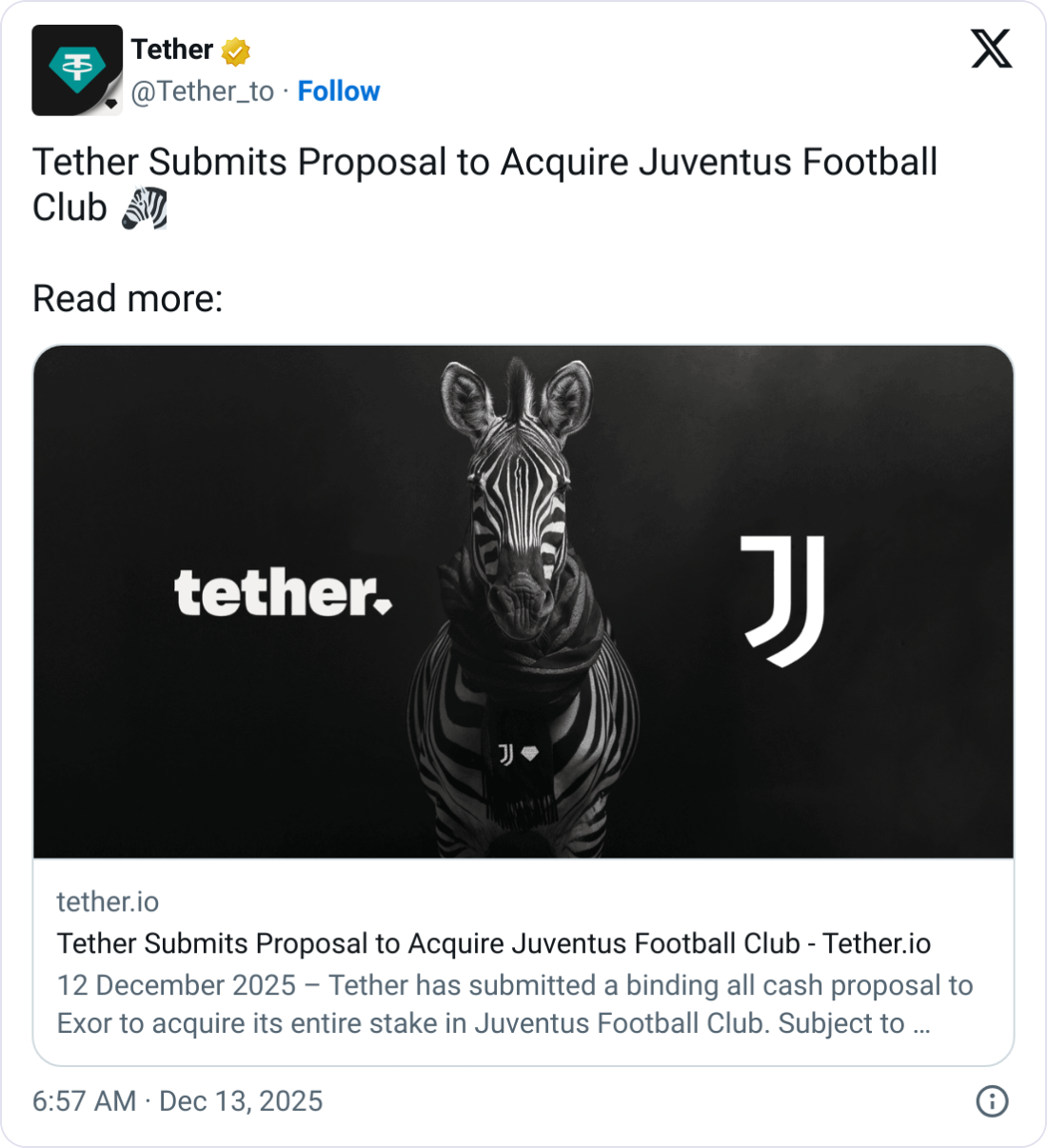
Source: Tether

“For me, Juventus has always been part of my life,” Ardoino added. “I grew up with this team. As a boy, I learned what commitment, resilience, and responsibility meant by watching Juventus face success and adversity with dignity.”

Related: Major fantasy sports operator enters prediction markets with Polymarket

Tether, which issues the self-named stablecoin Tether (USDT), has looked to expand its business beyond the token and has taken up investing in artificial intelligence, robotics and a health platform.

The company first bought a stake in Juventus in February and boosted its stake to over 10% in April.

It has since looked to boost its influence on the club and, in October, nominated its deputy investment chief, Zachary Lyons, along with Francesco Garino, to the football club’s board of directors.

The bids have paid off, as Juventus shareholders approved Garino’s appointment to the board of directors last month.

Magazine: Peter McCormack’s Real Bedford Football Club puts Bitcoin on the map

Пов'язані матеріали

Vitalik: We Need to Create Sanctuaries, Not Fight AI

In a recent interview, Vitalik Buterin, founder of Ethereum, addresses the central anxiety of the AI era. He argues the primary risk isn't AI's intelligence, but human passivity—ceding decisions, privacy, and agency to centralized systems or "super AIs" for a sense of "disempowering safety." His solution is not to fight AI, but to build "sanctuary technologies." These are optional, non-totalizing spaces that protect users while preserving their sovereignty and privacy. Ethereum is presented as a prime example, offering a parallel financial system one can freely choose, not a fix for the old one. Reflecting on his journey from a 19-year-old on "autopilot" to an active "pilot," Vitalik notes the world reinvents itself every 5-10 years. To keep up, individuals must actively pilot their lives, not be passive passengers. He stresses that active learning vastly outperforms passive learning, even with equal time invested. His practical advice for builders and individuals in the AI age includes: periodically forcing oneself to do tasks manually to keep the mind engaged; prioritizing active learning and verification over outsourcing answers; building tools that help retain human agency; not outsourcing all strategic thinking to AI; and preserving serendipity through real-world interactions. Ultimately, Buterin redefines Ethereum/crypto's role: not to win against or fix the old world, but to provide a free, optional alternative. The core message is that as AI grows more powerful, the truly scarce resource will be proactive humans who retain their sovereignty, privacy, and capacity for independent thought. The era demands not less tool use, but more intentional and active use of technology.

链捕手2 год тому

Vitalik: We Need to Create Sanctuaries, Not Fight AI

链捕手2 год тому

Conversation with Patagon Founder: Revealing the Inside Story of Anthropic's Secondary Market

**Summary: Inside Anthropic's Massive, Opaque Secondary Market** In a revealing interview, Patagon founder Dio Casares pulls back the curtain on the booming, high-risk secondary market for shares in companies like Anthropic. This private market, fueled by companies staying private longer and massive funding rounds, is estimated to involve hundreds of billions of dollars. Casares distinguishes between two types of "secondary" trading: 1. **Company-approved SPV (Special Purpose Vehicle) sales:** Where new capital flows into the company, often facilitated by select private equity firms. Anthropic supports this to manage liquidity and pre-IPO selling pressure. 2. **The "gray" market:** Platforms like Hive and Forge that match buyers and sellers, often creating pricing confusion and competing with official funding rounds. These intermediaries are widely disliked by companies. The market structure is complex and fragmented, relying heavily on personal connections. Brokers connect buyers and sellers, often layering multiple SPVs to pool capital, with single transaction fees as high as 10%. Strikingly, some finance professionals earn more from this trading than from their primary investment roles. **Key risks highlighted include:** * **High Fraud Rates:** An estimated 10-20% of transactions involve fake stock certificates or sellers who take payment without having the shares. * **Complex, Risky Structures:** Nested SPVs, "forward contracts" on employee equity, and tokenized private equity create layers of opacity. This is exemplified by a recent incident where an xAI employee's shares were revoked after an espionage allegation, leaving buyers empty-handed. * **Post-IPO "Settlement Hell":** After an IPO, delays in distributing shares through multiple SPV layers and decisions by fund managers to hold onto shares could trigger years of lawsuits as downstream investors are locked out. **For small investors** holding positions through tokenized vehicles or layered SPVs, it's often impossible to verify the underlying asset. Casares advises caution: if the investment feels wrong, consider exiting. As the private market now surpasses IPO fundraising, this "wild west" ecosystem faces a looming reckoning. While it will likely professionalize, the post-IPO period for a company like Anthropic could unleash a wave of disputes, exposing the vulnerabilities built into this frenzied, largely unregulated marketplace.

marsbit3 год тому

Conversation with Patagon Founder: Revealing the Inside Story of Anthropic's Secondary Market

marsbit3 год тому

Торгівля

Спот
Ф'ючерси
活动图片




