Spring Festival Asset Security Guide: How to Protect Your Tokens While Relaxing with Family and Friends?

marsbitОпубліковано о 2026-02-17Востаннє оновлено о 2026-02-17

Анотація

Ahead of the Lunar New Year, this guide outlines key strategies to protect your digital assets during a period of increased activity and potential distraction. Key risks highlighted include sophisticated AI-powered scams, such as voice and deepfake video calls that can perfectly mimic acquaintances to request urgent token transfers. The article stresses that traditional verification methods are no longer foolproof and recommends establishing offline verification protocols with trusted contacts. It also warns against clicking any links, even those shared by friends, and advises always using official channels for transactions. The second major risk involves accumulated wallet authorizations (approvals) from past DeFi interactions. These can become hidden vulnerabilities if old, unused permissions are exploited. The guide recommends a pre-holiday "security check" to review and revoke unnecessary approvals, especially unlimited ones, using tools within wallets like imToken or external sites like revoke.cash. The core principle is to adhere to the minimum necessary permissions. Finally, the article cautions against security lapses during travel and social gatherings. This includes never storing seed phrases digitally, avoiding public discussion of holdings, and only downloading wallets from official sources. For transactions, it is critical to double-check the full address (not just the first and last characters), conduct test transfers to new addresses, and use address whitel...

As the Lunar New Year approaches, a time for bidding farewell to the old and welcoming the new, it is also a moment to reflect:

Over the past year, have you fallen into the trap of Rug Pull projects? Have you "bought at the peak" due to the hype from shilling KOLs? Or have you fallen victim to increasingly rampant phishing attacks, suffering losses from clicking malicious links or signing malicious contracts?

Objectively speaking, the Spring Festival does not create risks, but it can amplify them—when the frequency of fund movements increases, when attention is diverted by holiday arrangements, and when trading pace quickens, even the smallest mistake can easily escalate into a loss.

Therefore, if you are planning to adjust your positions or organize your funds around the holiday, it is advisable to conduct a "pre-holiday security check" on your wallet. This article will also systematically outline specific actions ordinary users can take, starting from several real and high-frequency risk scenarios.

I. Beware of "AI Deepfake" and Voice Simulation Scams

The recent viral SeeDance 2.0 has once again made everyone realize a fact: in the era of rapidly penetrating AGI, "seeing is believing, hearing is truth" is becoming obsolete.

It can be said that since 2025, AI-based video and voice fraud technologies have become significantly more sophisticated, including voice cloning, video face-swapping, real-time expression imitation, and tone simulation, all entering an "industrialized stage" of low门槛 and scalable replication.

In fact, with AI, it is now possible to accurately replicate a person's voice, speech rate, pauses, and even micro-expressions. This means that during the Spring Festival, such risks are particularly likely to be amplified.

For example, while you are on your way home or during a gathering with relatives and friends, a message pops up on your phone: a "friend" from your contact list sends a voice or video message via Telegram or WeChat, sounding urgent, claiming that their account is restricted, they need to transfer funds for red envelopes, or they need a small temporary advance in tokens, and requesting an immediate transfer.

The voice sounds natural, and the video even shows a "real person." With your attention diverted by holiday arrangements, how would you judge?

In previous years, video verification was almost the most reliable method, but today, even if the other party is talking to you via camera, it is no longer 100% trustworthy.

In this context, relying solely on a glance at a video or a snippet of audio is no longer sufficient for verification. A more prudent approach is to establish an independent verification mechanism with your core circle (family, partners, long-term collaborators) outside of online communication, such as offline code words known only to each other, or some detail questions that cannot be inferred from public information.

Additionally, it is necessary to re-examine a common path risk: links forwarded by acquaintances. After all, as per tradition, during the Spring Festival, terms like "on-chain red envelopes" and "airdrop benefits" are highly likely to become诱导 entries for viral spread in the Web3 community. Many people are not deceived by strangers but by trusting links forwarded by acquaintances, thus clicking on精心 disguised authorization pages.

Therefore, everyone must also remember a simple yet extremely important principle: do not click on any links of unknown origin directly through social platforms, and certainly do not authorize, even if they come from "acquaintances."

It is best to conduct all on-chain operations through official channels, bookmarked websites, or trusted entry points, rather than completing them in chat windows.

II. Conduct a "Year-End Cleanup" of Your Wallet

If the first type of risk comes from trust being forged by technology, then the second type of risk comes from the risk exposure we ourselves have accumulated over time.

As is well known, authorization is the most basic yet easily overlooked mechanism in the DeFi world. When you operate in a DApp, you are essentially granting a token支配权 to a contract. This could be a one-time grant, an unlimited amount grant, short-term validity, or it could remain effective long after you have forgotten its existence.

Ultimately, it may not be an immediate risk point, but it is a持续存在的 risk exposure. Many users mistakenly believe that as long as assets are not stored in a contract, there is no security issue. However, during bull market cycles, users often frequently try various new protocols, participate in airdrops, staking, mining, and on-chain interactions, with authorization records continuously accumulating. When the hype subsides, many protocols are no longer used, but the permissions remain.

Over time, these excess historical authorizations are like a bunch of uncleaned keys. Once a protocol you long forgot has a contract vulnerability, it can easily lead to losses.

And the Spring Festival is a natural organizing node. It is a very worthwhile action to use the relatively calm pre-holiday time window to systematically check your authorization records:

Specifically, you can revoke authorizations that are no longer in use, especially unlimited authorizations; use limited authorizations for large assets held daily instead of长期开放全部余额 permissions; and separate long-term storage assets from daily operation assets, forming a structural分层 of hot wallets and cold wallets.

In the past, many users needed external tools (such as revoke.cash and other websites) to complete such checks. Nowadays, mainstream Web3 wallets like imToken have built-in authorization detection and revocation capabilities, allowing you to view and manage historical authorizations directly within the wallet.
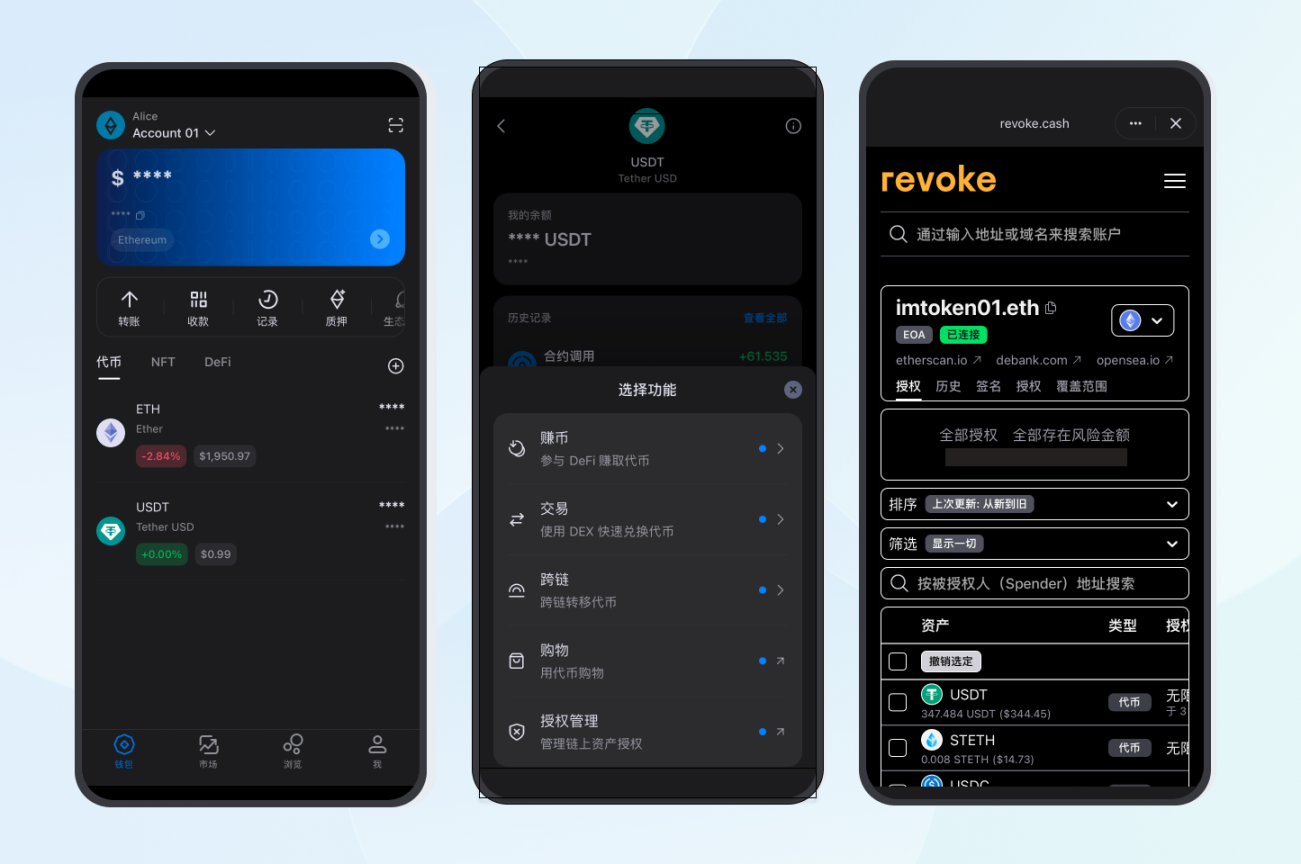
In the final analysis, wallet security is not about never authorizing, but about the principle of least privilege—only granting necessary permissions for the present and收回 them promptly when they are no longer needed.

III. Do Not Slack Off in Travel, Social Interactions, and Daily Operations

If the first two types of risks come from technological upgrades and permission accumulation, respectively, then the third type of risk comes from environmental changes.

Spring Festival travel (returning home, traveling, visiting relatives and friends) often means frequent device switching, complex network environments, and密集 social scenarios. In such an environment, the脆弱性 of private key management and daily operations can be significantly amplified.

Seed phrase management is the most typical example. Saving screenshots of seed phrases in手机相册, cloud storage, or forwarding them to yourself via instant messaging tools is often done for convenience. However, in mobile scenarios, this convenience恰恰 constitutes the greatest hidden danger.

So remember, seed phrases must be physically isolated, avoiding any online storage methods. The bottom line of private key security is to stay offline.

Social scenarios also require boundary awareness. Displaying large asset pages or discussing specific holding scales during holiday gatherings is often unintentional but can lay the groundwork for future risks. Even more需要警惕的是, behavior that guides the download of disguised wallet applications or browser extensions under the guise of "exchanging experiences" or "teaching guidance."

All wallet downloads and updates should be completed through official channels, not through跳转 from social chat windows.

In addition, always confirm three things before transferring: network, address, and amount. After all, there have been too many cases of whales suffering significant asset losses due to误操作 from similar首尾号 address attacks, and such phishing attacks have become industrialized in the past six months:

Hackers often generate a large number of on-chain addresses with different首尾号 as a预备 seed library. Once a address receives a fund transfer from the outside, they immediately find an address with the same首尾号 in the seed library and then initiate an associated transfer through a contract, casting a wide net and waiting for a catch.

Since some users sometimes directly copy the target address from transaction records and only check the first and last few digits, they fall victim. According to Cos, founder of SlowMist, regarding首尾号 phishing attacks, "hackers are playing a撒网 attack, waiting for willing上钩, a game of probability."
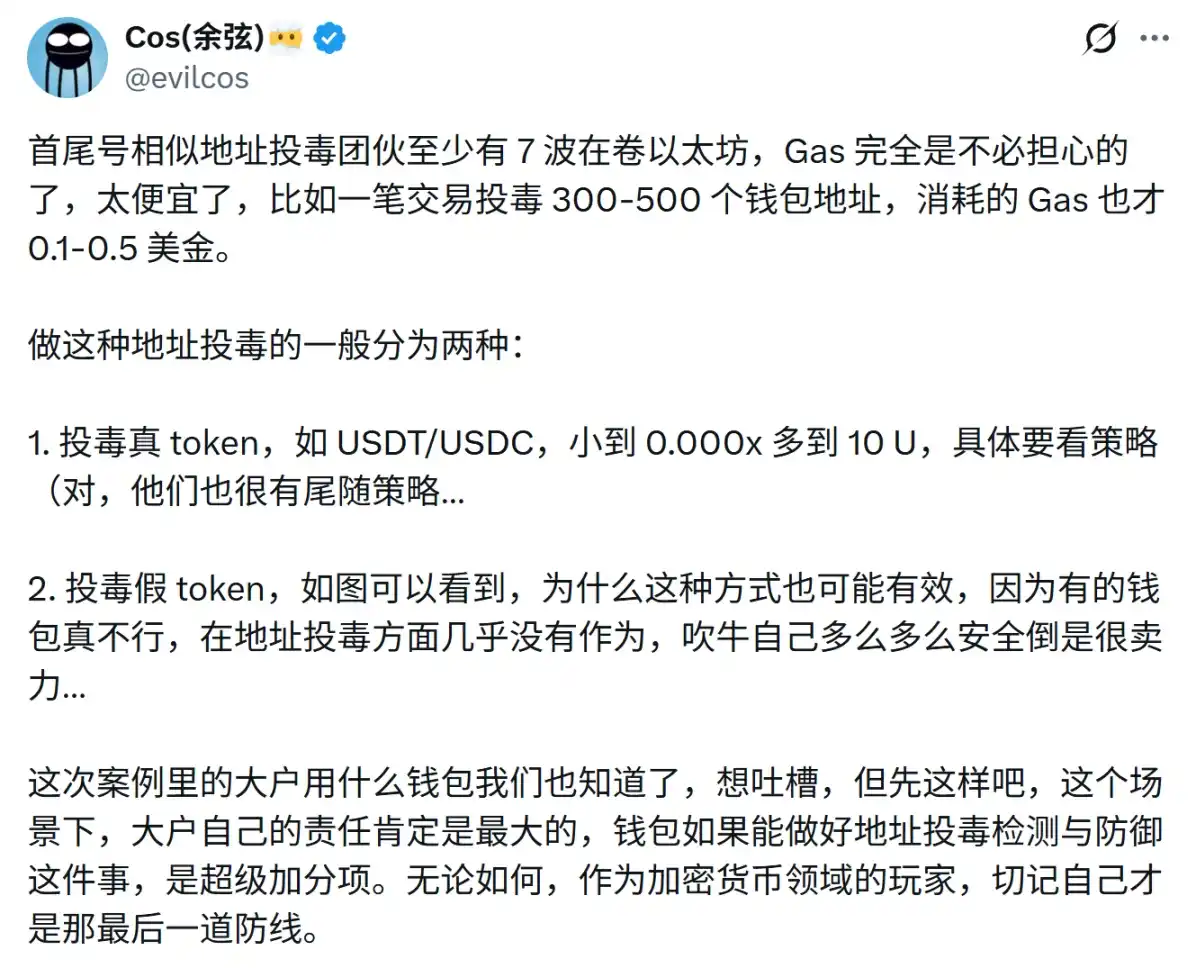
Since the Gas cost is extremely low, attackers can batch poison hundreds or even thousands of addresses, waiting for a few users to make mistakes while copying and pasting. One success yields收益远高于成本.

These issues are not about how complex the technology is, but about everyone's daily operating habits:

  • Check the full address characters, not just the beginning and end;
  • Do not copy transfer addresses directly from history records without checking;
  • When transferring to a new address for the first time, conduct a small test transfer first;
  • Prioritize using the address whitelist function to manage frequently used addresses固定;

In the current decentralized system dominated by EOA accounts, users themselves are always their own first responsible person and last line of defense (extended reading "The $3.35 Billion 'Account Tax': When EOA Becomes a Systemic Cost, What Can AA Bring to Web3?").

In Conclusion

Many people always feel that the on-chain world is too dangerous and not user-friendly for ordinary users.

To be实事求是, Web3确实很难 provide a zero-risk world, but it can become an environment where risks are manageable.

For example, the Spring Festival is a time to slow down the pace and is also the most suitable time window of the year to organize risk structures. Instead of rushing to operate during the holiday, it is better to complete security checks in advance; instead of remedying afterwards, it is better to optimize permissions and habits提前.

Wishing everyone a safe and smooth Spring Festival, and may everyone's on-chain assets be stable and worry-free in the new year.

Пов'язані питання

QWhat are the main types of risks discussed in the article regarding asset security during the Spring Festival?

AThe article discusses three main types of risks: 1) AI deepfake and voice simulation scams, 2) risks from accumulated hidden authorization exposures in wallets, and 3) risks from environmental changes during travel and social interactions.

QWhy is it no longer sufficient to rely solely on video or voice calls to verify someone's identity during the Spring Festival?

ABecause AI technology has advanced to the point where it can accurately clone voices, simulate facial expressions, and mimic speech patterns, making it possible for scammers to create convincing fake videos and audio messages that appear to be from trusted contacts.

QWhat is the recommended approach to managing wallet authorizations to minimize risk?

AThe recommended approach is to follow the principle of least privilege: regularly check and revoke unused authorizations, especially unlimited ones; use limited authorizations for large assets; and separate long-term storage assets from daily operational assets by using a structure of hot and cold wallets.

QWhat specific advice does the article give for avoiding address poisoning attacks during transactions?

AThe advice includes: always check the full address characters instead of just the beginning and end; avoid copying addresses directly from transaction history without verification; perform a small test transaction when sending to a new address for the first time; and use address whitelisting to manage frequently used addresses.

QWhat is the fundamental principle for storing seed phrases to ensure security?

ASeed phrases must be stored with physical isolation and should never be stored in any networked environment, such as phone galleries, cloud drives, or sent via instant messaging tools. The bottom line for private key security is to keep it offline.

Пов'язані матеріали

Borrowing Money from a Hundred Years Later, Building Incomprehensible AI

Tech giants like Alphabet, Amazon, Meta, and Microsoft are undergoing a radical financial transformation due to AI. Their traditional "light-asset, high-free-cash-flow" model is being dismantled by staggering capital expenditures on AI infrastructure—data centers, GPUs, and power. Combined 2026 guidance exceeds $700 billion, a 4.5x increase from 2022, causing free cash flow to plummet (e.g., Amazon's fell 95%). To fund this, they are borrowing unprecedented sums through long-dated, multi-currency bonds (e.g., Alphabet's 100-year bond). The world's most conservative capital—pensions, insurers—is now funding Silicon Valley's most speculative bet. This shift makes these companies resemble heavy-asset industrials (railroads, utilities) rather than software firms, threatening their premium valuations. Historically, such infrastructure booms (railroads, fiber optics) followed a pattern: genuine technology, overbuilding fueled by competitive frenzy, aggressive debt financing, and a crash triggered by financial conditions—not technology failure. The infrastructure remained, but many original builders and financiers did not survive. The core gamble is a "time arbitrage": using cheap debt today to build scale and lock in customers before AI capabilities commoditize. They are betting that AI revenue will materialize before debt comes due. Their positions vary: Amazon is under immediate cash pressure; Meta's path to monetization is unclear; Alphabet has a robust core business buffer; Microsoft has the shortest path from infrastructure to revenue. The contract is set: the most risk-averse global capital has lent its time to Silicon Valley, awaiting a future that is promised but uncertain.

marsbit28 хв тому

Borrowing Money from a Hundred Years Later, Building Incomprehensible AI

marsbit28 хв тому

The 'VVV' Concept Soars 9x in Half a Year, The New AI Narrative on Base Chain

"The article explores the 'VVV' concept as the new AI-focused narrative within the Base ecosystem, centered around the token $VVV of the privacy-focused, uncensored generative AI platform Venice, led by crypto veteran Erik Voorhees. Venice has seen significant growth in 2026, with its API users surging, partly attributed to exposure from OpenClaw. The platform now boasts over 2 million total users and 55,000 paid subscribers. Correspondingly, the $VVV token price has risen over 9x this year. Key to its performance are tokenomics designed for value accrual: reduced annual emissions, subscription revenue used for buyback-and-burn, and a unique staking mechanism. Staking $VVV yields $sVVV, which can be used to mint $DIEM tokens. Each staked $DIEM provides a daily $1 credit for using Venice's API services, creating tangible utility. The article also highlights other tokens associated with the 'VVV' narrative. $POD, the token of distributed AI network Dolphin (which co-developed Venice's default AI model), saw a massive price surge. $cyb3rwr3n, a project for a Venice credit auction market, gained attention due to perceived connections to Venice's team despite official denials. Finally, $SR of robotics platform STRIKEROBOT.AI rose after announcing a partnership with Venice for robot vision-language model development. Overall, the 'VVV' ecosystem combines AI platform growth, deflationary tokenomics, and innovative utility mechanisms, driving significant investor interest and price action in related tokens."

marsbit37 хв тому

The 'VVV' Concept Soars 9x in Half a Year, The New AI Narrative on Base Chain

marsbit37 хв тому

Anthropic and OpenAI Have Single-Handedly Severed the Logic of Pre-IPO Stock Tokenization

The pre-IPO stock token market is experiencing significant turmoil following strong statements from AI giants Anthropic and OpenAI. Both companies have updated their official policies, declaring that any transfer of their company shares—including sales, transfers, or assignments of share interests—without prior board approval is "invalid" and will not be recognized in their corporate records. This means buyers in such unauthorized transactions would not be recognized as shareholders and would have no shareholder rights. A major point of contention is the use of Special Purpose Vehicles (SPVs), which are legal entities commonly used by pre-IPO token platforms to pool investor funds and indirectly acquire shares from employees or early investors. The companies explicitly state they do not permit SPVs to acquire their shares, and any such transfer violates their restrictions. They warn that third parties selling shares through SPVs, direct sales, forward contracts, or stock tokens are likely engaged in fraud or are offering worthless investments due to these transfer limits. This stance directly threatens the core model of many pre-IPO token platforms, which rely on SPV structures. The announcement revealed additional risks within this model, such as complex "SPV-within-SPV" layering that obscures legal transparency, increases management fees, and creates a chain reaction risk of invalidation. Following the news, tokens like ANTHROPIC and OPENAI on platforms like PreStocks fell sharply (over 20%). The market reaction highlights a divergence: while asset-backed pre-IPO tokens plummeted, purely speculative pre-IPO futures contracts, which are bilateral bets on future IPO prices with no claim to actual shares, remained relatively stable as they are unaffected by the transfer restrictions. The industry is split on the implications. Some believe the fundamental logic of pre-IPO token trading is broken if leading companies reject SPV-held shares, potentially causing a domino effect. Others, like Rivet founder Nick Abouzeid, argue that buyers of such unofficial tokens always knowingly accepted the risk of non-recognition by the company. The statements serve as a stark risk warning and a corrective measure for a market where valuations for some AI-related pre-IPO tokens had soared to irrational levels, far exceeding recent funding round valuations.

marsbit1 год тому

Anthropic and OpenAI Have Single-Handedly Severed the Logic of Pre-IPO Stock Tokenization

marsbit1 год тому

Anthropic and OpenAI Personally Sever the Logic of Pre-IPO Crypto-Stocks

The pre-IPO token market has been rocked by strong statements from Anthropic and OpenAI. Both AI giants have updated official warnings, declaring that any sale or transfer of their company shares without explicit board approval is "invalid" and will not be recognized on their corporate records. This directly targets Special Purpose Vehicles (SPVs), the common legal structure used by pre-IPO token platforms. These platforms typically use an SPV to acquire shares from employees or early investors, then issue blockchain-based tokens representing a claim on the SPV's economic benefits. Anthropic and OpenAI's position means that if an SPV's share purchase lacked authorization, the underlying asset could be deemed worthless, nullifying the token's value. Anthropic explicitly warned that any third party selling its shares—via direct sales, forwards, or tokens—is likely fraudulent or offering a valueless investment. The crackdown highlights risks in the popular SPV model, including complex multi-layered "Russian doll" SPV structures that obscure legal ownership, add fees, and concentrate risk. If one layer is invalidated, the entire chain could collapse. Following the announcements, tokens like ANTHROPIC and OPENAI on platforms like PreStocks fell sharply (over 20%). In contrast, purely speculative pre-IPO prediction contracts remained stable, as they involve no actual share ownership. The move is seen as a corrective measure amid a market frenzy where some pre-IPO token valuations (e.g., Anthropic's token hitting a $1.4 trillion implied valuation) far exceeded recent official funding rounds. Opinions are split: some believe this undermines the core logic of pre-IPO token trading if top companies reject SPVs, while others argue buyers always assumed this legal risk when accessing unofficial channels. The statements serve as a stark warning and a potential catalyst for market de-leveraging and clearer boundaries.

Odaily星球日报1 год тому

Anthropic and OpenAI Personally Sever the Logic of Pre-IPO Crypto-Stocks

Odaily星球日报1 год тому

Торгівля

Спот
Ф'ючерси
活动图片