Spot volumes drop 66% in ‘lulls’ that often precede next cycle leg: Bitfinex

cointelegraphОпубліковано о 2025-12-13Востаннє оновлено о 2025-12-13

Анотація

Bitfinex reports a 66% decline in crypto spot trading volumes this quarter, dropping from over $500 billion in early November to around $250 billion. The exchange notes this mirrors historical market lulls that often precede the next cycle upswing. Analysts observe Bitcoin's tightening price structure near key levels of $89,000–$92,000, suggesting a breakout toward $100,000 is possible if resistance is broken. Despite a recent Fed rate cut and a large institutional purchase, momentum faded as the move was already priced in, leaving markets subdued amid softer ETF inflows and macroeconomic uncertainty.

Bitfinex says crypto spot trading activity has fallen sharply this quarter, with volumes down 66% from January’s peak as traders step back amid softer ETF inflows and an uncertain macro backdrop.

In a Sunday post on X, the exchange noted that the slowdown mirrors periods seen in earlier market cycles, where extended lulls often “precede the next leg in the cycle.”

According to data from CoinMarketCap, 30-day crypto spot volumes have slipped from over $500 billion in early November to roughly $250 billion this week.

Trading activity struggled to stay above the $300–$350 billion range throughout late November and early December, with several sessions sliding toward $200 billion, levels not seen in months. The decline followed a brief spike in mid-November, when volumes exceeded $550 billion before retreating quickly, data shows.
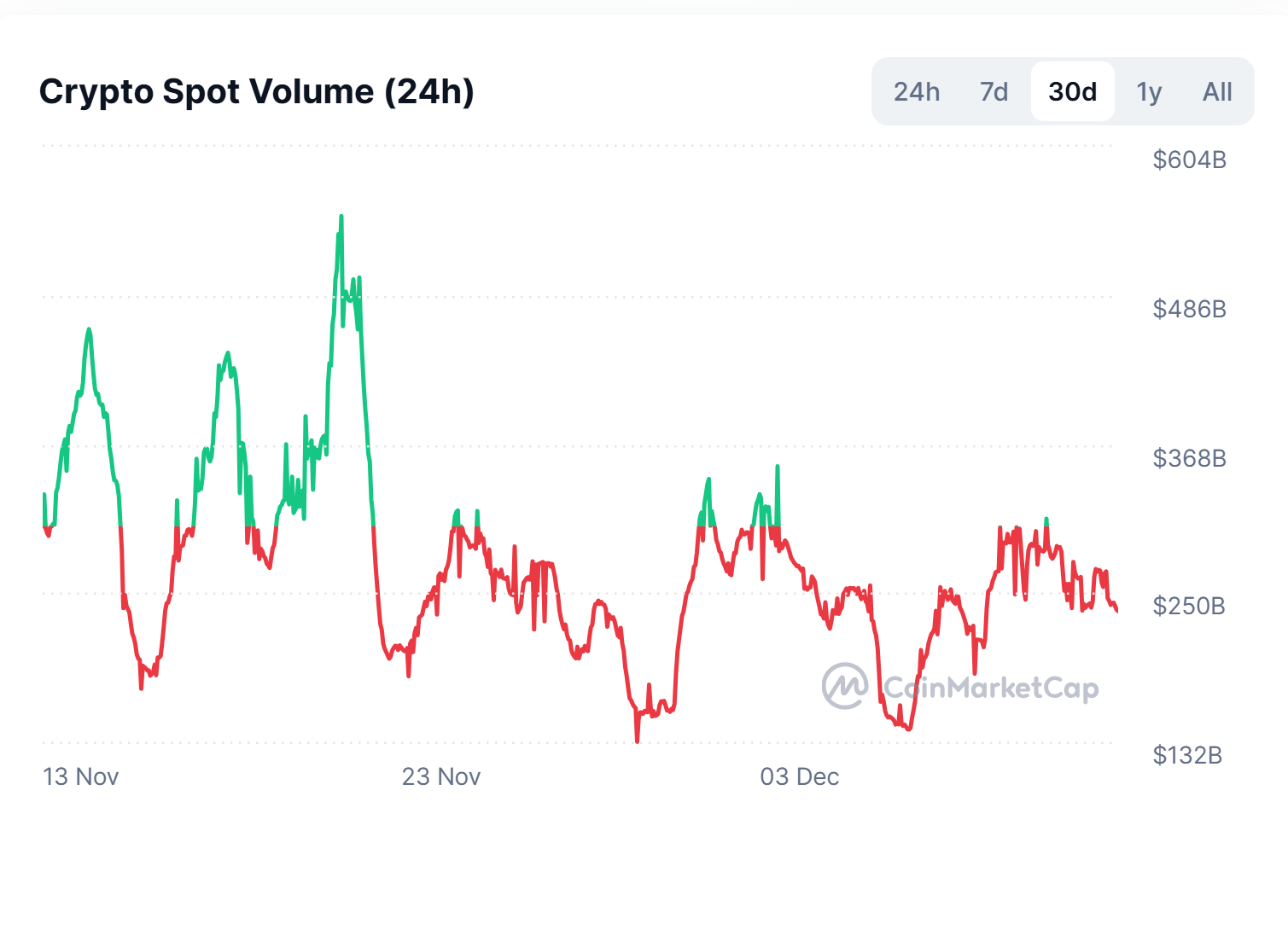
Spot crypto volumes continue to drop. Source: CoinMarketCap

Related: Brazil’s largest private bank advises investors to allocate 3% to Bitcoin in 2026

Bitcoin nearing breakout as key levels tighten

Meanwhile, market analysts say the current environment resembles previous pre-breakout periods. In a recent post on X, Michaël van de Poppe noted a tightening price structure in Bitcoin (BTC), saying that major macro events in the coming week could drive a surge in volatility.

“Bitcoin holds above this crucial level, but I'm sure we'll start to see volatility pick up significantly over the course of the next days,” the analyst said.

He pointed to key levels at $89,000 and $92,000, arguing that a break above resistance could accelerate a move toward $100,000 before 2026, while losing support risks another retest of lower ranges.

Related: Bitcoin rallies fail at $94K despite Fed policy shift: Here's why

Crypto slips despite fed cut

As Cointelegraph reported, Bitcoin briefly climbed to $94,330 early in the week, lifted by Strategy’s $962 million purchase, its largest Bitcoin investment since mid-2025.

However, the momentum faded quickly as traders awaited the final Federal Open Market Committee meeting of the year. The Federal Reserve delivered a widely expected 25-basis-point rate cut on Wednesday, giving markets a short-lived boost before sentiment cooled again. According to CoinEx analyst Jeff Ko, the move offered little upside because it was “already priced in.”

Magazine: 2026 is the year of pragmatic privacy in crypto — Canton, Zcash and more

Пов'язані питання

QAccording to Bitfinex, by what percentage have crypto spot trading volumes dropped from January's peak?

ACrypto spot trading volumes have dropped by 66% from January's peak.

QWhat does Bitfinex suggest that the current market slowdown often precedes, based on historical cycles?

ABitfinex suggests that extended lulls in the market often precede the next leg in the cycle.

QWhat are the two key Bitcoin price levels mentioned by analyst Michaël van de Poppe that could determine the next major price move?

AThe two key Bitcoin price levels are $89,000 and $92,000.

QDespite a Fed rate cut, why did the crypto market see little upside according to CoinEx analyst Jeff Ko?

AThe market saw little upside because the rate cut was already priced in by investors.

QWhat event in mid-November 2025 caused a brief spike in crypto trading volumes before they retreated?

AA brief spike in mid-November was caused by volumes exceeding $550 billion, though the article does not specify the exact event that triggered it.

Пов'язані матеріали

Blood Loss of $55 Million Selling 3,588 BTC, Strategy Becomes a Literal Scumbag

On July 6th, Strategy (formerly MicroStrategy) disclosed in an SEC filing that it sold 3,588 Bitcoin (BTC) between June 29th and July 5th for approximately $216 million, at an average price of ~$60,200. This marked the company's largest net sale since initiating its Bitcoin strategy in 2020 and its first institutionalized reduction of its core holding. The sale resulted in a realized loss of about $54.8 million, as the selling price was below its average cost basis of ~$75,476 per BTC. The proceeds were used to pay preferred stock dividends and replenish USD reserves. This move follows a new "Digital Credit Capital Framework" approved on June 29th, authorizing the sale of up to $1.25 billion in Bitcoin. The sale consumes roughly 17% of this authorized amount in its first week. Strategy's foundational narrative, built by founder Michael Saylor, was a commitment to "never sell" Bitcoin. The recent institutionalized selling framework and these substantial sales represent a significant shift from that original promise. While the amount sold is only 0.4% of Strategy's total holdings of 843,775 BTC, the action challenges the premium at which its stock (MSTR) trades relative to its Bitcoin holdings. Investors had priced in the "never sell" narrative. The company now faces a contradiction: it sells Bitcoin at a loss to pay dividends on the preferred stock it issued to fund Bitcoin purchases. Saylor has framed selling as a tool for future strategic purchases, but each sale erodes the credibility of the original commitment, potentially threatening the premium valuation of MSTR shares.

Foresight News37 хв тому

Blood Loss of $55 Million Selling 3,588 BTC, Strategy Becomes a Literal Scumbag

Foresight News37 хв тому

JP Morgan Tokenized Fund Surges 250% in TVL in One Month, Institutional Funds Are Treating Ethereum as the Default Underlying Layer

JPMorgan's tokenized money market fund, JLTXX, has seen its on-chain total value locked (TVL) surge approximately 250% in a month, reaching nearly $700 million from an initial $200 million since its launch seven weeks ago. The fund, which invests in short-term U.S. Treasuries and repos, operates exclusively on the public Ethereum mainnet, signaling growing institutional acceptance of Ethereum as a foundational layer for compliant financial products. A key driver of this growth is its inclusion as reserve assets for stablecoins like USDG, meeting requirements under U.S. stablecoin legislation. Simultaneously, despite a significant price decline—ETH has fallen over 50% from its 2025 high—institutional accumulation continues. BitMine Immersion Technologies, led by Tom Lee, purchased an additional $73 million worth of ETH last week, bringing its holdings to roughly 4.8% of Ethereum's circulating supply. The article highlights a divergence: while the tokenization of real-world assets and stablecoin reserves is driving long-term institutional adoption of Ethereum's infrastructure, short-term price action remains pressured by market sentiment and ETF outflows. This suggests that institutional on-chain activity, though a positive fundamental development, may not serve as a reliable signal for near-term price bottoms.

marsbit41 хв тому

JP Morgan Tokenized Fund Surges 250% in TVL in One Month, Institutional Funds Are Treating Ethereum as the Default Underlying Layer

marsbit41 хв тому

Dialogue with Yihui Capital, SoundAI Technology, Ling Universe, and Zhongbo Jili: Opportunities and Challenges in the AI Smart Hardware Track

On June 28, 2026, an event titled "New Opportunities in AI Hardware: The Battle for Interactive Entry Points Begins" was held in Beijing. It featured a report from ITJuzi and discussions with experts from SoundAI, Ling Universe, One Reed Capital, and Zhongbo Juli on the opportunities and challenges in China's AI hardware sector. Key report findings highlight the sector's intense activity: 327 out of 431 startups founded post-2023 have secured funding, with 179 investments in H1 2026 alone. The landscape is dominated by embodied intelligent robots, while wearable tech like smart rings and AI glasses shows rapid growth. Geographically, Shenzhen leads, leveraging its superior hardware supply chain, followed by Beijing and Shanghai. The overarching trend is for companies to focus on micro-innovations within specific scenarios rather than reinventing foundational technology. Industry leaders shared several critical insights: 1. **Balancing Innovation & Market Readiness**: Entrepreneurs face the "hammer looking for a nail" dilemma. Success requires balancing technical capability with user acceptance, cost control, and incremental design improvements rather than chasing disruptive innovation. 2. **Competitive Landscape**: The future interactive entry point may not be a single super-device but a mix of universal terminals and specialized, scenario-specific hardware. While large companies have ecosystem advantages, startups can win by deeply targeting vertical markets and specific user groups. 3. **Core Challenges & Business Models**: Key hurdles include deep understanding of AI models and navigating non-transparent hardware supply chains. Viable business models may involve selling hardware at cost and generating revenue through software subscriptions, but this requires tight control over both hardware BOM and model inference costs. 4. **The Road to Commercialization**: The ultimate test is market validation—achieving sales growth and sustainable cash flow. Companies must find the right application scenario, use edge computing effectively, and close the loop from technology to commercial success. 5. **The Future of Interaction**: Proactive, context-aware interaction is the next frontier, though it's currently limited by issues like model hallucinations and environmental perception. The near-term focus should be on identifying target users and creating a coherent experience in specific domains, such as health wearables. In summary, to succeed in the competitive AI hardware arena, companies must strategically choose their niche, build a team with the right geographical advantages (e.g., leveraging Shenzhen's supply chain), and most importantly, execute a flawless commercialization strategy that translates technology into market-accepted products and sustainable business growth.

marsbit1 год тому

Dialogue with Yihui Capital, SoundAI Technology, Ling Universe, and Zhongbo Jili: Opportunities and Challenges in the AI Smart Hardware Track

marsbit1 год тому

Торгівля

Спот
活动图片