SpaceX's Blazingly Hot IPO Breaks Records; The Previous Record Holder Was a Chinese Company

marsbitОпубліковано о 2026-06-09Востаннє оновлено о 2026-06-09

Анотація

SpaceX's upcoming IPO has ignited a feverish market response, poised to break records as the largest in US and global history with a targeted valuation of $1.77 trillion and fundraising of $75 billion. Elon Musk's assertive stance, rewriting IPO rules by allocating 30% of new shares to retail investors—far exceeding the typical 5-10%—and slashing underwriting fees below 0.75%, has fueled the frenzy. This event surpasses the previous US IPO fundraising record set by Chinese e-commerce giant Alibaba in 2014. Alibaba's landmark 2014 NYSE listing raised over $25 billion, crowning it the world's fourth-largest tech company. It symbolized China's rising consumer class and digital economy, ushering in a golden era for US-listed Chinese tech firms and even prompting Hong Kong's exchange to reform its listing rules. However, Alibaba's fortunes shifted post-2020 peak. It faced a record antitrust fine for "choosing one from two" practices, internal cultural crises, and strategic missteps. A focus on premium consumption eroded its core e-commerce market share to around 30%, while costly expansions into new retail and media incurred massive losses. In late 2023, its market value was overtaken by PDD (Pinduoduo). Now, Alibaba is pivoting to AI as a new growth engine. Its Tongyi Qianwen model boasts high user engagement, and Alibaba Cloud remains China's leading public cloud provider, with AI-related revenue growing significantly. The company is integrating AI across its ecosystem. Yet c...

Author: Aaron, Think AI

SpaceX is going public, seizing the spotlight and becoming the hottest topic in the market.

Not only will this IPO become the largest in the history of the U.S. stock market and globally.

Both the market capitalization at listing and the fundraising amount have set historical records. The valuation is set at $1.77 trillion, raising $75 billion. Each figure is stimulating public nerves.

It's also because Musk's firm stance towards investment banks and rewriting of IPO rules have pushed this IPO to its climax.

This IPO reserves 30% of the new shares for retail investors, far exceeding the U.S. IPO convention of 5-10%, breaking institutional monopolies on high-quality assets.

Moreover, Musk has pressured investment banks to lower the overall underwriting fee rate to below 0.75%, lower than the typical above 1% for large-scale IPOs, setting a new low for mega-IPO fees.

Global capital is scrambling to book quotas, betting on the space narrative, creating the most frenzied U.S. IPO market in decades. The previous record holder for the largest U.S. IPO by fundraising size was a Chinese company, Alibaba.

That was the era when Ma Yun said he couldn't find a competitor even with a telescope. In 2014, they created the largest fundraising record in U.S. stock market history, a record that stands until today, only now being broken.

How did that globally sensational IPO happen? And what has Alibaba experienced over these past ten-plus years?

The Feast Over a Decade Ago

On September 19, 2014, Alibaba officially listed on the New York Stock Exchange.

The offering price was set at the upper limit of the range, $68. On its first trading day, Alibaba opened at $92.70, a surge of about 36% from the offer price, and finally closed at $93.89. Its closing market cap reached $230 billion, surpassing Amazon and Facebook at once to become the world's fourth-largest tech company.

The originally planned fundraising was $21.76 billion. Due to the frenzy of global capital oversubscribing, the underwriters exercised the over-allotment option, ultimately raising over $25.03 billion, topping the global IPO fundraising chart at the time.
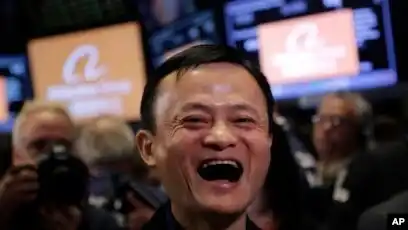
Back then, Alibaba was the combination of Taobao, Tmall, Alipay, Cainiao, Alibaba Cloud, and China's e-commerce infrastructure.

It represented a rapidly rising Chinese middle class, a continuously digitizing consumer market, and a Chinese growth story that global investors had long imagined but found hard to buy into directly.

In a sense, the 2014 Alibaba was the company closest to being the "gateway to the era" in the eyes of the capital market at that time.

Alibaba's listing made global investors realize that China could also have world-class internet platforms, entering the first tier of global tech companies, an influence that remains profound today. Simultaneously, it catalyzed the golden age of Chinese ADRs, sparking a wave of Chinese internet companies rushing to list.

In turn, it also forced the Hong Kong capital market to change.

Alibaba initially did consider Hong Kong, but its partnership structure conflicted with the Hong Kong exchange's "one share, one vote" rules at the time. Eventually, Alibaba chose to list in the U.S.

Years later, the Hong Kong exchange reformed its listing rules, allowing new economy companies with weighted voting rights to list. Companies like Xiaomi and Meituan were able to go public, and Alibaba later conducted a secondary listing in Hong Kong.

Thereafter, Alibaba's e-commerce empire entered a golden period of expansion, and in October 2020, its market capitalization peaked at $630 billion, reaching its historical zenith. During that phase, Alibaba planted a seed that wasn't the main character then, but helped Alibaba successfully transform until the AI era.

From "Pick One" to Being Surpassed by Pinduoduo in Market Cap

Just one month after Alibaba's market cap peaked, Ant Group's IPO was halted, abruptly ending the trillion-dollar valuation financial listing dream. This also marked the beginning of Alibaba's decline from its peak.

In 2021, Alibaba was fined 18.228 billion RMB for platform "Pick One" monopoly practices, setting a domestic antitrust penalty record.

The reason for the massive fine was that Alibaba, since before 2015, had abused its dominant market position by requiring merchants on its platform to exclusively open stores or participate in promotional activities on Alibaba's platform, seriously harming merchants' rights and constituting monopolistic behavior.

Subsequently, in December 2023, it was ordered to compensate JD.com 1 billion RMB, settling the decade-long "Pick One" feud.

During this period, the big-company malaise proliferated at Alibaba. Formalism and bureaucracy became rampant, with little innovation left. The sexual assault incident involving a female employee boiled over, triggering national舆论, ultimately leading to the resignation of several executives. CEO Zhang Yong publicly apologized, and Alibaba's value system was severely questioned.

Strategic misjudgments in multiple ventures during its expansion not only cost Alibaba hundreds of billions but also caused it to lose its core e-commerce moat. Alibaba bet on consumption upgrade, causing Taobao to lose its "cheap" positioning, with the market being captured by Pinduoduo. Taobao and Tmall's market share accelerated its decline from 66% in 2019 to around 30% today;

After 2016, it proposed the "New Retail" strategy, investing hundreds of billions attempting to integrate online and offline, investing in or acquiring Intime, Sun Art Retail, Suning.com, etc., all at significant losses, missing the golden period of short video and live-streaming e-commerce.

The Digital Media and Entertainment segment lost 60 billion RMB over 8 years, with its industry position continuously declining. After acquiring Youku, it fell from first place to fourth in the industry, being completely surpassed by Tencent Video and iQiyi. Xiami Music shut down in 2021. Applying technology and capital thinking to operate creative industries, it lacked content genes.

Local living services continued to be suppressed by Meituan. Then, at the end of November 2023, Pinduoduo's market cap surpassed Alibaba's for the first time. Ma Yun responded on the internal network, "Alibaba will change, Alibaba will reform," mentioning, "The AI e-commerce era has just begun."

Alibaba reached its darkest hour, and AI became Alibaba's new antidote.

AI Era Layout

Currently, Alibaba has a strong presence in the AI field. Its Tongyi Qianwen model reached a peak of 300 million monthly active users on the consumer side. Alibaba Cloud's Q1 total revenue reached 41.6 billion RMB, a year-on-year increase of 38%, with AI-related products accounting for 30% of revenue;

Alibaba Cloud has ranked first in China's public cloud IaaS market share for many consecutive years, becoming the core infrastructure for AI development in China.

It is investing in self-developed chips for AI training, and the large model is now embedded into ecosystems like Taobao, Alipay, Amap, and Feishu, accelerating commercialization. However, current challenges remain evident.

On the consumer side, it is still suppressed by ByteDance. Doubao's monthly active users far exceed Qianwen's, with higher user stickiness. After the Spring Festival activities, Qianwen's active users dropped to around 150 million.

The departure of Tongyi Qianwen's head, Lin Junyan, caused team turbulence. Competition for top AI talent is intensifying, and Alibaba's appeal is diminishing; Alibaba is wavering between AI traffic entrances (C-end users) and AI industry networks (ToB services), failing to form a clear differentiated positioning, and its technical roadmap is unstable.

Looking back at Alibaba's rise and fall over the twelve years since its listing, the fate of giants is clearly visible.

In 2014, the capital market gave Alibaba a super-high valuation, betting on the era红利 of China's consumer internet;

The subsequent years of setbacks stemmed from reckless strategic diversification driven by blind expansion, decision-making delays caused by big-company malaise, and era misjudgments from轻视 emerging sectors;

Ultimately, relying on AI for recovery proves that hardcore technology is the fundamental underpinning for tech companies to navigate through cycles.


Пов'язані питання

QWhat was the significance of Alibaba's IPO in 2014?

AAlibaba's IPO in 2014 set the record for the largest IPO in U.S. stock market history at that time, raising over $25.03 billion. It signaled the arrival of a world-class Chinese internet platform, propelled the company into the top tier of global tech firms, and triggered a wave of Chinese internet companies listing overseas.

QWhat major challenges did Alibaba face leading to its decline from its peak?

AAlibaba faced several major challenges, including the suspension of Ant Group's IPO, a record $2.8 billion antitrust fine for 'choosing one from two' practices, internal issues like bureaucracy and public scandals, and strategic missteps in e-commerce (losing market share to Pinduoduo), new retail investments, and the digital entertainment sector.

QHow has AI become a new focus for Alibaba according to the article?

AAI has become a new strategic focus for Alibaba. Its Tongyi Qianwen model has reached up to 300 million monthly active users. AI-related products contribute 30% of Alibaba Cloud's revenue, and the model is being integrated across its ecosystem (Taobao, Alipay, etc.). However, it faces challenges like competition from ByteDance's Doubao and talent retention.

QWhat impact did Alibaba's 2014 U.S. listing have on the Hong Kong stock exchange?

AAlibaba's choice to list in the U.S. due to conflicts with Hong Kong's 'one share, one vote' rule prompted the Hong Kong Stock Exchange to later reform its listing rules. It began allowing dual-class share structures for new economy companies, enabling listings from firms like Xiaomi and Meituan, and facilitating Alibaba's own secondary listing in Hong Kong.

QWhat key rules did Elon Musk reportedly rewrite for SpaceX's IPO as mentioned in the article?

AFor SpaceX's IPO, Elon Musk reportedly rewrote key IPO rules by allocating 30% of new shares to retail investors (far above the typical 5-10%) and pushing the overall underwriting fee rate below 0.75%, setting a new low for mega-IPOs and challenging institutional dominance.

Пов'язані матеріали

Wang Chuan: After Investing in Storage Stocks and Seeing a Thirty-Fold Return, How to Remain Unanxious (Part 7) - A Quarter-Century Cycle

Wang Chuan: Reflections on Investment Anxiety and Market Cycles After Observing a 30x Gain in a Storage Stock (Part 7) – A Quarter-Century Cycle This article examines the cyclical nature and inherent risks in technology hardware investments, using the storage and semiconductor sectors as examples. It criticizes the misleading practice of "annualized" Net Dollar Retention (NDR) rates, where short-term growth is extrapolated unrealistically. A key concept explored is "reflexivity" – demand driven by panic, exploration, and liquidity during market booms, which can vanish just as quickly when conditions reverse. This reflexivity exists both in product demand and among speculative stock buyers, creating powerful feedback loops that inflate prices during upturns and exacerbate crashes during downturns. The author highlights a major risk for hardware sectors: unlike assets with defined cycles (e.g., Bitcoin's halving), there's no guarantee of a swift recovery post-crash. Companies like Micron, Intel, and Cisco took roughly a quarter-century to surpass their 2000 highs, enduring drawdowns exceeding 80%. This is attributed to the "bullwhip effect" in supply chains, where demand collapses instantly but过剩产能 persists, and a migration of narrative-driven capital. High-valuation stories吸引 speculative funds during growth phases, but these funds quickly depart for the next hot narrative once growth slows, leaving behind stronger companies with much lower valuations. The piece warns of dangerous mental models formed during bull markets: 1) equating current strong demand with perpetual high growth, and 2) believing that making fast, large profits is easy. Citing巴菲特, the author notes that easy money undermines rationality, likening speculators to Cinderella at a ball with a clock that has no hands. The current phase presents an asymmetric risk-reward scenario: potential for further gains exists, but the downside risk is an 80%+ drawdown and a multi-decade wait for breakeven, which reflexive speculators cannot tolerate. The hypothetical investor "老王" (Lao Wang), who achieved a 30x return, is used to illustrate potential pitfalls. Leverage could lead to a wipeout during a sharp correction. Even without leverage, ingrained beliefs in easy money would likely lead him to double down after losses, expecting a quick rebound. Instead, he might face a protracted decline, depleting his resources through frantic trading as the high-growth narrative fades. The conclusion references Schopenhauer, comparing those who have seen multiple market cycles to an audience seeing the same magic trick repeatedly—once the illusion is understood, its power is gone.

marsbit20 хв тому

Wang Chuan: After Investing in Storage Stocks and Seeing a Thirty-Fold Return, How to Remain Unanxious (Part 7) - A Quarter-Century Cycle

marsbit20 хв тому

US Stocks Too Expensive? This Top CIO Scoured the Globe and Found 5 Stocks More Attractive Than NVIDIA

Summary: Main Street Research CIO James Demmert maintains his bullish 8,100 target for the S&P 500 but argues that greater opportunities now lie overseas. He identifies five international stocks with superior valuations poised to benefit from the AI revolution, suggesting international markets will outperform the US for years. Key Recommendations: 1. **ASML (Netherlands):** A foundational chip manufacturing technology provider, offering crucial AI exposure and geographic diversification. Demmert's top long-term pick. 2. **HSBC (UK/Asia):** A global bank with a 9x P/E ratio, better growth prospects than US peers like JPMorgan, and strong Asian presence. 3. **Siemens Energy (Germany):** A direct play on global power grid expansion driven by AI, crypto, and EV electricity demand. 4. **BHP Group (Australia):** A "hidden AI play" and "second derivative" of the trend due to massive copper demand for data centers. Trades at a 16x P/E. 5. **AstraZeneca (UK):** An undervalued healthcare stock with a strong pipeline (18x P/E, >20% growth), expected to benefit from AI's impact on medicine. Core Thesis: International outperformance is driven by both attractive valuations and a major policy shift. While the US tightens fiscal policy, Europe and Japan are launching unprecedented stimulus, reigniting growth. Demmert recommends allocating 45% of a portfolio internationally, citing excessive US investor conservatism as a key mistake.

marsbit25 хв тому

US Stocks Too Expensive? This Top CIO Scoured the Globe and Found 5 Stocks More Attractive Than NVIDIA

marsbit25 хв тому

a16z Partner: Three Paths for Crypto Projects to Find PMF

Author: Jason Rosenthal. Compiler: Shenchao TechFlow. Finding Product-Market Fit (PMF) is the most critical variable for a company's survival. In the crypto space, misaligned growth hacking and airdrops often mask the absence of true PMF. However, leading teams are now finding PMF faster. Here are three proven paths for crypto projects to achieve PMF: 1. **Co-build with Anchor Clients:** Partner with the most sophisticated potential clients in your field and develop the product based on their specific needs. Their adoption serves as the strongest validation, more valuable than media coverage or TVL metrics. This approach is shaping current product roadmaps, as seen in collaborations between crypto startups and traditional finance. 2. **Position Ahead of an Exponential Curve:** Identify and position yourself ahead of a major emerging trend before the market fully realizes it. The most evident current curve is the rise of AI Agents as autonomous economic actors. Projects like AgentCash by Merit Systems, which enables AI Agents to pay for API access with crypto, are building foundational payment rails for the impending Agent economy. 3. **Be Your Own First and Best Customer:** The most enduring infrastructure companies don't wait for external validation. They first build and prove their technology by using it to power their own applications at scale before offering it to others. Matter Labs exemplifies this by anchoring its ZKsync technology in a concrete application, Cari Network, which enables U.S. regional banks to conduct real-time, on-chain interbank transfers of tokenized deposits. The underlying logic is consistent: the fastest path to PMF involves choosing the right battlefield and executing with conviction—by co-building with clients whose validation compounds, positioning ahead of the curve before consensus forms, or becoming your own best case study.

marsbit26 хв тому

a16z Partner: Three Paths for Crypto Projects to Find PMF

marsbit26 хв тому

Wang Chuan: How to Avoid Anxiety When the Neighbor, Lao Wang, Made Thirty Times His Investment in Storage Stocks (7) - A Quarter-Century Cycle

Wang Chuan: Reflections on a Quarter-Century Cycle – How to Stay Calm After a 30x Gain on Storage Stocks (Part 7) This article continues the discussion on investment pitfalls. It highlights the deceptive use of metrics like the "Annualized Net Dollar Retention Rate" by some companies to inflate growth projections. The core analysis focuses on the "reflexivity" present in both product demand and financial markets during boom periods. In a bubble, speculative and fear-driven demand in the real economy interacts with speculative, leveraged buying in financial markets, creating a powerful upward feedback loop. This dynamic reverses sharply when faced with physical or liquidity constraints, leading to a cascading downturn. The hardware and semiconductor sectors face unique risks. Unlike assets with defined cycles, there's no guarantee of a swift recovery post-crash. Historical examples like Micron, Intel, and Cisco show it can take decades to surpass previous peaks after severe drawdowns (80-95%). This is due to the "bullwhip effect" in supply chains—demand vanishes quickly while过剩产能 persists—and the migration of speculative capital and growth narratives to new sectors once momentum slows. Companies may have stronger fundamentals years later, but the speculative "soul" of extreme valuations is long gone. The author warns of psychological traps for new investors: mistaking temporary, intense demand for permanent growth, and believing that making quick, large profits is easy. Citing Buffett, the piece cautions that easy money erodes rationality. The current phase presents an asymmetric risk-reward scenario: potential for further gains versus the risk of an 80%+ drawdown and a multi-decade recovery wait—an outcome reflexive speculators cannot endure. The hypothetical "Lao Wang" who made 30x may be wiped out by leverage or, driven by the "get-rich-quick" mindset, may repeatedly try to recover losses until exhausted, failing to recognize that the high-growth narrative has ended. The piece concludes with Schopenhauer's analogy: those who've seen multiple cycles are like an audience watching the same magic trick repeatedly—the illusion no longer works.

链捕手34 хв тому

Wang Chuan: How to Avoid Anxiety When the Neighbor, Lao Wang, Made Thirty Times His Investment in Storage Stocks (7) - A Quarter-Century Cycle

链捕手34 хв тому

Торгівля

Спот
Ф'ючерси
活动图片




