SpaceX Plunges Below $150 on First Day of Index Inclusion, Wall Street Unanimously Bullish with Highest Target at $800?

Odaily星球日报Опубліковано о 2026-07-08Востаннє оновлено о 2026-07-08

Анотація

SpaceX made history by being the fastest company ever added to the Nasdaq 100 index on July 7th. However, its stock (SPCX) fell over 6.8% to close at $149.47 that day, hitting a new low since its IPO. Analysts suggest the positive impact of the index inclusion was already priced in by the market, while upcoming insider share unlocks in August are creating downward pressure. Despite the current bearish sentiment and recent market-wide declines, major Wall Street firms have issued overwhelmingly positive ratings following the IPO quiet period's end. Targets range from $200 to $300, with Raymond James setting the most optimistic price target of $800, citing SpaceX's long-term potential in rocket launches, Starlink, and AI space data centers. In the short term, potential catalysts to support the stock price include a possible endorsement from former President Trump—following a donation of SpaceX shares to a trust he promoted—and the scheduled Starship Flight 13 test on July 14th. Nonetheless, with key support at $150 being tested and significant share unlocks looming, the near-term outlook remains challenging despite strong institutional long-term confidence.

Original | Odaily Planet Daily (@OdailyChina)

Author | Golem (@web 3_golem)

SpaceX has once again made history: on July 7th (Tuesday), SpaceX was officially included in the Nasdaq 100 Index, becoming the fastest publicly listed company ever to be added to the Nasdaq 100, with a corresponding weight of about 1.3% in the index. However, this historic achievement was not reflected in SpaceX's stock price performance. According to Gate US stock data, SPCX closed down over 6.8% on Tuesday at $149.47, hitting its lowest closing price since its listing. How will SPCX perform in the future? What judgments have Wall Street institutions made?

Index Inclusion Good News Exhausted, Only Bad News Remains, Holding $150 is Already an Achievement

Prior to SpaceX's inclusion in the Nasdaq 100 Index, JPMorgan estimated it would trigger at least about $4.3 billion in passive fund inflows, and over $800 billion in assets tracking the Nasdaq 100 Index would subsequently continue to passively allocate to SpaceX.

Although this is a significant positive, since SpaceX's IPO day, "entering the Nasdaq Index" has been constantly speculated, and market expectations had already been digested. When the expectation was realized on July 7th, market sentiment was no longer able to push the stock price higher. On the other hand, the massive buying pressure behind the Nasdaq Index did not hit the market on the day SpaceX was included; in reality, most passive fund buying had been completed ahead of July 7th.

Furthermore, historical data also shows that index inclusion does not necessarily constitute a sustained upward signal and has, in some cases, become a short-term peak.

Strategy is a typical example. On December 23, 2024, Strategy was included in the Nasdaq 100, but on that day, MSTR actually opened high and closed low, falling about 7.3% to close at $332.23. Subsequently, Strategy entered a sustained downtrend, with its stock price dropping to $255.43 in February 2025. The passive buying pressure from the Nasdaq index did not become effective support for Strategy's stock price.

And after the positive news of SpaceX's index inclusion is exhausted, the well-known negative of the share unlocking wave in August will be magnified indefinitely. SpaceX's prospectus clearly states that two days after the Q2 2026 earnings report, eligible internal shareholders can sell up to 20% of their locked-up shares. If the stock price rises 30% above the IPO price by then and meets that standard for 5 days, an additional 10% can be unlocked. 22V Research strategist Jeff Jacobson estimates that insiders may sell up to 44% of SpaceX's shares before early September.

Similar to how the positive expectations of index inclusion were digested by the market in advance, the panic brought by SpaceX's share unlocking is also bound to be reflected in the price ahead of time. This is an important factor suppressing SpaceX's stock price from a market sentiment perspective both recently and in the future. BitMine Chairman Tom Lee also specifically mentioned SpaceX's upcoming share unlock in an interview, believing that one should not chase the high on SpaceX in the short term, and that using the pullback brought by the unlock to build positions is the appropriate choice.

But this past Tuesday's US market close, SpaceX was not alone in falling. According to Gate US stock data, the three major US stock indices all closed lower: the Dow fell 0.25%, the S&P 500 fell 0.45%, and the Nasdaq fell 1.16%. AI concept stocks also fell broadly: Astera Labs fell 11.52%, Ambarella fell 9.92%, Teradyne fell 9.59%, AeroVironment fell 8.09%.

By comparison, in the context of a broad market decline and exhausted positive news leaving only negatives, SPCX still holding near $150 without breaking the IPO price is already an achievement. Meanwhile, according to OptionCharts data, the current Put-Call Ratio for SPCX is 0.92, indicating market sentiment remains neutral, not significantly bearish.
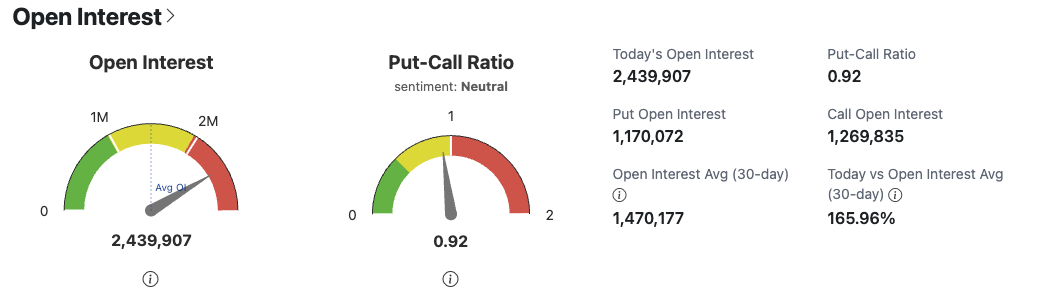
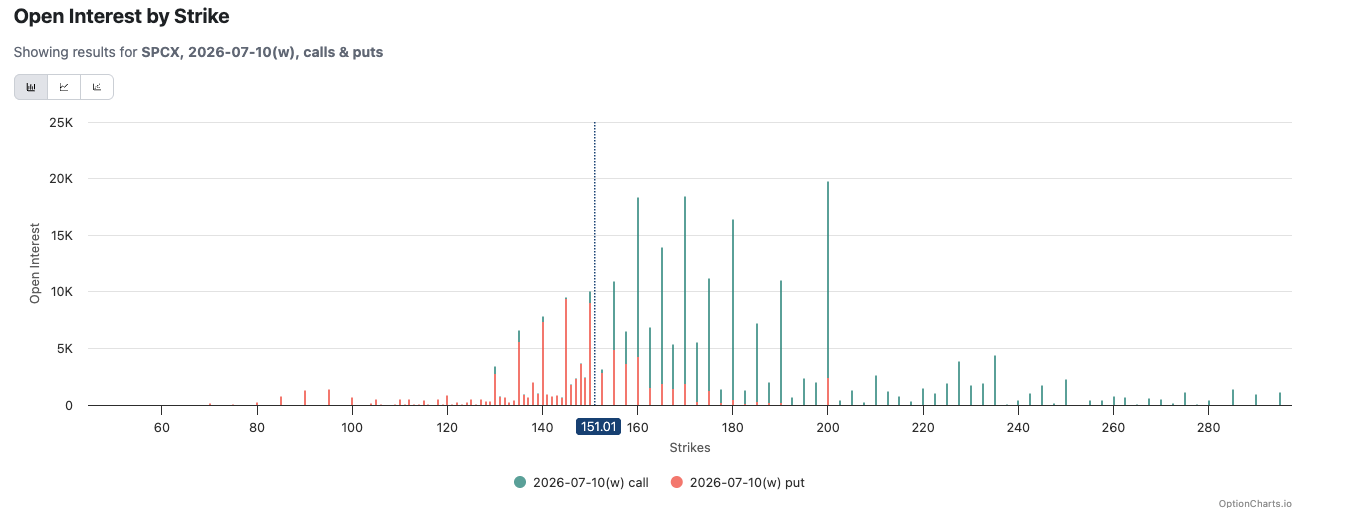
Furthermore, a large number of call options expiring on July 10th are stacked at $160 and above for SPCX, making the $150-$155 range the main battleground for bulls and bears.
Institutions Collectively Give Buy Ratings, Does SPCX Have Potential Upside?

Obviously, neither time nor market sentiment is on the side of the bulls anymore. Over the past month, SPCX has tested the $150 support level multiple times, but previously, $150 support was on the offensive side; now it is purely on the defensive. However, bizarrely, after the end of the IPO quiet period, Wall Street institutional analysts have collectively given SPCX a Buy rating.

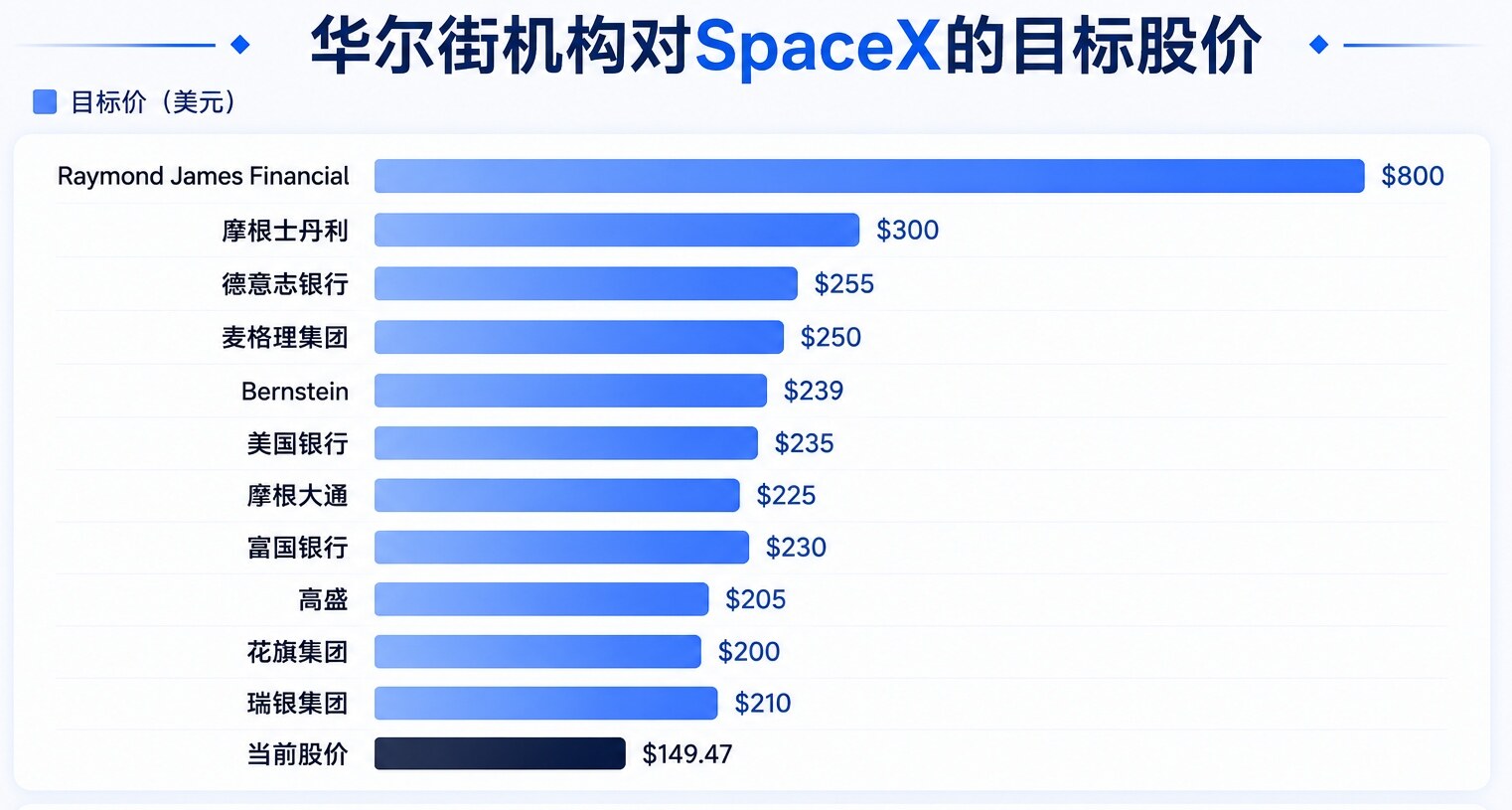
As IPO underwriters, both Goldman Sachs and Morgan Stanley gave SpaceX a Buy rating. Goldman Sachs analyst Eric Sheridan set a target price of $205, while Morgan Stanley analyst Adam Jonas gave a target price of $300. Additionally, Bank of America initiated coverage on SpaceX with a Buy rating and a target price of $235; Citigroup set a target price of $200 for SpaceX; Bernstein gave SpaceX an Outperform rating with a target price of $239; Macquarie Group set a target price of $250; Deutsche Bank set a target price of $255; JPMorgan set a target price of $225; UBS Group set a target price of $210; Wells Fargo set a target price of $230.

Raymond James Financial gave the most optimistic forecast, with analyst Brian Gesuale setting a target price for SPC as high as $800, believing SpaceX will become "one of the most iconic industrial infrastructure companies of the 21st century."
However, these institutional ratings primarily focus on SpaceX's long-term value, such as its positioning in rocket launches, Starlink, and AI space data centers. In the short term, especially before the August share unlocking wave arrives, what can SpaceX rely on to support its stock price from falling below $150 and heading straight for the $135 IPO price? The foreseeable potential positives are as follows:

First, relying on Trump's promotion. On July 7th, SpaceX President and COO Gwynne Shotwell and her husband announced participation in the Invest America plan, donating part of their SpaceX shares to over 2 million American children's "Trump Accounts," with an estimated donation of about 2 million SpaceX shares worth approximately $325 million. Trump had previously publicly urged Musk to donate SpaceX shares to the "Trump Account." Trump is a businessman who understands value exchange. After SpaceX stock enters the "Trump Account," he might promote SpaceX just as he promoted Micron and Dell.

Second, SpaceX's Starship flight test scheduled for July 14th. SpaceX's Starship's 13th flight test (Flight 13) is currently targeted for launch on July 14, 2026 (Tuesday), with a backup date of July 15th. The US Federal Aviation Administration (FAA) has issued an operational advisory confirming NET (No Earlier Than) July 14th. Rocket launches have always sparked public interest. As a world-leading aerospace company, each of SpaceX's launches garners global attention. If Flight 13 is completed successfully, SpaceX's aerospace narrative might once again briefly ignite "fan" enthusiasm, thereby boosting the stock price. Although the community and tracking sites generally consider July 14th as the primary launch target, it could be delayed by days or weeks due to technical readiness, weather, or other factors.

But ultimately, what investors most anticipate might be for Musk himself to do something to "rescue the market."


Пов'язані питання

QWhat was SpaceX's closing price and performance on its first day of inclusion in the Nasdaq 100 index?

ASpaceX (SPCX) closed at $149.47 on July 7th, the day it was included in the Nasdaq 100 index, marking a decline of over 6.8% and setting a record low closing price since its IPO.

QAccording to the article, why didn't the inclusion in the Nasdaq 100 index boost SpaceX's stock price?

AThe article states that the positive impact of index inclusion was already priced into the stock well before the official date. Much of the expected passive fund buying had already occurred pre-inclusion. Furthermore, history shows index inclusion can sometimes mark a short-term price peak rather than guarantee a sustained rally.

QWhat major near-term risk does the article highlight for SpaceX's stock price?

AThe article highlights the upcoming stock unlock in August 2026 as a major near-term risk. Internal shareholders could potentially sell a significant portion of their locked shares, and the market is likely pricing in this anticipated selling pressure ahead of time.

QWhich financial institution provided the most optimistic price target for SpaceX, and what was the target?

ARaymond James Financial provided the most optimistic price target. Analyst Brian Gesuale set a target price of $800 per share for SpaceX.

QWhat are two potential short-term catalysts mentioned in the article that could support SpaceX's stock price?

AThe article mentions two potential short-term catalysts: 1) The possibility of former President Trump publicly endorsing or 'talking up' the stock after a planned donation of SpaceX shares to his associated 'Trump Account'. 2) The successful test flight of SpaceX's Starship (Flight 13), currently scheduled for July 14, 2026, which could renew investor enthusiasm.

Пов'язані матеріали

Odaily Editorial Department Tea Party (July 8)

Odaily Editorial Team Casual Chat (July 8) This is an informal column from Odaily's editorial team, sharing immediate thoughts on industry news, data, and hot topics from various angles. It presents investment ideas and opportunity hypotheses still under verification—which may not be direct wealth codes but questions in themselves—alongside observations from industry interactions and materials that genuinely enhance the team's understanding. The content is based on real investment and observation experiences, carries no advertising, and does not constitute investment advice. Its purpose is to broaden perspectives and supplement information sources, not to create consensus. Team Member Shares: * **Wenser (@wenser2010):** Noted a deeper correction (nearly 30%) in US and Korean stocks, including memory stocks, but remains bullish on DRAM due to perceived supply shortages. In prediction markets, personal small bets outperformed blind copying; favors France to win the World Cup. Views crypto-related stocks like STRK as bearish for now, while seeing Circle and Coinbase as potential rebound plays. Observes recent strength in software stocks like Microsoft but is unsure if it's a sustained recovery. * **Bcxiongdi (@bcxiongdi):** Discusses the recent "recovery training" in meme coin markets on Solana and BSC, characterized by small-scale PVP opportunities, admitting to having sold many assets too early. Suggests also watching the Robinhood chain. Found World Cup prediction markets challenging, advising to consider buying during matches rather than only before. * **Azuma (@azuma_eth):** Focuses on the US stock market, particularly the significant semiconductor correction. Believes demand fundamentals remain and considers buying the dip in DRAM stocks. Notes a potential rotation signal as hedge funds have recently concentrated buying in tech stocks. Plans to continue adding to RKLB (Rocket Lab) stock, seeing limited downside and high upside potential at current levels after its founder's share sale window closed.

Odaily星球日报3 хв тому

Odaily Editorial Department Tea Party (July 8)

Odaily星球日报3 хв тому

Former Huawei 'Genius Teen' Who Questioned DeepSeek Interview Lands in 'Crossfire' from Web3 Investor

Former Huawei "Genius Youth" Li Bojie recently drew public attention by criticizing his interview experience with DeepSeek. The controversy escalated when Du Jun, co-founder of Web3 investment firm ABCDE Capital, publicly accused Li of being "the founder with the least sense of contractual spirit" he had ever cooperated with, sparking a dispute over Li's startup project, Metagent. Li detailed a frustrating DeepSeek interview where he was accused of potential plagiarism, leading him to end the session. The spotlight then shifted to his venture, Metagent, a Web3+AI project aiming to tokenize AI agents. ABCDE invested $1.5 million, with an initial $500k disbursed. Du Jun claimed the project's progress was severely lacking, with a poor-quality demo and minimal social media activity. He alleged Li stopped communicating, deleted his Telegram, and failed to provide proper financial reporting. In response, Li argued the remaining $1 million was never received, crippling operations and forcing salary cuts. He stated he left Metagent in October 2024 due to family reasons and Web3 compliance concerns, with board approval. He claimed to have fulfilled disclosure duties and that his subsequent projects avoided conflicting fields. Other investors, including ArkStream Capital, shared negative due diligence experiences, citing unprofessional contracts and evasive answers on tokenomics. Metagent's social media went silent in June 2024, effectively stalling. Li has since moved to a new consumer AI agent platform, Pine AI (formerly Logenic AI), which has raised $25 million in Series A funding. He served as its Chief Scientist but recently left, clarifying he was not the founder and departed due to a shift in research interests.

Foresight News33 хв тому

Former Huawei 'Genius Teen' Who Questioned DeepSeek Interview Lands in 'Crossfire' from Web3 Investor

Foresight News33 хв тому

SemiAnalysis: Anthropic's Q3 Profit to Exceed $1 Billion

Research firm SemiAnalysis reveals that Anthropic is reshaping the AI commercialization landscape with profitability and growth rates far exceeding competitors. Leveraging a high-margin, API-centric business model, Anthropic has become a leader in the B2B AI market. The report projects that Anthropic will achieve a GAAP EBIT of $1 billion in Q3 2026, with a 6% margin. Its Annual Recurring Revenue (ARR) has surged from $9 billion at the end of 2025 to over $60 billion currently. If it maintains a Net New ARR (NNARR) of approximately $15 billion per month, its ARR could reach $300 billion by the end of 2027, implying a $6 trillion enterprise value and making it the world's most valuable company. Anthropic secretly filed for an IPO on June 1st. SemiAnalysis argues the timing is strategically urgent due to narrowing capital market windows as rivals like Alphabet and Meta secure major funding. The superior financials and business model suggest Anthropic should go public before OpenAI to seize the competitive initiative. The performance inflection stems from the explosive adoption of Claude Code, which now accounts for over 7% of all GitHub commits, driving monthly NNARR from $3 billion in January to $11 billion in March. Anthropic's revenue structure differs significantly from OpenAI's. Approximately 75-85% of Anthropic's ARR comes from usage-based API fees, with consumer subscriptions constituting only about 5%. In contrast, over 65% of OpenAI's Q1 2026 revenue was from subscriptions, with ~40% from consumers. The API model's key advantage is no per-user revenue cap, enabling growth within existing accounts. Anthropic's Net Revenue Retention (NRR) is an extraordinary 500%. This drives superior gross margins, now in the mid-60% range versus -94% in 2024, with API margins exceeding 80%. Core drivers are improved inference efficiency and a largely enterprise-focused model without the cost of serving hundreds of millions of free users. The report introduces "EBTIT" (Earnings Before Training & Interest & Taxes) to measure re-investment capacity, projecting Anthropic's cumulative EBTIT through 2028 will be $250 billion higher than OpenAI's. Over 65% of lab ARR currently comes from programming use cases. Cybersecurity is seen as the next major vertical, with upcoming model releases like Fable expected to further increase token pricing and expand NNARR. Indirect sales via hyperscaler platforms (AWS Bedrock, Azure Foundry) now account for 15-20% of ARR. A core constraint is compute supply. By 2030, combined unconstrained compute demand from Anthropic and OpenAI could exceed 100 GW, far outstripping projected new capacity. IPO proceeds are seen as crucial to lock in future compute resources. Key risks include potential price cuts by OpenAI, competitive pressure from Google DeepMind and Meta in coding models, potential government restrictions on frontier model releases, and margin dilution from growing indirect "Token-as-a-Service" sales. Regulatory actions that narrow the capability gap between open-source and proprietary models are highlighted as a fundamental threat to Anthropic's moat.

marsbit45 хв тому

SemiAnalysis: Anthropic's Q3 Profit to Exceed $1 Billion

marsbit45 хв тому

Торгівля

Спот
活动图片