SpaceX Faces Heavy Selling After IPO Followed by Massive Bond Issue 'Angers' the Market

marsbitОпубліковано о 2026-06-28Востаннє оновлено о 2026-06-28

Анотація

Following a record-breaking IPO, SpaceX's massive $25 billion bond issuance faced fierce selling pressure in the secondary market. The aggressive financing pace of the long-unprofitable rocket and AI company quickly backfired, eroding investor confidence and causing its bond spreads to widen sharply, nearing speculative-grade ("junk") levels. Within 48 hours of pricing, SpaceX's bonds plummeted. The 10-year bond yield rose to nearly 6%, with its spread over US Treasuries widening to over 160 basis points (bps). Longer-dated bonds saw spreads surge to 193 bps and 201 bps, significantly worse than the average spread for BB-rated junk bonds at 167 bps. This rapid deterioration shocked fixed-income traders. Initial strong demand, with nearly $90 billion in orders, was driven largely by short-term speculative "fast money" rather than traditional buy-and-hold investors. When these funds sought quick profits, heavy selling ensued. Analysts describe a "perfect storm" caused by SpaceX's post-IPO market cap decline, technical selling pressure from the enlarged deal size, and investor uncertainty in pricing its unique risk profile. The core concern for bond investors is SpaceX's fundamentals: while it reported $18.7 billion in 2025 revenue, it posted a net loss of $4.9 billion. Creditors focus on actual cash flow for debt repayment, not future growth expectations tied to AI. Heavy reliance on CEO Elon Musk's leadership and weak corporate governance were also cited as key credit weakn...

Written by: Bao Yilong

Following a record-breaking IPO, SpaceX's massive $25 billion bond issue encountered heavy selling in the secondary market. The aggressive financing pace of this long-unprofitable rocket and artificial intelligence company quickly backfired on investor confidence, causing its bond spreads to widen sharply, directly approaching speculative-grade (i.e., "junk") levels.

By Friday, SpaceX corporate bonds had turned from "hot demand" on the book to a full-blown sell-off within just 48 hours of pricing.
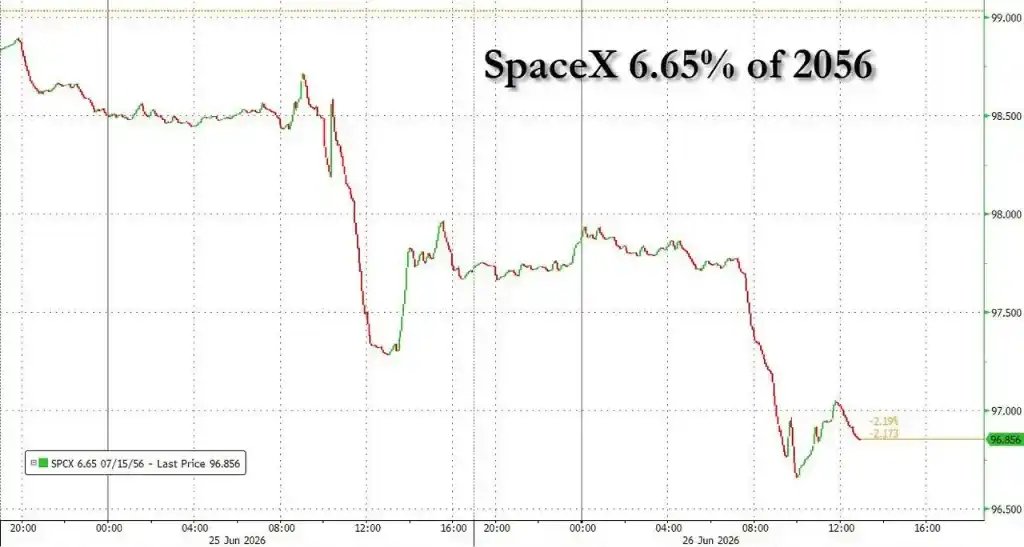
Selling pressure across SpaceX's various maturities led to cumulative book losses of approximately $400 million compared to U.S. Treasuries, completely erasing the spread tightening achieved by underwriters during the book-building stage with the declines in the long-end bonds.

According to MarketAxess data, SpaceX's 10-year bond yield rose to nearly 6%, with the spread over U.S. Treasuries widening to more than 1.6 percentage points. The spreads on its long-end bonds maturing in 2046 and 2056 surged to 1.93 and 2.01 percentage points, respectively.

According to Ice Data Services, the current market's average spread pricing for BB-rated "junk bonds" is 1.67 percentage points, meaning that with its Baa1/BBB investment-grade rating, SpaceX's actual trading price is significantly worse than that of some junk-grade issuers.

The magnitude and speed of the plunge shocked fixed-income market traders. Market participants noted that among recent mega bond issues, it's almost impossible to find a precedent where spreads widened so rapidly to such an extent.

"Perfect Storm" Hits Secondary Market

The initial book data for SpaceX's bond issue once masked the underlying risks.

According to Bloomberg, the deal initially garnered nearly $90 billion in subscription orders, nearly 4 times oversubscribed, and the issuance size was subsequently increased from $20 billion to $25 billion.

However, traders revealed that this frenzy was mainly driven by fast money seeking short-term arbitrage, not traditional buy-and-hold investors. When these funds tried to take quick profits in the secondary market, selling pressure surged.

Tony Trzcinka, portfolio manager at Impax Asset Management, said the market had anticipated a widening of SpaceX's spreads, but the current magnitude constitutes a "perfect storm."

He pointed out that this stems from the company's significant market cap decline since the IPO, the technical selling pressure brought by the increased issuance size, and investors still grappling with how to price its unique risk profile.

In contrast, Nvidia, which recently completed a $25 billion bond issue, saw its long-end bond spreads widen by only 11 to 12 basis points, while Alphabet's long-end spreads even narrowed.
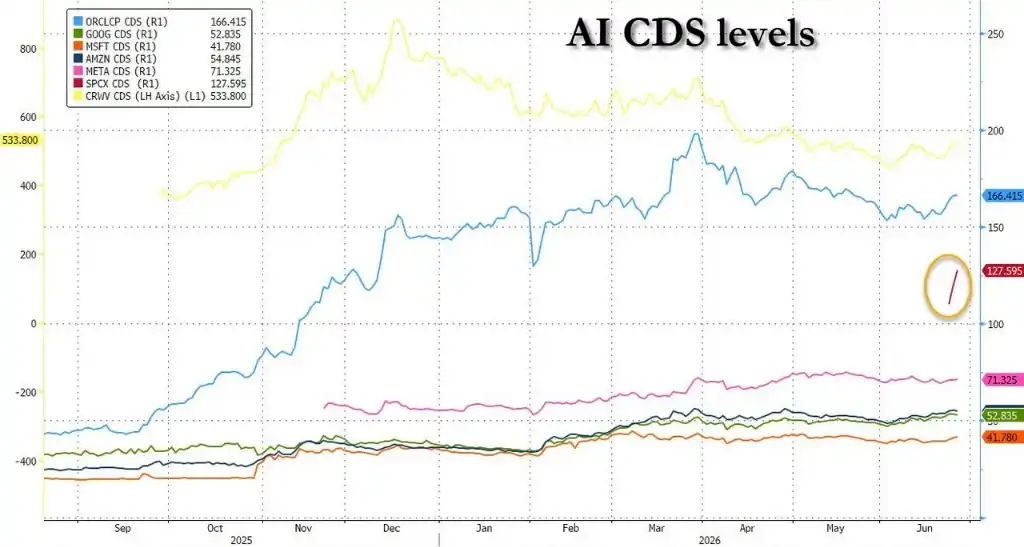
Additionally, SpaceX's credit default swaps (CDS) widened significantly after trading began, further confirming the market's defensive stance towards its credit.

Cash Flow and Governance Risks Spark Direct Concerns

Stock and bond investors have fundamentally different logics for evaluating SpaceX.

The company raised $86 billion through its IPO earlier this month, with its valuation once reaching nearly $3 trillion before falling back to $2 trillion. This valuation is largely built on expectations that its AI revenue will surge in the future.

However, for creditors, the core fact is that while SpaceX achieved $18.7 billion in revenue in 2025, it recorded a net loss of $4.9 billion. PGIM portfolio manager Michael Campion stated:

In the investment-grade bond market, we focus on whether a company can repay its debt. We are accustomed to lending based on actual cash flows, not expectations.

Allianz Chief Investment Officer Ludovic Subran also remarked bluntly:

Bond investors are different from equity investors. Equity investors might go to Mars with you, but bond investors will just ask, 'Where's my coupon?'

Furthermore, the extreme reliance on Musk's personal leadership has become a core concern for rating agencies and investors. Fitch Ratings sees this as a "key rating constraint."

Professor James Dow of the London Business School pointed out that SpaceX is currently highly reliant on Musk, lacks a succession plan, and has exceptionally weak corporate governance, which significantly reduces the appeal of its long-term debt.

Tech Giant Bond-Issuance Wave Nears "Bubble" Territory

The cold reception faced by SpaceX is not an isolated incident but exposes systemic vulnerabilities in the current tech giant debt expansion.

As tech companies race to raise huge sums to fund AI projects, investors are facing a massive supply shock of bonds.

According to Morgan Stanley data, AI-related debt issuance this year has reached $236 billion, a 357% year-over-year increase, and is projected to double to $570 billion by year-end.

The borrowing frenzy is rapidly pushing up industry leverage ratios. Data shows that the total leverage ratio of mega-tech companies has doubled in just over two quarters, skyrocketing from 0.9x to 1.8x, already exceeding the total leverage ratio of the entire energy sector.

This massive supply is overwhelming the market structure. Bloomberg calculations show that as of Wednesday, U.S. investment-grade bond supply for June has reached $180 billion, a record high.

The supply glut has begun to weigh on broader credit spreads. Morgan Stanley notes that spreads for mega-size issuers are widening overall, a trend confirmed by the performance of bonds from Oracle and Meta.

In a report, Mark Dowding, Chief Investment Officer of Fixed Income at RBC BlueBay Asset Management, wrote, bondholders have clearly concluded that future debt issuance could be significant as this unprofitable company finances its path to future profitability.

Analysis suggests that if this pace of debt expansion continues, credit spreads could ultimately break out further, thereby imposing material constraints on tech companies' capital expenditure cycles.


Пов'язані питання

QWhy did SpaceX's bonds experience a sharp sell-off in the secondary market shortly after issuance?

ASpaceX's bonds experienced a sharp sell-off due to a combination of factors: aggressive fundraising following its IPO, investor concerns over its persistent losses and high valuation based on future AI expectations, a large supply of bonds driven by short-term speculative 'fast money' seeking quick profits, and significant selling pressure as those investors exited their positions. Additionally, market confusion over how to price the company's unique risk profile and its high dependence on Elon Musk contributed to the sell-off, causing spreads to widen dramatically.

QHow do bond investors' concerns about SpaceX differ from equity investors' perspectives?

ABond investors focus on a company's ability to generate cash flow to service and repay debt, prioritizing current financial reality over future growth potential. They are concerned with SpaceX's significant net losses ($4.9 billion in 2025 despite $18.7 billion revenue). Equity investors, in contrast, are more willing to fund long-term growth based on future expectations, such as a surge in AI revenue, which supported SpaceX's high IPO valuation. Bondholders prioritize coupon payments, while equity investors may tolerate losses for future capital appreciation.

QWhat specific governance risk is highlighted as a key concern for SpaceX by rating agencies and analysts?

AA key governance risk highlighted is the company's extreme reliance on Elon Musk's personal leadership and the lack of a formal succession plan. Fitch Ratings cited this as a 'key rating constraint,' and analysts note that the weak corporate governance structure significantly reduces the attractiveness of SpaceX's long-term debt to fixed-income investors.

QAccording to the article, what broader market trend is contributing to pressure on corporate bond spreads?

AA broader trend of massive debt issuance by technology giants to fund AI projects is creating a supply shock in the bond market. This surge in issuance is rapidly increasing the sector's leverage and overwhelming market capacity. The article notes that AI-related debt issuance has soared, and the sheer volume of new supply is putting upward pressure on credit spreads across the technology sector, as seen with other issuers like Oracle and Meta.

QWhat was the market's reaction in terms of credit default swaps (CDS) for SpaceX following the bond issuance?

AFollowing the bond issuance, SpaceX's credit default swaps (CDS) also widened significantly. This movement indicates that the cost of insuring against a default on SpaceX's debt increased, reflecting a defensive market stance and growing concerns about the company's creditworthiness among investors.

Пов'язані матеріали

Blood Loss of $55 Million Selling 3,588 BTC, Strategy Becomes a Literal Scumbag

On July 6th, Strategy (formerly MicroStrategy) disclosed in an SEC filing that it sold 3,588 Bitcoin (BTC) between June 29th and July 5th for approximately $216 million, at an average price of ~$60,200. This marked the company's largest net sale since initiating its Bitcoin strategy in 2020 and its first institutionalized reduction of its core holding. The sale resulted in a realized loss of about $54.8 million, as the selling price was below its average cost basis of ~$75,476 per BTC. The proceeds were used to pay preferred stock dividends and replenish USD reserves. This move follows a new "Digital Credit Capital Framework" approved on June 29th, authorizing the sale of up to $1.25 billion in Bitcoin. The sale consumes roughly 17% of this authorized amount in its first week. Strategy's foundational narrative, built by founder Michael Saylor, was a commitment to "never sell" Bitcoin. The recent institutionalized selling framework and these substantial sales represent a significant shift from that original promise. While the amount sold is only 0.4% of Strategy's total holdings of 843,775 BTC, the action challenges the premium at which its stock (MSTR) trades relative to its Bitcoin holdings. Investors had priced in the "never sell" narrative. The company now faces a contradiction: it sells Bitcoin at a loss to pay dividends on the preferred stock it issued to fund Bitcoin purchases. Saylor has framed selling as a tool for future strategic purchases, but each sale erodes the credibility of the original commitment, potentially threatening the premium valuation of MSTR shares.

Foresight News56 хв тому

Blood Loss of $55 Million Selling 3,588 BTC, Strategy Becomes a Literal Scumbag

Foresight News56 хв тому

JP Morgan Tokenized Fund Surges 250% in TVL in One Month, Institutional Funds Are Treating Ethereum as the Default Underlying Layer

JPMorgan's tokenized money market fund, JLTXX, has seen its on-chain total value locked (TVL) surge approximately 250% in a month, reaching nearly $700 million from an initial $200 million since its launch seven weeks ago. The fund, which invests in short-term U.S. Treasuries and repos, operates exclusively on the public Ethereum mainnet, signaling growing institutional acceptance of Ethereum as a foundational layer for compliant financial products. A key driver of this growth is its inclusion as reserve assets for stablecoins like USDG, meeting requirements under U.S. stablecoin legislation. Simultaneously, despite a significant price decline—ETH has fallen over 50% from its 2025 high—institutional accumulation continues. BitMine Immersion Technologies, led by Tom Lee, purchased an additional $73 million worth of ETH last week, bringing its holdings to roughly 4.8% of Ethereum's circulating supply. The article highlights a divergence: while the tokenization of real-world assets and stablecoin reserves is driving long-term institutional adoption of Ethereum's infrastructure, short-term price action remains pressured by market sentiment and ETF outflows. This suggests that institutional on-chain activity, though a positive fundamental development, may not serve as a reliable signal for near-term price bottoms.

marsbit1 год тому

JP Morgan Tokenized Fund Surges 250% in TVL in One Month, Institutional Funds Are Treating Ethereum as the Default Underlying Layer

marsbit1 год тому

Dialogue with Yihui Capital, SoundAI Technology, Ling Universe, and Zhongbo Jili: Opportunities and Challenges in the AI Smart Hardware Track

On June 28, 2026, an event titled "New Opportunities in AI Hardware: The Battle for Interactive Entry Points Begins" was held in Beijing. It featured a report from ITJuzi and discussions with experts from SoundAI, Ling Universe, One Reed Capital, and Zhongbo Juli on the opportunities and challenges in China's AI hardware sector. Key report findings highlight the sector's intense activity: 327 out of 431 startups founded post-2023 have secured funding, with 179 investments in H1 2026 alone. The landscape is dominated by embodied intelligent robots, while wearable tech like smart rings and AI glasses shows rapid growth. Geographically, Shenzhen leads, leveraging its superior hardware supply chain, followed by Beijing and Shanghai. The overarching trend is for companies to focus on micro-innovations within specific scenarios rather than reinventing foundational technology. Industry leaders shared several critical insights: 1. **Balancing Innovation & Market Readiness**: Entrepreneurs face the "hammer looking for a nail" dilemma. Success requires balancing technical capability with user acceptance, cost control, and incremental design improvements rather than chasing disruptive innovation. 2. **Competitive Landscape**: The future interactive entry point may not be a single super-device but a mix of universal terminals and specialized, scenario-specific hardware. While large companies have ecosystem advantages, startups can win by deeply targeting vertical markets and specific user groups. 3. **Core Challenges & Business Models**: Key hurdles include deep understanding of AI models and navigating non-transparent hardware supply chains. Viable business models may involve selling hardware at cost and generating revenue through software subscriptions, but this requires tight control over both hardware BOM and model inference costs. 4. **The Road to Commercialization**: The ultimate test is market validation—achieving sales growth and sustainable cash flow. Companies must find the right application scenario, use edge computing effectively, and close the loop from technology to commercial success. 5. **The Future of Interaction**: Proactive, context-aware interaction is the next frontier, though it's currently limited by issues like model hallucinations and environmental perception. The near-term focus should be on identifying target users and creating a coherent experience in specific domains, such as health wearables. In summary, to succeed in the competitive AI hardware arena, companies must strategically choose their niche, build a team with the right geographical advantages (e.g., leveraging Shenzhen's supply chain), and most importantly, execute a flawless commercialization strategy that translates technology into market-accepted products and sustainable business growth.

marsbit1 год тому

Dialogue with Yihui Capital, SoundAI Technology, Ling Universe, and Zhongbo Jili: Opportunities and Challenges in the AI Smart Hardware Track

marsbit1 год тому

Торгівля

Спот
活动图片