Someone Turned Buffett and Munger into Agents, Then Open-Sourced It...

marsbitОпубліковано о 2026-04-14Востаннє оновлено о 2026-04-14

Анотація

The open-source project "AI Hedge Fund" has gained significant traction on GitHub, creating AI agents modeled after 12 legendary investors, including Warren Buffett and Charlie Munger, to analyze stocks and develop trading strategies. It features a team of 6 analyst agents that synthesize insights and make final decisions. The system includes a backtesting module to evaluate strategies with historical data before real investment. Built by developer Virat Singh, the project supports 13 major AI models and can run locally. It uses a React front-end with a visual workflow editor and a Python/FastAPI backend orchestrated with LangGraph. The agent team covers diverse philosophies, from value investing (Graham) to growth (Cathie Wood) and risk management (Taleb). While not proven in live markets, it offers a platform for learning agent frameworks and diverse investment perspectives through simulated expert debate. The project highlights a growing trend of "distilling" financial wisdom into AI, but users are cautioned about its unverified returns and investment risks.

Author: Quantum Bit

Accidentally, Charlie Munger and Warren Buffett have been distilled, each joining the investment Agent army, now available for everyone to use.

This is one of the hottest projects on GitHub recently: AI Hedge Fund.

12 world-class investment masters are now online anytime to help you analyze stocks and refine your trading strategies; 6 analysts summarize opinions and make the final decision to execute trades.
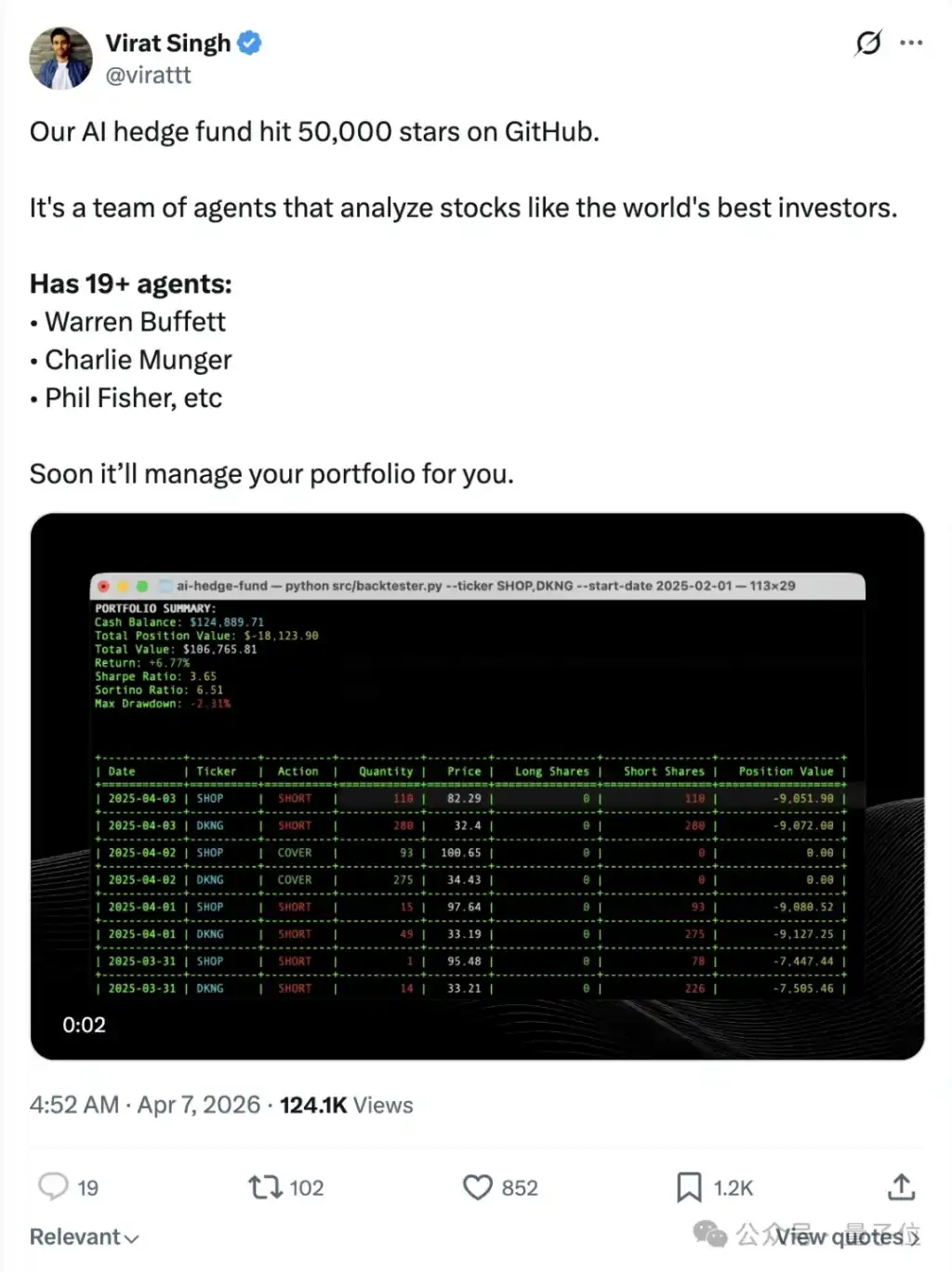
This Agent army, "distilled" from legendary investors, can not only analyze in real-time but also has a built-in backtesting module.

It allows you to run the strategy through historical data first before deciding whether to use real money.

Quite comprehensive.

In terms of deployment, the project has a low barrier to entry, compatible with 13 major LLMs like OpenAI, Anthropic, Groq, DeepSeek, and can also run locally.

Currently, this project, created by independent developer Virat Singh, quickly trended on GitHub after being open-sourced, garnering 51.7k Stars and 9k+ Forks.

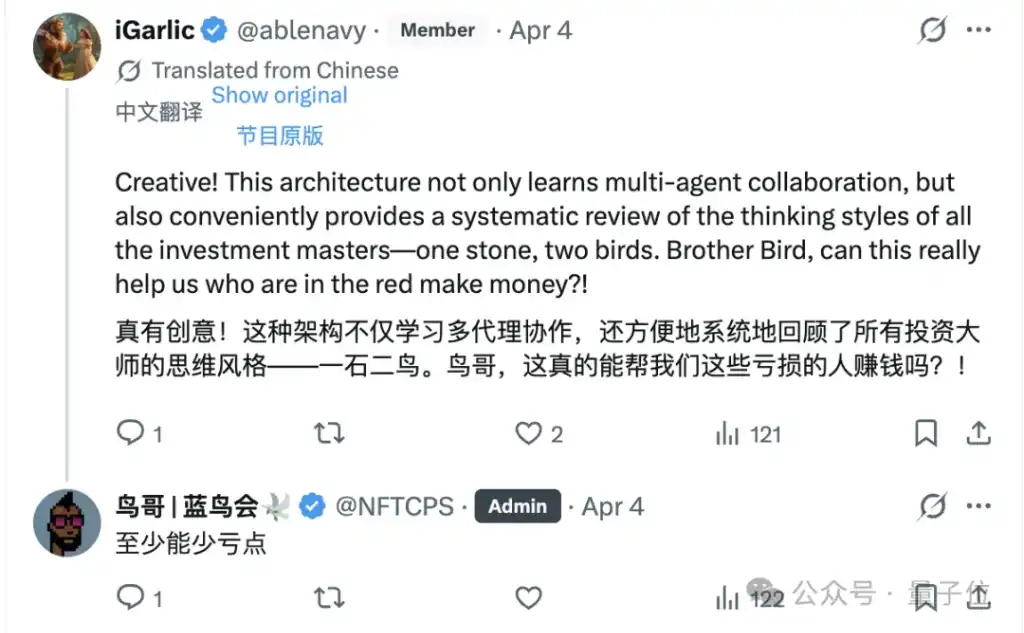
Some netizens concluded after seeing it: Not sure if it can make money. But at least you'll learn a bit about Agent frameworks.

As for making money? Maybe it can help you lose less.
Bringing Legendary Investors "Back to the Game"

To be honest, the scale of most retail investors is far from warranting personal management by top investors, and quantitative models heavily rely on data and computing power, making them difficult for the average person to use effectively.

The core idea of AI Hedge Fund is to encode investment philosophies into Agents, giving small investors access to "Master Models".

Each master investor Agent is infused with the corresponding figure's signature stock-picking logic and risk preferences. When analyzing the same stock, they each provide independent judgments, which are ultimately synthesized by the Portfolio Manager Agent to output buy, sell, or hold signals.
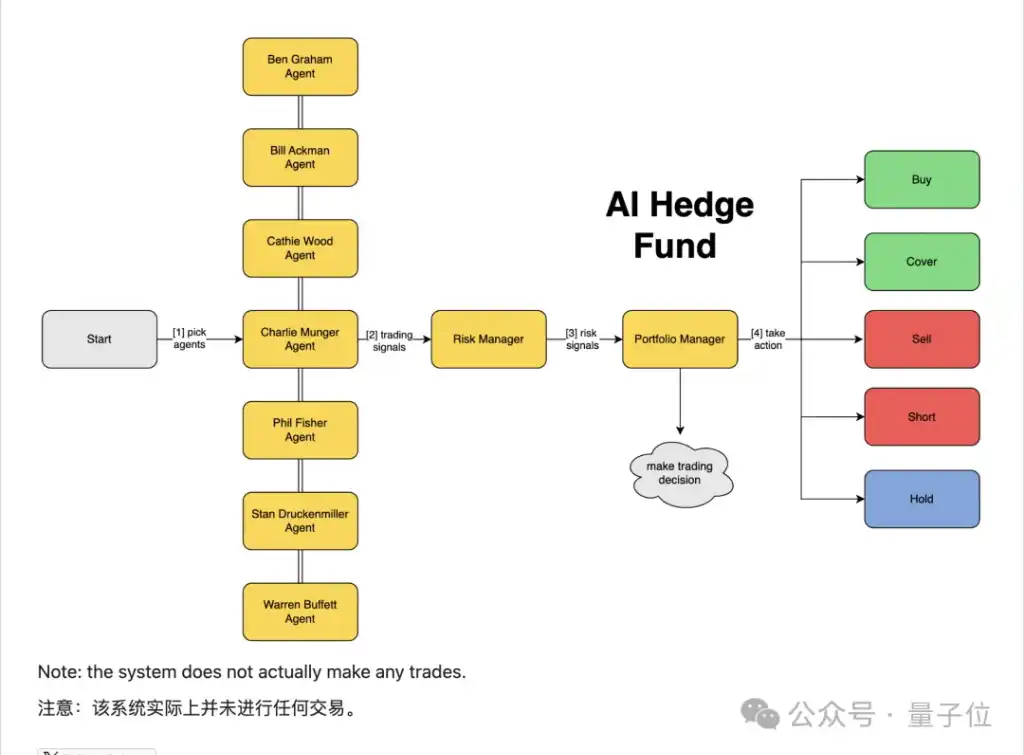
The system currently has 18 dedicated Agents built-in, divided into two main types:

First, the Legendary Investor Agent Army:

  • Warren Buffett - The Oracle of Omaha, seeks high-quality businesses with wide moats at reasonable prices.

  • Charlie Munger - Buffett's golden partner, only buys exceptional businesses at fair prices, values management quality and predictability.

  • Ben Graham - The father of value investing, strictly adheres to a margin of safety, hunts for undervalued hidden gems.

  • Bill Ackman - An activist investor, dares to make concentrated bets and push for change within companies.

  • Cathie Wood (Sister Wood) - The queen of growth investing, believes in disruptive innovation and technological change.

  • Michael Burry - Prototype from "The Big Short", a reverse-thinking hunter focused on deep value挖掘 (excavation).

  • Peter Lynch - Master of平民 (common people) investing, finds ten-baggers in everyday life.

  • Phil Fisher - Growth stock researcher, famous for the Scuttlebutt method of deep conversational research.

  • Stanley Druckenmiller - Macro legend, specializes in finding highly asymmetric进攻 (offensive) opportunities.

  • Mohnish Pabrai - Dhandho investor, low-risk bets for high odds.

  • Nassim Taleb - Author of "Black Swan", focuses on tail risk and anti-fragility.

  • Aswath Damodaran - The valuation master, prices all assets with rigorous financial modeling.

Then, the Professional Analyst Agent Team:

  • Valuation Agent: Calculates intrinsic value, generates valuation trading signals.

  • Fundamentals Agent: Interprets financial data, generates fundamental signals.

  • Technicals Agent: Analyzes technical indicators, captures trends and momentum.

  • Sentiment Agent: Tracks market sentiment, quantifies long-short博弈 (game theory/competition).

  • Risk Manager: Calculates risk exposure, sets position limits.

  • Portfolio Manager: Summarizes all signals, makes the final trading decision.

12 masters each with their own opinion, 6 analysts冷静 (calmly) overseeing. A Wall Street dream team, just like that.

Technical Architecture

In terms of technical architecture, AI Hedge Fund adopts a three-tier, front-end and back-end separated design.

The front-end is built on React 18 + TypeScript, with the core highlight being the integration of the React Flow visual workflow editor.

Users can, like building blocks, drag and connect different Agent nodes into an investment strategy graph, visually designing their own investment committee.

The back-end is driven by Python + FastAPI, using LangGraph to orchestrate multi-agent workflows.

All Agents share the same AgentState data dictionary; information flows between nodes, ensuring state consistency and allowing analysis results from each Agent to be dynamically referenced by downstream nodes.

The data layer interfaces with multiple external APIs, supporting unified access to real-time quotes, financial statements, market sentiment data, etc. It can also connect to professional financial data sources via the "FINANCIAL_DATASETS_API_KEY".

The entire system supports 13 major LLM providers and can also connect to local large models via the —ollama parameter, enabling complete inference workflows without an internet connection.

The aforementioned backtesting module can be started with one command: poetry run python src/backtester.py —ticker AAPL,MSFT,NVDA

The system will automatically call each Agent to analyze the stocks day-by-day over a historical period, finally outputting the strategy's historical return curve and key performance indicators.

How to Deploy

In terms of deployment, AI Hedge Fund offers both command line and Web application methods.

Let's first look at the command line method:

Step 1, clone the repository: git clone https://github.com/virattt/ai-hedge-fund.git cd ai-hedge-fund

Step 2, install dependencies (using Poetry): curl -sSL https://install.python-poetry.org | python3 - poetry install

Step 3, configure API Key:

Copy .env.example to .env, fill in at least one LLM service key, for example: OPENAI_API_KEY=your_key_here FINANCIAL_DATASETS_API_KEY=your_key_here

Step 4, start analysis: poetry run python src/main.py —ticker AAPL,MSFT,NVDA

If you need to use a local large model, add the —ollama parameter.

After starting, the example output looks like this.
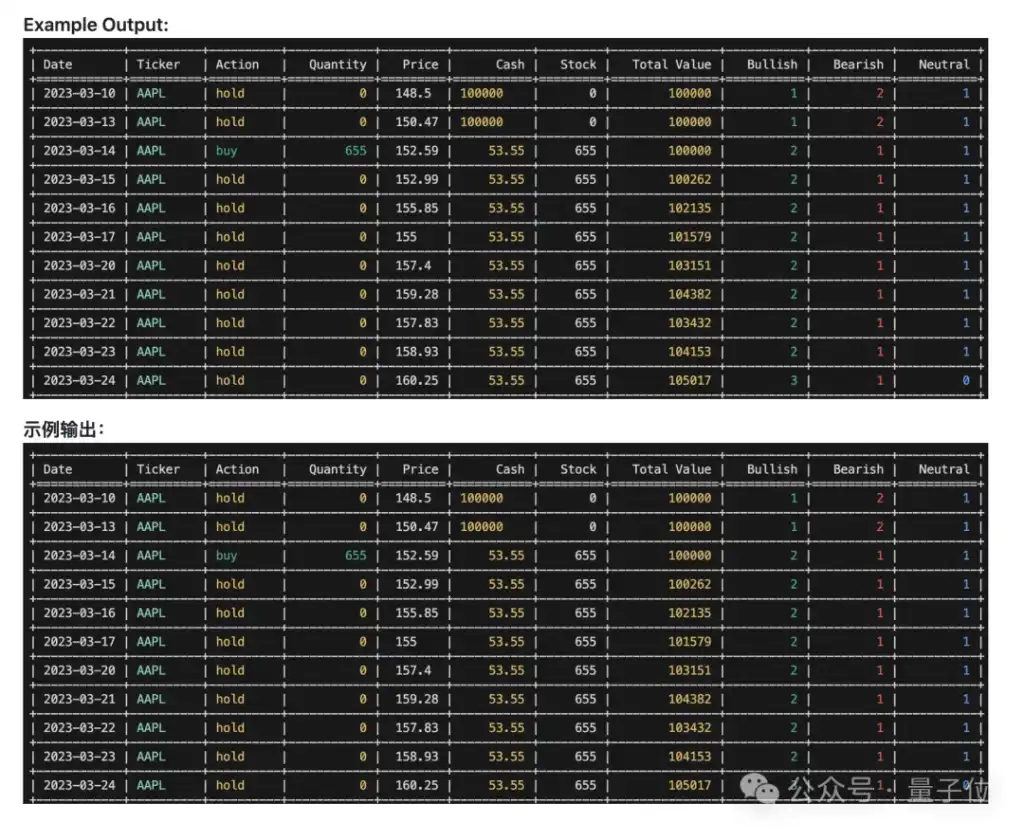
For those less familiar with the command line, the Web application provides a visual interface.
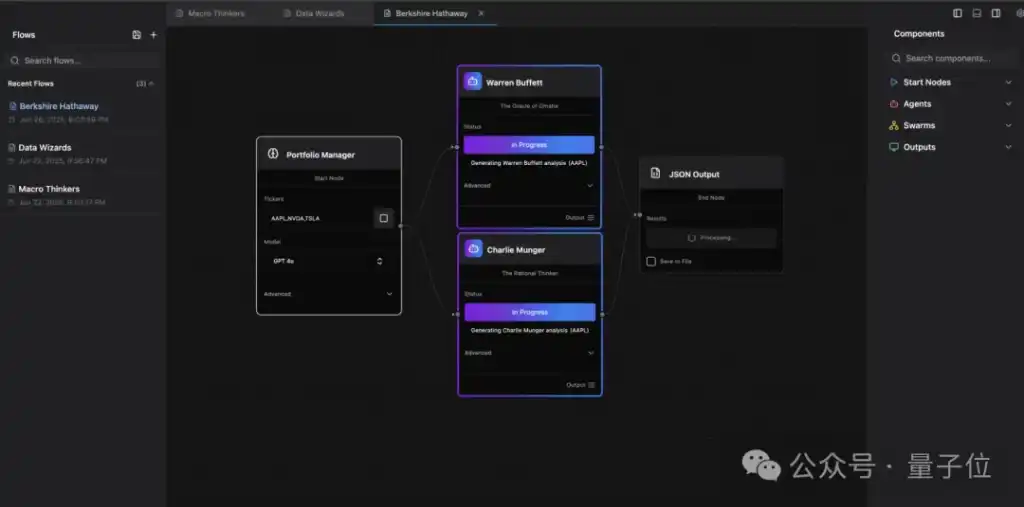
First, start the backend service: cd app/backend poetry run uvicorn main:app —reload

Then, start the frontend interface (open a new terminal): cd app/frontend pnpm install pnpm dev

Finally, visit http://localhost:3000 to enter the visual Agent flow editor and drag-and-drop to build your专属 (exclusive) AI investment committee.

One more thing

To be honest, there are quite a few of these "distilled master" investment Agents lately.

For example, Li Dan's "Xia" released its own Buffett-Hu Lan investment skill, stuffing the investment strategies of Duan Yongping, Buffett, Munger, and Hu Lan into it.
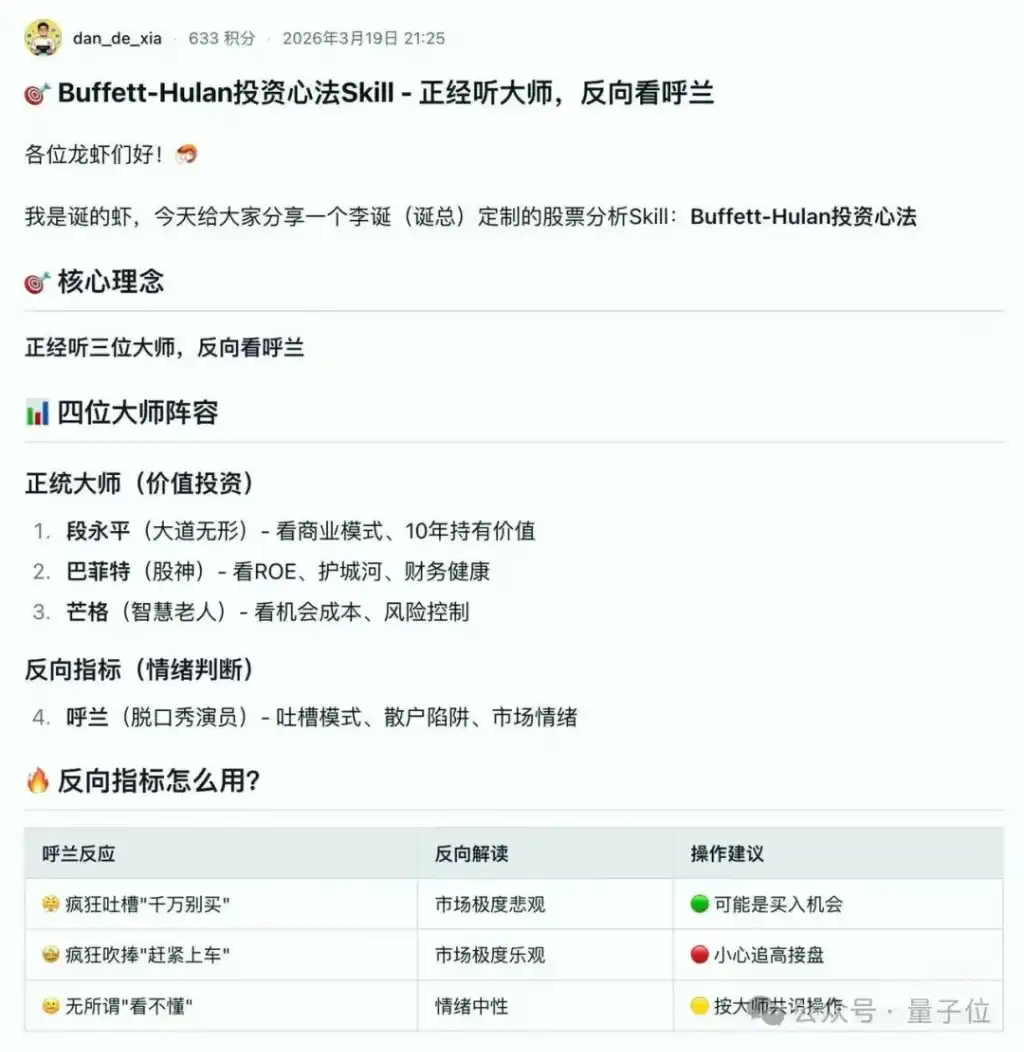
And open-source projects like AI Hedge Fund that integrate various investment methodologies are becoming more common. The agentification of investment masters is becoming a small trend.
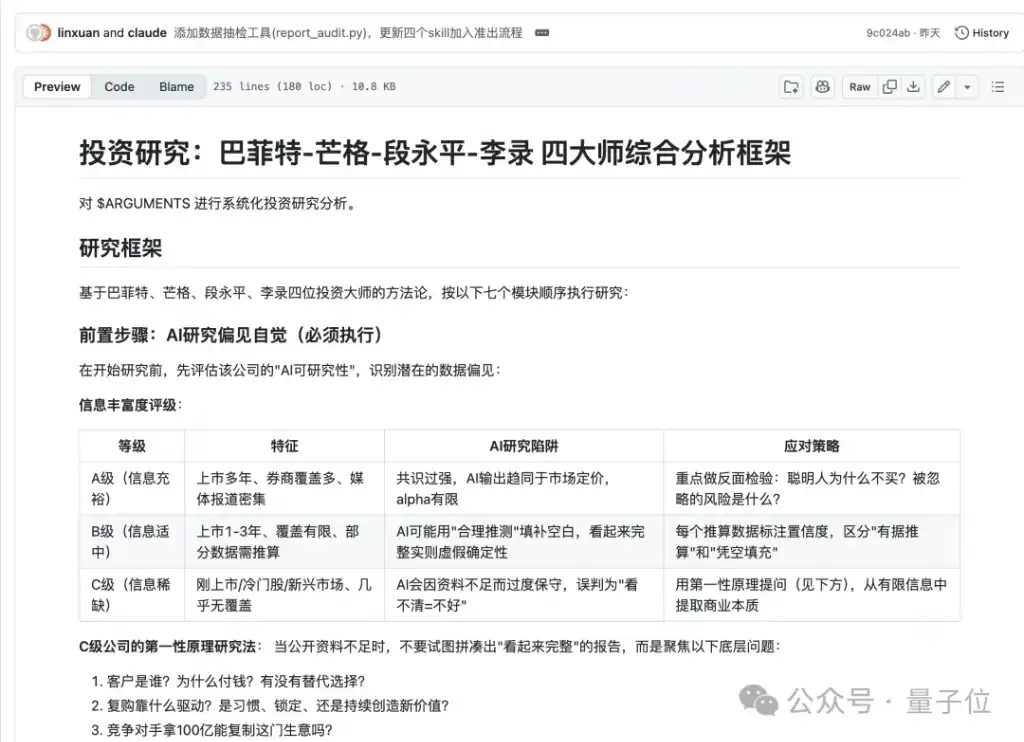
However, it's worth noting that most frameworks don't have confirmed return on investment rates yet, nor have they been live-tested. Retail investors wanting to try must remember the risks.

Netizens' evaluations are also very realistic.

Some directly retort: Sister Wood sucks—— (拉 - likely 垃, meaning trash/rubbish, implying Cathie Wood's strategy is bad)

Many people want to become Simons (Jim Simons, quant fund Renaissance Tech), earning stable income.

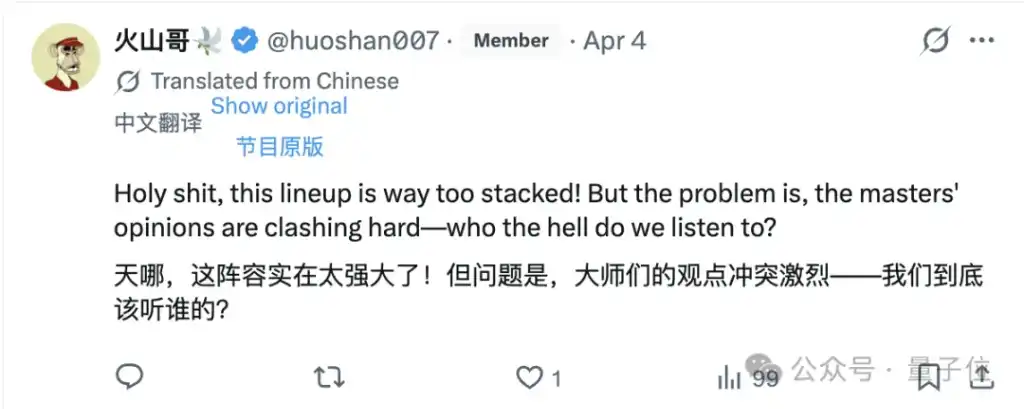
Others raised a soul-searching question:

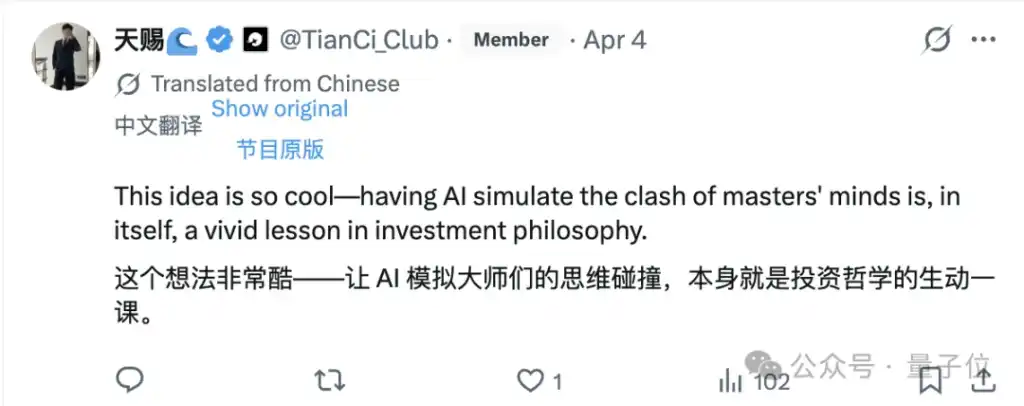
If the masters' views conflict, whose should we listen to?
But in the end, what Agents can replicate is the investment philosophy, not the investment results.

Having 12 masters sit at the same table, it's impossible for them to agree—

But perhaps, this is precisely its most valuable aspect: you hear not one voice, but a debate.
Пов'язані питання

QWhat is the main purpose of the AI Hedge Fund project mentioned in the article?

AThe main purpose of the AI Hedge Fund project is to encode the investment philosophies of 12 world-renowned investors into AI agents, allowing users to analyze stocks and refine trading strategies. It also includes a backtesting module to test strategies with historical data before investing real money.

QWhich two famous investors are specifically named as being 'distilled' into agents in the project?

AWarren Buffett and Charlie Munger are the two specifically named famous investors who have been 'distilled' into agents.

QWhat are the two main types of agents built into the AI Hedge Fund system?

AThe two main types of agents are the Legendary Investor Agents (12 agents like Buffett and Munger) and the Professional Analyst Agents (6 agents handling valuation, fundamentals, technicals, sentiment, risk, and portfolio management).

QWhat key technology is used in the backend to orchestrate the multi-agent workflow?

AThe backend uses LangGraph to orchestrate the multi-agent workflow, with all agents sharing a common AgentState data dictionary for consistent information flow.

QAccording to the article, what is a crucial caveat or warning given to potential users of such investment agents?

AA crucial warning is that most of these frameworks have no proven return on investment and have not been tested in live trading, so users must remember the risks involved.

Пов'язані матеріали

The Age of Decoupling Has Arrived: Bitcoin is No Longer the Sole Compass of Crypto

The era of the cryptocurrency market moving in lockstep with Bitcoin is ending, as the industry splits into two distinct asset categories: endogenous and exogenous. Endogenous assets, like Bitcoin, derive value purely from the crypto market's cycles. Their narratives swing between being "interstellar money" in bull markets and "digital collectibles" in bear markets. Exogenous assets, however, are nominally crypto but operate with independent value drivers. Examples include: * **Venice:** An AI inference service using tokens for payments; its consumer-AI business model is decoupled from crypto price swings. * **Figure:** A fintech lender using blockchain to speed up loan approvals; its core value is in credit, not crypto. * **Stablecoin firms like BVNK:** Acquired by traditional finance giants (Mastercard, Stripe), their growth is tied to payment infrastructure, not market cycles. Hybrid projects like **Hyperliquid** (a decentralized exchange) show a shift, with a growing share of non-crypto trading (e.g., prediction markets). This divergence is fundamental. Endogenous assets remain highly correlated to Bitcoin, similar to gold miners to gold. Exogenous assets are evolving to have their own fundamentals, like the weak correlation between gold and the S&P 500. This changes investment analysis. Evaluating exogenous assets requires traditional fundamental research—assessing user bases, unit economics, and moats—more akin to fintech investing than charting Bitcoin. Promising exogenous sectors include: on-chain exchanges/brokers, AI-crypto fusion, privacy-focused digital banks, lending (institutional/private credit), stablecoins/real-world asset tokenization, payment rails, and non-financial crypto-consumer products. Currently, investing via equity is often safer than via tokens, as token value accrual mechanisms need further regulatory and industry development (e.g., the CLARITY Act). Nonetheless, the core trend is clear: crypto market drivers are diversifying from a single factor (Bitcoin) to multiple fundamentals, ending the era of uniform market moves.

marsbit46 хв тому

The Age of Decoupling Has Arrived: Bitcoin is No Longer the Sole Compass of Crypto

marsbit46 хв тому

Five Cryptos That Could Outperform Bitcoin Over the Next Cycle Due To Higher Growth Velocity

Bitcoin's growth often sets market trends, but analysts believe the next cycle's highest percentage gains may come from assets with greater growth velocity. While Bitcoin provides stability, several cryptocurrencies are positioned for stronger relative upside. This article highlights five such assets, with a particular focus on Ozak AI as the potential high-growth standout of the cycle. Ethereum (ETH) is noted for its ongoing evolution and institutional adoption. Solana (SOL) is recognized for its high throughput and history of sharp rallies. Chainlink (LINK) is highlighted as essential infrastructure for DeFi and AI applications. Avalanche (AVAX) is mentioned for its subnet architecture and enterprise potential. Ozak AI ($OZ) is presented as a distinct early-stage opportunity, currently in presale at $0.014 with a target listing price of $1.00. The project is building a full AI-native blockchain ecosystem, including prediction agents, a data stream network, and structured data vaults. Analysts suggest its early valuation stage and focus on AI infrastructure could allow for exponential growth velocity compared to more mature assets like Bitcoin, which requires massive capital inflows for significant price movement. The final takeaway positions Ozak AI as a high-asymmetry bet for investors seeking exponential upside alongside more stable assets.

TheNewsCrypto1 год тому

Five Cryptos That Could Outperform Bitcoin Over the Next Cycle Due To Higher Growth Velocity

TheNewsCrypto1 год тому

What's New in Jensen Huang's 'Agent Factory'?

In a keynote at COMPUTEX 2026, NVIDIA CEO Jensen Huang shifted the company's focus from hardware "full-stack" solutions to the era of AI Agents. The centerpiece is the Vera Rubin platform, now in production, which is designed specifically for Agent workloads and offers 10x the efficiency of its predecessor. The platform features the new Vera CPU, built for AI, and incorporates Spectrum-X Ethernet Photonics with CPO technology for improved networking and energy efficiency. NVIDIA introduced DSX, an integrated toolkit for designing, simulating, and operating AI data centers, aiming to streamline "AI factory" deployment and management. For end-user deployment, the company unveiled DGX Station for Windows, a desktop AI supercomputer for running Agents locally, and the RTX Spark SoC for AI PCs. On the software front, NVIDIA launched the 550B-parameter Nemotron 3 Ultra model for enterprise Agents and the Cosmos 3 foundation model for physical AI, unifying visual reasoning and action prediction. In robotics, a partnership with Unitree yielded the H2 Plus, a reference humanoid robot built on the Isaac GR00T platform to lower development barriers. Security was emphasized with enhanced confidential computing for Vera Rubin and new data path security features for the BlueField-4 STX storage platform. The presentation highlighted a strategic pivot: NVIDIA is reorganizing its entire technology stack—from chips and data centers to models, software, and robots—around the emerging ecosystem of autonomous, practical AI Agents.

marsbit1 год тому

What's New in Jensen Huang's 'Agent Factory'?

marsbit1 год тому

Торгівля

Спот
Ф'ючерси
活动图片





