Someone Predicts South Korean Stock Market with Hyperliquid, Achieving 74% Accuracy?

Foresight NewsОпубліковано о 2026-06-10Востаннє оновлено о 2026-06-10

Анотація

A study analyzed whether weekend price movements of four Korean stock perpetual futures contracts (Samsung Electronics, SK Hynix, Hyundai Motor, and EWY) on Hyperliquid could predict their Monday opening directions on their respective primary exchanges (KRX, NYSE). Over 62 weekend observations across the four assets, Hyperliquid correctly predicted the Monday opening direction 45 times (73.8% accuracy). However, performance varied significantly. Samsung Electronics showed the strongest and statistically significant signal, with Hyperliquid's weekend close correctly predicting its KRX Monday open in 15 out of 16 cases (94% accuracy, p-value < 0.001). This signal remained strong (75% accuracy) even when using Saturday's close instead of Sunday's, suggesting genuine price discovery beyond last-minute convergence. Hyundai Motor also showed high accuracy (81%, 13/16 correct), but this was not statistically significant after accounting for a baseline downward bias in its Monday opens. SK Hynix performed marginally better than a coin flip (63%, 10/16). EWY performed the worst (54%, 7/13), underperforming a simple strategy of always predicting a Monday rise. The stark difference between Samsung and EWY is largely attributed to market timing. KRX opens shortly after Hyperliquid's Sunday close, while NYSE opens ~14 hours later, allowing new information to flow in. The results suggest that for assets like Samsung Electronics, where weekend trading on Hyperliquid precedes the primary...


Written by: Ponyo(@ponyo_fp), Four Pillars Researcher & Hyperliquid Core Contributor

Compiled by: AididiaoJP, Foresight News


In February, TradeXYZ launched perpetual futures contracts for Samsung Electronics, SK Hynix, Hyundai Motor, and EWY on Hyperliquid, allowing investors to gain exposure to South Korean stocks on weekends for the first time.


I reviewed the weekend price movements of these stock contracts since their launch, covering a total of 62 observation samples across the 4 assets. I compared each contract's movement from Friday close to Sunday close with the direction of the underlying asset's Monday opening auction. For South Korean stocks, I used the KRX opening price at 9:00 AM (KST); for EWY, I used the NYSE opening price at 9:30 AM (ET).


Hyperliquid correctly predicted the opening direction in 45 out of the 62 cases, an accuracy rate of 73.8%. This number sounds good, but the aggregate data masks highly uneven performance across different assets.
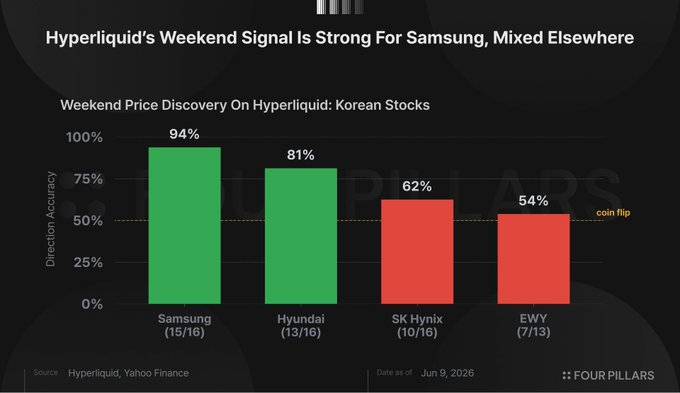


Samsung Electronics shows a clear outlier. Hyperliquid correctly predicted the direction 15 out of 16 weekends. Since Samsung's Monday openings were evenly distributed between up and down, there's no inherent directional bias inflating the hit rate. The binomial test (against a 50% benchmark) yields a p-value of 0.0003, meaning the probability of such a strong result occurring by random chance is only 0.03%. Although the sample size is still small, a result of 15 correct out of 16 is hard to ignore.


Hyundai Motor also performed well, with 13 correct predictions out of 16, an 81% accuracy rate. However, after accounting for the stock's slight downward bias on Mondays, this result did not reach statistical significance. During the sample period, Hyundai Motor opened lower on Mondays 62% of the time, meaning a simple strategy of always predicting "down" would have had a high baseline win rate.


SK Hynix is less convincing. It was correct only 10 out of 16 times, barely better than a coin flip. Some misses were significant. On the weekend of June 5-7, the Hyperliquid contract closed up 0.11%, while SK Hynix gapped down 10.34% at the Monday KRX open.


EWY had the worst results. It was correct only 7 out of 13 weekends, even underperforming the benchmark. Out of those 13 Mondays, EWY opened higher 10 times, accounting for 77%. A simple weekly prediction of "up" would have outperformed Hyperliquid's signal. Meanwhile, the Hyperliquid weekend contract closed down in 9 out of the 13 cases, repeatedly pointing traders in the wrong direction.


The discrepancy between Samsung Electronics and EWY can largely be explained by market time differences. The KRX opens at 9:00 KST, which is 00:00 UTC, almost exactly coinciding with Hyperliquid's daily candle reset time. Therefore, the time gap between Hyperliquid's last weekend trade and the KRX opening auction is only a few minutes.


In contrast, EWY trading on the NYSE doesn't start until 9:30 AM ET, about 14 hours after Hyperliquid's Sunday candle close. By then, the entire Monday trading session on the KRX is complete, European markets are open, and US pre-market trading has incorporated a new round of information. The information set determining EWY's Monday open simply didn't exist when Hyperliquid's weekend candle closed.


A reasonable critique is that even Samsung's results might reflect last-moment convergence rather than genuine price discovery. Informed traders might adjust positions on Hyperliquid just before the KRX opens, making this "prediction" almost tautological.


To test this, I repeated the analysis using Saturday's close instead of Sunday's, creating a lead time of about 24 hours instead of just minutes. The results show that the Saturday signal still predicted Samsung's Monday opening direction with 75% accuracy (against a 50% benchmark). Sunday trading improved the result but didn't create the signal from scratch.


In comparison, Samsung's own Friday price movement predicted Monday's direction with only 62% accuracy. This suggests Hyperliquid's weekend market provides information beyond a simple continuation of the previous KRX trading session.


Among the four assets tested, only Samsung Electronics produced a statistically significant directional signal. The sample size remains small, and the results have not been validated out-of-sample. Nevertheless, this might still be valuable information for anyone trading Samsung Electronics or the broader KOSPI market.


Despite an average weekend trading volume of only about $12,000, Hyperliquid correctly predicted the Monday opening direction for a company with a market cap of roughly $300 billion with 94% accuracy and a p-value below 0.001. For anyone trading Samsung Electronics on the KRX, checking Hyperliquid's weekend closing price before Monday's opening auction appears to be a very worthwhile practice.


Пов'язані питання

QWhat is the main finding of the analysis regarding Hyperliquid's weekend contracts for predicting Korean stock market opens?

AThe analysis found that Hyperliquid's weekend contracts, specifically for Samsung Electronics, predicted the direction of Monday's KRX opening auction with 94% accuracy (15 out of 16 times), a result highly unlikely to be due to random chance (p-value < 0.001).

QWhy was the performance of the EWY contract on Hyperliquid significantly worse than for Samsung Electronics?

AThe EWY contract performed poorly because NYSE opens approximately 14 hours after Hyperliquid's Sunday close. By that time, new information from a full day of KRX trading, European markets, and US pre-market activity becomes available, which was not reflected in the Hyperliquid weekend price.

QWhat was the author's method to test if the Samsung result was due to last-minute convergence or genuine price discovery?

ATo test this, the author repeated the analysis using Saturday's closing price on Hyperliquid instead of Sunday's, creating a 24-hour lead time. The result showed a 75% accuracy rate, indicating the signal existed beyond just last-minute convergence before KRX open.

QHow did the author account for potential bias from a stock's inherent Monday opening direction when evaluating the results?

AThe author noted that for stocks like Hyundai Motor, which had a 62% probability of opening down on Mondays, a high accuracy rate needed to be considered against this baseline. They also mentioned that Samsung's Monday openings were evenly distributed, so a high accuracy was not due to a directional bias.

QWhat is a key limitation of the study's findings mentioned by the author?

AA key limitation is the small sample size (only 16 weekends for Samsung Electronics) and the fact that the results have not yet been validated out-of-sample.

Пов'язані матеріали

When AI Traffic Surpasses Humans, How Do You Prove You're Human?

As AI-generated web traffic now surpasses human activity, the internet's foundational business models—built on human attention, browsing, and advertising—face severe disruption. AI agents crawl websites at immense scale without generating ad revenue, while AI summaries divert traffic from original content sites. In response, over 2.5 million sites are blocking AI crawlers, and protections like Cloudflare's "honeypot" traps have emerged, though advanced AI can bypass these. The collapse of traditional CAPTCHAs, which assumed machines were weaker than humans, has led to a shift toward behavioral biometrics for human verification. Companies like IBM and BioCatch now analyze unique human patterns—cursor movements, typing rhythms, keystroke dynamics, and even cognitive delays like the Stroop effect—to distinguish real users from bots. These biometric signatures are difficult to fake or alter, offering a new layer of security but raising significant privacy concerns. Two competing visions for a reliable human verification system are emerging. One, exemplified by Sam Altman’s World (formerly Worldcoin), uses centralized iris scanning to generate unique credentials, though it faces bans and criticism over unauthorized data collection. The other employs cryptographic zero-knowledge proofs, allowing users to prove they are human without revealing identity or biometric data, as advocated by Vitalik Buterin. However, decentralized approaches risk exploitation through identity renting in economically unequal regions. The central dilemma is between a scalable but privacy-invasive centralized system that permanently controls users' biometric data, and a privacy-preserving cryptographic system vulnerable to real-world economic manipulation. The author expresses a preference for the cryptographic path, arguing that despite its flaws, it avoids the irreversible biometric surveillance inherent in centralized alternatives.

Foresight News2 хв тому

When AI Traffic Surpasses Humans, How Do You Prove You're Human?

Foresight News2 хв тому

Crypto Primary Market Investment and Financing Forward-Looking Weekly Report | Stablecoin Regulation Nears Implementation, ETF Funds Continue to Withdraw, Capital Begins Betting on Payment and Cash Flow

Crypto Market Weekly Report (Jun 1-7, 2026): Capital Shifts Focus to Payments & Cash Flow Market data indicates a significant divergence: while traditional institutional funds continue exiting via BTC and ETH ETFs (recording net outflows of $1.72B and $168M this week, respectively), stablecoin supply continues growing. This suggests capital is shifting from speculative asset allocation toward defensive positioning within on-chain liquidity, awaiting new, concrete opportunities. This trend is reflected in venture capital focus. Weekly fundraising fell 27% to $302M, with investments concentrating on infrastructure with tangible revenue potential: 1. **Stablecoin Infrastructure (28% of funding):** Projects like M0 Protocol ($35M raise) are gaining attention as regulatory clarity (e.g., the GENIUS Act) nears, shifting the focus from legitimacy to building payment and settlement networks. 2. **AI Agent Infrastructure (26%):** Investments are moving from conceptual AI Agents towards the execution and economic layers required for a functional "Agent economy." Key raises include OpenRouter ($40M) and Halliday ($20M). 3. **Real World Assets (RWA) (18%):** The search for on-chain yield and cash flow drives continued interest in RWA platforms like Ondo Finance. Security threats are evolving from smart contract exploits toward key management failures, permission control issues, and regulatory execution risks (e.g., court-ordered asset freezes). **Key Takeaways:** The investment thesis is shifting from narrative-driven bets to revenue and cash-flow-generating protocols. Future attention should be on the progression of stablecoin regulations, the commercial validation of AI Agent economies, and the performance of high-revenue protocols like derivatives platforms.

marsbit9 хв тому

Crypto Primary Market Investment and Financing Forward-Looking Weekly Report | Stablecoin Regulation Nears Implementation, ETF Funds Continue to Withdraw, Capital Begins Betting on Payment and Cash Flow

marsbit9 хв тому

Buy an NFT First to Get a Ticket? The Largest World Cup Ticket Slump in History

"Ticketing Woes for 2026 World Cup: NFT 'Right-to-Buy' and High Prices Dampen Sales" Despite anticipation for the 2026 FIFA World Cup, with 48 teams and 104 matches across North America, the tournament faces significant unsold tickets, with approximately 180,000 group-stage tickets still available for resale just before kick-off. This unexpected shortfall is attributed to FIFA's controversial new ticketing strategy, which includes an NFT-based "Right-to-Buy" (RTB) system and opaque, dynamic pricing. FIFA introduced RTBs as digital collectibles (NFTs) sold on its FIFA Collect platform. An RTB grants the holder only the right to purchase a ticket for a specific match later, not the ticket itself. This two-step process, criticized for selling "scarcity" first, saw RTBs priced from tens to hundreds of dollars, generating millions in revenue for FIFA. With many tickets remaining available on official channels, the value of these prepaid purchase rights is now being questioned. Compounding the issue are ticket prices, reported to be 2 to 4 times higher than the 2022 Qatar World Cup, and up to 7 times more for marquee matches. FIFA employed dynamic pricing, common in U.S. sports, but lacked transparency on seat availability and exact locations during sales, frustrating global fans facing high travel costs. This has drawn scrutiny from regulators in New York and New Jersey. FIFA's official resale platform also drew criticism for imposing high fees—roughly 10% on sellers and 17% on buyers, allowing FIFA to profit further from secondary market transactions. While FIFA President Gianni Infantino states over 6 million tickets have been sold, the situation highlights a potential disconnect between fan enthusiasm and willingness to pay under an aggressive commercial model.

marsbit17 хв тому

Buy an NFT First to Get a Ticket? The Largest World Cup Ticket Slump in History

marsbit17 хв тому

Торгівля

Спот
Ф'ючерси
活动图片




