Someone Predicts South Korean Stock Market with Hyperliquid, Achieving 74% Accuracy?

Foresight NewsОпубліковано о 2026-06-10Востаннє оновлено о 2026-06-10

Анотація

A study analyzed whether weekend price movements of four Korean stock perpetual futures contracts (Samsung Electronics, SK Hynix, Hyundai Motor, and EWY) on Hyperliquid could predict their Monday opening directions on their respective primary exchanges (KRX, NYSE). Over 62 weekend observations across the four assets, Hyperliquid correctly predicted the Monday opening direction 45 times (73.8% accuracy). However, performance varied significantly. Samsung Electronics showed the strongest and statistically significant signal, with Hyperliquid's weekend close correctly predicting its KRX Monday open in 15 out of 16 cases (94% accuracy, p-value < 0.001). This signal remained strong (75% accuracy) even when using Saturday's close instead of Sunday's, suggesting genuine price discovery beyond last-minute convergence. Hyundai Motor also showed high accuracy (81%, 13/16 correct), but this was not statistically significant after accounting for a baseline downward bias in its Monday opens. SK Hynix performed marginally better than a coin flip (63%, 10/16). EWY performed the worst (54%, 7/13), underperforming a simple strategy of always predicting a Monday rise. The stark difference between Samsung and EWY is largely attributed to market timing. KRX opens shortly after Hyperliquid's Sunday close, while NYSE opens ~14 hours later, allowing new information to flow in. The results suggest that for assets like Samsung Electronics, where weekend trading on Hyperliquid precedes the primary...


Written by: Ponyo(@ponyo_fp), Four Pillars Researcher & Hyperliquid Core Contributor

Compiled by: AididiaoJP, Foresight News


In February, TradeXYZ launched perpetual futures contracts for Samsung Electronics, SK Hynix, Hyundai Motor, and EWY on Hyperliquid, allowing investors to gain exposure to South Korean stocks on weekends for the first time.


I reviewed the weekend price movements of these stock contracts since their launch, covering a total of 62 observation samples across the 4 assets. I compared each contract's movement from Friday close to Sunday close with the direction of the underlying asset's Monday opening auction. For South Korean stocks, I used the KRX opening price at 9:00 AM (KST); for EWY, I used the NYSE opening price at 9:30 AM (ET).


Hyperliquid correctly predicted the opening direction in 45 out of the 62 cases, an accuracy rate of 73.8%. This number sounds good, but the aggregate data masks highly uneven performance across different assets.
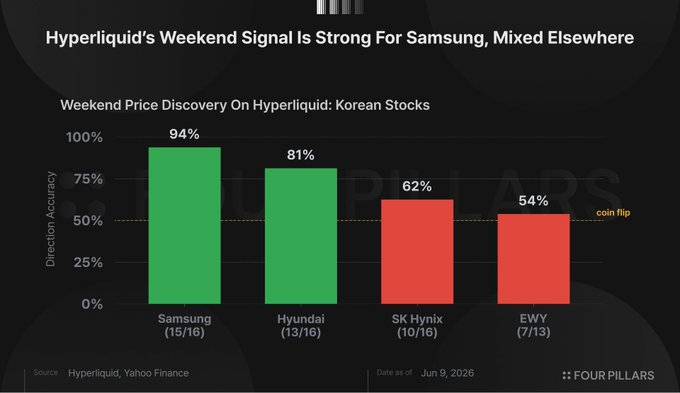


Samsung Electronics shows a clear outlier. Hyperliquid correctly predicted the direction 15 out of 16 weekends. Since Samsung's Monday openings were evenly distributed between up and down, there's no inherent directional bias inflating the hit rate. The binomial test (against a 50% benchmark) yields a p-value of 0.0003, meaning the probability of such a strong result occurring by random chance is only 0.03%. Although the sample size is still small, a result of 15 correct out of 16 is hard to ignore.


Hyundai Motor also performed well, with 13 correct predictions out of 16, an 81% accuracy rate. However, after accounting for the stock's slight downward bias on Mondays, this result did not reach statistical significance. During the sample period, Hyundai Motor opened lower on Mondays 62% of the time, meaning a simple strategy of always predicting "down" would have had a high baseline win rate.


SK Hynix is less convincing. It was correct only 10 out of 16 times, barely better than a coin flip. Some misses were significant. On the weekend of June 5-7, the Hyperliquid contract closed up 0.11%, while SK Hynix gapped down 10.34% at the Monday KRX open.


EWY had the worst results. It was correct only 7 out of 13 weekends, even underperforming the benchmark. Out of those 13 Mondays, EWY opened higher 10 times, accounting for 77%. A simple weekly prediction of "up" would have outperformed Hyperliquid's signal. Meanwhile, the Hyperliquid weekend contract closed down in 9 out of the 13 cases, repeatedly pointing traders in the wrong direction.


The discrepancy between Samsung Electronics and EWY can largely be explained by market time differences. The KRX opens at 9:00 KST, which is 00:00 UTC, almost exactly coinciding with Hyperliquid's daily candle reset time. Therefore, the time gap between Hyperliquid's last weekend trade and the KRX opening auction is only a few minutes.


In contrast, EWY trading on the NYSE doesn't start until 9:30 AM ET, about 14 hours after Hyperliquid's Sunday candle close. By then, the entire Monday trading session on the KRX is complete, European markets are open, and US pre-market trading has incorporated a new round of information. The information set determining EWY's Monday open simply didn't exist when Hyperliquid's weekend candle closed.


A reasonable critique is that even Samsung's results might reflect last-moment convergence rather than genuine price discovery. Informed traders might adjust positions on Hyperliquid just before the KRX opens, making this "prediction" almost tautological.


To test this, I repeated the analysis using Saturday's close instead of Sunday's, creating a lead time of about 24 hours instead of just minutes. The results show that the Saturday signal still predicted Samsung's Monday opening direction with 75% accuracy (against a 50% benchmark). Sunday trading improved the result but didn't create the signal from scratch.


In comparison, Samsung's own Friday price movement predicted Monday's direction with only 62% accuracy. This suggests Hyperliquid's weekend market provides information beyond a simple continuation of the previous KRX trading session.


Among the four assets tested, only Samsung Electronics produced a statistically significant directional signal. The sample size remains small, and the results have not been validated out-of-sample. Nevertheless, this might still be valuable information for anyone trading Samsung Electronics or the broader KOSPI market.


Despite an average weekend trading volume of only about $12,000, Hyperliquid correctly predicted the Monday opening direction for a company with a market cap of roughly $300 billion with 94% accuracy and a p-value below 0.001. For anyone trading Samsung Electronics on the KRX, checking Hyperliquid's weekend closing price before Monday's opening auction appears to be a very worthwhile practice.

Пов'язані питання

QWhat is the main finding of the analysis regarding Hyperliquid's weekend contracts for predicting Korean stock market opens?

AThe analysis found that Hyperliquid's weekend contracts, specifically for Samsung Electronics, predicted the direction of Monday's KRX opening auction with 94% accuracy (15 out of 16 times), a result highly unlikely to be due to random chance (p-value < 0.001).

QWhy was the performance of the EWY contract on Hyperliquid significantly worse than for Samsung Electronics?

AThe EWY contract performed poorly because NYSE opens approximately 14 hours after Hyperliquid's Sunday close. By that time, new information from a full day of KRX trading, European markets, and US pre-market activity becomes available, which was not reflected in the Hyperliquid weekend price.

QWhat was the author's method to test if the Samsung result was due to last-minute convergence or genuine price discovery?

ATo test this, the author repeated the analysis using Saturday's closing price on Hyperliquid instead of Sunday's, creating a 24-hour lead time. The result showed a 75% accuracy rate, indicating the signal existed beyond just last-minute convergence before KRX open.

QHow did the author account for potential bias from a stock's inherent Monday opening direction when evaluating the results?

AThe author noted that for stocks like Hyundai Motor, which had a 62% probability of opening down on Mondays, a high accuracy rate needed to be considered against this baseline. They also mentioned that Samsung's Monday openings were evenly distributed, so a high accuracy was not due to a directional bias.

QWhat is a key limitation of the study's findings mentioned by the author?

AA key limitation is the small sample size (only 16 weekends for Samsung Electronics) and the fact that the results have not yet been validated out-of-sample.

Пов'язані матеріали

M&A Deals in the Crypto Market Are Unusually Active

Title: M&A Activity in Crypto Market Becomes Unusually Active A rare signal is emerging in the crypto primary market: mergers and acquisitions (M&A) are nearing half of all financing deals. According to RootData, this month, M&A cases in the crypto industry reached 10, while financing rounds numbered only 14, meaning M&A accounts for approximately 42% of primary market transactions—the highest level in history. This does not signal a sudden industry boom. Instead, the rapid rise in M&A share primarily reflects the continued downturn in the financing market. Since November 2024, monthly crypto M&A deals have remained between 10-20, while financing deals have plummeted from around 100 to about 50, possibly hitting a new low this month. For project teams, this means the traditional path of relying on narratives, token expectations, and ecosystem subsidies to maintain valuations is narrowing. For leading companies, it presents a rare window to acquire teams, licenses, technology, liquidity, and market access at lower prices, with less competition and stronger bargaining power. Key active buyers include Coinbase, Kraken, Ripple, MoonPay, Polymarket, Kaiko, Sol Strategies, GSR, Keyrock, Jupiter, Paxos, and Ondo Finance. Their M&A logic is consistent: acquiring key capabilities at lower costs during the industry downturn. This is driven by more attractive valuations, reduced time and trial-and-error costs, the acquisition of licenses and compliance resources, and the integration of industry upstream and downstream segments. Current M&A focuses are concentrated in four areas: trading infrastructure (e.g., Coinbase acquiring Deribit, Kraken acquiring NinjaTrader), payments and stablecoins (e.g., MoonPay, Ripple expanding payment networks), compliance licenses, and asset issuance/distribution (e.g., acquisitions related to RWA and token issuance platforms like Coinbase's purchases of Liquifi and Echo). The rise in M&A is altering the primary market's exit logic. It provides an alternative path to the token-dependent model, encouraging teams to build tangible products, revenue, and strategic value that can be integrated. This could inject confidence into the market, showing that asset buyers and exit possibilities still exist, albeit with a stricter focus on real utility. However, this trend also indicates the crypto industry is becoming more centralized. As asset issuance, trading, market-making, custody, payments, and data gradually consolidate in the hands of a few major players, the industry's initial emphasis on openness and anti-monopoly is being reshaped by commercial realities. Coupled with rising compliance barriers, this signals the end of the low-barrier era for crypto entrepreneurship.

链捕手24 хв тому

M&A Deals in the Crypto Market Are Unusually Active

链捕手24 хв тому

M&A Deals Are Exceptionally Active in the Crypto Market

Mergers and acquisitions (M&A) activity in the cryptocurrency primary market has reached a historic high, accounting for approximately 42% of total deals in the current month, nearly matching the number of financing rounds. This shift does not signal a new boom cycle but rather reflects a severe contraction in the venture capital funding environment. As financing dwindles, established industry giants—including major exchanges, payment firms, and infrastructure providers—are seizing the opportunity to acquire strategic assets at lower valuations. Key drivers behind the surge in M&A include depressed project valuations, the need to quickly acquire talent and technology to capture short market windows, the pursuit of crucial regulatory licenses, and the strategic expansion into adjacent business verticals such as derivatives, payments, stablecoins, and real-world asset (RWA) issuance. Major acquisitions, like Coinbase's purchase of Deribit and Kraken's acquisition of NinjaTrader, exemplify the push to expand into high-margin areas like derivatives and multi-asset trading. This trend is reshaping the industry's exit landscape, offering an alternative to token-based exits and incentivizing startups to build tangible products and revenue streams with inherent strategic value for acquisition. However, it also points toward increasing centralization, as critical functions—trading, custody, payments, compliance—become concentrated within a few large, well-capitalized platforms, potentially raising barriers to entry for new ventures.

marsbit25 хв тому

M&A Deals Are Exceptionally Active in the Crypto Market

marsbit25 хв тому

Solana Privacy Ecosystem Panorama: A Complete Privacy Stack from Compute to AI

**Title: The Solana Privacy Ecosystem: A Full-Stack View from Compute to AI** **Summary:** This article provides a comprehensive overview of the emerging privacy landscape on the Solana blockchain, characterizing it as still in early development. It identifies two primary verticals—Neobanks and Private DeFi—as key drivers, while noting gaps in tooling and user experience. The discussion centers on two main approaches to private computation: Arcium, which utilizes Multi-Party Computation (MPC) networks (Multi-Party eXecution Environments) to process encrypted data with final settlement on Solana; and Magic Block, which leverages Trusted Execution Environments (TEEs) via its Private Ephemeral Rollup (PER). Both enable confidential applications like dark pools and private DeFi with minimal code changes. Building on this infrastructure, projects are creating privacy-focused applications. Umbra, built on Arcium, offers Encrypted Token Accounts (ETAs) for private balances, transfers, and selective disclosure for compliance. Other wallets like Privacy Cash and Hush provide mixer-like functionality for SOL. For private trading, encifherio uses TEEs to encrypt swap details routed through Jupiter, while VanishTrade and Darklake focus on shielding transaction intent and liquidity routing, with Darklake introducing a "blind slippage pool" to prevent front-running. Further applications include private prediction markets (e.g., Melee Markets using Arcium's encrypted order books) and private AI. Loyal exemplifies the latter, using both Magic Block and Arcium to enable decentralized AI agents that store user data, conversations, and transactions confidentially on-chain. The article concludes by framing privacy not as a single technology but as an evolving "ultimate privacy stack," with experts like Helius's Mert envisioning a future combination of Fully Homomorphic Encryption (FHE) and Zero-Knowledge proofs (ZK). Helius Privacy itself is developing a ZK-based UTXO privacy layer for Solana.

Foresight News30 хв тому

Solana Privacy Ecosystem Panorama: A Complete Privacy Stack from Compute to AI

Foresight News30 хв тому

Торгівля

Спот
Ф'ючерси
活动图片