Solana Price Rallied 2,000% The Last Time This Happened, And It Just Triggered Again

bitcoinistОпубліковано о 2026-06-12Востаннє оновлено о 2026-06-12

Анотація

The Solana (SOL) price is garnering renewed attention as it trades near a key historical Fibonacci zone ($40-$60), which previously triggered a massive 2,200% rally in 2023. Analyst Crypto Patel suggests this could signal a breakout from its prolonged slump, potentially leading to new highs and even a challenge of the $1,000 mark if market conditions align, especially during an altcoin season. However, not all outlooks are bullish. Another expert, 'The Martini Guy', warns of near-term downside risks, noting SOL has broken down on weekly charts and entered an illiquid zone. He cautions it could retest $40 or even $25 if sentiment worsens. SOL is currently trading around $65, down significantly over recent weeks amid bearish market structure and a lack of bullish catalysts.

The Solana price is drawing renewed attention after months of declines, selling pressure, and mixed performance. Market analyst Crypto Patel highlighted in a recent X post that SOL is currently trading near a historical price level that previously triggered a massive 2,000% rally during the 2023 cycle. He emphasized that if history were to play out as expected, Solana could finally break out of its prolonged price slump and consolidation phase, potentially paving the way for new all-time highs.

Solana Price Reenters Zone That Triggered Explosive Past Rally

Crypto Patel is reminding investors to remember Solana’s past price behavior and its tendency to execute sharp moves. He pointed out that the last time Solana traded within the 0.5 to 0.618 Fibonacci Retracement zone, it rallied over 2,200%.

According to Patel, Solana is once again trading inside this key Fibonacci zone around the $40 to $60 range. Sharing a chart, the analyst noted that this range has historically acted as a major accumulation area for traders, with SOL’s price surging rapidly once buying pressure builds.

Given how fast the cryptocurrency tends to move, Crypto Patel has suggested that investors who position themselves strategically in this zone could benefit significantly once the market enters another bullish phase. The analyst also indicated that if the highly anticipated altcoin season finally unfolds, Solana would be among the cryptocurrencies leading the rally with a substantial upside.
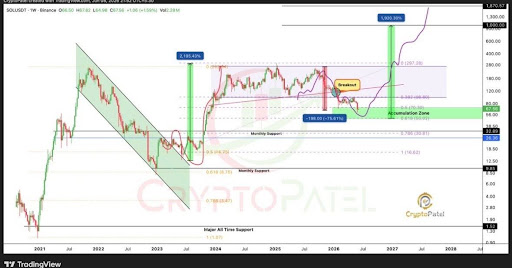
Source: Chart from Crypto Patel on X

Notably, Crypto Patel hinted that SOL might even challenge the $1,000 mark if market conditions align. However, he acknowledged that the real question is not whether Solana can hit $1,000 during this cycle, but whether investors will have enough exposure to the asset if the price actually goes parabolic. As a result, the analyst has cautioned that maintaining proper market positioning during these consolidation phases could yield higher returns for investors during a potential price breakout.

SOL Faces Fresh Downside Risk After Major Breakdown

Not all analysts are optimistic about Solana’s near-term trajectory. A well-known crypto expert, identified as ‘The Martini Guy’ on X, has warned that Solana’s price faces a serious risk of a decline. He noted that the cryptocurrency has broken down on the weekly chart and is now trading within a highly illiquid price zone, which could accelerate downward movement.

The Martini Guy explained that historically, Solana tends to move very quickly through the $40 to $80 range. If history repeats itself, SOL could dip toward the lower end of this spectrum, potentially testing $40. In more extreme scenarios, he added, a backtest toward $25 cannot be ruled out if market sentiment deteriorates further.

Notably, SOL is currently trading above $65 after declining by roughly 20% this last week and a staggering 32% over the past month. The cryptocurrency’s price structure remains inherently bearish as broader market sentiment, volatility, and a lack of sustainable bullish catalysts continue to weigh on price.

SOL trading at $65 on the 1D chart | Source: SOLUSDT on Tradingview.com

Пов'язані питання

QAccording to the article, what specific technical zone is Solana currently trading in, and what historical precedent is associated with it?

AAccording to analyst Crypto Patel, Solana is currently trading within the 0.5 to 0.618 Fibonacci Retracement zone, specifically around the $40 to $60 range. Historically, the last time Solana traded in this zone, it rallied over 2,200% during the 2023 cycle.

QWhat is the optimistic long-term price target for Solana mentioned by Crypto Patel?

ACrypto Patel hinted that if market conditions align, Solana (SOL) might even challenge the $1,000 mark during this cycle.

QWhich analyst presents a bearish view for Solana's near-term price, and what is the key risk they identify?

AA crypto expert identified as 'The Martini Guy' presents a bearish view. He warns that Solana's price faces a serious risk of a decline because it has broken down on the weekly chart and is trading within a highly illiquid price zone, which could accelerate downward movement.

QWhat are the potential downside price levels mentioned by The Martini Guy?

AThe Martini Guy suggested that Solana could dip toward $40, and in more extreme scenarios, a backtest toward $25 cannot be ruled out if market sentiment deteriorates further.

QWhat is the current price and recent performance of Solana as reported in the article?

ASolana (SOL) is currently trading above $65. It has declined by roughly 20% in the last week and approximately 32% over the past month. The broader market sentiment and a lack of bullish catalysts are weighing on its price.

Пов'язані матеріали

Ethereum Foundation Cuts 20% of Staff, 54 Depart: The Survival Logic Behind the Restructuring

The Ethereum Foundation (EF) has announced a major restructuring, resulting in the departure of 54 staff members, representing approximately 20% of its workforce. This reorganization is not merely a cost-cutting measure but a strategic refocusing. The EF will now concentrate its resources on what it deems critical and unique tasks, structured around five new operational clusters. The new structure comprises clusters dedicated to: the Protocol Layer (ensuring Ethereum's core properties like censorship resistance and security); the Access Layer (enabling trusted, non-intermediated user interactions); the User Layer (grounding decisions in real user needs and constraints); the Community Layer (representing EF's stance and building alliances); and the Institutional Layer (engaging with enterprises, governments, and academia to promote principled adoption). The foundation stated that the layoffs were a difficult but necessary step to align its organization and spending with its long-term mandate, insulating its core work from short-term market fluctuations. Affected employees were offered a severance package and transition support. The restructured EF emerges as a leaner and more focused organization, poised to prioritize the development and preservation of Ethereum's foundational promise of self-sovereignty. Further details on the new operational model are expected in the coming weeks.

marsbit2 хв тому

Ethereum Foundation Cuts 20% of Staff, 54 Depart: The Survival Logic Behind the Restructuring

marsbit2 хв тому

Talking About Returns But Not Collection? Goldfinch's Liquidation Sounds the Alarm for RWA Credit

Goldfinch, a crypto lending platform connecting investors with real-world borrowers, has proposed a full wind-down via governance proposal GIP-87. The plan would halt all new development, shut down its flagship Goldfinch Prime product, and allocate 150,000 USDC to manage the collection of outstanding loans. While the proposal is under community vote, it highlights a critical shift for the RWA (Real World Asset) lending sector: the transition from a growth phase focused on yields to a difficult recovery phase focused on collections. The proposal reveals that while the protocol's on-chain TVL is low, it still holds tens of millions in active, non-performing loans off-chain. This gap underscores that tokenizing debt makes tracking exposure transparent but does not simplify the offline, labor-intensive, and legally complex process of loan recovery. The case of the Lend East pool, where only an estimated 42% of a $10.15 million loan may be recovered, exemplifies the potential for significant investor losses. The wind-down plan forces token holders to govern not expansion but the maintenance of a debt collection system, including funding legal trust structures and preserving user access for repayments. This move starkly contrasts with the sector's typical narrative of rapid, AI-powered underwriting and high yields, exposing the often-overlooked necessity for robust borrower vetting, standardized disclosure, and sustainable collection mechanisms. Ultimately, Goldfinch's situation serves as a crucial stress test for the entire RWA lending space. It demonstrates that a platform's true resilience is tested not during capital deployment but during the protracted, costly, and uncertain process of recovering defaulted loans from real-world borrowers, a challenge blockchain transparency alone cannot solve.

Foresight News7 хв тому

Talking About Returns But Not Collection? Goldfinch's Liquidation Sounds the Alarm for RWA Credit

Foresight News7 хв тому

Meta Launches Prediction Market, Code-Named "Arena": Not Using Real Money, 3.56 Billion Daily Active Users Are Its Biggest Bargaining Chip

Meta, under the codename "Arena," is developing a standalone prediction market application, according to a June 23 report by The New York Times. Initially, the app will operate on a points-based system rather than real-money betting, though future integration of financial transactions is not ruled out. Meta plans to leverage its vast ecosystem of apps, boasting 3.56 billion daily active users, to distribute the product. The strategy aims to lower user acquisition costs and navigate regulatory complexities associated with real-money prediction markets, which are overseen by bodies like the CFTC. News of Meta's entry caused stock dips for established players like DraftKings and Robinhood, reflecting market concerns over Meta's potential to disrupt incumbents like Polymarket and Kalshi with its massive scale. The prediction market sector has seen explosive growth, with monthly trading volume on major platforms surging to approximately $24 billion as of April 2026. This marks Meta's second foray into the space, having launched and later shut down a similar virtual-points app called Forecast in 2020. While Arena poses a competitive threat to crypto-based platforms like Polymarket, its mainstream reach could also significantly expand the overall user base and awareness for prediction markets. The project remains in development with no public launch timeline, but its announcement has already impacted market sentiment.

marsbit12 хв тому

Meta Launches Prediction Market, Code-Named "Arena": Not Using Real Money, 3.56 Billion Daily Active Users Are Its Biggest Bargaining Chip

marsbit12 хв тому

Торгівля

Спот
Ф'ючерси
活动图片