Snowflake's stock price surges 33%, AI infrastructure expands from chips to the data layer

marsbitОпубліковано о 2026-05-29Востаннє оновлено о 2026-05-29

Анотація

Snowflake's stock surged over 33% after the company raised its full-year revenue forecast and announced a $6 billion, five-year partnership with AWS. This agreement, which secures AWS Graviton chip supply, underscores Snowflake's evolving role in the AI infrastructure landscape. The market's reaction reflects a reassessment of data platforms as critical enablers for enterprise AI adoption. As companies move beyond conceptual AI to building operational, data-integrated AI workflows, demand for robust data storage, processing, and analysis capabilities is increasing. The deal strengthens AWS's custom chip ecosystem while positioning Snowflake not just as a data warehouse, but as a key data layer for deploying and managing AI applications. Analysts have rapidly revised their valuations upwards, signaling a shift in sentiment where proven AI-driven revenue growth is now commanding premium multiples.

Editor's note: The narrative of AI investments is further expanding from chips and models to the data infrastructure layer.

After facing stock price pressure since the beginning of the year, Snowflake saw its stock surge over 33% in a single day after raising its full-year revenue forecast and securing a $6 billion five-year cooperation agreement with AWS. The core of this market reaction isn't just about better-than-expected earnings; it's that investors have started to reassess Snowflake's position in the enterprise AI implementation chain.

Over the past year, enterprise software companies have generally faced a question: Will AI become a growth engine, or will it undermine their existing business models? Snowflake's latest performance and the AWS partnership provide a relatively clear answer—when enterprises start deploying AI applications at scale, the capabilities for data storage, processing, analysis, and model deployment become even more critical.

In this partnership, the supply of AWS Graviton chips addresses the computing power constraint issue, while the deeper integration of the Snowflake platform with AWS AI workloads points to a more profound enterprise need: companies don't simply "use AI"; they need to connect their own data into AI workflows to build operational, manageable, and scalable application systems.

This is also why Snowflake is being re-integrated into the "AI winner" narrative. AI software stocks previously experienced a sell-off, with the market being skeptical about whether "AI can truly contribute to revenue." However, Snowflake's case shows that once AI translates from conceptual demonstrations into real revenue growth, market sentiment can reverse rapidly. The fact that at least 30 analysts raised their price targets illustrates that the capital markets are re-pricing the value of data platforms within the AI infrastructure cycle.

What's even more noteworthy is that this deal also reinforces the presence of AWS's in-house chip ecosystem. From Anthropic, OpenAI, and Meta to Uber, and now Snowflake, Amazon is embedding itself deeper into the AI infrastructure through cloud, chip, and enterprise software partnerships. For Snowflake, this means it is not just an enterprise data warehouse company but is becoming a critical data layer in the process of enterprise AI application implementation.

The original text follows:

May 28—Snowflake's stock surged more than 33% on Thursday. The company previously raised its full-year revenue forecast and announced a $6 billion cooperation agreement with Amazon, bolstering investor confidence in its position as a key beneficiary of the AI boom.

This five-year agreement with Amazon Web Services (AWS) will secure a crucial supply of AWS Graviton chips for Snowflake. Currently, computing resources are becoming increasingly scarce as AI usage grows substantially.

The agreement will also further deepen the integration between Snowflake's data storage, processing, and analytics products and AI workloads on the AWS cloud. As enterprises rapidly scale their AI applications, Snowflake is poised to capture more demand. Currently, most of Snowflake's customers run on AWS.
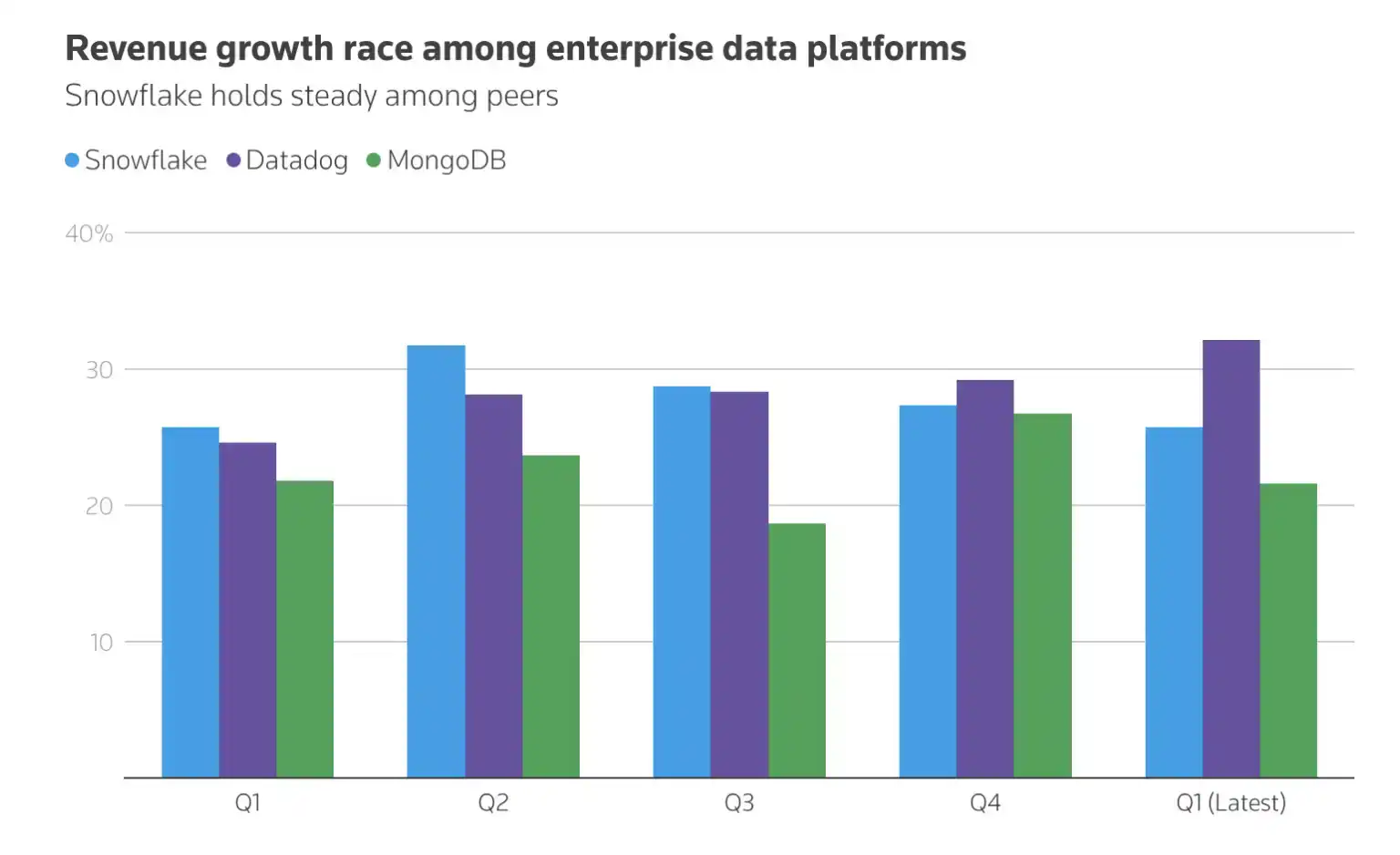
Following the announcement, at least 30 analysts raised their price targets for Snowflake, pushing the median target price from $230 before Wednesday's earnings report to $280. The stock was last trading at $233.50 in early trading.

If the current gains hold, Snowflake's market value would increase by approximately $20 billion from its previous $607.5 billion.

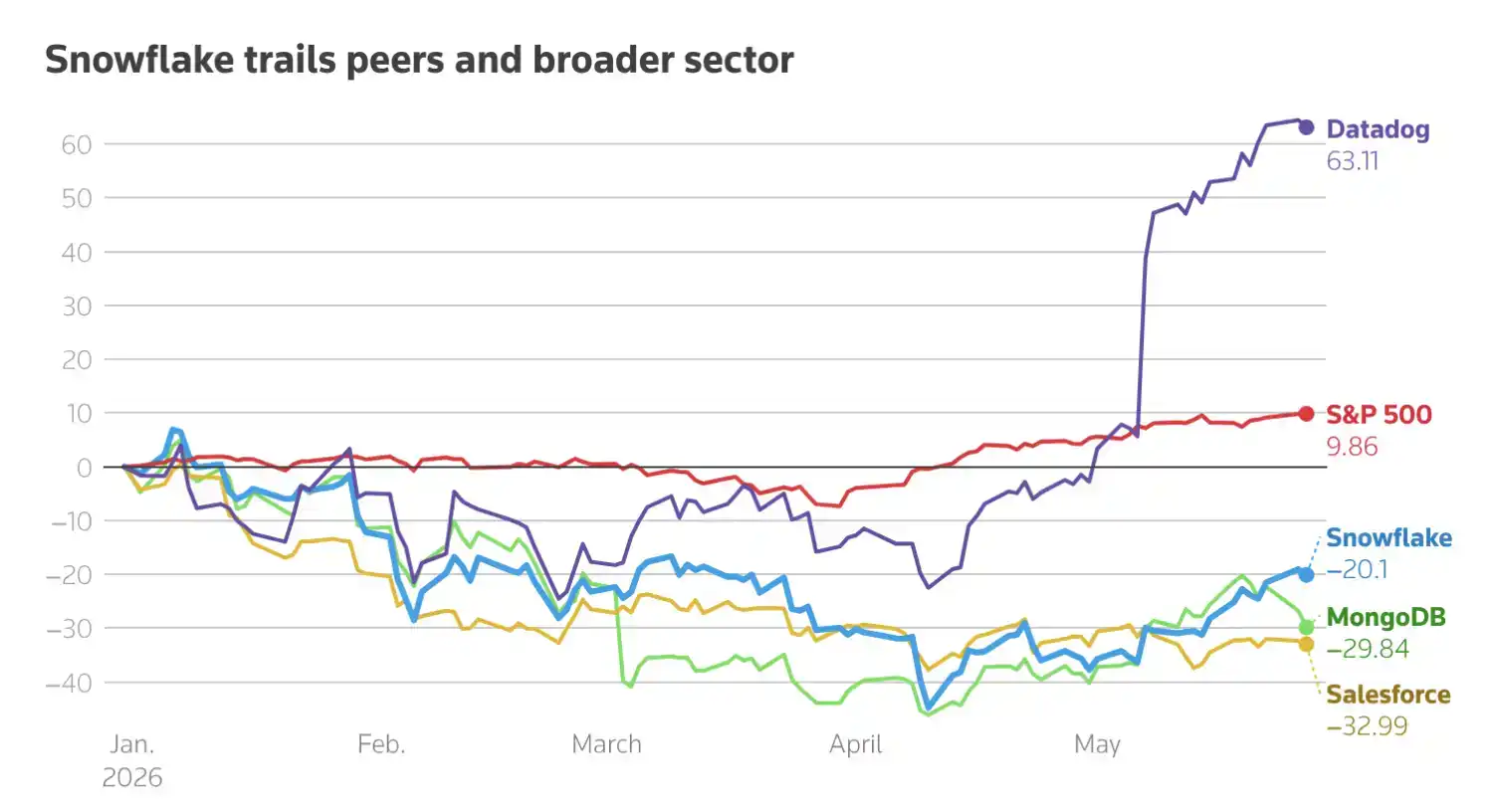
Matt Britzman, a senior equity analyst at Hargreaves Lansdown, stated that Snowflake's sharp stock rise—the stock was down 20% year-to-date before the previous trading day's close—"shows how much skepticism had built up during the wider AI software sell-off that hit data names."

"But it also shows how quickly sentiment can turn once a company proves AI is already driving revenue rather than just being PowerPoint filler."

Currently, Snowflake's forward 12-month price-to-earnings ratio is 85.21 times, compared to 85.19 times for Datadog and 47.17 times for MongoDB. A higher P/E ratio typically indicates investors are betting on stronger future growth.
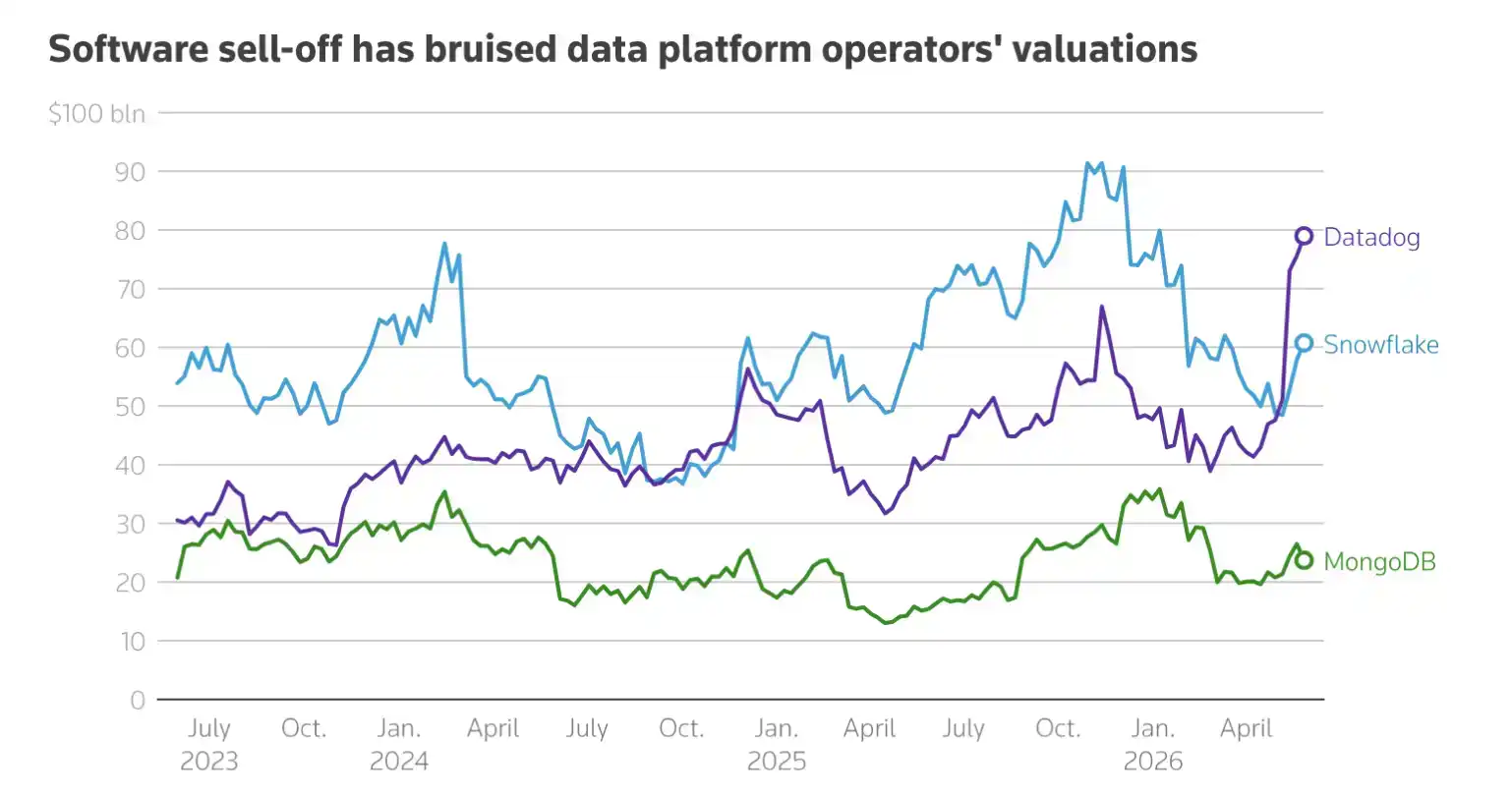
Previously, market concerns that AI would disrupt enterprise software put pressure on Snowflake. Now, the company is embedding AI into its platform, helping businesses integrate data from multiple sources, perform analysis, and build AI tools.

"We believe this set of results puts Snowflake squarely in the 'AI winner' camp and deserves a higher valuation multiple," said Patrick Colville, an equity research analyst at Scotiabank. He added that this clearly indicates Snowflake is benefiting from the growth in enterprise AI adoption.

Snowflake helps businesses store, manage, and analyze all their data on one platform. Its AI tools like Cortex Code and Snowpark are seeing strong adoption. These tools enable enterprises to build generative AI applications based on their own data and deploy machine learning models.

This agreement also serves as another vote of confidence in Amazon's in-house chip business. In recent months, Amazon has secured several significant customers, including Anthropic, OpenAI, Facebook parent Meta, and Uber.
Пов'язані питання

QWhat were the two main factors that led to Snowflake's stock price surging over 33%?

ASnowflake's stock price surged over 33% primarily due to two factors: 1) The company raised its full-year revenue guidance. 2) It announced a five-year, $6 billion partnership agreement with Amazon Web Services (AWS).

QWhat does the $6 billion AWS deal specifically provide to Snowflake, and why is it important?

AThe $6 billion deal provides Snowflake with a critical supply of AWS Graviton chips. This is important because as AI usage grows, computing power resources are becoming increasingly scarce and constrained.

QHow does the article describe the shift in the AI investment narrative, and what role does Snowflake now play in it?

AThe article states that the AI investment narrative is shifting from chips and models to the data infrastructure layer. Snowflake is now being re-evaluated as a key data layer, essential for enterprises to integrate their own data into AI workflows and build manageable, scalable AI application systems.

QAccording to the analyst from Hargreaves Lansdown, what does Snowflake's stock surge indicate about market sentiment?

AMatt Britzman from Hargreaves Lansdown stated that the surge indicates how much skepticism had built up during the broader AI software sell-off that dragged down data-related companies. It also shows how quickly market sentiment can reverse once a company proves that AI is driving actual revenue growth, not just being a presentation talking point.

QWhat are some of the specific AI tools offered by Snowflake mentioned in the article, and what is their purpose?

AThe article mentions Snowflake's Cortex Code and Snowpark AI tools. Their purpose is to enable enterprises to build generative AI applications and deploy machine learning models based on their own data.

Пов'язані матеріали

Claude Code Introduces Dynamic Workflows: Enabling AI to Form Teams and Collaborate

Claude Code introduces dynamic workflows, enabling AI to coordinate teams of specialized agents for complex tasks. This transforms Claude from a code assistant into a programmable workbench. Workflows address key limitations of single-agent systems: agentic laziness (premature task completion), self-preferential bias (favoring own outputs), and goal drift (losing sight of original objectives). The system allows Claude to dynamically create execution frameworks using JavaScript. It can split tasks, dispatch parallel agents for isolated work (e.g., in separate worktrees), implement adversarial validation, run tournaments, and synthesize results. This multi-agent approach is valuable for tasks requiring deep research, factual verification, code migration, root cause analysis, large-scale triage, and qualitative sorting. Key patterns include: classify-and-route, fan-out-and-synthesize, adversarial verification, generate-and-filter, tournaments, and loop-until-done. While token usage is higher, workflows excel where tasks resemble programming—needing problem decomposition, isolated context, hypothesis testing, and handling many details. They extend Claude Code's utility beyond technical work to areas like business plan review, resume screening, and naming brainstorm. The feature is not a universal solution but points to a future where AI tool competitiveness depends on organizing reliable, reusable, and auditable execution flows for complex goals.

marsbit2 хв тому

Claude Code Introduces Dynamic Workflows: Enabling AI to Form Teams and Collaborate

marsbit2 хв тому

Hyperliquid, Wall Street's 24/7 Trading Convenience Store

Hyperliquid: The 24/7 Trading "Convenience Store" for Wall Street Hyperliquid, a decentralized cryptocurrency exchange, has become a go-to platform for Wall Street traders seeking to trade around the clock, especially during traditional market closures. Founded by Jeff Yan, a former quantitative trader, after the FTX collapse, the platform emphasizes user self-custody of assets. It offers a wide range of perpetual contracts—leveraged derivatives with no expiry—on assets from Bitcoin and crude oil to the S&P 500 and even pre-IPO companies like SpaceX. A notable example involves a hedge fund trader who capitalized on geopolitical news over a weekend, securing a 243% return on oil derivatives before markets reopened. The platform, run by just 11 employees, generated approximately $800 million in revenue last year, and its native token HYPE has seen significant growth. Its rise highlights the merging of traditional finance and crypto. While U.S. users are currently restricted, recent CFTC rule changes could open access. The platform is known for its transparency, having processed $10 billion in liquidations during a market crash while competitors faltered. Regulators warn of the high risks and complexity of perpetual contracts for retail investors. Key to its appeal is a strong community culture, direct engagement with founders, and a simple interface. Despite rules against VPN use, it attracts global users with its permissionless approach. Hyperliquid plans to expand into prediction markets and options, aiming to eventually host all financial activity.

marsbit3 хв тому

Hyperliquid, Wall Street's 24/7 Trading Convenience Store

marsbit3 хв тому

Who Funds the Agents?

**Summary: Who Funds AI Agents?** OpenAI recently shut down a feature allowing AI agents to shop for users, highlighting the challenge of creating a secure and regulated environment for agent-driven transactions. While payment infrastructure exists, a crucial governance layer—defining spending limits, fraud detection, tax handling, and return policies—is largely missing. The potential is enormous: AI agents already processed $73M across 176M transactions last year, with McKinsey forecasting this could grow to $3-5T in global consumer commerce by 2030. The core competition isn't just about processing payments, which can be very cheap (especially with crypto-based settlement), but about controlling the rules that govern agent spending. Key players like Stripe and Coinbase are racing to dominate this governance layer. Stripe's acquisition of wallet provider Privy allows it to set spending policies, identity checks, and human-in-the-loop approvals directly at the wallet level. Similarly, Coinbase's stack, including its x402 protocol and AgentKit, embeds governance rules. This vertical integration across settlement, wallet, and governance layers is becoming the dominant strategy. Control over the governance layer is where significant future value lies. If agents handle trillions in transactions, even a small fee for managing compliance, fraud prevention, and policy enforcement could generate billions in annual revenue. The companies that successfully integrate across the payment stack will capture value from idle agent balances, transaction fees, and governance services, positioning themselves as the foundational banks of the AI agent economy.

marsbit30 хв тому

Who Funds the Agents?

marsbit30 хв тому

Торгівля

Спот
Ф'ючерси

Популярні статті

Як купити LAYER

Ласкаво просимо до HTX.com! Ми зробили покупку Solayer (LAYER) простою та зручною. Дотримуйтесь нашої покрокової інструкції, щоб розпочати свою криптовалютну подорож.Крок 1: Створіть обліковий запис на HTXВикористовуйте свою електронну пошту або номер телефону, щоб зареєструвати обліковий запис на HTX безплатно. Пройдіть безпроблемну реєстрацію й отримайте доступ до всіх функцій.ЗареєструватисьКрок 2: Перейдіть до розділу Купити крипту і виберіть спосіб оплатиКредитна/дебетова картка: використовуйте вашу картку Visa або Mastercard, щоб миттєво купити Solayer (LAYER).Баланс: використовуйте кошти з балансу вашого рахунку HTX для безперешкодної торгівлі.Треті особи: ми додали популярні способи оплати, такі як Google Pay та Apple Pay, щоб підвищити зручність.P2P: Торгуйте безпосередньо з іншими користувачами на HTX.Позабіржова торгівля (OTC): ми пропонуємо індивідуальні послуги та конкурентні обмінні курси для трейдерів.Крок 3: Зберігайте свої Solayer (LAYER)Після придбання Solayer (LAYER) збережіть його у своєму обліковому записі на HTX. Крім того, ви можете відправити його в інше місце за допомогою блокчейн-переказу або використовувати його для торгівлі іншими криптовалютами.Крок 4: Торгівля Solayer (LAYER)Легко торгуйте Solayer (LAYER) на спотовому ринку HTX. Просто увійдіть до свого облікового запису, виберіть торгову пару, укладайте угоди та спостерігайте за ними в режимі реального часу. Ми пропонуємо зручний досвід як для початківців, так і для досвідчених трейдерів.

316 переглядів усьогоОпубліковано 2025.02.11Оновлено 2026.06.02

Як купити LAYER

Обговорення

Ласкаво просимо до спільноти HTX. Тут ви можете бути в курсі останніх подій розвитку платформи та отримати доступ до професійної ринкової інформації. Нижче представлені думки користувачів щодо ціни LAYER (LAYER).

活动图片













