SK Hynix Becomes the 'Capitalist Traitor', Samsung Employees Launch Major Strike

marsbitОпубліковано о 2026-05-13Востаннє оновлено о 2026-05-13

Анотація

A major labor dispute is escalating at Samsung Electronics, with its union threatening an 18-day strike from May 21st after mediation failed. The core conflict is over profit-sharing, not the wage increase amount. The union, emboldened by a precedent set at rival SK Hynix, demands a permanent, formula-based annual bonus tied to 13% of the semiconductor division's operating profit. Management offered a large one-time payout instead, refusing to institutionalize an annual split, fearing it would set a costly precedent across Samsung's diverse business groups and the wider Korean conglomerate system. SK Hynix's deal, guaranteeing employees 10% of annual operating profit for a decade, has already delivered substantial bonuses due to its dominance in the lucrative HBM memory market for AI chips. This has triggered rare employee movement from Samsung to SK Hynix. The strike, potentially involving tens of thousands, risks impacting global DRAM and NAND production. Analysts see this as the start of a broader recalibration within the AI supply chain, where workers in critical, scarce roles are beginning to renegotiate their share of the massive profits generated, moving beyond traditional models like stock options towards more direct, transparent cash profit-sharing agreements.

Written by: Xiao Bing, Shenchao TechFlow
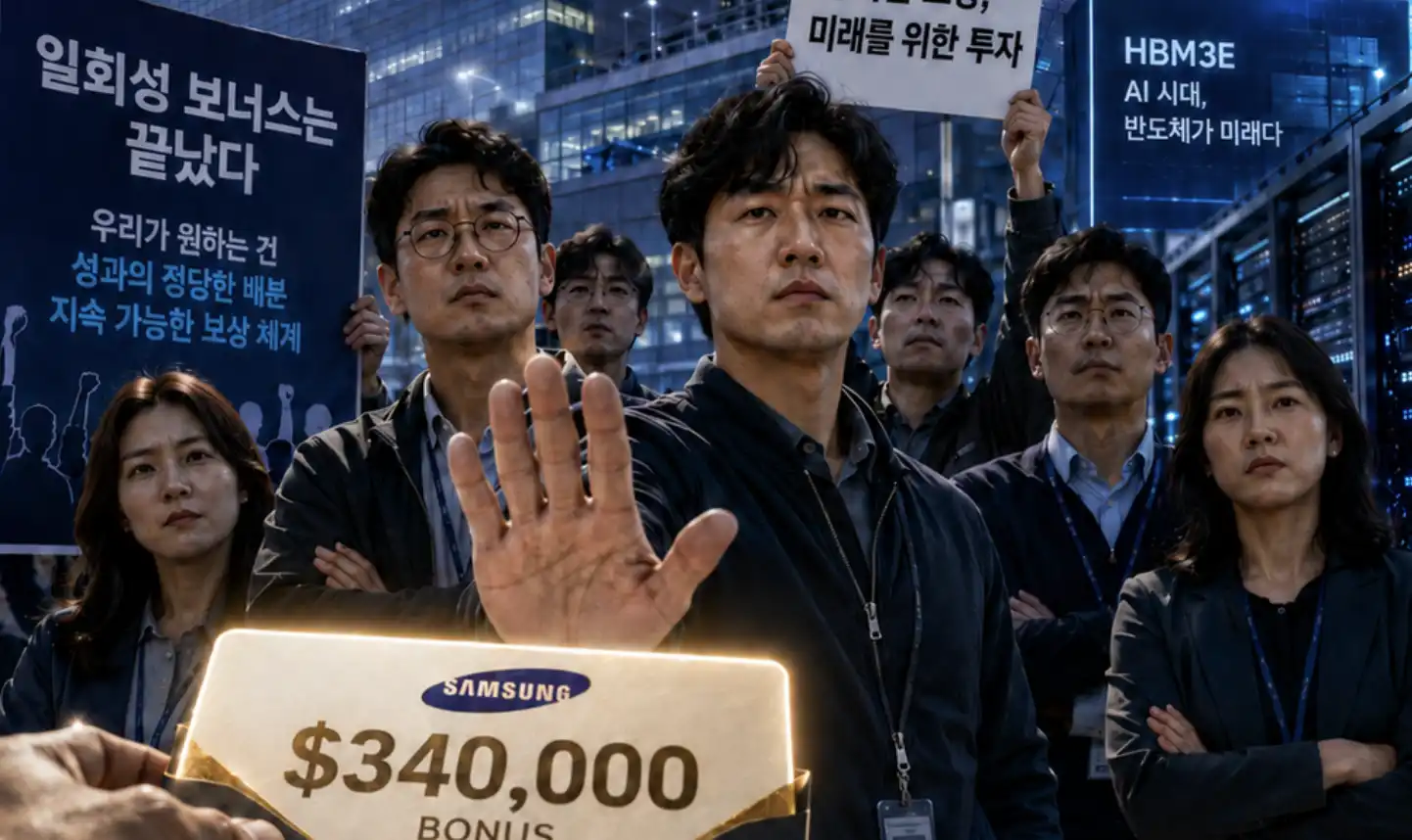
Samsung Electronics' labor negotiations have finally reached the brink of a strike.

Late on May 12th, mediation led by Korea's National Labor Relations Commission broke down. Samsung Electronics Union President Choi Seung-ho told reporters as he left the meeting room, "There's no point in waiting any longer." Barring any unforeseen circumstances, starting May 21st, the union will launch a major 18-day strike, lasting until June 7th.

The union currently has about 74,750 members, with approximately 80% from the semiconductor division (DS). According to Choi, about 41,000 members have expressed willingness to participate in the strike, with the final number potentially exceeding 50,000. Considering Samsung's participation rates in labor actions over the past two years, industry analysts estimate the actual participation this time will be between 30,000 and 40,000, making it the largest labor action in Samsung's history. A one-day partial strike previously caused a 58% reduction in night shift production on some lines. If the full 18-day strike proceeds, TrendForce estimates it could affect 3-4% of global DRAM capacity and 2-3% of NAND capacity. JPMorgan estimates that based on the current disagreements, Samsung Electronics' annual operating profit could be reduced by over 40 trillion KRW.

The real story isn't the strike itself, but the proposal the union rejected.

A 13% Offer, No Deal

According to the UK's Financial Times, the two sides had recently narrowed their initial gap considerably. The union's initial demands were a 15% bonus pool from the semiconductor division's operating profit, removal of the 50% bonus cap, plus a 7% wage increase. Management's initial response was 10% plus some other benefits. After back-and-forth negotiations, it was rumored both sides were close to the 13% figure.

But talks stalled.

The union wanted the 13% written into the agreement, to be paid annually according to this formula. Management was willing to pay a lump sum at this ratio, but only for this year, translating to an average one-time bonus of about $340,000 per person based on current profit levels.

It doesn't sound that different, but the union rejected it.

For employees, the difference isn't complicated:

The logic of a one-time bonus is: the company made a lot this year, so we're giving you a bonus. Whether the company makes a lot next year, whether we give a bonus, and according to what formula, will be renegotiated every year.

The logic of annualized profit-sharing is: according to the agreement, a certain percentage of operating profit inherently belongs to employees. Employees receive it for as long as the AI boom lasts; if the boom fades, employees accept that.

Both models are "bonuses," but they correspond to different statuses. The former is a temporary gift from the company; the latter is a share that is institutionally allocated by rule. With similar amounts, the two arrangements mean either employees wait for management's decision every year, or they have a predictable rule written in black and white.

This is the core point the union won't let go.

SK Hynix Has Already Made This Work

The union's confidence comes from its neighbor.

In the second half of last year, SK Hynix reached an agreement with its union, abolishing the previous bonus cap and establishing a 10% annual operating profit pool for employee sharing, valid for the next ten years. In February 2026, SK Hynix issued the first bonus under this new mechanism, amounting to 2,964% of base salary, averaging nearly $100,000 per person.

SK Hynix's Q1 2026 operating profit surged more than 5 times year-over-year, with an operating margin of 72%, an extremely rare figure in the hardware industry. The reason is clear: it holds over 50% of the global HBM (High Bandwidth Memory) market, being the main supplier of HBM for Nvidia's H100 and H200 chips. It earns as much as AI data centers are built.

As profit expectations have been raised throughout the year, some Korean and foreign media have calculated, under optimistic scenarios, that the average SK Hynix employee bonus this year could be around $470,000; if the high-end profit forecasts from institutions like Macquarie for 2027 materialize, it could theoretically approach $900,000. These figures require caution; they are projections based on optimistic profit assumptions, not money already in hand. But even based on the already disbursed amount and conservative expectations for the second half, the absolute numbers still far exceed Samsung's current offer.

Since December last year, about 200 Samsung employees have jumped ship to SK Hynix, according to the Samsung union's own statistics. This is a very rare migration direction among engineers, as SK Hynix has been playing catch-up to Samsung for the past decade. But this time, with the bonus structure changed, people are following.

Samsung Management Finds It Hard to Compromise

From the outside, Samsung just seems stingy, but from management's perspective, it's more complex than it appears.

Samsung Electronics is not a pure-play memory chip company. It has multiple business lines: mobile phones, home appliances, display panels, foundry, memory, and more. The semiconductor division making a lot this year doesn't mean other divisions can enjoy the same cycle. In Q1, the DX division's operating profit was already declining. If semiconductors alone get a 15% written profit share, people within the group would immediately ask: why do they get a share, and we don't?

According to external analyst calculations, if Samsung Semiconductor truly allocated 15% of operating profit to employees, the corresponding bonus pool would reach 40 to 45 trillion KRW, an amount higher than SK Hynix's total annual operating profit. This isn't just the company being "reluctant," but such a large-scale fixed expense, once institutionalized, would be very difficult to roll back in the future.

What management is most unwilling to do is write "formulaic profit-sharing" into a contract. Once this precedent is set, next year the DX union, the display panel union, will all use the same logic to negotiate. The entire internal compensation order within the Samsung Group would be reshuffled, and labor contracts across the entire Korean chaebol system would be used as new references.

That's why Samsung would rather endure strike losses, be called "stingy" by the union and media, and hold its ground on the wording of "annualization."

This Won't Stop at Korea

The specific day the union and management reach a compromise isn't the most important thing in the long run.

What's important is: Scarce positions on the AI industrial chain have begun renegotiating their value.

Over the past thirty years, Silicon Valley's script has been to tie employees' fates to the company's stock price with equity incentives. But this script has two implicit premises: the company must go public, and employees must be part of the early batch. Engineers joining later, after stock dilution, get far less than those who came before.

SK Hynix has carved a second path: no need to wait for an IPO, no need to watch the stock price; use cash profit-sharing to turn employees into cycle partners. Its benefits are a transparent formula, a timetable, and predictability. The cost is the company needs to acknowledge that employees aren't just a cost item, but also part of the profit item.

Once this path is proven at SK Hynix, and some version is negotiated at Samsung, the next entities facing the same question might not just be Korean companies.

What do TSMC engineers think about how much Nvidia earns for every GPU sold? What do ASML workers think about the $200 million price tag of an EUV lithography machine? Will veterans in those age-old industries supplying liquid cooling, power, and transformers for data centers suddenly realize they hold scarce resources?

Not all questions will have immediate answers, but the questions have been asked.

The capital market has already provided one round of answers to "Who gets the AI红利?" in the past two years: Nvidia shareholders were the first to reap the红利, followed by TSMC, SK Hynix, and Samsung through capacity and pricing power—this is distribution among companies.

Distribution within companies has just begun.

The 18 days starting May 21st might end with a union victory, or with some compromise, where management concedes a step on "annualization," writing it into a shorter-term agreement to leave an escape route. The specific outcome affects this contract's amount, but not the real direction.

SK Hynix employees have already received their first profit-sharing ticket. Samsung employees are using a strike to fight for theirs. Who gets the next ticket, when, and in what form, might be one of the most interesting underlying trends to follow in the AI industrial chain over the next three to five years.


Пов'язані питання

QWhat are the main differences between the bonus structures proposed by Samsung management and the union?

AThe union demands a 13% annual profit-sharing scheme written into a long-term agreement, ensuring a predictable, rule-based bonus tied to profits each year. Management offers a one-time bonus of approximately $340,000 per employee based on current profits, but refuses to institutionalize an annual formula. The core dispute is over creating a permanent, predictable rule versus retaining management discretion for annual negotiations.

QHow has SK Hynix's new bonus system influenced the Samsung labor dispute?

ASK Hynix successfully implemented a ten-year agreement last year, abolishing bonus caps and allocating 10% of annual operating profit to employees. This resulted in substantial per-employee bonuses (e.g., nearly $100,000 in early 2026). This precedent has empowered Samsung's union, leading to employee defections (around 200) from Samsung to SK Hynix and strengthening the union's demand for a similar, formula-based, long-term profit-sharing scheme at Samsung.

QWhy is Samsung management resistant to the union's demand for a formula-based annual profit share?

ASamsung is a conglomerate with multiple divisions (e.g., smartphones, appliances, displays, foundry). A formula for its high-profit semiconductor division alone would create internal equity issues, prompting demands from other divisions' unions. Institutionalizing a large-scale, fixed profit share (estimated at 40-45 trillion won) is seen as a rigid, costly commitment that would be difficult to reverse and could redefine compensation norms across the entire Samsung Group and the wider Korean chaebol system.

QWhat potential global impact could the resolution of this dispute have beyond South Korea?

AThe dispute highlights a broader trend: workers in critical AI supply chain roles (e.g., semiconductor manufacturing, equipment, infrastructure) are beginning to renegotiate their share of the profits. If profit-sharing models like SK Hynix's become established, it could set a precedent, prompting similar demands at companies like TSMC, ASML, and key infrastructure suppliers, challenging traditional compensation models and shifting the internal distribution of AI industry profits from companies to their skilled workforce.

QWhat is the estimated operational and financial impact of the potential Samsung strike?

AA full 18-day strike by an estimated 30,000-40,000 workers (primarily in semiconductor production) could reduce global DRAM output by 3-4% and NAND output by 2-3%. Financially, JP Morgan estimates that the full-year impact of the labor dispute, based on the current disagreements, could reduce Samsung Electronics' annual operating profit by over 40 trillion won.

Пов'язані матеріали

TechFlow Intelligence Bureau: Chip Stocks Lose Trillions in a Single Day, Bitcoin Falls Below $60,000, US-Iran Conflict Escalates

**Daily Tech & Markets Roundup: AI Advances, Market Turmoil, and Geopolitical Tensions** **AI / LLMs**: Anthropic's internal report on AI self-improvement sparked serious discussions about Recursive Self-Improvement (RSI). Meanwhile, debate continues on AI coding tools after Claude was accused of introducing bugs into the rsync codebase. In positive news, DeepSeek V4 Flash impressed in local deployment tests, and GitHub Copilot now supports custom endpoints for local models. A surprising research turn suggests removing chain-of-thought prompting can sometimes improve LLM performance. **Crypto / Web3**: Bitcoin plunged below $60,000, with its RSI hitting levels last seen during the COVID-19 crash, driven by strong U.S. jobs data reviving interest rate hike fears. Discussions highlight Ethereum DeFi's continued lack of a smooth consumer payment layer. **Chips / Hardware**: Chip stocks suffered a massive sell-off, with the Philadelphia Semiconductor Index posting its worst single-day drop in six years, erasing over a trillion dollars in value. Marvell, Micron, AMD, and Intel were among the biggest losers. **Tech Companies**: A leaked Microsoft document revealing goals to make Copilot "addictive" drew criticism. LinkedIn founder Reid Hoffman left Microsoft's board to focus full-time on his AI agent startup, Manus. Google was revealed to be paying SpaceX $920 million monthly for AI training compute. **Markets & Macro**: A blowout U.S. jobs report (172k vs. 80k expected) crushed hopes for near-term rate cuts, sending Treasury yields soaring and triggering a broad market sell-off. CEOs from Kraft, McDonald's, and Whirlpool simultaneously warned U.S. consumers are exhausting their savings. **Geopolitics**: U.S.-Iran tensions escalated with missile/drone interceptions and U.S. strikes on Iranian radar sites, keeping the critical Strait of Hormuz largely closed since late February and posing ongoing oil supply risks. **The Bottom Line**: The strong jobs data acted as a single trigger for correlated sell-offs across equities, crypto, and chips. Underlying the volatility is a stark contradiction between robust employment data and warnings of consumer weakness, alongside geopolitical risks that could reignite inflation, leaving markets to price in a fraught macro outlook with no clear "soft landing" path.

marsbit51 хв тому

TechFlow Intelligence Bureau: Chip Stocks Lose Trillions in a Single Day, Bitcoin Falls Below $60,000, US-Iran Conflict Escalates

marsbit51 хв тому

It Took Me a Year to See the Bitter Truth About Agent Payments

After a year building infrastructure for the Agent economy, engaging with major players like Stripe, Visa, and Coinbase, the author shares a sobering analysis of the current state of Agent payments. The core finding is a stark lack of genuine, immediate demand across most envisioned use cases. The article breaks down four key market segments: 1. **Agent-to-Merchant (Consumer Shopping):** For most product categories (e.g., clothing, electronics), conversational AI shopping is a step backwards from visual e-commerce interfaces. While agents excel at understanding needs, they can't replace side-by-side product comparison. Real merchant interest is defensive "Agent Engine Optimization," not driven by current customer demand. Potential exists for high-frequency, low-decision purchases (like food delivery) or navigating complex store UIs, but these require massive B2C distribution channels dominated by giants like Amazon. 2. **Agent-to-API (Developer Services):** Developers already have subscriptions and billing relationships for APIs (compute, data). Prepaid balances solve micro-payment issues for low transaction volumes. A deeper structural problem is that major SaaS vendors' business models rely on enterprise contracts, resisting granular pay-per-call pricing. While protocols like MPP and x402 serve the long tail of niche services, this market is small and developers are historically low-willingness-to-pay. 3. **Agent-to-Agent:** This remains largely theoretical with minimal transaction volume. While it represents a long-term bet on a fundamentally new transaction infrastructure (sub-second, micro-penny to million-dollar, multi-party settlements), it does not constitute a present market. 4. **Agent-to-Finance:** This is the only category with existing, paying demand. Integrating AI into financial workflows (trading, portfolio management) is a natural evolution and enables new capabilities like autonomous rebalancing. However, competition favors established, regulated institutions. The "real problem" is not moving money between agents, but the broader challenge of **coordination**—orchestrating work between agents and humans, verifying outcomes, and settling results. Payment is just one component of settlement, which is itself part of coordination. Companies that solve the coordination layer will subsume payment, not the other way around. While well-funded incumbents build defensively for a long-term future, startups must find where the market is today—which, for the author's team, lies outside these four categories in an area of real, growing, and underserved activity.

marsbit1 год тому

It Took Me a Year to See the Bitter Truth About Agent Payments

marsbit1 год тому

It Took Me a Year to See the Hard Truth About Agent Payments

**Title: It Took Me a Year to See the Hard Truth About Agent Payments** Over the past year, I've worked on infrastructure for the Agent economy, engaging with major players like Stripe, Visa, Coinbase, and numerous startups. The findings reveal a stark reality: genuine, widespread demand for Agent-based payments does not yet exist. **Key Observations:** * **Agent-to-Merchant (Shopping):** The user experience for AI shopping often falls short, especially for visual product discovery. While AI excels at understanding needs, conversational interfaces can't yet replace browsing and comparing multiple products visually. Current merchant interest is largely defensive ("Agent Engine Optimization") for a future that hasn't arrived. High-frequency, low-friction purchases (like food delivery) are potential fits, but lack open APIs and face high AI inference costs. Simpler, more affordable, or cross-language interactions for complex UIs are a niche opportunity but require massive consumer distribution to scale. * **Agent-to-API (Developer Tools):** Developer payment needs for APIs (computing, data, models) are already met through subscriptions and prepaid credits. The core challenge is not payment friction but supplier economics: most large SaaS providers prefer enterprise contracts over micropayments for API calls. Protocols like MPP and x402 suit the long-tail of smaller services but cater to a developer market historically reluctant to pay for these tools. Major infrastructure needs at the top of the stack are already being addressed. * **Agent-to-Agent (Machine Commerce):** This is a long-term vision with almost no current transaction volume. While a future with high-speed, high-frequency, multi-party machine-to-machine transactions would require novel infrastructure, it remains theoretical. The market is not here yet. * **Agent-to-Finance:** This is the only category with clear, present demand. Financial professionals and DeFi users already pay for tools, and AI augmentation is a natural evolution. Autonomous AI agents can enable entirely new financial strategies. However, competition is fierce from established, regulated incumbents who can more easily layer AI onto their existing products. **The Core Insight:** Companies, especially giants with long time horizons, are building defensively for a potential future of mass machine commerce. For them, early investment is a low-cost hedge. For startups, the current market reality is different. The primary challenge isn't just moving money between agents (payments). The larger, unsolved problem is **orchestration** – coordinating work between agents and humans, verifying outcomes, and then settling. Payment is just a part of settlement, which is just a part of orchestration. Companies that solve the orchestration problem will subsume payments, not the other way around. After a year of building, we see the real, growing, and underserved market opportunity lies in this broader domain of orchestration.

链捕手1 год тому

It Took Me a Year to See the Hard Truth About Agent Payments

链捕手1 год тому

Claude Opus 4.8 Finds a $4.5 Billion Bug: The AI Era is Mass-Producing Hackers

A researcher discovered a critical "infinite mint" vulnerability in the Zcash cryptocurrency's Orchard protocol using Claude Opus 4.8, leading to a swift fix but also a 50% market drop, erasing billions in value. This incident highlights a new era where powerful, accessible AI models are dramatically lowering the barrier to finding software vulnerabilities. Previously, the security community feared specialized models like Claude Mythos Preview, capable of finding decades-old zero-day exploits. The Zcash case, however, involved a publicly available, general-purpose model. This shift makes advanced security auditing—and attack capabilities—accessible to far more people, not just experts. The mass democratization of vulnerability discovery brings a dual challenge: a flood of low-quality, AI-generated false reports that overwhelm maintainers, and the real, rapid uncovering of deep, dangerous bugs. Open-source projects, often understaffed and unfunded, are particularly vulnerable to this "attention DDoS." The article cites examples like curl shutting down its bug bounty program due to the unsustainable workload. Our perceived digital safety has often been luck, relying on the high cost and effort required to find deeply hidden flaws in complex systems, as seen with historical vulnerabilities like Heartbleed or Baron Samedit. AI changes this cost structure, effectively "mass-producing flashlights" to illuminate every corner of our codebase. While large companies operate extensive security chains involving external white-hat hackers and massive defensive operations, the global cybersecurity workforce faces a severe shortage, especially of experienced personnel capable of analyzing complex threats and coordinating fixes. The core dilemma emerges: AI makes *finding* bugs cheap and scalable, but *fixing* them remains a slow, expensive, and human-intensive process. The article concludes that AI won't destroy the internet but acts as a bright light, revealing that our digital existence is not inherently secure but is precariously maintained by ongoing human effort. The true cost in the AI era may not be discovery, but whether there will be enough people left willing and able to do the hard work of repair.

marsbit2 год тому

Claude Opus 4.8 Finds a $4.5 Billion Bug: The AI Era is Mass-Producing Hackers

marsbit2 год тому

Торгівля

Спот
Ф'ючерси
活动图片




